
AUTO
Police Scotland Says Illegal E-Bikes Remain Legal to Sell
Police Scotland seized 1,204 illegal e-bikes in ten months and told Holyrood that shops can still sell machines banned on the road.

Police Scotland seized 1,204 illegal electric bikes, motorbikes and e-scooters between January and October, and told MSPs those machines are still legal to sell. The haul is up from 727 in the same months of 2025 and 380 in 2024.
Assistant Chief Constable Alan Waddell, giving evidence on 18 November, said officers cannot police their way out of a market that keeps restocking the pavement. Holyrood’s Criminal Justice Committee is also being asked about balaclavas. His longest answers were about shops.
1,204 Seizures in Ten Months, and Still Rising
The 1,204 figure sits in operational records the force sent to MSPs. Recorded incidents involving the vehicles reached 3,208 in the same ten months, against 1,689 a year earlier, which is an almost doubling of calls and stop records. Crimes and offences logged against the same machines rose from 1,730 to 3,367.
JANUARY TO OCTOBER COUNTS
| Year | Vehicles seized | Recorded incidents | Crimes and offences |
|---|---|---|---|
| 2024 | 380 | Not published | Not published |
| 2025 | 727 | 1,689 | 1,730 |
| 2026 | 1,204 | 3,208 | 3,367 |
E-scooters now make up half of the incident list, 1,604 this year against 624 last year. Public nuisance descriptions rose from 508 to 1,103. Theft is still the most common e-bike offence, 393 cases against 281. The force warned that a vehicle on a crime report does not always mean the rider was the offender, and that a harder policing push, including a national week of action, is part of why seizures climbed.
It also said the files understate the harm. An 89-year-old woman was seriously hurt in a collision. An eight-year-old was struck by an illegal e-bike that ran a red light. David Linden, the committee convener, told officers that people in Glasgow’s east end already call the problem an epidemic, and that he had heard, anecdotally, of the bikes being used as “Deliveroo for drugs.”
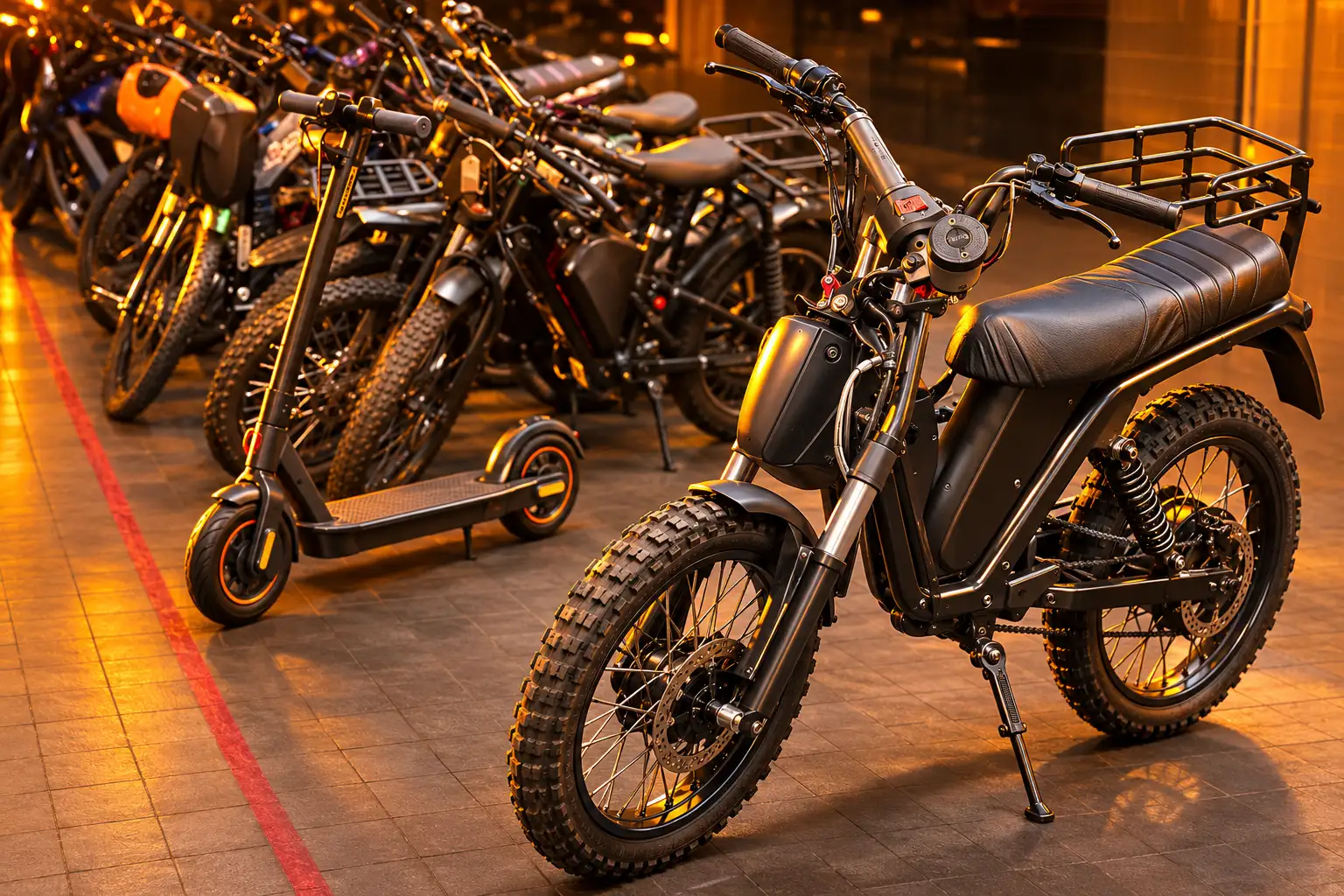
Shops Still Sell Machines Illegal on the Road
Waddell’s written evidence told the committee that section 165A of the Road Traffic Act 1988, the power to take a motor vehicle being used without a licence or insurance, already works on illegal e-bikes and e-scooters. Enforcement, the same paper said, is not the whole answer. Easy access to the products, and the retail rules around them, had to be tested for whether they prevent harm.
We can enforce all we like, but if the supply continues to hit the streets then that’s almost a fool’s errand in certain regards.
Alan Waddell, Assistant Chief Constable, Holyrood Criminal Justice Committee
He asked MSPs to look at limiting or banning the sale of scooters and e-bikes that are illegal the moment they roll onto a public road, or at a rulebook that puts a duty on the companies that sell them and the people who buy them. “We can’t enforce our way out of this,” he said. Will Linden, deputy head of the Scottish Violence Reduction Unit, put the same gap in plainer words: parents are being enabled to buy their children “stuff that’s actually helping them break the law.”
Road transport law is reserved to Westminster. Policing is not. That split is why a Scottish committee can count seizures and still cannot rewrite the product rules that put the machines on sale. On 11 November, Martin Rhodes, the MP for Glasgow North, asked the Prime Minister about online marketplaces selling unsafe e-bikes and kits that push pedal cycles past the legal limits. The Prime Minister said the UK Government is considering tougher rules on the sale of non-compliant e-bikes and conversion kits across the UK, and would work with the Scottish Government so any change applied in Scotland.
The same day, the Office for Product Safety and Standards issued guidance on conversion kits that create a motor vehicle. Kits that push a bike above 250 watts or 15.5 mph, it said, turn the cycle into a machine that is illegal on the road unless it meets ordinary electric motorcycle law. Selling the kit is still a regulated product question, not an automatic ban.
What Counts as a Legal E-Bike?
A legal e-bike in Great Britain is an electrically assisted pedal cycle, an EAPC. Riders must be 14 or over. The motor must stop assisting at 15.5 mph and its continuous power must stay at or under 250 watts. A bike that meets those tests is treated like an ordinary pedal cycle: no licence, no insurance, no tax. A bike that fails them is a motor vehicle, and the rider needs a licence, insurance and an approved helmet.
THE EAPC LEGAL TESTS
- Pedals: The cycle must have pedals that can actually propel it.
- Power cap: The motor’s maximum continuous rated power must not exceed 250 watts.
- Speed cut-off: Electrical help must cut out at 15.5 mph (25 km/h).
- Off-road switch: UK guidance says a built-in off-road mode does not comply, and the machine is then a motor vehicle.
- E-scooters: They have no EAPC-style exemption, so they are motor vehicles; with no rental trials in Scotland they may be used only on private land with the owner’s consent.
Most owners stay inside those lines. The trouble is the other stock: dirt-style electric motorbikes sold as off-road toys, street bikes with the limiter chipped, and kits that turn a pedal cycle into something that belongs in the motorcycle class. On 23 June in Bridge of Don, Aberdeen, a woman was charged over an off-road bike bought for a child who fell after making off from officers. He had no protective clothing. The machine was capable of about 50 mph. His injuries were minor. Inspector Steve Manson of the Road Policing Unit said the bike had been purchased legally, and that parents still had to know the public-road ban.
The Force Now Destroys What It Used to Auction
Since September the force has destroyed seized illegal e-bikes and e-scooters. Before that, some were auctioned and could be bought back onto the same streets. The change is an admission that the old disposal route was feeding the problem the seizures were meant to cut.
Operation Overlap, in the week beginning 19 October, put that policy on a national footing. Officers took 142 e-bikes and e-scooters in one week, 99 bikes and 43 scooters, and said every one would be destroyed. Greater Glasgow accounted for 54. By 16 October, before that week, the year total was already 1,002, split as 561 e-bikes and 441 e-scooters. Superintendent Andy Barclay, deputy head of Road Policing, said illegally modified e-bikes are not suitable for the public road and put riders, emergency crews and pedestrians at risk.
THE YEAR THE SEIZURES STACKED UP
- January 2024: Police Scotland records a rising monthly trend in offences involving illegal e-bikes and e-scooters, driven by more users and a harder police response.
- 18 May to 5 June 2026: Operation Armour in Aberdeen identifies 154 crimes and charges 50 people, seizing 5 electric motorbikes, 19 adapted e-bikes, 15 e-scooters, 5 petrol motorcycles, a van and a car after 8 search warrants, with 4 people also charged with drug supply.
- September 2026: The force switches to destroying seized illegal vehicles instead of sending some to auction.
- 19 to 25 October 2026: Operation Overlap seizes 142 vehicles nationwide, 54 of them in Greater Glasgow, all listed for destruction.
- 11 November 2026: The Prime Minister tells the Commons that tougher sale rules for non-compliant e-bikes and conversion kits are under consideration.
- 18 November 2026: Waddell and road-policing leads give evidence at Holyrood, and the force issues a festive buying warning.
Armour is the clearest local specimen of how the machines sit beside other crime. Cannabis, cocaine, diamorphine and a four-figure sum of cash were recovered in the same Aberdeen searches. That does not prove Linden’s Glasgow anecdote, but it shows why a committee that started on noisy streets is now reading drug charges next to no-insurance seizures.
Officers Still Lack a Clear Power on Masks
Many of the riders who generate the complaints wear balaclavas. Rank-and-file officers have spent the autumn asking for a power to order those coverings off. David Threadgold, chair of the Scottish Police Federation, said the options for dealing with people riding these vehicles dangerously are extremely limited, and that officers need to be able to stop a masked rider and see who they are.
Waddell told MSPs there is “no specific power in this space” in Scotland and that “the time is right” for a debate, “being really cognisant of human rights.” The force’s written evidence said a general ban on face coverings is unlikely to comply with human rights law, and asked ministers to look at narrower options. Scotland already has section 60 of the Criminal Justice and Public Order Act 1994, which can support a search in a designated area if serious violence is feared; the threshold is high, and it is not a standing street power to unmask a rider. England and Wales have a distinct unmasking power under section 60AA, and a 2026 statute that lets an inspector declare a short mask-free zone around a protest.
WHERE OFFICIALS DISAGREE
- Federation view: David Threadgold says officers need a clear power to require face coverings to be removed when they are used to hide identity during dangerous riding.
- Force leadership: Waddell wants that debate and says there is no specific Scottish power, while warning that any law still has to be enforceable in the street and compatible with human rights.
- Ministerial line: Community Safety Minister Kirsten Oswald has said Police Scotland already has powers to require removal of coverings in some cases, that those powers have been treated as proportionate, and that any extra power would need clear evidence the current ones fail.
The mask argument is the one that travels. It is also the one Holyrood can legislate without waiting for London. Waddell still put a caveat on it: you can pass a law and still be unable to use it, depending on the circumstances in front of the officer.
A Christmas Market for Road-Illegal Gifts
The force’s own prevention plan now runs through the till. Written evidence said prevention has to reach parents, riders and buyers before a vehicle is used unlawfully, and that Christmas communications were being prepared. On 18 November Police Scotland posted a public warning over festive-season purchases, telling people to check what they are buying and how it may be used.
Police Scotland is urging people to be cautious when buying electric bikes or e-scooters in the upcoming festive season.
Read more – https://t.co/acZSCnTTUu pic.twitter.com/AjOavHoW1n
— Police Scotland (@PoliceScotland) November 18, 2026
Waddell said the legal split is still not fully understood. Police Scotland also said almost two-thirds of e-scooter injuries involved children under 16, which is why the Christmas appeal is aimed at adults holding the card, not at the child on the deck. Project Trail in Renfrewshire and Inverclyde has already taken that message into schools and community councils. In Glasgow, officers have spoken directly to delivery riders about compliance. Those schemes treat the buyer as the point of control, because the rider is often 14, or younger, and the machine was a gift.
MSPs Have the Sale Question in Front of Them
The committee’s inquiry into crime and antisocial behaviour is built around four headings: causes, impact, enforcement and prevention. An open call for views closes on 2 December. Ministers are due in mid-December. Road traffic product law will still sit in London on both of those dates unless the UK Government turns the Prime Minister’s 11 November line into a rule.
Oswald has already told MSPs that privately owned e-scooters are illegal on public roads and pavements in Scotland, and that e-bikes modified past the legal limit can be seized. She has also said legislation on these vehicles is reserved. That is the bind Waddell described without naming it: Scottish officers can take 1,204 machines off the road in ten months and destroy them, and the next crate can still be sold as an off-road toy the same afternoon.
The committee can still tighten what officers may do with a balaclava. It cannot, on its own, close the shop that sold the bike underneath it.

New Audi Q3 Skips Cameras a Mahindra XUV 3XO Includes

Scotland’s £65m Universities Fund Bets on Later Rounds

Suzuki Access 125 Adds Paint as Jupiter Takes Share

Scotland Face Argentina at Twickenham With Rankings at Stake

Motorola’s Android 17 List Trails the Real Rollout

Volkswagen Sells the Osnabruck Plant to Clear a Board Fight

Apple’s Foldable iPhone Hinges on Samsung Display Supply

Saksham Gaur Finds He Is His Own Company’s Client

Tata Motors’ Iveco Tender Opens as Holders Still Decide

What Is SD on Amazon Prime?
-
 AUTO3 months ago
Volkswagen Sells the Osnabruck Plant to Clear a Board Fight
-
 NEWS3 months ago
Apple’s Foldable iPhone Hinges on Samsung Display Supply
-
 BUSINESS3 months ago
Saksham Gaur Finds He Is His Own Company’s Client
-
 AUTO3 months ago
Tata Motors’ Iveco Tender Opens as Holders Still Decide
-
 TECHNOLOGY3 years ago
What Is SD on Amazon Prime?
-

 BUSINESS3 months ago
Hyderabad 22-Carat Gold Jumps After a False Bargain
-

 GAMING3 months ago
Onimusha Way of the Sword Preload Hits a Windows 11 Wall
-

 ENTERTAINMENT2 years ago
Andy Scott’s Steel Loon Repeats the Kelpies Regeneration Bet