
AUTO
BYD Doubles India EV Tally to 20,000 Without a Plant
BYD India hit 20,000 EV deliveries, doubling in 14 months, while remaining a 2.21 percent importer in a 3-lakh market.

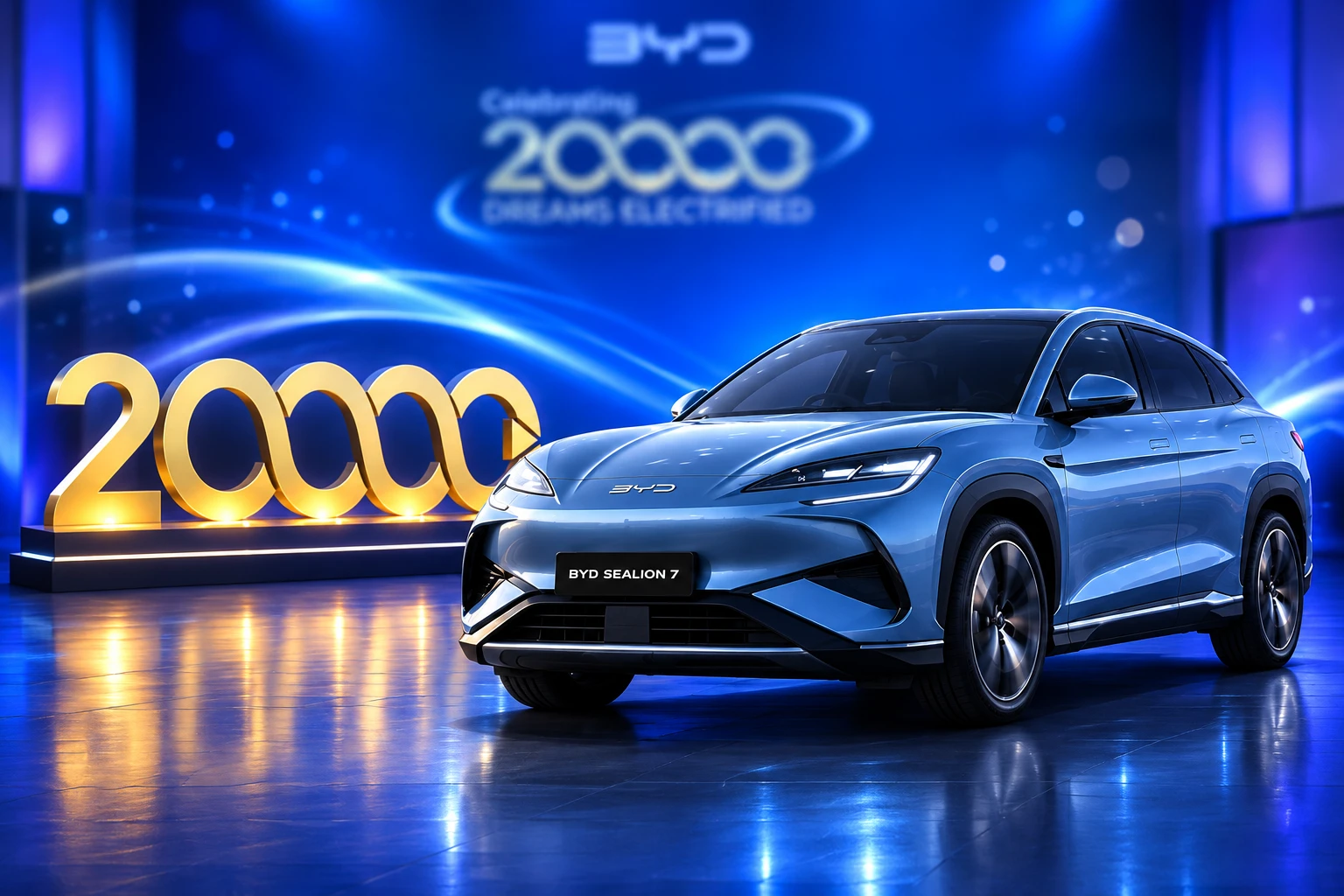
BYD India handed its 20,000th electric passenger car to a buyer at PPS BYD in Delhi on November 20, 2026. That total is twice the 10,000 the company marked in September 2025, and the second half arrived in about 14 months.
Vahan records counted 304,701 electric passenger vehicles from January 1 to November 9, 2026. BYD’s slice of that year is 6,755 cars, or 2.21 percent, which is why a doubled running total still reads as an import niche, not a volume breakout.
The Atto 3 and Sealion 7 Carried the Tally
Rajeev Chauhan, senior vice president and head of electric passenger vehicles at BYD India, and Shrirang Joshi, vice president and national sales head, gave the milestone car to its owner at the Delhi dealer. Joshi put the growth on two SUVs that now dominate the India book.
We are grateful to our customers for the trust they have placed in BYD and for being part of our journey in India. Reaching 20,000 customer deliveries is an important milestone and reflects the growing acceptance of our products and technology. The ATTO 3 has surpassed 9,000 deliveries, while the SEALION 7 has crossed 5,000 customer deliveries, highlighting the strong response to our electric vehicle portfolio.
Shrirang Joshi, VP and National Sales Head, BYD India, at PPS BYD in Delhi
The Atto 3, on sale as a born-electric SUV with an ARAI-tested range of up to 521 km, is the volume car. The Sealion 7, launched in February 2025, crossed 5,000 handovers in 21 months and does 0 to 100 km/h in 4.5 seconds in its dual-motor form. Together they account for more than 14,000 of the 20,000, which leaves the Seal sedan and the eMAX 7 MPV, plus the older e6, as the rest of a total the company has not split further.
THE BYD INDIA LINE-UP
| Model | Body | Stated figure | India deliveries |
|---|---|---|---|
| Atto 3 | Electric SUV | Up to 521 km ARAI | Surpassed 9,000 |
| Sealion 7 | Electric SUV | 0 to 100 km/h in 4.5 seconds | Crossed 5,000 |
| Seal | Electric sedan | Up to 650 km NEDC | Not disclosed |
| eMAX 7 | Three-row MPV | Up to 530 km NEDC | Not disclosed |
The Atto 3 starts at Rs 24.99 lakh ex-showroom on retailer listings, which is the cheapest way into the range and the reason it still leads. Every one of those cars is a fully built import, so the mix can shift faster than a factory plan, and it can stall when a quota or a duty gets in the way.
Three Models Are Free of the 2,500-Car Cap
Days before the Delhi handover, Chauhan said three of the four current models now hold certification from the Automotive Research Association of India, which is the test house that signs off cars for Indian roads. Models that rely only on a foreign certificate can be brought in at 2,500 units a year each. Indian approval removes that ceiling.
THE 2,500-UNIT IMPORT CAP
- Atto 3: Locally approved, so the annual import ceiling no longer applies.
- eMAX 7: Locally approved, clearing the three-row MPV for larger shipments.
- Sealion 7: Locally approved, which matters most because it had already crossed 5,000 deliveries.
- Seal: Still the exception, so the sedan remains on the 2,500-unit yearly limit.
Chauhan put it in one line: “We have four models and three of them are homologated with a certified agency, ARAI, except for Seal.” The Sealion 7 is the car that had most to gain, because it was the one model that had already outrun a 2,500-unit year on its own. Approval does not cut the duty, shorten the wait, or lower the sticker. It only means BYD can ship more of the two SUVs and the MPV if buyers keep signing.
Denza Opens at Rs 90 Lakh and Rs 1.57 Crore
On November 13, 2026, BYD brought its luxury brand Denza to India with two more imported electrics, sold through separate stores. The seven-seat D9 MPV is Rs 90 lakh (about $96,000) ex-showroom. The Z9 GT shooting brake is Rs 1.57 crore. Chauhan said the company has secured 80 to 90 cars for the first couple of months and will judge demand after about two months before it places larger orders. Dedicated outlets are planned in Gurugram, Mumbai, Ahmedabad, Bengaluru, Chennai and Hyderabad.
The Z9 GT uses three motors, 1,156 hp and 1,210 Nm, and BYD claims 0 to 100 km/h in 2.7 seconds plus 670 km on the NEDC cycle from a 122.49 kWh Blade pack. Chauhan is selling that hardware against European badges that have had decades in Indian driveways.
The established European brands have positioned themselves around luxury and safety, luxury and performance, luxury and elegance, or luxury and four-wheel-drive capability. Our positioning is that we will bring all of that to the table. We will give you performance better than any of these, along with features which are unique not only to India but to the world.
Rajeev Chauhan, Senior Vice President, BYD India, at the Denza launch in Mumbai
He also named the gap those cars will hit on Indian roads. High-power public chargers here sit around 360 kW, with a few near 460 kW, well below the 1,500 kW flash system BYD talks about for a 10 to 97 percent charge in nine minutes. “One flash charger in Mumbai and one in Delhi. Does it solve the problem? No, it doesn’t,” Chauhan said. Denza is a second brand at a second price tier, still arriving in crates, and it does not change the 20,000-unit passenger count that BYD just toasted in Delhi.
Tata’s Year Already Dwarfs BYD’s Whole India Run
The 20,000 figure is a running total since passenger cars arrived in 2021. The market that closed around it is a single-year flood. Vahan data for January 1 to November 9, 2026, put electric passenger retails at 304,701, up 66 percent from the same stretch of 2025, and already 56 percent above the whole of calendar 2025, which finished at 195,571. Tata Motors sold 120,895 of those cars, which is already larger than every BYD passenger car delivered in India since the e6.
INDIA ELECTRIC CARS, 2026
| Brand | Units (Jan 1-Nov 9) | Share |
|---|---|---|
| Tata | 120,895 | 39.67% |
| Mahindra | 69,660 | 22.86% |
| MG | 56,988 | 18.70% |
| VinFast | 15,867 | 5.20% |
| Maruti Suzuki | 12,390 | 4.06% |
| Kia | 7,612 | 2.49% |
| BYD | 6,755 | 2.21% |
BYD’s own 2026 line through 9 November is 6,755, which is only 297 more than the 6,458 it sold in all of 2025, when it ranked fifth. This year it sits seventh, behind Kia and well behind VinFast, which has 15,867 in a shorter India life. June was BYD’s best month of 2026 at 940 cars. The companies above it build in India. That is the fork the 20,000th car does not cross.
Why BYD Still Ships Every Passenger Car
BYD has been in India since 2007 on the electric bus side. Passenger cars still come in as complete vehicles, and duties on that route can reach 100 percent. The investment rule behind the missing factory is Press Note 3 of April 17, 2020, from the Department for Promotion of Industry and Internal Trade, which put prior government approval for land-border FDI on the books, covering China among the seven countries that share a land border with India.
Chauhan, asked about a plant or an Indian partner, would not name a date. “We have to judge the right moment, the right scale and the right opportunities,” he said. He also said plug-in hybrids are on the shelf, with the Seal U named as the first such car for India, but he tied any launch to more research. “We are ready with plug-in hybrids also, but a lot of awareness has to be built up, and a lot of research has to go on. When we introduce it, it should click.”
A factory would change landed cost and the pace at which 10,000 can become 20,000 again. Until that approval exists, the next jump depends on how many Sealion 7s and Atto 3s the newly open cap can actually feed, at prices that already sit above the Tata and Mahindra cars taking four in every five electric sales.
The First India Car Was a Fleet MPV
The 20,000 includes a long fleet prologue. BYD’s first passenger model, the e6, arrived in 2021 for commercial operators. The eMAX 7 later took that three-row job for private buyers, in six- and seven-seat form. The dealer map grew with that shift: 51 showrooms in 40 cities now, against a business that started as a taxi MPV and a bus maker.
THE INDIA TIMELINE
- 2007: BYD sets up in India on electric buses, years before a passenger car.
- 2021: The e6 MPV opens the passenger business, aimed at fleet operators.
- February 2025: The Sealion 7 goes on sale as the second electric SUV.
- September 2025: Customer deliveries pass 10,000.
- November 13, 2026: Denza debuts with the D9 and Z9 GT as separate luxury stores.
- November 20, 2026: The 20,000th passenger car is handed over at PPS BYD in Delhi.
Inside the cars, BYD leans on in-house kit rather than a local line. The Blade Battery is a lithium iron phosphate pack whose cells sit in a thin blade layout; BYD says it has passed a nail penetration test without fire or smoke. Cell-to-body construction folds the pack into the floor. e-Platform 3.0 is the dedicated electric base under compatible models. Those are the reasons a buyer pays import money. They are also the reasons a missing plant hurts, because the same kit is already being bolted up in countries where BYD is allowed to build.
Chauhan has set a nearer bar than a factory: growth toward 9,000 to 10,000 cars in a year, with no sub-Rs 20 lakh hatch in the next product review. The 2,500-unit lid is now off the two SUVs that already did more than 14,000 of the work. The 20,000th car is in a driveway in Delhi. The rank in a 304,701-car year is still seventh.
Frequently Asked Questions
What Is the 2,500-Unit Import Cap on Cars in India?
It is an annual, per-model ceiling on vehicles that enter India on a foreign type-approval certificate rather than a full Indian one. Once the Automotive Research Association of India certifies a model, that quota no longer applies to it. Most other foreign carmakers already hold Indian certificates, so they never meet this lid; BYD was unusual in still using the foreign-certificate route on part of its range, which is why the Seal remains capped at 2,500 a year while the Atto 3, eMAX 7 and Sealion 7 do not.
Why Can BYD Not Open a Car Factory in India?
Press Note 3, issued on April 17, 2020, requires government clearance for any investment from an entity of a country that shares a land border with India, or where the beneficial owner is from such a country. That list is China, Pakistan, Bangladesh, Nepal, Myanmar, Bhutan and Afghanistan. Auto projects were not folded into a later easing of the same rule, so a BYD car plant still needs a yes from New Delhi, which Chauhan has not said is in hand.
What Is BYD’s Blade Battery?
It is BYD’s own lithium iron phosphate cell, shaped as a long thin blade so more of the pack’s volume holds active material, a gain the company puts at over 50 percent versus older pack layouts. BYD says the cell survived a nail test with no fire or smoke and a surface temperature of 30 to 60C, and it cites more than 5,000 charge-discharge cycles. The chemistry uses no nickel or cobalt.
What Else Is in the BYD India Range Besides the Two SUVs?
The Seal is a fastback sedan with an NEDC range of up to 650 km in Premium form and a claimed 3.8-second 0 to 100 km/h time in the Performance variant, and it is the one current BYD car still on the 2,500-unit import cap. The eMAX 7 is the six- and seven-seat heir to the e6 taxi MPV, with up to 530 km NEDC in the Superior variant. Denza’s D9 and Z9 GT sit on a separate dealer channel and are not part of the 20,000 BYD passenger count.
Chauhan’s working target is 9,000 to 10,000 cars in a year, with the cap now off the two SUVs that already built most of the 20,000. Whether that year arrives as another imported doubling, or stalls on price, is the next figure dealers in those 40 cities will file.

New Audi Q3 Skips Cameras a Mahindra XUV 3XO Includes

Scotland’s £65m Universities Fund Bets on Later Rounds

Suzuki Access 125 Adds Paint as Jupiter Takes Share

Scotland Face Argentina at Twickenham With Rankings at Stake

Motorola’s Android 17 List Trails the Real Rollout

Volkswagen Sells the Osnabruck Plant to Clear a Board Fight

Apple’s Foldable iPhone Hinges on Samsung Display Supply

Saksham Gaur Finds He Is His Own Company’s Client

Tata Motors’ Iveco Tender Opens as Holders Still Decide

What Is SD on Amazon Prime?
-
 AUTO3 months ago
Volkswagen Sells the Osnabruck Plant to Clear a Board Fight
-
 NEWS3 months ago
Apple’s Foldable iPhone Hinges on Samsung Display Supply
-
 BUSINESS3 months ago
Saksham Gaur Finds He Is His Own Company’s Client
-
 AUTO3 months ago
Tata Motors’ Iveco Tender Opens as Holders Still Decide
-
 TECHNOLOGY3 years ago
What Is SD on Amazon Prime?
-

 BUSINESS3 months ago
Hyderabad 22-Carat Gold Jumps After a False Bargain
-

 GAMING3 months ago
Onimusha Way of the Sword Preload Hits a Windows 11 Wall
-

 ENTERTAINMENT2 years ago
Andy Scott’s Steel Loon Repeats the Kelpies Regeneration Bet