
BUSINESS
Gold’s Crash Hands Cheaper Metal to Indian Jewellers
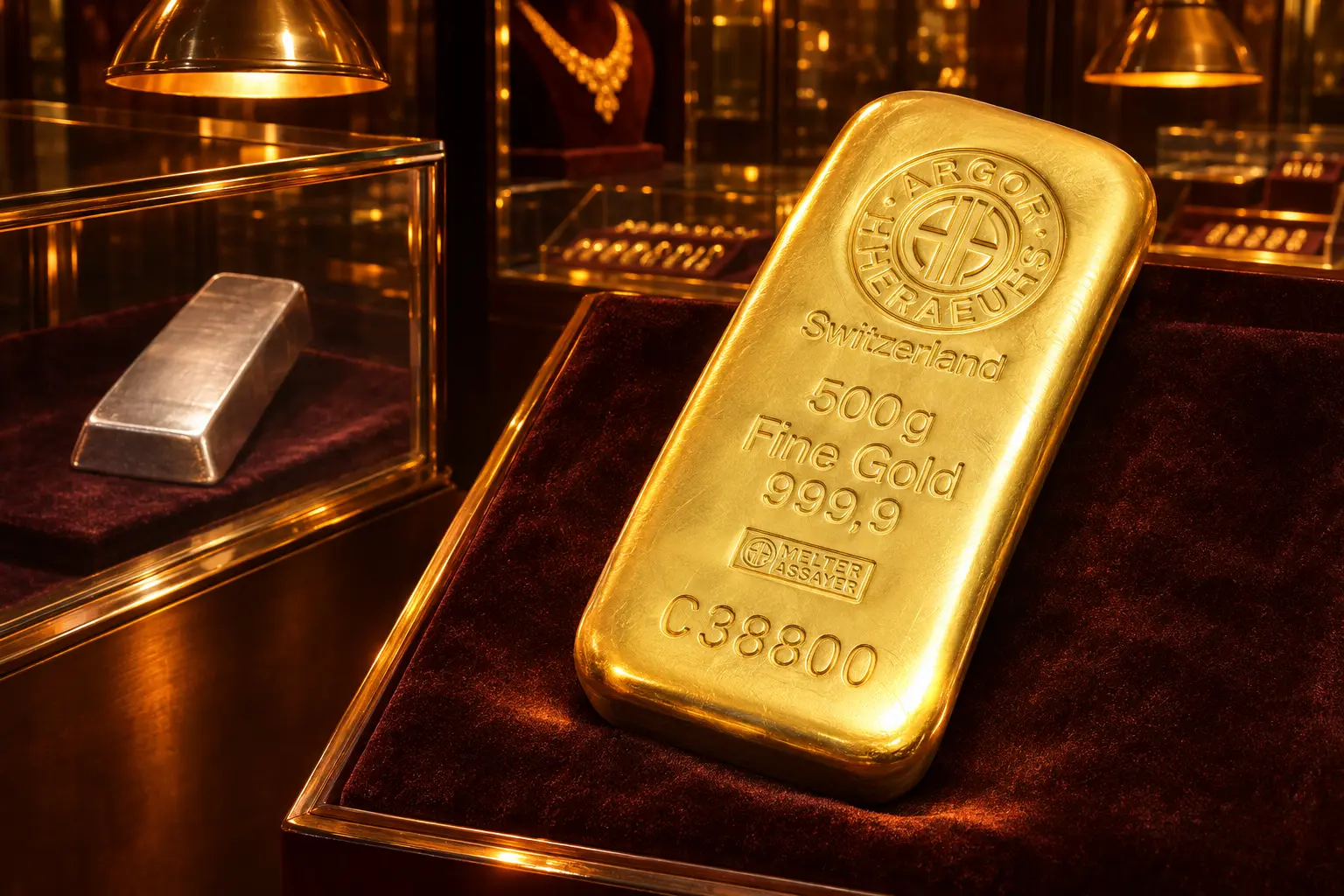
A ₹10 lakh gold stake at the January peak is ₹6.85 lakh, but the same slide is the affordability reset Indian jewellers needed after record prices.

A ₹10 lakh gold purchase at the January peak was worth ₹6.85 lakh on November 20, after a 31.5 percent slide. The same stake in silver was worth ₹3.58 lakh, a 64.2 percent decline from the top of a rally that had sold both metals as a one-way hedge.
The mark-to-market on those January tickets is ugly. The other side of the same tape is cheaper metal on Indian wedding counters, and gold-backed funds that were still adding tonnes while the price fell.
A ₹10 Lakh Bet at the January Peak
Treat the figures as an illustration, not anyone’s audited account. Taxes, making charges and the gap between futures and the jewellery counter are ignored. Even on that clean math, late buyers of the January spike gave back a chunk of 2025’s gains in ten months.
THE ₹10 LAKH JANUARY PEAK
| Particulars | Gold | Silver |
|---|---|---|
| Stake at the January peak | ₹10 lakh | ₹10 lakh |
| Value on November 20 | ₹6.85 lakh | ₹3.58 lakh |
| Absolute loss | ₹3.15 lakh | ₹6.42 lakh |
| Decline from the peak | 31.5% | 64.2% |
| Value left | 68.5% | 35.8% |
Those rupee percentages are not the same as the dollar tape. Spot gold had peaked at $5,595.02 an ounce and, after a $2,080 drop, was near $3,515 on November 20, more than 37 percent down in dollar terms. Silver’s official high was $121.65 on January 26, then $52 on November 4 and $41.12 on November 20. A firmer rupee in November added a second squeeze for Indian bullion quotes, which track London and New York and then take the currency on top.
Holders who bought in 2024 still sit on a multi-year gain. The pain is concentrated among people who treated the January print as a safe entry rather than the end of a squeeze.
The Fed Hike That Ended the One-Way Trade
The 2025 run-up, and the spike into late January, leaned on the idea that US rates were heading down and that gold was the hedge if they did not. That script flipped. On September 16 the Federal Open Market Committee, by a 12-0 vote, raised the federal funds rate by a quarter point to a 3.75 to 4 percent target range and said inflation remained elevated.
Navneet Damani, head of commodities research at Motilal Oswal Financial Services, said the move reinforced tighter money and that gold’s near-term path still hangs on Fed policy, inflation, the dollar and real bond yields. He still calls gold a defensive asset when geopolitics and fiscal worries flare. He also said strong US growth and firm jobs data could let the Fed keep rates higher for longer, which is the opposite of the cut cycle the January crowd had been pricing.
By late November a further quarter-point increase in December was widely priced, the dollar was near a 19-month high, and US real yields had climbed enough that a metal that pays no coupon had to compete with cash. The November slide did not look like a gold-only scare. It arrived in a week when stocks and bitcoin were sold too, which is what happens when the risk-free rate starts to pay.
THE PATH FROM THE JANUARY HIGH
- January 26, 2026: Silver prints a record $121.65 an ounce, with tight London liquidity and heavy investment demand behind the spike.
- January 29, 2026: Gold and silver both sit at lifetime highs as retail buying and geopolitics stretch the move.
- May 2026: India raises the gold import duty by 9 percentage points, and official inbound flows start to thin.
- September 16, 2026: The Fed lifts its funds rate to 3.75 to 4 percent, the first tightening step of the year.
- October 2026: The LBMA afternoon gold price finishes the month at $3,913, down 6.3 percent, a second monthly drop.
- November 6, 2026: Dhanteras falls in November rather than October, and jewellers report healthier festive traffic as prices ease.
- November 20, 2026: The rupee illustration on a ₹10 lakh January stake is ₹6.85 lakh in gold and ₹3.58 lakh in silver.
Carsten Menke, head of next generation research at Julius Baer, called the tape a mirror image of early 2026, with crowded bets on US tightening now driving the metals lower.
Flows are dominating the markets, while the fundamental backdrop has undoubtedly deteriorated.
Carsten Menke, Head of Next Generation Research, Julius Baer
He flagged a return of US exceptionalism and a strong dollar as headwinds, and said the bigger risk would be sustained selling of physically backed gold and silver products. Holdings, he noted, had barely moved when he said it. The flow data since then has not produced the dump he warned about, at least not in gold tonnes.
Wedding Counters Got the Metal Investors Sold
Record prices did what high prices always do in India. They cut the grams people took home, even as the rupee bill stayed large. The World Gold Council’s India desk put India gold demand of 162.5 tonnes in July-September, up 24 percent from the second quarter but still 29 percent below a year earlier. The rupee value of that demand rose 3 percent to ₹2.42 lakh crore. Households spent more and bought less metal.
Volumes Fell, Bills Did Not
INDIA GOLD DEMAND, JULY TO SEPTEMBER
| Channel | Tonnes | Change vs Q3 2025 |
|---|---|---|
| Jewellery | 99.9 | -20% |
| Bars and coins | 55.0 | -40% |
| Gold ETFs | 5.3 | -50% |
| Total demand | 162.5 | -29% |
Jewellery still led the sequential rebound, up 33 percent from the second quarter as late-quarter prices eased and South Indian festivals landed in August. In value terms jewellery demand rose 16 percent to ₹1.49 lakh crore. Over January-September, jewellery volumes were 241.1 tonnes, down 18 percent, while spending rose 29 percent to ₹3.62 lakh crore. India remained the world’s largest jewellery market, with 32 percent of global jewellery consumption in the third quarter.
Bars and coins, last year’s star, normalised hard, down 40 percent from an exceptional base. Investment still proved stickier than jewellery over nine months, down 4 percent against jewellery’s 18 percent drop. Digital gold purchases rose 76 percent to 16.3 tonnes in the first nine months, a reminder that small-ticket financial gold kept finding new accounts even as physical tickets shrank.
Festive Counters Used the Dip
Kavita Chacko, the World Gold Council’s research head for India, wrote in the November 17 market update that lower prices and the wedding season should support jewellery demand, though a fresh jump in prices could check it. Retailer estimates for Dhanteras and Diwali put festive demand 15 to 25 percent higher in value, with volumes flat to slightly higher, even though festive-period prices were still about 10 percent above last year’s festival and 17 percent higher year on year.
Customers came back in larger numbers and left with lighter pieces. Old-gold exchange made up 40 to 60 percent of sales at many retailers, which is how a household funds a new set without writing a full cheque at ₹1.49 lakh per 10 grams, the third-quarter average domestic price, up 45 percent from a year earlier. Damani had already said elevated prices had moderated discretionary jewellery demand. The November tape is the first real test of whether that demand returns when the metal cheapens.
Official imports tell the same story from the supply side. October inbound gold was about 70 tonnes, or $5.51 billion, more than triple September’s 23 tonnes and still 63 percent lower than a year earlier. January-October official imports were about 470 tonnes, down 14 percent, and $47.36 billion, down 6 percent. Combined September-October arrivals were about 93 tonnes, against a 2021-25 average near 180 tonnes. Some of the gap was unofficial metal after the May duty hike, and some was old gold coming back over the counter.
Why Silver Fell Twice as Far as Gold
Silver is the metal people reach for when gold feels too expensive, and it is also an industrial input. That double identity is why the ride up was faster and the ride down was worse. The Silver Institute, citing Metals Focus at its November 12 industry dinner in New York, put the January 26 record at $121.65 an ounce and the gold-silver ratio at 43 that month, the lowest since 2011. By early November the ratio was back in the high 70s, which is another way of saying silver gave up far more than gold.
The silver market is on track for its sixth consecutive annual deficit in 2026, with demand expected to exceed supply by 35 million ounces.
Since 2021, the cumulative shortfall has reached approximately 746 million ounces. Industrial demand outside photovoltaics is forecast to… pic.twitter.com/11GIsNJTLO
— The Silver Institute (@SilverInstitute) November 17, 2026
The same note still sees a sixth consecutive annual silver deficit of 35 million ounces in 2026, with demand at 1.08 billion ounces, down 5 percent. A deficit did not stop a crash once investment flows reversed. Elevated prices pushed solar makers to use less silver per cell or to switch materials, which is why total industrial demand is expected to ease 3 percent to 640 million ounces even as demand outside photovoltaics rises 4.5 percent to 492 million ounces.
WHY THE WHITE METAL TOOK THE HEAVIER HIT
- Crowded trade: The move from ₹3 lakh a kg to the January extreme took only about two weeks, a squeeze that unwinds violently when the last buyer is gone.
- Solar thrift: Record prices sped up substitution in photovoltaic paste, cutting a pillar of the 2024-25 industrial story.
- Jewellery retreat: Silver jewellery demand is forecast down 22 percent, and silverware down 17 percent, as Indian buyers shrink ticket sizes.
- Fund selling: Global silver exchange-traded product holdings were 1.25 billion ounces on November 3, down 4 percent, or 55 million ounces, since the start of the year, with a full-year outflow of 45 million ounces still in the Metals Focus forecast.
Mine supply is barely moving, down 0.5 percent to 834 million ounces, and recycling is up 6 percent to 210 million ounces as scrap comes out of drawers. The physical shortage argument never died. It just stopped setting the price once real yields and the dollar did.
ETF Holdings Rose While the Price Crashed
Menke’s warning was about physically backed products. Gold’s tonne count has not confirmed a run for the exits. Global gold ETFs added $2.7 billion in October and 19 tonnes of metal, taking holdings to 4,275 tonnes, another month-end record, while assets under management fell 6 percent to $542 billion because the price dropped under the inflows. North America pulled $512 million; Europe added $1.8 billion and Asia $1.3 billion. Over the first ten months, global gold ETFs added $41 billion and 246 tonnes.
India’s own gold ETFs are a smaller pool and a cleaner read on domestic retail. They posted a fifth consecutive month of ETF inflows in October, ₹3,500 crore, and holdings rose 2.2 tonnes to 126 tonnes. Ten-month additions were 31.3 tonnes, up 22 percent year on year. Assets under management still fell 3 percent to ₹1.80 lakh crore because the metal price fell. The cash was coming in on the dip. Another ₹2,450 crore, about 1.75 tonnes, arrived between November 1 and 11, and October added 64,163 folios, taking the count to 12.74 million. That flow held even after mutual funds paused fresh gold fund-of-funds subscriptions in mid-October.
Third-quarter Indian ETF demand of 5.3 tonnes was half the year-earlier total, so the comparison with 2025’s melt-up is still weak. It was also up from 3.6 tonnes in the second quarter, and nine-month ETF demand of 28.8 tonnes was 47 percent higher than a year earlier. The people who bought the January peak on leverage are not the same as the SIP accounts still adding grams.
Central Banks Kept Buying Through the Slide
Official buyers were the other silent party. Global central-bank demand was 321 tonnes in the third quarter, up 42 percent from a year earlier, and 675 tonnes over nine months, up 6 percent. China added 63 tonnes in the quarter and Poland 40 tonnes among the reported names, with a large unreported share still sitting in the World Gold Council’s 321-tonne total. Those purchases do not show up in an Indian trading app, but they are the bid that keeps a floor under the long-term story Damani still cites.
The Reserve Bank of India was not in that queue. Reserves were about 880.5 tonnes at the end of the third quarter, with only 0.3 tonnes of purchases in nine months against 4 tonnes a year earlier and 50 tonnes in the first nine months of 2024. Gold’s share of India’s foreign reserves eased from 19 percent in January to 14.5 percent, a valuation and mix shift rather than a selling programme. Delhi stopped adding. Other central banks did not.
MCX gold futures activity cooled with the price. Average daily volumes in October fell 30 percent to 12.7 tonnes, the lowest since January 2025, and average daily turnover was ₹17,650 crore, the lowest since August 2025. Speculative heat left the building. The jewellery queue and the ETF folio count did not.
Gold at $4,500, or Another 5-10 Percent Down
Saiyam Mehra, director at Unique Chains and Jewells and a former president of the All India Gems and Jewellery Domestic Council, called current prices an attractive entry and said he does not expect a much sharper break, even if further weakness cannot be ruled out. He expects gold at $4,500 an ounce next year. That target sits well above the November 20 dollar print near $3,515 and well below January’s $5,595.02.
Rajesh Rokde, chairman of the same council, is telling customers not to write one cheque.
The way the situation is in gold, customers should buy in parts, not together, because if there’s a fall, it can come down by 5-10%. Overall, there’s no expectation of a sharp fall in the market right now.
Rajesh Rokde, Chairman, All India Gems and Jewellery Domestic Council
WHERE EXPERTS DISAGREE
- Damani: Elevated US real yields and a stronger dollar can still force more profit-taking, and a firm US labour market lets the Fed stay tight, even as central-bank buying and fiscal worries support the metal over a longer horizon.
- Menke: Flows still run the tape, the fundamental backdrop has worsened, and disappointed holders of physically backed products could yet sell, even though holdings had barely moved when he issued the warning.
- Mehra and Rokde: The crash has already done most of the damage that jewellery buyers will see, with a 5-10 percent further dip possible and a $4,500 gold recovery in the next year if they stagger purchases.
A January peak buyer sitting on ₹6.85 lakh of a ₹10 lakh gold ticket, or ₹3.58 lakh of a silver one, is not in that jewellery queue. The grams that left those accounts are the grams that now cost less on a wedding invoice, which is the transfer the 2025 boom never advertised.
Disclaimer: This article is news reporting and analysis of gold and silver prices, demand figures and public comments, and it is for information only. It is not investment advice, a recommendation to buy or sell bullion, jewellery, futures or exchange-traded funds, or a forecast of returns. Readers should consult a SEBI-registered investment adviser or a qualified financial planner who can look at their own holdings, time horizon and tax position before acting. Prices, demand estimates and policy settings are those published by the cited firms and official bodies as of the dates named above and can change with the next trading session or data release.

New Audi Q3 Skips Cameras a Mahindra XUV 3XO Includes

Scotland’s £65m Universities Fund Bets on Later Rounds

Suzuki Access 125 Adds Paint as Jupiter Takes Share

Scotland Face Argentina at Twickenham With Rankings at Stake

Motorola’s Android 17 List Trails the Real Rollout

Volkswagen Sells the Osnabruck Plant to Clear a Board Fight

Apple’s Foldable iPhone Hinges on Samsung Display Supply

Saksham Gaur Finds He Is His Own Company’s Client

Tata Motors’ Iveco Tender Opens as Holders Still Decide

What Is SD on Amazon Prime?
-
 AUTO3 months ago
Volkswagen Sells the Osnabruck Plant to Clear a Board Fight
-
 NEWS3 months ago
Apple’s Foldable iPhone Hinges on Samsung Display Supply
-
 BUSINESS3 months ago
Saksham Gaur Finds He Is His Own Company’s Client
-
 AUTO3 months ago
Tata Motors’ Iveco Tender Opens as Holders Still Decide
-
 TECHNOLOGY3 years ago
What Is SD on Amazon Prime?
-
 BUSINESS3 months ago
Hyderabad 22-Carat Gold Jumps After a False Bargain
-

 GAMING3 months ago
Onimusha Way of the Sword Preload Hits a Windows 11 Wall
-

 ENTERTAINMENT2 years ago
Andy Scott’s Steel Loon Repeats the Kelpies Regeneration Bet