
BUSINESS
Paytm Drops as India’s Free UPI Promise Comes Due
Paytm, Pine Labs and MobiKwik fell as much as 10% after the UPI merchant fee, written in September, still had no start date past Diwali.

Paytm, Pine Labs and MobiKwik shares fell as much as 10% on November 19 after the UPI merchant fee still lacked a start date. One97 Communications Ltd., parent of Paytm, printed an intraday low of ₹1,697. Pine Labs Ltd. fell as much as 5.5% to ₹159.90, and One MobiKwik Systems Ltd. fell as much as 9% to ₹206.61, with Paytm and Pine Labs among the weakest names on the Nifty 500.
The National Payments Corporation of India published a 0.4% merchant discount rate on September 15 for specified person-to-merchant UPI payments above ₹2,000, then pushed the start past Diwali. By November 19, eleven days after the festival, no date had been notified, and listed payment companies that had modeled that fee marked the gap.
Three Payment Stocks Fall on a Date That Never Came
The tape was not reacting to a new rate. It was reacting to the absence of a gazette day for a rate that has been on paper since mid-September. People familiar with the matter said the NPCI UPI and Services Steering Committee had already cleared a separate flat ₹5 charge for merchant-to-merchant transfers about a month earlier, and that this too had not been formally notified.
THURSDAY’S INTRADAY LOWS
| Company | Intraday fall | Intraday low |
|---|---|---|
| Paytm (One97 Communications) | as much as 10% | ₹1,697 |
| Pine Labs | as much as 5.5% | ₹159.90 |
| MobiKwik (One MobiKwik Systems) | as much as 9% | ₹206.61 |
Those prints sit five weeks past the original October 15 start date. NPCI had said on October 13 that the levy would begin immediately after Diwali, which fell on November 8, with the exact day to be notified separately. The notification never came, and industry officials began talking about a much later window, including the 2027 assembly elections in five states, as a possible floor under any new merchant cost.
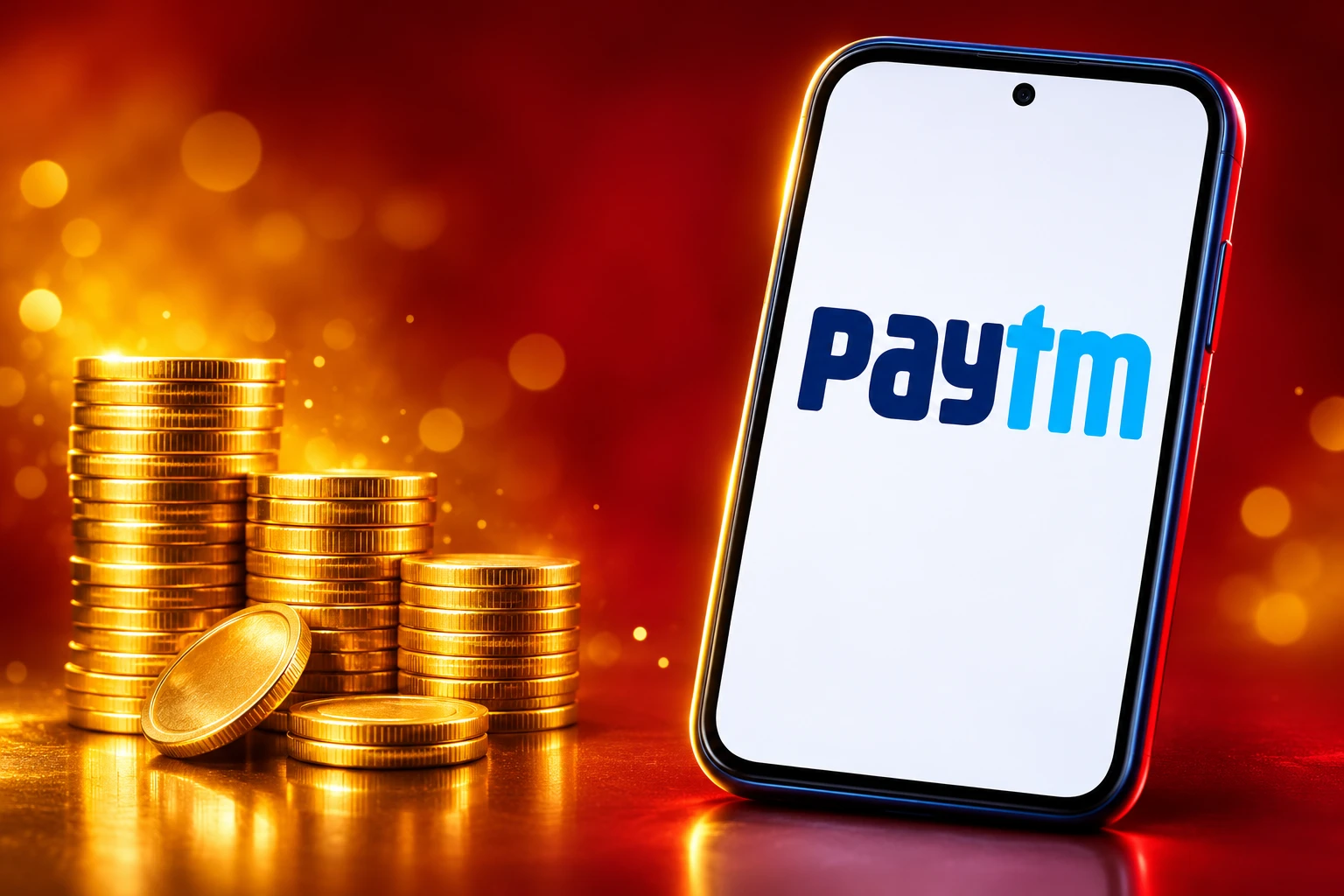
India Made UPI Free for Merchants in 2020
The charge these companies are waiting on is the unwinding of a political choice, not a product launch. In the July 2019 Budget, Finance Minister Nirmala Sitharaman proposed that firms with turnover above ₹50 crore must offer low-cost digital modes such as BHIM UPI, and that no merchant discount rate would be levied on customers or merchants, with the Reserve Bank of India and banks absorbing the cost from savings on cash. From 1 January 2020 that promise was locked in through Section 269SU of the Income-tax Act and Section 10A of the Payment and Settlement Systems Act, which together created the zero-fee mandate that ran until September.
Before that freeze, NPCI had capped UPI person-to-merchant MDR at 0.30%, with a maximum of ₹100 a transaction, after an August 2019 revision. RuPay debit MDR had run as high as 0.9%. Making both rails free, and forcing large firms to accept them, did what the Budget speech wanted. UPI went from a cheap add-on to the default way India pays a shop.
The scale is now the problem. Ministry of Finance figures put FY2025-26 UPI at 24,161.69 crore transactions worth about ₹314 lakh crore, against 1.78 crore transactions worth ₹0.07 lakh crore in FY2016-17, the year the system went live, with banks on the rail rising from 44 to 703. Anil Katia, a former banker whose September 2026 policy paper is hosted by Vinod Kothari Consultants, cites the Parliamentary Standing Committee on Finance’s 44th Report, tabled on 12 August 2026, for UPI operating costs of ₹20,700 crore against a government budget of ₹2,000 crore, and a FY2025-26 subsidy allocation cut 78% to ₹437 crore. The public cheque that replaced MDR has shrunk. The companies that built merchant apps on a free rail are listed, and they need a replacement.
A Paper Fee of 0.4% and a ₹300 Cap
The replacement was written in two steps. The Department of Financial Services notified S.O. 5067(E) on 14 September 2026, narrowing the statutory ban on charges so that UPI person-to-merchant payments up to ₹2,000, and RuPay debit across the board, stayed free. NPCI issued a 42-question FAQ the next day setting the commercial schedule, originally effective 15 October 2026.
THE WRITTEN MDR SCHEDULE
- Standard rate: 0.4% on eligible person-to-merchant UPI payments above ₹2,000.
- High-ticket cap: ₹300 a transaction once the amount hits ₹75,000, so a ₹1 lakh credit is charged ₹300 rather than ₹400.
- Essential sectors: railways, telecom, insurance, fuel, farm inputs, utilities and education pay a flat ₹5 above ₹2,000 instead of 0.4%.
- Capital markets: mutual funds, securities and stock-broker flows pay 0.02%, also capped at ₹300.
- Small merchants: P2PM shops taking up to ₹1 lakh a month through UPI QR codes into personal accounts stay at zero, as do all person-to-person transfers.
NPCI told the Supreme Court in a 3 November affidavit that about 96% of person-to-merchant volume stays untouched because it is under ₹2,000 or sits in the small-merchant bucket, leaving about 4% of those payments in the charged set. The finance ministry has said person-to-person flows are 37% of UPI volume and 70% of value and remain free at any size, and that 5% of MDR collections will fund UPI acceptance among small merchants. Customers are not meant to pay. NPCI’s FAQ says on-boarded merchants cannot pass the charge to buyers, while the underlying circular tells acquiring banks they are advised to ensure that outcome.
The Reserve Bank backed the levy the same day NPCI published it, calling a charge on large-value merchant payments a step toward the long-term health of digital payments and repeating that users pay nothing.
The introduction of MDR on large-value UPI transactions (i.e., above ₹2,000) is an important step towards strengthening the long-term sustainability of India’s digital payments ecosystem. It will help UPI in continuing to scale, innovate and serve consumers and businesses across…
— ReserveBankOfIndia (@RBI) September 15, 2026
Katia’s arithmetic is why shopkeepers still fight a fee the central bank has already blessed. He puts the unit processing cost near 70 paise and the MDR on a ₹15,000 ticket at ₹60, and he estimates a system-wide pool of about ₹24,452 crore if 0.4% is applied to a CareEdge Ratings addressable base of ₹61.13 lakh crore. Credit-card MDR still runs about 1.5% to 2.5%, and debit up to 0.90%, so UPI would remain the cheap rail. Cheap is not free, and free is the habit six years of statute built.
Why October 15 Came and Went
The schedule met politics before it met a switch. Trader groups had already called a “No UPI Day” for 2 October, then pulled it after a 30 September meeting with Sitharaman led by CAIT secretary-general and Chandni Chowk MP Praveen Khandelwal, with the All India Mobile Retailers Association and the All India Consumer Products Distributors Federation in the room. They wanted a later start, a small-merchant threshold of ₹5 lakh rather than ₹1 lakh a month, a slower climb toward 0.4%, and merchant-to-merchant flows kept outside the levy.
The Supreme Court on 28 September issued notices to the Union government, RBI and NPCI on a petition by advocate Anjan Datta challenging the 14 September notification and the 15 September schedule. It did not stay the October 15 start. The legal path was still open. The festive calendar was not.
THE MDR CALENDAR
- 1 January 2020: Zero MDR on UPI merchant payments takes effect under the 2019 finance law.
- 14-15 September 2026: The finance ministry notifies the legal opening and NPCI publishes the 0.4% schedule for 15 October.
- 13 October 2026: Two days before the start, NPCI deferred the levy until after Diwali, with the date to be notified separately.
- 8 November 2026: Diwali passes. No start date is issued.
- 19 November 2026: Paytm, Pine Labs and MobiKwik fall as the date remains blank.
NPCI’s own statement on 13 October put the delay on the festive season and kept the rate card unchanged.
UPI MDR on Select Merchant Transactions Shall be Implemented Post Diwali
Press Release Link: https://t.co/5KMjOP0tHd pic.twitter.com/pD8IKfN6sR
— NPCI (@NPCI_NPCI) October 13, 2026
The replies under that post were not a debate about basis points. They were a demand to kill the fee. A merchant charge is still read by a large public as an attack on UPI itself, even though the circular leaves the customer unpaid. That reflex is political fuel, and it is why a published fee can sit for weeks without a gazette date once Diwali has come and gone.
Bernstein Named the Delay Risk a Day Early
Pranav Gundlapalle of Bernstein, in a note dated 18 November, kept a buy rating on Paytm and a price target of ₹2,200. He argued the company is set for non-linear earnings growth from operating leverage and financial services, especially merchant lending, with MDR on UPI a near-term catalyst. He also wrote down the risk the next session then priced.
The most immediate risk is the non-implementation or indefinite postponement of MDR on UPI which remains a key driver of near-term earnings growth
Pranav Gundlapalle, Bernstein, November 18 note
He flagged two other Paytm risks, caps on internal rates of return in merchant lending and changes to the digital lending model, and still called the risk-reward attractive. The street’s MDR maths is not 0.4% of every rupee these firms touch. Emkay, using realised take rates of 10 basis points for Paytm and 6 basis points for Pine Labs after the split with banks, has put FY28 UPI MDR revenue at ₹1,120 crore for Paytm and ₹155 crore for Pine Labs, and has raised its targets to ₹2,400 and ₹230. Jefferies has said the new stream could be about 20% of Pine Labs’ EBIT and profit before tax, which is why a smaller UPI book can still move that stock hard.
Pine Labs, in its Q2FY27 investor presentation, said more than 65% of its UPI gross transaction value already sits above ₹2,000, with an average UPI ticket of ₹1,400 that quarter and a FY28 monthly UPI GTV target of ₹33,000-₹34,000 crore. That mix is why a delay is not an abstract policy story for the acquirers. It is a quarter of charged volume that does not start.
The ₹5 B2B Rate the Committee Already Cleared
The one new commercial detail on November 18 and 19 was not a higher fee. It was a lower one. People aware of the discussions said NPCI’s UPI and Services Steering Committee had decided that merchant-to-merchant transfers, including wholesaler-to-retailer settlements, B2B marketplaces and B2B collections, would pay a flat ₹5 rather than 0.4%. Average tickets on that rail have been about ₹20,000 to ₹40,000. At the standard percentage those payments would have cost ₹80 to ₹160, and a ₹75,000 transfer would have hit the ₹300 cap.
B2B FEE VERSUS 0.4% MDR
| Transaction value | MDR at 0.4% | Proposed B2B fee |
|---|---|---|
| ₹5,000 | ₹20 | ₹5 |
| ₹10,000 | ₹40 | ₹5 |
| ₹20,000 | ₹80 | ₹5 |
| ₹30,000 | ₹120 | ₹5 |
| ₹40,000 | ₹160 | ₹5 |
| ₹75,000 | ₹300 | ₹5 |
The All India Consumer Products Distributors Federation had written to Sitharaman on 11 November asking for merchant-to-merchant flows to be kept out of MDR altogether, for GST on the charge to be reviewed, for the start to be paused, and for a formal consultation. The federation said about 65% of consumer payments to retailers, and 40-45% of retailer credit-bill settlements to distributors, already run on UPI, and that a second layer of fees on thin margins would hurt both rungs. The ₹5 flat rate is a concession to that complaint. It is still a charge, it is still uncleared in a public circular, and it did not give the listed acquirers a start date for the 0.4% person-to-merchant pool their models actually use.
GST sits to the side of NPCI’s pen. Sitharaman told the GST Council on 8 October that deferring MDR was not the council’s decision. States had worried about the 18% tax on the fee and floated a cut to 5% or a drop. Until that tax question is settled, every rupee of MDR is also a rupee of GST for the merchant who pays it.
Uttar Pradesh Votes Hang Over the Notification
WHAT WE KNOW
- The rate card: 0.4% above ₹2,000, a ₹300 cap, sector flats of ₹5, and a small-merchant zero band are published.
- The first delay: NPCI moved the start from 15 October to after Diwali and said the day would be notified separately.
- The B2B carve-out: the steering committee has cleared a flat ₹5 for merchant-to-merchant transfers, people familiar with the discussions said, without a public notification.
WHAT IS UNCONFIRMED
- A new start date: no gazette or NPCI circular on November 19 named a day.
- The election window: industry officials have floated a hold past the 2027 assembly polls in Uttar Pradesh, Punjab, Uttarakhand, Goa and Manipur as a worst case, not as a decision.
- GST on MDR: the council has not fixed the 18% tax, and distributors are still asking for a review.
Talk of waiting until after those five state elections is source chatter, not a ministry order, and one industry official has called a slide past the Uttar Pradesh poll the worst case rather than the base case, saying the levy will come and the fight is over timing. Year-end retail, the Union Budget, and then that election cluster are the dates that now sit in front of a fee RBI already called a support for the rail.
Paytm at ₹1,697, Pine Labs at ₹159.90 and MobiKwik at ₹206.61 are the listed price of a 2020 promise that merchants would not pay to accept UPI. The 0.4% schedule is written. The ₹5 B2B rate is cleared in committee. Eleven days after Diwali, the start date is still the missing line.
Disclaimer: This article is news reporting and analysis of listed payment companies and UPI pricing policy, and it is for information only. It is not investment advice, a recommendation to buy or sell any share, or a forecast of when merchant discount rate collections will begin. Readers should consult a SEBI-registered investment adviser or other qualified financial professional before acting on any stock, and they should not treat analyst price targets or estimated MDR revenue as guarantees. Share prices, policy dates and revenue estimates reflect the sources cited as of 19 November 2026 and can change with trading, court filings or a later NPCI or finance ministry notification.

New Audi Q3 Skips Cameras a Mahindra XUV 3XO Includes

Scotland’s £65m Universities Fund Bets on Later Rounds

Suzuki Access 125 Adds Paint as Jupiter Takes Share

Scotland Face Argentina at Twickenham With Rankings at Stake

Motorola’s Android 17 List Trails the Real Rollout

Volkswagen Sells the Osnabruck Plant to Clear a Board Fight

Apple’s Foldable iPhone Hinges on Samsung Display Supply

Saksham Gaur Finds He Is His Own Company’s Client

Tata Motors’ Iveco Tender Opens as Holders Still Decide

What Is SD on Amazon Prime?
-
 AUTO3 months ago
Volkswagen Sells the Osnabruck Plant to Clear a Board Fight
-
 NEWS3 months ago
Apple’s Foldable iPhone Hinges on Samsung Display Supply
-
 BUSINESS3 months ago
Saksham Gaur Finds He Is His Own Company’s Client
-
 AUTO3 months ago
Tata Motors’ Iveco Tender Opens as Holders Still Decide
-
 TECHNOLOGY3 years ago
What Is SD on Amazon Prime?
-

 BUSINESS3 months ago
Hyderabad 22-Carat Gold Jumps After a False Bargain
-

 GAMING3 months ago
Onimusha Way of the Sword Preload Hits a Windows 11 Wall
-

 ENTERTAINMENT2 years ago
Andy Scott’s Steel Loon Repeats the Kelpies Regeneration Bet