
BUSINESS
NSE Overtakes Nasdaq by Pricing an Options Franchise
NSE’s $59.3 billion ranking passed Nasdaq 57 days after a 5.1 percent offer-for-sale, pricing weekly Nifty options more than the cash market underneath.

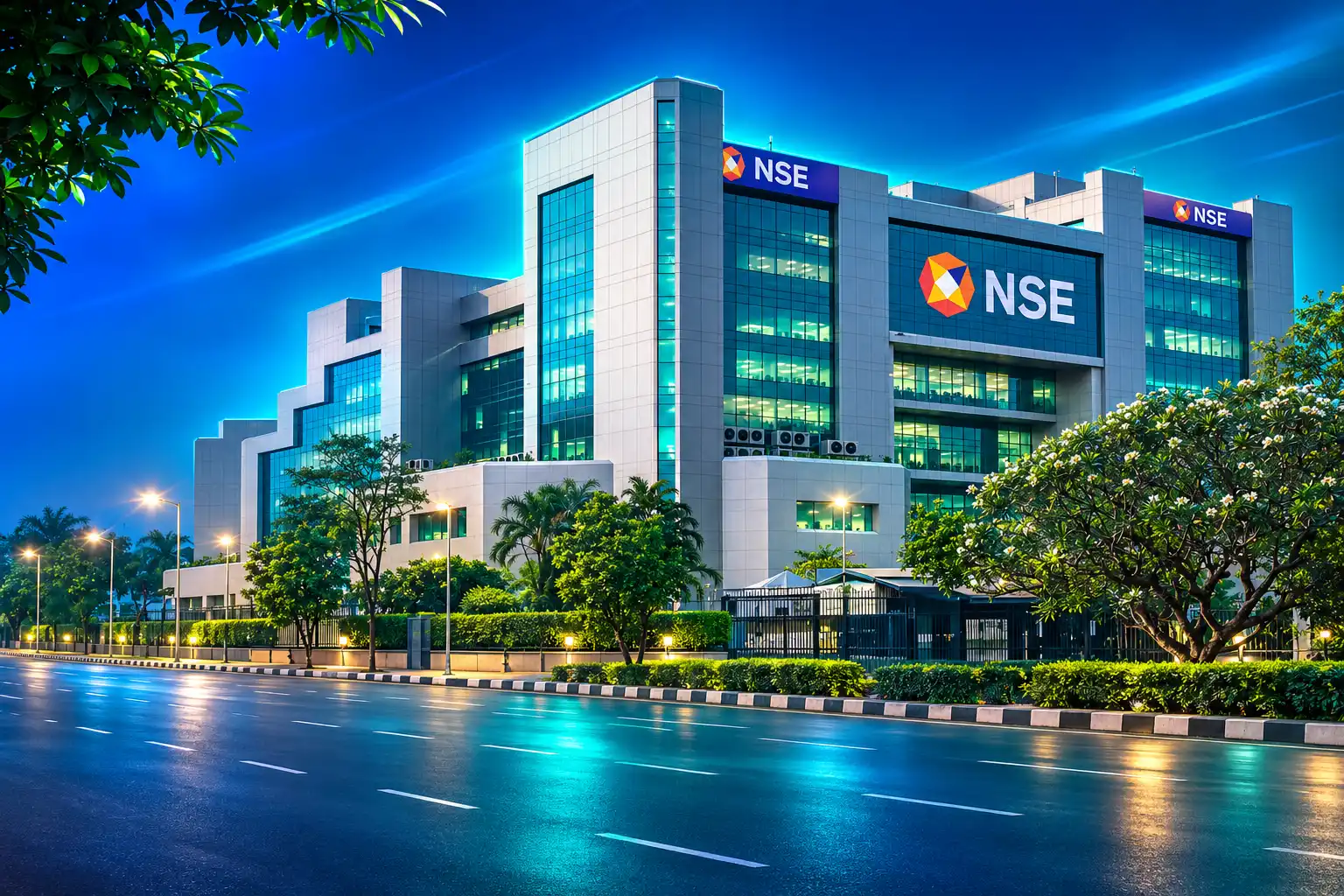
NSE’s market value reached $59.3 billion on November 20, passing Nasdaq and Hong Kong Exchanges as the world’s fifth-largest listed exchange operator. The stock changed hands at Rs 2,222, up 1.5 percent on the day and 24.5 percent above the September issue price of Rs 1,785.
That figure is a price on the company that collects India’s trading fees, 57 days after a 5.1 percent sale of existing shares that sent NSE no cash. Weekly Nifty options still supplied 37 percent of its income in the September quarter.
A $59.3 Billion Seat Behind London
The league table that put NSE fifth is a ranking of listed exchange holding companies, not of the cash markets they host. CME Group led at $109.6 billion. Intercontinental Exchange, parent of the New York Stock Exchange, stood at $95.5 billion. Deutsche Boerse was third at $63.7 billion, and London Stock Exchange Group fourth at $60.1 billion, $800 million in front of NSE.
LISTED EXCHANGE OPERATORS BY MARKET VALUE
| Rank | Operator | Market value |
|---|---|---|
| 1 | CME Group | $109.6 billion |
| 2 | Intercontinental Exchange | $95.5 billion |
| 3 | Deutsche Boerse | $63.7 billion |
| 4 | London Stock Exchange Group | $60.1 billion |
| 5 | National Stock Exchange of India | $59.3 billion |
| 6 | Hong Kong Exchanges and Clearing | $57.7 billion |
| 7 | Nasdaq | $57.7 billion |
Figures as of November 20, 2026. NSE’s gap over Nasdaq and HKEX was $1.6 billion each. In rupees the operator was worth about Rs 5.5 lakh crore, against about Rs 4.4 lakh crore at the issue price, a gain of roughly Rs 1.1 lakh crore since listing.
HKEX is the clearer lagging peer. Its own October report put the Hong Kong listed-market value of HK$42.4 trillion, down from HK$48.1 trillion a year earlier, with the Hang Seng Index off 10.1 percent over 12 months. NSE did not overtake a booming Hong Kong franchise. It overtook one whose underlying market had already shrunk.
The IPO Sold Five Percent and Paid NSE Nothing
The re-rating was easier because so little stock came out. The September issue was entirely an offer for sale of 12.64 crore shares, 5.1 percent of 247.50 crore outstanding. Issue size was Rs 22,561.57 crore at Rs 1,785. Every rupee went to selling shareholders. NSE booked none of it.
THE PATH TO A 5 PERCENT LISTING
- June 2025: Files a settlement application with the Securities and Exchange Board of India in the co-location case that had blocked a listing for years.
- January 2026: SEBI chairman Tuhin Kanta Pandey says the regulator has granted in-principle approval for that settlement.
- September 4, 2026: SEBI issues final observations on the offer, clearing the sale.
- September 17, 2026: The book opens in a Rs 1,700 to Rs 1,785 band, with no fresh issue.
- September 21, 2026: The offer closes 5.71 times subscribed.
- September 24, 2026: Shares list on BSE at Rs 1,800, a 0.84 percent premium to the issue price.
- November 20, 2026: Market value reaches $59.3 billion, 57 days after listing.
Draft papers named State Bank of India, Canada Pension Plan Investment Board and Aranda Investments among the sellers. Life Insurance Corporation of India remained a large holder after the sale, with a 10.9 percent stake in later shareholding tables. The issue was India’s second-largest public sale, behind Hyundai Motor India’s Rs 27,870 crore offering in 2024.
WHAT THE OFFER ACTUALLY SOLD
- Issue type: A pure offer for sale. NSE received no IPO proceeds.
- Equity sold: 12.64 crore shares, 5.1 percent of 247.50 crore outstanding.
- Price and list: Rs 1,785 issue price; Rs 1,800 on BSE on September 24.
- Demand: 5.71 times overall, 12.68 times from institutions, 1.39 times from retail.
Retail demand was full but not frantic. Institutions carried the book. Half the anchor lock-in ended on October 21. The rest is due to come off on December 20, which will add stock to a still-thin public float.
37 Percent of Income From One Weekly Contract
NSE’s first results as a listed company, for the July-September quarter, show what the market is paying for. Consolidated profit was Rs 2,578 crore, up 23 percent from Rs 2,098 crore a year earlier and down 17 percent from Rs 3,120 crore in the June quarter. Total income was Rs 4,554 crore, up 9 percent. Operating revenue was Rs 4,067 crore, up 11 percent.
The 23 percent profit rise overstates the run rate. A one-time SEBI settlement expense in the year-ago quarter inflated the operating-profit jump. On NSE’s own normalised figures, discussed on the November 3 call with analysts by managing director and chief executive Ashishkumar Chauhan and finance chief Ian De Souza, pre-tax profit from continuing operations rose 9 percent. Normalised operating EBITDA margin held at 76 percent.
NSE SEPTEMBER QUARTER, IN BRIEF
- Profit: Rs 2,578 crore, up 23 percent year on year and down 17 percent from the June quarter.
- Weekly Nifty options: Rs 1,699 crore, equal to 37 percent of total income.
- Margin: 76 percent normalised operating EBITDA, on operating revenue of Rs 4,067 crore.
- Cash volumes: Average daily turnover of Rs 1,18,377 crore, up 24 percent from a year earlier.
The September-quarter investor presentation is blunt about mix. Transaction charges were Rs 3,035 crore. Options as a group brought in Rs 2,216 crore. Weekly Nifty index options alone were Rs 1,699 crore, 37 percent of total income, and they fell 22 percent from Rs 2,170 crore in the June quarter, which is most of the sequential slide in trading fees.
Cash-market average daily turnover rose 24 percent to Rs 1,18,377 crore, though it was 13 percent below the June quarter. Equity options premium turnover rose 3 percent year on year to Rs 47,977 crore and fell 25 percent quarter on quarter. Equity futures average daily turnover was Rs 1,24,574 crore, down 12 percent from a year earlier. Listing-service revenue jumped 70 percent to Rs 150 crore. Data-feed and terminal revenue rose 43 percent to Rs 165 crore. Those lines are still small next to one weekly options contract.
NSE said it held 92 percent of the cash market in the quarter, about 100 percent of equity futures, and 68 percent of equity options on a premium-turnover basis. Unique registered investors stood at 13.7 crore on September 30. First-half profit was Rs 5,698 crore, up 13 percent, on operating revenue of Rs 8,627 crore.
What the Nasdaq Comparison Leaves Out
Operator market value does not rank the size of the cash market underneath, the number of companies listed, or the value of those companies. Nasdaq at $57.7 billion still lists the large US technology names that dominate global equity value, and it traded at 27.68 times earnings with a net margin near 23 percent. CME Group, at $109.6 billion, earned $6.97 billion of trailing revenue and traded at 25 times earnings, a derivatives franchise with a net margin above 60 percent. NSE is being priced in that second club: a high-margin fee business on Indian index options, not as a peer of Nasdaq’s listing franchise.
The confusion is easy and it is already the popular reading of the ranking, which treats “bigger than Nasdaq” as a statement about Indian markets. It is a statement about the listed holding company. CME and ICE sit at the top of the same table because public markets pay up for clearing, data and derivatives, not because Chicago replaced New York as a place to list shares. NSE’s 76 percent normalised margin and 37 percent income share from weekly Nifty options are why a 5.1 percent float could pass Nasdaq in 57 days.
Earnings per share in the quarter was Rs 10.41, not annualised. Net worth was Rs 28,907 crore on September 30. Those are the books under a $59.3 billion price. The multiple will move with volumes in a single contract, with SEBI product rules, and with how much stock actually trades.
BSE Is Taking Share in Equity Options
The cash franchise is still NSE’s. The options franchise is not sealed. BSE’s share of options notional turnover rose to 48.7 percent in October from 42.1 percent in September, and its share of premium value to about 33 percent from 31 percent. Premium is the base on which exchange fees sit, so NSE still collects most of the options rent, but the notional split shows the rival can now clear almost half the contract flow.
NSE AND BSE, SEPTEMBER QUARTER
| Metric | NSE | BSE |
|---|---|---|
| Operating revenue | Rs 4,067 crore | Rs 1,432.6 crore |
| Net profit | Rs 2,578 crore | Rs 807.5 crore |
| Profit growth, year on year | 23 percent | 45 percent |
| Cash-market share (NSE reported) | 92 percent | Not disclosed in the same filing |
BSE’s profit is growing faster off a smaller base. NSE’s profit was still more than three times BSE’s. BSE operating revenue rose 34 percent to Rs 1,432.6 crore; profit rose 45 percent to Rs 807.5 crore. For a $59.3 billion price that assumes options stay on NSE, a 33 percent BSE premium share is the number that can eat the multiple without touching the cash market at all.
SEBI Already Cut the Volume Boom Once
Public investors now own a slice of a business SEBI has already resized. In 2025 the regulator raised minimum contract sizes, limited weekly expiries and required options premiums to be collected upfront, after heavy retail losses on short-dated index options. The Futures Industry Association then recorded one of the steepest volume drops in recent years: global derivatives volume fell 42.2 percent to 119.29 billion contracts, with options down 50.3 percent to 88.6 billion. Asia-Pacific volume fell 55.6 percent to 75.6 billion contracts, concentrated in Indian equity index options.
The Indian regulators really cracked down, and we saw a very significant reduction in trading volume. Volumes in some contracts have dropped by almost 100%.
Will Acworth, global head of market intelligence, FIA webinar
Acworth also said India remains one of the world’s largest equity options markets after that purge. NSE’s September quarter is the after picture: weekly Nifty options still dominate income, but premium turnover was only 3 percent above a year earlier and 25 percent below the June quarter. Futures volumes were down 12 percent year on year. The 24 percent rise in cash turnover is the line that is not a weekly-options story.
A further plumbing change is already dated. From December 7, expiry-day settlement of index derivatives will use a 30-minute volume-weighted average price of the cash constituents in the last half hour of regular trading, under SEBI’s October 15 circular. Expiring index contracts will stop trading at 3:30 pm that day. NSE told analysts it was not expecting further changes to equity-derivatives expiry frequency for now. Frequency is the political lever. Settlement method is the next one already pulled.
The Shares Listed on the Rival Exchange
NSE listed its own shares on BSE. The operator that holds 92 percent of India’s cash market and about 100 percent of equity futures had to take a BSE scrip (544937) because it cannot list itself on itself in any simple way. The stock that just passed Nasdaq as a listed exchange company still trades on the smaller cash venue it dwarfs. Remaining half of the anchor book comes off lock-in on December 20.
Chauhan’s first public quarter as a listed-company chief was a 9 percent normalised pre-tax rise and a 17 percent sequential profit drop once the June options burst faded. Technology costs in the presentation rose 22 percent and staff costs 18 percent, faster than operating revenue. Mutual-fund orders on NSE’s platform rose 155 percent, and its share of those orders went from 12 percent to 22 percent, but the line earned Rs 13 crore. Commodities and electricity futures are growing off a small base. The listed story is still the weekly Nifty contract, the 5.1 percent float, and a $800 million gap to London.
London Stock Exchange Group’s lead on November 20 was $800 million. Remaining anchor shares are due to come off lock-in on December 20, before year-end settlement rules change on December 7. The next move in this ranking will track how much stock actually trades, and how much of the options premium stays at NSE, as much as it tracks the Nifty.
Disclaimer: This article is news reporting and analysis of a listed company’s market value and published results. It is for information only and is not investment advice, a recommendation to buy or sell NSE or any other security, or a forecast of future prices or rankings. Readers should consult a SEBI-registered investment adviser or other qualified financial professional before acting on any figure in this piece. Market values, share prices, rankings and operating numbers reflect the cited filings and market data as of the dates given and will change with trading, regulation and further results.

New Audi Q3 Skips Cameras a Mahindra XUV 3XO Includes

Scotland’s £65m Universities Fund Bets on Later Rounds

Suzuki Access 125 Adds Paint as Jupiter Takes Share

Scotland Face Argentina at Twickenham With Rankings at Stake

Motorola’s Android 17 List Trails the Real Rollout

Volkswagen Sells the Osnabruck Plant to Clear a Board Fight

Apple’s Foldable iPhone Hinges on Samsung Display Supply

Saksham Gaur Finds He Is His Own Company’s Client

Tata Motors’ Iveco Tender Opens as Holders Still Decide

What Is SD on Amazon Prime?
-
 AUTO3 months ago
Volkswagen Sells the Osnabruck Plant to Clear a Board Fight
-
 NEWS3 months ago
Apple’s Foldable iPhone Hinges on Samsung Display Supply
-
 BUSINESS3 months ago
Saksham Gaur Finds He Is His Own Company’s Client
-
 AUTO3 months ago
Tata Motors’ Iveco Tender Opens as Holders Still Decide
-
 TECHNOLOGY3 years ago
What Is SD on Amazon Prime?
-

 BUSINESS3 months ago
Hyderabad 22-Carat Gold Jumps After a False Bargain
-

 GAMING3 months ago
Onimusha Way of the Sword Preload Hits a Windows 11 Wall
-

 ENTERTAINMENT2 years ago
Andy Scott’s Steel Loon Repeats the Kelpies Regeneration Bet