
BUSINESS
Lahori Zeera Opened a ₹10 War Campa Is Winning
Cumin soda made ₹10 Indian fizz fashionable, but Campa’s haul and Coke’s RimZim show the real fight is volume at the cheapest pack.

Challenger sodas took about 15 percent of India’s fizzy-drink market in January to September 2025, while Coca-Cola and PepsiCo fell to about 85 percent. The swing is real. The flavour story is only half of it.
Lahori Zeera, the Punjab cumin soda, is on course to close 2026 with between $115 million and $120 million in sales. Reliance’s revived Campa, sold as Campa Cola, lemon, orange and Campa Jeera, already posted more than ₹4,700 crore ($496 million) in FY26 gross sales, more than six times Lahori Zeera’s FY26 haul. The fight that looks like a kitchen revolt is a ₹10 ($0.11) volume war.
Three Cousins Bottled a Kitchen Experiment
Saurabh Munjal, Nikhil Doda and Saurabh Bhutna, three cousins in Punjab, turned a after-dinner cumin soda into Lahori Zeera in 2017. Street stalls had sold jeera fizz for decades. Few had built a national brand around it.
Archian Foods, which makes the drink, closed FY26 with ₹775 crore in sales, Munjal said in June 2026, after ₹468 crore of revenue and ₹54 crore of profit in FY25, according to filings compiled by Tofler. Combined output at three owned plants in Punjab, Uttar Pradesh and Gujarat plus five contract bottlers stood at about one crore bottles a day, up from about 50 lakh a year earlier. Demand still ran ahead of the lines.
Every year’s revenue has effectively been a function of what we could produce rather than what we could sell. We want to alter this.
Saurabh Munjal, co-founder and CEO, Archian Foods
Belgian investor Verlinvest put a $15 million Series A in 2021 behind a ₹10 pack of 160 ml, with cumin, pepper and black salt as the pitch. Motilal Oswal later added about $23.6 million, a 7.14 percent stake that valued the firm at ₹2,800 crore in May 2025. About 90 percent of sales still move through kirana shops, across more than 15 lakh outlets, 3,000-plus distributors and 21 states.
Munjal’s tagline is “apna desi thanda,” India’s own cold drink. For years, he said, consumer brands either westernised Indian products or Indianised western ones. The bet was that a familiar taste at a coin-drop price would do what cricket ads had done for cola.
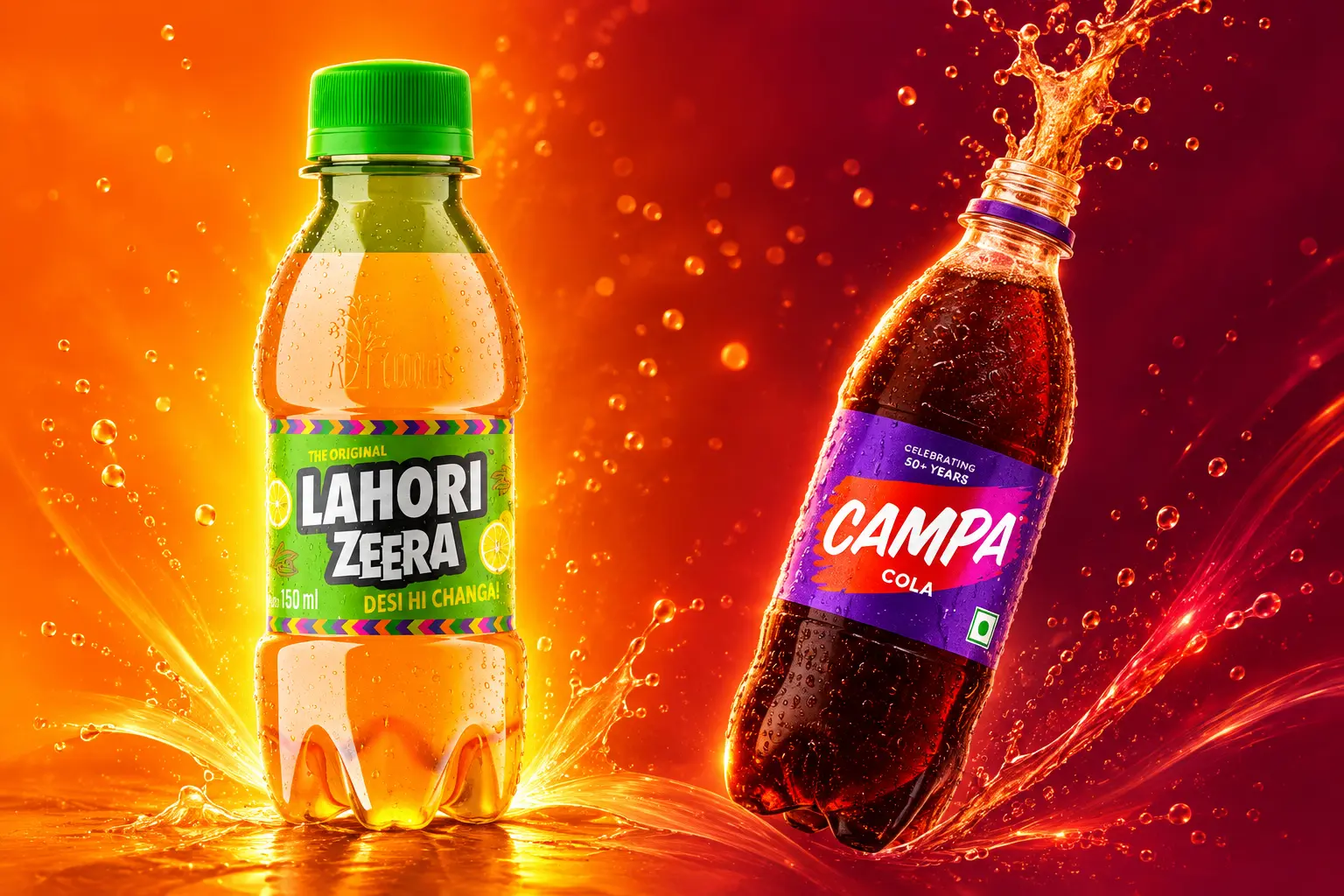
Campa Is the Volume Behind the 15 Percent
Kotak Mutual Fund, in a 2025 note, lumped Lahori Zeera, Campa and smaller rivals into an “ethnic beverages market” that had doubled its carbonated-soft-drink share to around 15 percent by September 2025. Coca-Cola and PepsiCo, Kotak said, had slipped from roughly 93 percent to 85 percent. “In global markets, established duopolies rarely lose more than 1-2% share annually; an 8% swing in less than a year is a structural disruption.”
NielsenIQ figures cited by industry executives in November 2025 match that 15 percent reading for January to September, up from about 7 percent a year earlier, in a ₹60,000 crore soda market that was otherwise flat after a wet summer. NielsenIQ and Reliance Consumer Products did not comment. The mix inside that 15 percent is the part the cumin headline hides. Campa is a full soda range revived at ₹10, not a spice experiment.
WHO IS MOVING THE ₹10 SHELF
| Brand | Owner | Latest scale | ₹10 pack |
|---|---|---|---|
| Campa | Reliance Consumer Products | More than ₹4,700 crore FY26 gross sales | Yes, including 200 ml |
| Lahori Zeera | Archian Foods | ₹775 crore FY26 | Yes, 160 ml |
| RimZim | Coca-Cola | One northern bottler at about 4 million units a month | Yes |
| Dhishoom | Parle Agro | Rural since 2012, national from May 2024 | 125 ml at ₹10 |
| Bindu Fizz Jeera Masala | House of Bindu | Cumin soda at 40% of company revenue | Mass fizz |
| Coke and Pepsi brands | Coca-Cola and PepsiCo | About 85% of CSD share, Jan-Sep 2025 | ₹10 packs on Coke, Thums Up, Sprite, Pepsi |
Reliance told shareholders in July 2026 that Campa had become India’s fourth-largest carbonated soft-drinks brand, with double-digit share in key states. “Campa is not merely a brand. It is India ka Thanda.” RCPL, the parent FMCG arm, reported ₹22,000 crore of gross revenue in FY26. The same firm already uses IPL airtime, actor Ram Charan, Hyderabad Metro pouring rights and a 200 ml bottle at ₹10, with family packs priced 30 to 40 percent below rivals when the relaunch was scaling.
On 3 January 2023 RCPL also took a 50 percent stake in Sosyo Hajoori Beverages, a Gujarat house with cumin SKUs of its own. In Andhra Pradesh the Campa range has included Jeera Up. Kotak called the share loss a “Jio moment” for drinks. The Jio in this metaphor is not a Mohali startup. It is the same owner, using the same cheap-pack playbook, on a brand India already knew.
FROM CAMPA’S FIRST LIFE TO THE ₹10 REFIGHT
- 1977: Coca-Cola leaves India after a FERA fight; Campa Cola, launched by Pure Drinks, and Thums Up fill the gap under the line “The Great Indian Taste.”
- 24 October 1993: Coca-Cola returns and buys Thums Up, Limca and Gold Spot from Parle for $60 million, with Rimzim in the same bundle; Pepsi is already in.
- 2000-2001: Campa bottling plants cease; the mark fades to memory.
- 2000: House of Bindu starts jeera masala fizz from Puttur, Karnataka.
- 2012: Parle Agro sells Dhishoom in rural markets.
- 2017: The cousins launch Lahori Zeera.
- 2018: Coca-Cola relaunches RimZim, then lets it idle.
- August 2022: Reliance buys the Campa trademark for about ₹22 crore.
- 9 March 2023: Campa returns, first in Andhra Pradesh and Telangana, later as “Naye India Ka Apna Thanda.”
- January-September 2025: Challenger share, led by Campa and Lahori Zeera, reaches about 15 percent.
India has run this race before. Homegrown cola filled a vacuum, then lost the shelf when Atlanta and Purchase came back with bottlers and film stars. The new twist is price. Campa’s second life is not nostalgia. It is a ₹10 bottle in the same kirana fridge as jeera fizz.
Little Room Left in a ₹10 Soda
The pack that built the category is also the vice. Packaging is tied to crude, and Munjal said oil around $108 a barrel against a more usual $60 to $70 band, with sugar having spiked from about ₹45-48 a kilogram to ₹72 before easing to about ₹56-57. When the sticker is ₹10, a few rupees of PET or freight wipe the profit off a bottle that cannot travel far.
THE ₹10 BOTTLE’S MATH
- Packaging share: PET and related packs take nearly 60 percent of Lahori Zeera’s making cost, Munjal said in June 2026.
- Gross margin: The firm works at around 35 percent gross margin; Munjal put FY26 EBITDA at around 16 percent.
- Diet SKU: A zero-sugar Lahori Zeera Diet is priced at ₹20, aimed at a thinner, more careful slice of buyers after a stevia batch had to be scrapped.
- Hold time: Doda said in November 2026 the ₹10 sticker can still work for four to five years if plants sit closer to shops.
That is why Archian is scattering co-packers inside a few hundred kilometres of demand, including a Bengaluru line for Karnataka, Andhra Pradesh and Telangana, rather than hauling cheap bottles across the country. Bihar has become its highest-volume state. The east now matches the north. Quick commerce is rising off a tiny base, from about 1 percent of sales to 5 to 6 percent in an early quarter, still a side channel beside general trade.
Rajiv Agarwal, a professor at Mumbai’s SP Jain Institute of Management who advises family firms that compete with multinationals, doubts cumin fizz can ever match cola for size. “The million-dollar question is how big can the cumin-flavoured drink market become. And I suspect it won’t become as big as the colas.” He also called the rivalry “extremely aggressive,” and said the global players still have the tighter systems, routes and bottling contracts. Kotak’s 8 point swing and Agarwal’s ceiling can both be true: share can move fast at ₹10 without jeera replacing cola as the default cold drink.
Coca-Cola and PepsiCo have already cut flagship packs of Coke, Thums Up, Sprite, Gatorade and Pepsi to ₹10, from ₹12 and above. The slot some boosters still treat as a place giants will not go is the slot they are now defending.
What Coca-Cola’s RimZim Is Doing Now
Coca-Cola did not need to invent jeera soda. It bought Rimzim from Parle in the 1990s, relaunched it in 2018, then left it quiet until the category started moving. The company’s India site now sells RimZim as a jeera flavoured sparkling beverage under the line “Asli Jeera, Full Fizz,” in 150 ml and 250 ml PET, with reconstituted apple juice at 10.4 percent of the recipe.
Northern bottlers doubled output over a stretch of months in 2025. One leading bottler said his RimZim lines were near 4 million units a month, up 100 percent from two years earlier, and that the brand was in more than 30,000 shops across Delhi-NCR, Uttar Pradesh, Gujarat and Karnataka, including ₹10 packs. Coca-Cola did not answer questions about the push. PepsiCo was also said by industry executives to be looking at the space through Nimbooz; it did not comment either.
The sequence is the second-order plot in miniature. A Punjab brand proved that bottled jaljeera could sell out. A bottler network that already reaches every pin code then scaled a SKU it already owned. People who only this month noticed that Coke has a jeera soda are late. The brand sat in the 1993 Parle deal, went to sleep, and woke up when the volume was obvious.
Bindu, Dhishoom and a Crowded Jeera Shelf
Industry executives put the cumin-flavoured non-alcoholic slice at about ₹2,500 crore in August 2025. India’s wider non-alcoholic drinks market was valued at $32 billion in 2024 and is projected to double by 2033. Online orders for the fizzy jeera set rose 900 percent in the summer of 2026, according to one Indian delivery firm. The shelf is no longer a two-horse race.
WHO ELSE IS POURING CUMIN FIZZ
- House of Bindu: Jeera masala fizz from Puttur around 2000; director Megha Shankar said the drink went from 20 percent to 40 percent of revenue in five years and is now the firm’s fastest-growing carbonated line, with a zero-sugar version added. By August 2025 the company listed 1,500-plus distributors and more than 5 lakh outlets as it pushed north from Karnataka, Andhra Pradesh and Telangana.
- Parle Agro Dhishoom: Sold in rural markets from 2012, taken national in May 2024 in 125 ml at ₹10 and 250 ml at ₹20, with the line “Mere Paas Masala Hai.”
- Jeeru: Mumbai’s Xotik Frujus, one of several regional names now on the same fridge.
- Dabur Hajmola Zeera: A digestive brand stretched into cumin soda; extensions were already more than 15 percent of the Hajmola franchise.
- Campa Jeera and Sosyo: Reliance’s own spice SKUs sitting beside the cola that actually moves the cases.
Munjal has said the rush of copycats is “a validation of our thesis that people are looking for familiar flavours that they grew up with.” Shankar told interviewers the category is now the fastest-growing among carbonated drinks. The next obvious bottles are already named in shops and kitchens: kokum, sattu, raw mango, tamarind. Lahori has tried Aamras and a masala cola; it pulled a product called Imily Banta within 10 months after shops and drinkers said no.
House of Bindu waited a quarter century for the same taste to become fashionable. Parle sat on Dhishoom in the hinterland for 12 years. The cousins did not invent jeera soda. They timed a ₹10 PET pack to a moment when “desi thanda” could be sold as modern rather than rustic.
Munjal Still Cannot Fill Every Order
On 20 November 2026, the Indian Beverage Association closed its National Beverage Conclave with a “Future Ahead” session that put Munjal on the same dais as Arpan Basu, vice-president and head of public affairs, communications and sustainability at Reliance Consumer Products. The cousins and the conglomerate now share industry stages as well as fridge space.
The final session brought the curtains down on an extraordinary day at the National Beverage Conclave 2026, marking a fitting close to a landmark gathering of industry leaders, policymakers and stakeholders.
Mr. Anuraag Jaipuria – MD, Jai Drinks Pvt. Ltd., Mr. Saurabh Munjal –… pic.twitter.com/pYrqQhcNDr
— Indian Beverage Association (@India_IBA) November 20, 2026
Archian is trying to grow without another funding round, Doda said in October 2026, by adding co-bottlers rather than plants it owns. A second “hero” drink is on the wish list. A UAE co-packing idea is meant to reach the Gulf diaspora, with a wider foreign presence talked about for 2028. South India, still thin for Lahori, is the domestic hole; Doda had said in late 2025 the brand was missing only in the south and wanted 80 to 90 percent of pin codes. Munjal has refused a celebrity face, even as Campa signed Ram Charan. “The brand ambassadors for Lahori Zeera are the everyday Indians who consume the product,” he said.
He still talks like a man building a flavour house, not a price discounter. “Indian flavours need to find a global spotlight.” And: “For generations, we’ve grown up drinking colas of the world, but I hope the next generations will drink the zeeras of India.” The sold-out tanks in Punjab, Uttar Pradesh and Gujarat are the nearer test. Campa already has the cases, the cricket spots and the ₹10 habit. Coca-Cola already has RimZim and a matching cheap pack on Thums Up. The kitchen experiment opened the door. The next bottles through it will come from whoever can keep a ₹10 soda in stock when the heat returns.

New Audi Q3 Skips Cameras a Mahindra XUV 3XO Includes

Scotland’s £65m Universities Fund Bets on Later Rounds

Suzuki Access 125 Adds Paint as Jupiter Takes Share

Scotland Face Argentina at Twickenham With Rankings at Stake

Motorola’s Android 17 List Trails the Real Rollout

Volkswagen Sells the Osnabruck Plant to Clear a Board Fight

Apple’s Foldable iPhone Hinges on Samsung Display Supply

Saksham Gaur Finds He Is His Own Company’s Client

Tata Motors’ Iveco Tender Opens as Holders Still Decide

What Is SD on Amazon Prime?
-
 AUTO3 months ago
Volkswagen Sells the Osnabruck Plant to Clear a Board Fight
-
 NEWS3 months ago
Apple’s Foldable iPhone Hinges on Samsung Display Supply
-
 BUSINESS3 months ago
Saksham Gaur Finds He Is His Own Company’s Client
-
 AUTO3 months ago
Tata Motors’ Iveco Tender Opens as Holders Still Decide
-
 TECHNOLOGY3 years ago
What Is SD on Amazon Prime?
-

 BUSINESS3 months ago
Hyderabad 22-Carat Gold Jumps After a False Bargain
-

 GAMING3 months ago
Onimusha Way of the Sword Preload Hits a Windows 11 Wall
-

 ENTERTAINMENT2 years ago
Andy Scott’s Steel Loon Repeats the Kelpies Regeneration Bet