
BUSINESS
Anthropic IPO Puts a $900.9 Billion Compute Bill on Tape
Anthropic stock closed at $97.17 after an $81.34 billion IPO, putting $900.9 billion of compute commitments and founder voting control on the public tape.

Anthropic shares closed at $97.17 on Nasdaq on November 19, 2026, 17.1% above the $83.00 IPO price, after the Claude maker raised $81.34 billion in the largest initial offering on record. The stock had opened at $111.50, then gave back a slice of that pop while the Nasdaq and the S&P 500 each finished down more than 2%.
Buyers got the first listed bet on a stand-alone frontier lab. They also got a prospectus that lists about $900.9 billion of compute and infrastructure commitments, most of them payable whether demand holds, and a voting design that keeps public Class A holders off the controls.
Thursday’s Open at $111.50 Did Not Hold
The first print at $111.50 implied about $2 trillion on the same fully diluted basis the company had used for a $1.5 trillion value at $83.00. By the close, that fully diluted figure was about $1.75 trillion. On the 13,219,642,276 shares the prospectus lists as outstanding after the deal and the private placement, $97.17 implied about $1.28 trillion.
THE FIRST-DAY TAPE
| Date | Price | Versus $83.00 | |
|---|---|---|---|
| IPO price | November 18, 2026 | $83.00 | Priced $5 above the $70 to $78 range |
| Opening trade | November 19, 2026 | $111.50 | Up 34% |
| Close | November 19, 2026 | $97.17 | Up 17.1% |
The fade from the open still left ANT green on a session that punished the rest of the tape. Nvidia, a buyer in Anthropic’s private placement and a supplier to the wider AI build, was already under pressure after chief executive Jensen Huang resigned amid a reported affair with a woman U.S. intelligence suspected of being a Chinese spy.
Art Hogan of B. Riley Wealth Management called the listing “the breath of fresh air that the tech trade needed to move beyond the fog of artificial intelligence that we’ve been living in for the last couple of weeks.” The fog did not lift for the indexes. It just parted around one new ticker.
SpaceX had set the prior bar in June 2026 with a $75 billion IPO at a $1.77 trillion value, later $86 billion after its banks took their extra shares. Anthropic’s base deal is already larger than that first SpaceX print. The comparison that matters for holders is not the league table of proceeds. It is what those proceeds sit next to on the balance sheet.
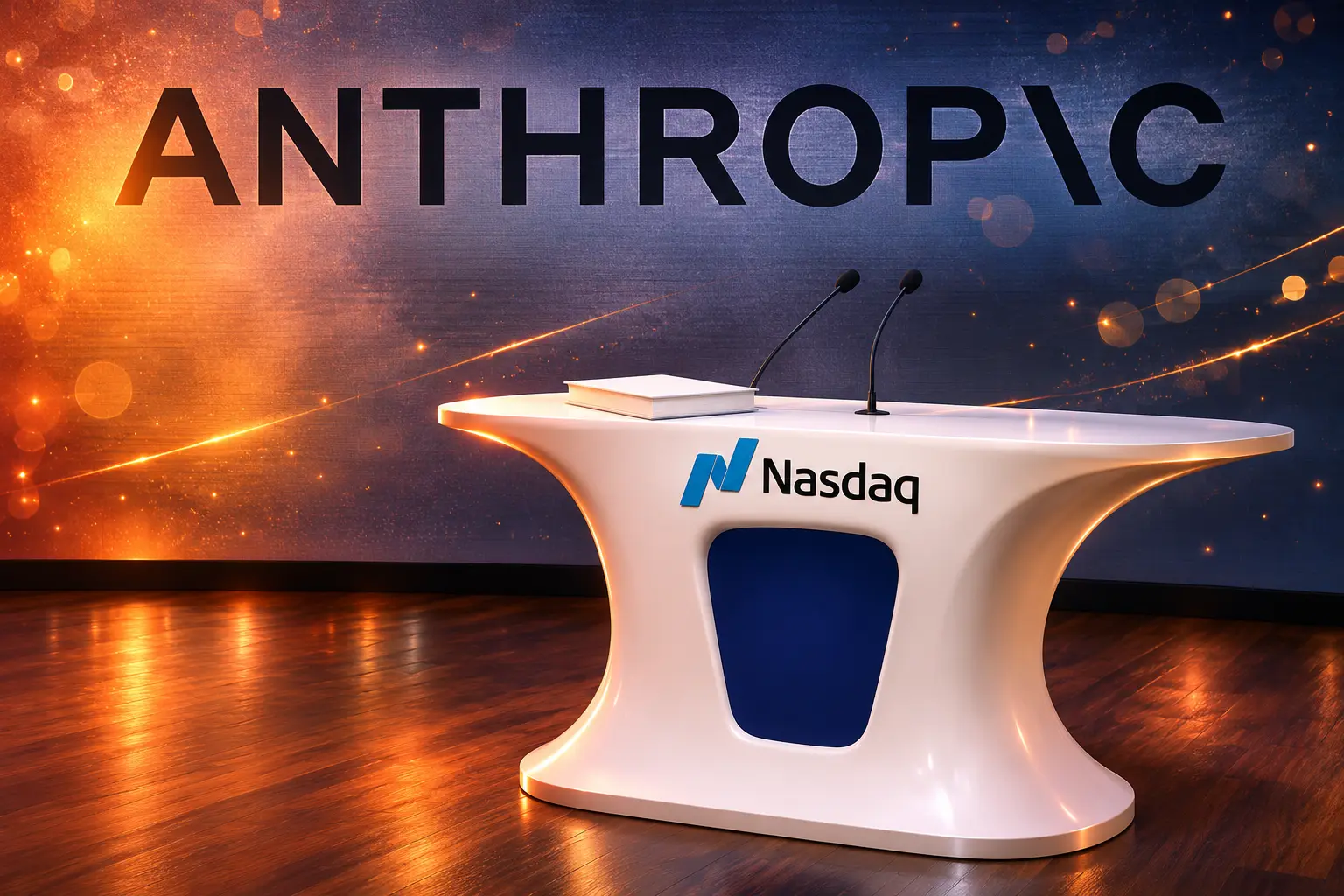
What Anthropic Raised in Its Record IPO
Anthropic, PBC priced 980 million Class A shares at $83.00 on November 18, 2026, for an offering price of $81.34 billion. The company sold 956,351,354 new shares. Selling stockholders sold 23,648,646 and keep those proceeds. Goldman Sachs & Co. LLC and Morgan Stanley led a syndicate that collected $550 million in discounts, $50 million more than the SpaceX fee stack.
Before expenses, Anthropic is due about $78.84 billion from the primary shares and selling holders about $1.95 billion. Banks hold a 30-day option on 147 million more Class A shares at the same $83.00. If they take it in full, gross proceeds rise to about $93.54 billion. They receive no discount on those option shares, so the extra paper is a support tool first and a fee event second.
A separate $26.0 billion sale of non-voting Class N stock was set to close right after the IPO, at the same $83.00, with combined net proceeds of about $104.8 billion, or about $117.0 billion if the option is exercised in full. The sale of the listed shares was due to settle on November 20, 2026.
CLASS N BUYERS AT $83.00
- The chip side: NVIDIA Corporation, Advanced Micro Devices, Broadcom, Micron Technology, and TSMC Partners, Ltd. agreed to buy.
- The cloud side: Google LLC and Microsoft Corporation joined the same $26.0 billion book.
- The structure: Class N has no general vote and is not registered in the IPO; it converts to Class A if it is sold to an unaffiliated buyer.
Those names already sit inside Anthropic’s compute stack. They now hold equity in a customer whose value moves with the same AI build they supply. Altimeter founder Brad Gerstner said his firm asked for $5 billion of the listed deal, more than five times its largest prior IPO order. Demand cleared. Control did not transfer with it.
$900.9 Billion of Compute Comes Due Either Way
The prospectus states that as of and after September 30, 2026, Anthropic had entered purchase commitments and leases with “an aggregate committed spend of approximately $900.9 billion, substantially all of which is related to compute and infrastructure.” About $70.7 billion falls due in the 12 months after that date. About $451.6 billion is expected before December 31, 2030, with nearly all the rest running from 2031 to 2045.
About $186.2 billion sits in contracts that can still be ended or that start only once a partner secures financing, sites, or approvals. A further $150 billion to $175 billion of deals carry no fixed dollar total and are expected to be paid as capacity shows up. The rest is the hard stack.
NAMED COMPUTE COUNTERPARTIES
| Counterparty | Stated commitment | Shape of the deal |
|---|---|---|
| Broadcom | $161.2 billion | Five-year equipment leases on accelerators, rent before interest |
| $121.3 billion | Cloud capacity running at least to July 2033 | |
| SpaceXAI | Up to $120.5 billion | Compute into 2029, with a 90-day termination right |
| Amazon | $110.0 billion | Minimum cloud spend at least to April 2036 |
| Microsoft | At least $47.2 billion | Cloud capacity on a multi-year term |
Those five lines add to about $560 billion and still leave hundreds of billions in other hosting, leases, and projects. Anthropic now buys some chips itself and runs them in dedicated halls it calls Anthropic Direct, with the first site opening in 2026. It trains and serves Claude across AWS Trainium, Google TPUs, Nvidia GPUs, and AMD GPUs, and it says customer demand has stayed ahead of the machines it can get.
Most of the revenue that is supposed to pay this bill is usage. About 80% of sales are metered in tokens. Customers can cut spend in a quarter. The leases do not cut as fast. That mismatch is now a public-market fact, not a private-round footnote.
Claude’s $17 Billion Quarter Came With a Loss
Revenue reached $17.0 billion in the third quarter of 2026, up from $1.4 billion a year earlier. For the first nine months it was $33.24 billion. More than 11,900 customers produced at least $100,000 of trailing twelve-month revenue, and net revenue retention on usage accounts was about 900%. A large share of that bill comes from teams paying to have Claude write and edit code.
Q3 2026 IN THE PROSPECTUS
- Operating line: A $567 million operating loss, after $974 million of operating income in the second quarter.
- Compute share: Compute and infrastructure equaled 58% of third-quarter revenue, up from 48% in the second quarter.
- Short-term machines: $5.0 billion of extra compute bought on short contracts, which Anthropic says costs much more than its multi-year deals.
- Cash on hand: $131.8 billion of cash and short-term investments at September 30, 2026, before IPO proceeds landed.
The $5.0 billion of expensive spot capacity, plus $2.0 billion of non-cash charges on a donation-matching plan, flipped the quarter from profit to loss. Cash at September 30 covered the $70.7 billion due in the next year. It does not cover the $900.9 billion stack. The new equity is the bridge, and it is a bridge that now has a daily price.
Founders Keep 50.1% of the Vote
Anthropic is a Delaware public benefit corporation and a Nasdaq “controlled company.” A Long-Term Benefit Trust, via Class T stock, elects Class T directors who make up a majority of the authorized board. Those trustees are meant to be financially disinterested people with backgrounds in AI safety, national security, public policy, and social enterprise.
THE VOTE PUBLIC BUYERS DID NOT GET
- Class F: One share sits in a Founder LLC and carries 50.1% of the voting power on matters submitted to stockholders, including election of directors other than the Class T seats.
- The members: Chief executive Dario Amodei, president and chair Daniela Amodei, and the five other co-founders are the initial members of that LLC.
- Class A: The listed line carries one vote a share and no conversion right into a control stock.
- Class E: Employee stock votes only on limited questions and has no economic rights.
Dario and Daniela Amodei left OpenAI in 2021 and founded the company with colleagues around a safety brief. Five years later the listed float can mark the stock to market. It cannot fire the trust’s directors, and it cannot outvote the Founder LLC on the seats the trust does not hold. Ordinary holders own the residual claim on Claude. They do not own the firm in the way a textbook common stock implies.
Critics Called the Safety Pitch a Cover
At the Nasdaq MarketSite in Times Square, Dario Amodei tied the cash raise to the original brief. He said the company would pace training and deployment “taking as long as is necessary to have confidence that they are safe and will remain under human control,” and that it would not bend to business or political pressure.
Today puts the company in a stronger financial position, and in doing so, only strengthens our resolve to do the right thing. If we can show it’s possible to make the right choices on safety and still build an incredibly successful company, others in our industry will be inspired to do the same.
Dario Amodei, Chief Executive Officer, Nasdaq opening remarks
He called that idea a “race to the top.” Daniela Amodei said the listing was “one stop on the journey” and that staff would “wake up tomorrow and we’re going to be the same company.” She also told listeners, “This technology needs you, not your trust, not your use, but your voice.”
The same prospectus that carried those pledges warns that advanced systems “could pose catastrophic or existential risks to humanity” if they are misused, weaponized, or left to run with high autonomy. On November 18, 2026, the day the deal priced, a coalition published a three-sentence attack on that brand.
Anthropic warns that recursively self-improving AI could concentrate power and escape human control, yet races to build it first. The company uses safety branding to court investors, employees, and the public, even as it has quietly weakened its safety pledges and lobbied for self-serving regulation. Anthropic is not a safe AI company, and we must reject its reckless attempt to amass power in the name of the greater good.
The MisAnthropic Statement, November 18, 2026
The full MisAnthropic Statement text sits on the organizers’ site. Signers include Harvard psychologist Steven Pinker, Nobel economist Oliver Hart, Turing Award winner Judea Pearl, MIT physicist Max Tegmark, Hugging Face co-founder Thomas Wolf, and Center for AI Safety director Dan Hendrycks. Hendrycks said a firm cannot credibly claim to be safe while weakening prior commitments and asking the public for tens of billions of dollars to build recursively self-improving systems. The group points to a February revision of Anthropic’s Responsible Scaling Policy that dropped a unilateral pledge to pause if safety could not be guaranteed.
As Anthropic begins trading today, the MisAnthropic Statement has passed 1,000 signatures. Signatories now include Stephen Fry, Tim Urban, Nepal’s former PM, 4 Fields Medalists, and 2 Nobel Laureates. Read why we’re not buying Anthropic’s safety branding:https://t.co/GtkkAQ4NfZ
— Center for AI Safety (@CAIS) November 19, 2026
On November 19, as ANT began trading, the Center for AI Safety said the letter had passed 1,000 signatures. The listed stock did not wait for that argument to settle. The louder split around the debut is not whether the book cleared. It is whether a usage business can carry leases that run to 2045, and whether a safety charter still binds a company whose Class A holders cannot appoint the board that is supposed to enforce it.
ANT now packages Claude’s growth, a $900.9 billion compute stack, and a majority board the public float does not elect. The 30-day option remains live. The safety dispute is in the same file as the earnings.
Frequently Asked Questions
What Is Anthropic’s Stock Ticker?
Anthropic’s Class A common stock trades on the Nasdaq Global Select Market under ANT. Each Class A share carries one vote. Strategic partners hold separate Class N shares that have no general voting rights except where law requires them, and those shares convert into Class A if they are sold to an unaffiliated buyer.
How Does the Underwriters’ Option on Anthropic Shares Work?
The banks have 30 days from the November 18, 2026 prospectus date to buy up to 147 million extra Class A shares at $83.00. The prospectus says they receive no discount or commission on those option shares, which is the reverse of a typical greenshoe fee. If the option is taken in full, gross proceeds from the listed deal rise to about $93.54 billion.
What Public Benefit Is Written Into Anthropic’s Charter?
As a Delaware public benefit corporation, Anthropic must balance the money interest of stockholders, the best interests of people materially affected by its conduct, and a stated purpose: “the responsible development and maintenance of advanced AI for the long-term benefit of humanity.” The Long-Term Benefit Trust’s Class T directors, a majority of the authorized board, exist to police that balance.
When Did the Anthropic IPO Settle?
Anthropic said the offering was expected to close on November 20, 2026, the business day after the first trade. The prospectus also tells dealers they may have to deliver a copy through December 13, 2026, the 25th day after the prospectus date, even after the shares have begun changing hands.
Disclaimer: This article is news reporting and analysis of Anthropic’s initial public offering and first trading session. It is informational only and is not investment advice, a recommendation to buy or sell ANT or any other security, or a solicitation to participate in any offering. Readers should consult a licensed financial adviser, broker, or other qualified investment professional before making any decision about these shares, options, or related instruments. Figures, listings, option windows, and corporate statuses reflect the prospectus, company statements, and market prints cited here as of the dates given and may change as the greenshoe is exercised, as filings are updated, or as the stock trades.

New Audi Q3 Skips Cameras a Mahindra XUV 3XO Includes

Scotland’s £65m Universities Fund Bets on Later Rounds

Suzuki Access 125 Adds Paint as Jupiter Takes Share

Scotland Face Argentina at Twickenham With Rankings at Stake

Motorola’s Android 17 List Trails the Real Rollout

Volkswagen Sells the Osnabruck Plant to Clear a Board Fight

Apple’s Foldable iPhone Hinges on Samsung Display Supply

Saksham Gaur Finds He Is His Own Company’s Client

Tata Motors’ Iveco Tender Opens as Holders Still Decide

What Is SD on Amazon Prime?
-
 AUTO3 months ago
Volkswagen Sells the Osnabruck Plant to Clear a Board Fight
-
 NEWS3 months ago
Apple’s Foldable iPhone Hinges on Samsung Display Supply
-
 BUSINESS3 months ago
Saksham Gaur Finds He Is His Own Company’s Client
-
 AUTO3 months ago
Tata Motors’ Iveco Tender Opens as Holders Still Decide
-
 TECHNOLOGY3 years ago
What Is SD on Amazon Prime?
-

 BUSINESS3 months ago
Hyderabad 22-Carat Gold Jumps After a False Bargain
-

 GAMING3 months ago
Onimusha Way of the Sword Preload Hits a Windows 11 Wall
-
 ENTERTAINMENT2 years ago
Andy Scott’s Steel Loon Repeats the Kelpies Regeneration Bet