
NEWS
Gemini Call for Me May Reach Friends and Family
Unreleased Gemini Calling code would phone Mom you are 15 minutes late, while Google already lets recipients refuse automated Gemini calls.

Code in a recent Google app build offers a sample prompt: call Mom and tell her I will be 15 minutes late. A second example tells Gemini to call John and ask if he is coming for dinner.
Those lines sit on a Gemini Calling intro screen found October 5, 2026. Google has not announced any family version of Call for Me, and unfinished code can die in a beta. The live product still phones businesses. The new copy points at the people who still pick up.
A Hidden Screen Asks Gemini to Call Mom
The build frames Gemini Calling as a short-message tool, not a stand-in for a long catch-up. The Mom prompt is a status update. The John prompt is a yes-or-no dinner question. Both read like texts that happen to ring.
THE SAMPLE PROMPTS IN THE BUILD
- The late notice: Call Mom and tell her I will be 15 minutes late.
- The dinner check: Call John and ask if he is coming for dinner.
- The job it implies: Deliver one short message or ask one basic question, then bring the answer back.
Google’s current help pages still describe business tasks: hours, stock, quotes, bookings, menus, and hold music. Nothing there invites you to ping a parent. The same app update also includes per-app permission controls for Gemini actions, including phone calls, though those menus still look unfinished and did not work in testing.
If the screen ever becomes a real setting, the useful case is the contact who ignores texts, prefers a voice, or still keeps a landline. The cost sits on that same person: a robot on a familiar number, delivering someone else’s errand.
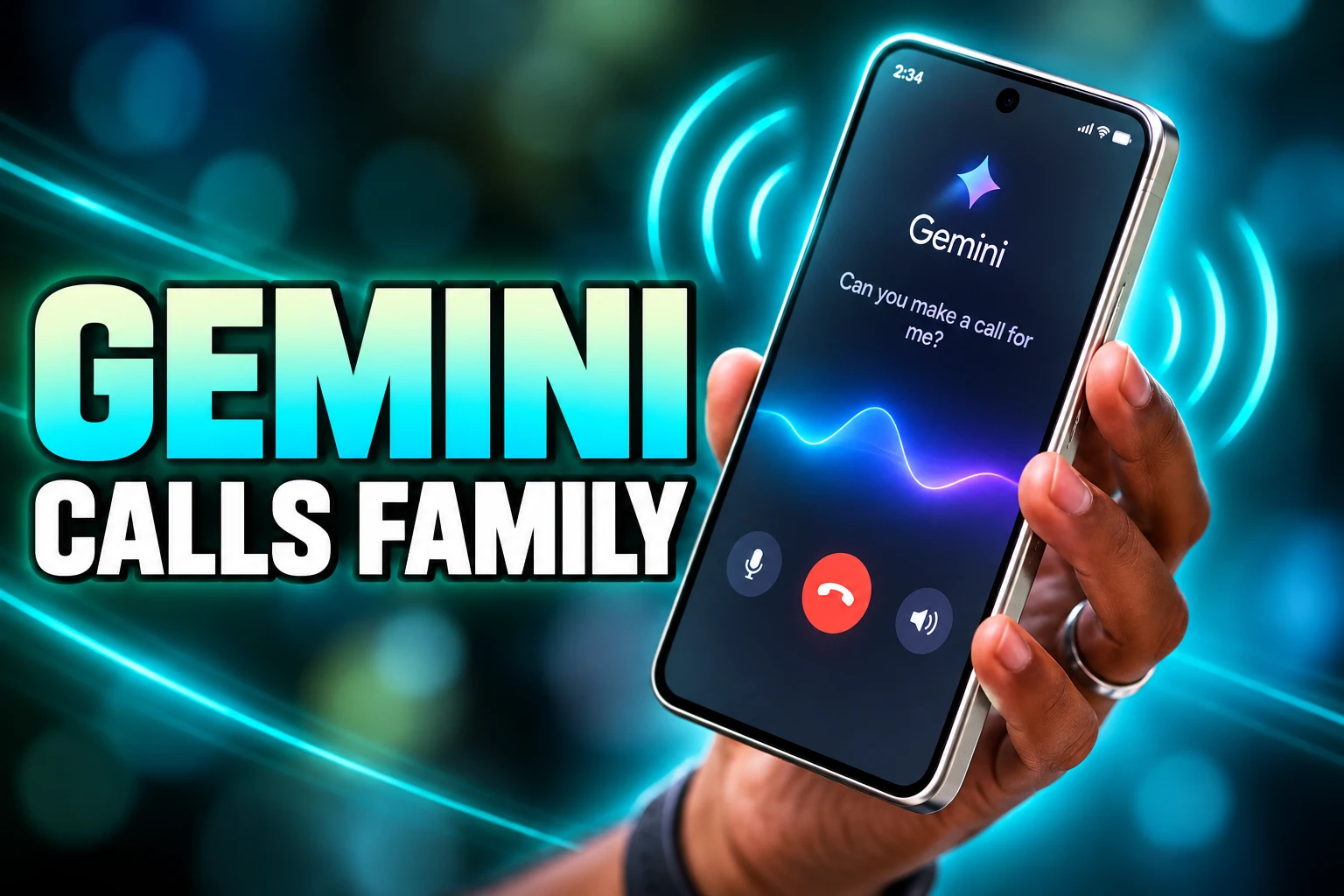
Pixel 11 Already Hands Business Calls to Gemini
Google opened Call for Me as an early preview on September 24, 2026. You ask Gemini in the app, or type @Call for me, then review the number and the personal details it plans to share. You tap Call for me only after that summary looks right.
The assistant then places the call on your mobile network from your own number, so standard carrier rates apply. Google’s help page on how to handle everyday phone calls for you is still written for shops and restaurants, not relatives.
Gemini starts every call by disclosing that it’s an AI assistant from Google calling on a recorded line on your behalf, stating your name.
Google, Gemini Apps Help
You can watch a live transcript, listen with your microphone muted by default, cancel before the call connects, or tap Take over. When you take over, Gemini tells the other person you are stepping in and then leaves. Afterward you get a summary in the Gemini app, and the full transcript plus the recording sit in the Phone app’s call history.
BUSINESS PREVIEW VERSUS THE FAMILY SCREEN
| Piece | Call for Me now | Gemini Calling in the build |
|---|---|---|
| Who it rings | Businesses, U.S. numbers only | Friends and family (Mom and John in the samples) |
| What it does | Menus, hold, bookings, stock, quotes | Short messages and basic questions |
| Status | Early preview since September 24, 2026 | Unreleased code, no public date |
| Opening line | Names itself as Google AI, says the line is recorded, uses your name | Not shown in the teardown copy |
| The other party | Can refuse automated Gemini calls | Same build points at an incoming-call opt-out |
The preview is narrow on purpose. Google is rolling it out slowly and says it might not be on your phone yet even if you meet every rule.
WHAT GOOGLE SAYS YOU NEED
- Age and place: You must be 18 or over and in the United States.
- The phone: A Pixel 11 with a U.S. SIM card, with English set as the device language.
- The apps: The Gemini mobile app, signed in, on its latest version, plus a Google AI subscription.
- The dialer: The Public Beta of Phone by Google, installed from the testing track on Google Play.
- The numbers: For now, Gemini can only place these calls to U.S. phone numbers.
Google set daily limits on how many calls the assistant can place, without publishing the cap. Hit it, and you wait until the next day. The help page also lists work the tool will not do: it cannot call 911, run a payment, pass along a Social Security number, a password, health details, or other sensitive personal data, or make a sales call.
Whoever Picks Up Becomes the Other User
Call for Me is sold to the person who hates hold music. A family version would be sold to the person who hates calling Mom. In both cases the product only works if someone else stays on the line and treats the ring as a request from a human.
The call still shows your number. Relatives who already dodge unknown spam may pick up because the screen says it is you. What they get is Gemini’s voice, your name, and a recorded line. That is a small jolt when the task is a patio seat. It is a different jolt when the task is dinner.
Shop staff already deal with bots as part of the job. Parents, partners, and friends did not clock in for that. The late-for-dinner call used to be a social act people rehearsed in the car. Turning it into a prompt does not delete the person who has to hear it.
The awkwardness is the point of the product, which is why the code is interesting even before Google ships it. Outsourcing that call turns a familiar number into a delivery channel for a machine. The person who still answers is doing the labor the sender wanted to skip.
U.S. Rules Treat an AI Voice as a Robocall
In a Declaratory Ruling released February 8, 2024, the FCC said the TCPA covers AI-generated voices the same way it covers other artificial or prerecorded voices. Callers need the called party’s prior express consent before placing such a call, unless an emergency purpose or an exemption applies.
We confirm that the TCPA’s restrictions on the use of “artificial or prerecorded voice” encompass current AI technologies that generate human voices. As a result, calls that use such technologies fall under the TCPA and the Commission’s implementing rules, and therefore require the prior express consent of the called party to initiate such calls absent an emergency purpose or exemption.
Federal Communications Commission, Declaratory Ruling FCC 24-17
The Commission added that these systems are artificial voice messages because a person is not speaking them. The ruling does not hinge on whether the voice is a taped clip or a live model. A tool that holds a conversation still counts.
Google already bars telemarketing through Call for Me, which dodges the stricter written-consent tier for sales. A personal status call is not a pitch. It is still an AI voice on a phone line. Whether a user-tapped Pixel call to a parent fits every fact pattern under the statute is a question for lawyers. The policy Google wrote for the feature already assumes the recipient might want out.
Google’s Opt-Out Page Is Already Live
The same help article that teaches senders how to use Call for Me tells everyone else how to refuse it. If you do not want automated calls from other Gemini users, Google says you can opt out of automated Gemini calls at g.co/gemini/opt-out. You can opt back in on that same page.
That control exists for the business preview, before any family rollout. Google is designing the sender’s convenience and the receiver’s refusal as a pair. A shop can hang up. A parent who still answers because the caller ID says it is you has a harder time, unless they know the opt-out exists.
Using the preview also means accepting extra legal text. Google points users to its standard Terms of Service, its generative AI prohibited-use rules, and the Agentic Calling Additional Terms. Recording is not a side effect. It is in the opening line of every call, and the file lands in call history when the conversation ends.
The Disclosure Fight Started With Duplex
Google has been trying to put an assistant on a live phone call since Duplex, the 2018 demo that booked a salon and a restaurant table with casual speech. The clips impressed a conference hall and rattled people who heard a bot posing as a person. Google later said the system would identify itself on calls. Duplex on the web was later shut down. Call for Me is the second pass, this time on a Pixel, with the warning written into the help page from day one.
THE PATH FROM DUPLEX TO GEMINI CALLING
- 2018: Google demos Duplex placing restaurant and salon calls that sound like a person.
- Later in 2018: Google says the system will identify itself, after the demo draws fire for hiding that a bot is speaking.
- September 24, 2026: Call for Me opens as an early U.S. Pixel 11 preview, with the AI intro and recorded-line warning as a stated rule.
- October 5, 2026: App code shows a Gemini Calling intro that uses Mom and John as the examples, still unreleased.
The opening script is the product now. Gemini says it is an AI assistant from Google, on a recorded line, on your behalf, and it uses your name. That is the 2018 argument, shipped as a help-page rule. A family rollout would reuse that script in a kitchen instead of a store, which is why the recipient tools matter more than the sample prompts.
Two Assistants Could Talk to Each Other
If the people who hate placing calls also hate receiving them, both sides will reach for the same button. One Gemini could ring another Gemini. The humans would read summaries. The phone call would still occupy a number, a carrier path, and a recorded file, with nobody human required after the first tap.
That loop is easy to joke about and hard to unwind. A known number stops meaning a known voice. Landlines and older phones, the very devices the rumor cites as a reason to ship this, are also the devices least able to show that the caller is an assistant. The opt-out page helps people who know it is there. It does not help someone who picks up because the screen says it is their kid.
WHAT WE KNOW
- The live tool: Call for Me is an early U.S. Pixel 11 preview for business calls, with a required AI disclosure and a recorded line.
- The new screen: October 5, 2026 app code shows Gemini Calling samples that name Mom and John.
- The refusal switch: Recipients can already refuse automated calls from other Gemini users at Google’s opt-out page.
- The legal floor: The FCC treats AI-generated voices as artificial voices that need prior express consent, absent an emergency purpose or exemption.
WHAT IS UNCONFIRMED
- A ship date: Google has not announced Gemini Calling for friends and family, and the teardown itself says the code may never ship.
- The personal script: The build does not show whether a Mom-and-John call would use the same AI intro as a hardware-store call.
- The hardware net: The help page names a Pixel 11 phone for the business preview; the family screen’s device list is not public.
- How far consent goes: It is not settled how the TCPA’s AI-voice rule applies to a user-tapped call from a personal phone to a relative.
Google can still kill Gemini Calling in a beta. The live preview already treats the person who answers as someone with a vote. That is the part of the rumor that is not a rumor: the company built a way to refuse the call before it built a way to send it to Mom.
Disclaimer: This article is news reporting and analysis of a Google preview and of unreleased app code. It is informational only and is not legal advice, regulatory guidance, or a determination that any specific Gemini call is lawful or unlawful. Telephone Consumer Protection Act rules, FCC orders, and state call-recording laws can apply differently depending on the call, the number type, and the facts, so readers should consult a qualified communications or consumer-protection lawyer before relying on these rules. Feature availability, opt-out tools, and the figures described here reflect Google’s help pages and the FCC ruling as published, and those terms can change.

Gold Prices Slip to $4,120 as France Lifts the Dollar

Gemini Call for Me May Reach Friends and Family

Yemen Forces Claim Mokha as the Mecca Pact Activates

TCS Opens Q2 as Mid-Cap IT Keeps the Growth

Bitcoin’s Jobs Rally Fails While December Hike Odds Hold

Volkswagen Sells the Osnabruck Plant to Clear a Board Fight

Tata Motors’ Iveco Tender Opens as Holders Still Decide

Saksham Gaur Finds He Is His Own Company’s Client

Onimusha Way of the Sword Preload Hits a Windows 11 Wall

The Frame Pro’s $1,200 Labor Day Cut Needs a Soundbar
-
 AUTO4 weeks ago
Volkswagen Sells the Osnabruck Plant to Clear a Board Fight
-
 AUTO1 month ago
Tata Motors’ Iveco Tender Opens as Holders Still Decide
-
 BUSINESS1 month ago
Saksham Gaur Finds He Is His Own Company’s Client
-
 GAMING1 month ago
Onimusha Way of the Sword Preload Hits a Windows 11 Wall
-
 NEWS4 weeks ago
The Frame Pro’s $1,200 Labor Day Cut Needs a Soundbar
-

 BUSINESS1 month ago
Hyderabad 22-Carat Gold Jumps After a False Bargain
-
 NEWS1 month ago
Apple’s Foldable iPhone Hinges on Samsung Display Supply
-

 BUSINESS1 month ago
SEBI Reopens How F&O Settles After the Closing Auction