
BUSINESS
Scotland’s Small Inshore Fleet Faces New MPA Fishing Limits
Scotland’s 1,439 smallest boats land little of the catch, but inshore MPA rules will decide how they share the seabed with trawls.

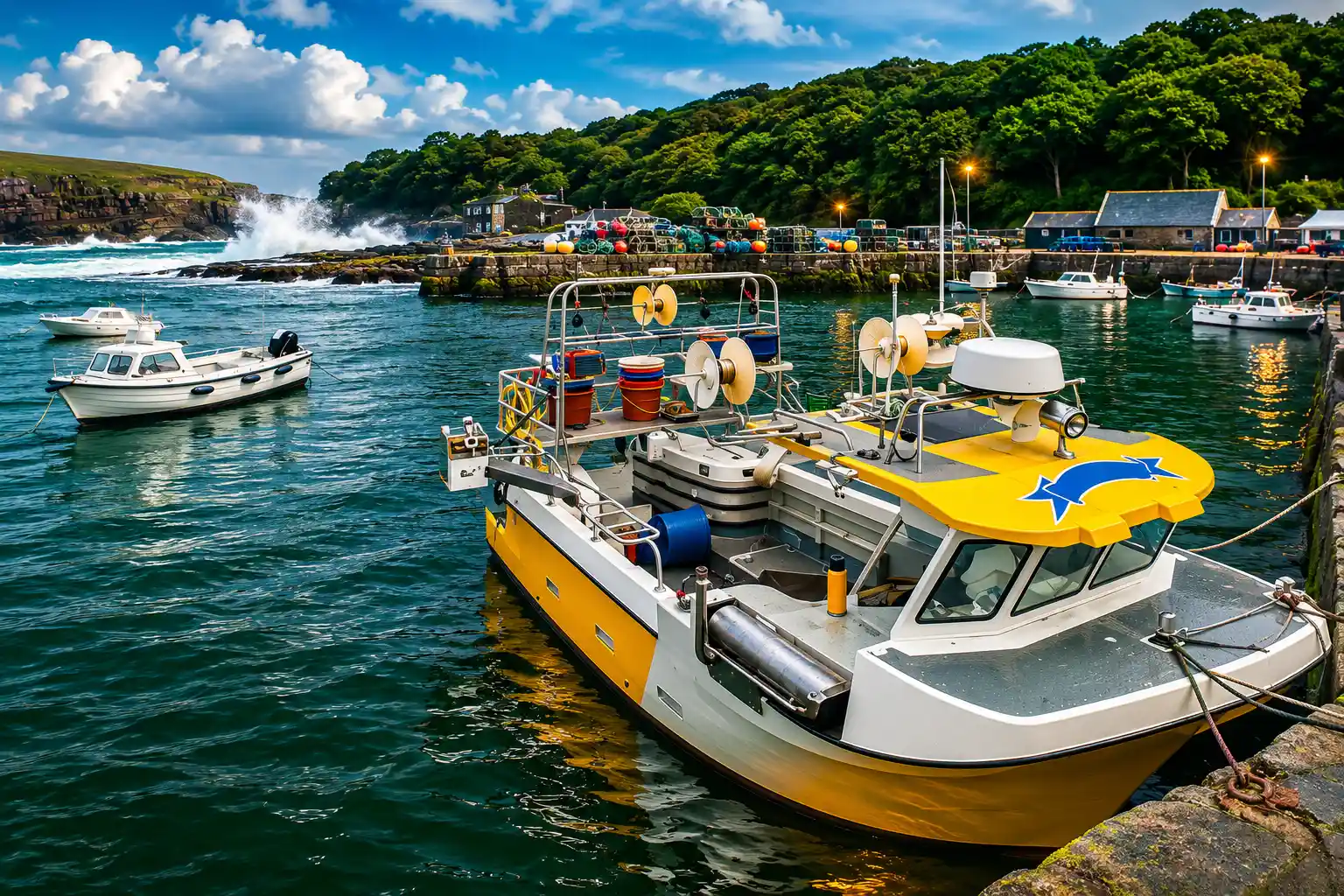
Scotland’s 1,439 smallest fishing boats make up 75 per cent of the fleet and landed £57 million of the catch in 2025. A live consultation on fishing inside inshore Marine Protected Areas will decide how those boats share the seabed with trawls and dredges.
The package covers 166 existing sites and habitat zones, not a new set of parks, and it is open until 18 January 2027. Ministers have still made no final choice on the gear rules.
75 Per Cent of Scottish Boats Are Under 10 Metres
Scottish vessels landed £885 million of sea fish and shellfish in 2025, the highest inflation-adjusted total of the past ten years, on 479 thousand tonnes of catch. Tonnage fell 10 per cent on 2024. Value still rose.
That money is not spread across the harbour wall. The Marine Directorate’s final 2025 statistics, published on 29 October 2026, record 1,918 active Scottish vessels and 3,738 people working on them, three more than in 2024. Employment has fallen 16 per cent since 2016.
Boats of 10 metres and under number 1,439. They landed £57 million, 85 per cent of it shellfish. Twenty-four boats over 40 metres, about 1 per cent of the fleet, landed £489 million, 55 per cent of all value and 99 per cent of pelagic value. Mackerel alone was worth £405 million, 46 per cent of the national total.
THE SCOTTISH FLEET IN 2025
| Group | Number | Landings value |
|---|---|---|
| 10 metres and under | 1,439 | £57 million |
| Over 40 metres | 24 | £489 million |
| Whole fleet | 1,918 | £885 million |
| People on the boats | 3,738 | – |
When records began in 1922, more than 30,000 fishers worked Scotland’s 19,000 km of coast. The under-10-metre fleet has only shrunk 2 per cent since 2016, while boats over 10 metres are down 16 per cent. The small boats stayed. Their share of the money did not.
What the Inshore MPA Consultation Puts on the Table
On 14 September 2026 the Marine Directorate opened proposed fisheries rules for 76 inshore Marine Protected Areas and 90 proposed Priority Marine Feature management areas. Jim Fairlie, Minister for Agriculture, Marine and the Islands, said the work had taken more than 120 meetings over four years.
Healthy seas are not separate from a healthy fishing industry, they are the foundation of it.
Jim Fairlie, Minister for Agriculture, Marine and the Islands, launching the consultation
No new parks are on offer. The 2016 promise was to put fishing rules on sites that already exist. For Marine Protected Areas, Option 1 uses zonal limits on named gears, with some seasonal rules and some caps that apply only above a set engine power. Option 2 applies those gear limits across the whole designated site.
Fifty-three of the 76 Marine Protected Areas have both options. The other 23 have only a full-site limit, because NatureScot advice treated that as the level needed to protect the feature. Of the 90 habitat zones, 46 have two sizes of box and 44 have one. Both versions close the box to bottom-contacting demersal mobile gear; the choice is how large the box is.
There are 26 drop-in sessions on the coast and 17 online events. Fairlie said the run of dates is longer than the usual 12 weeks because of the scale, more than 160 sites in his wording, 166 in the consultation paper.
THE ROAD TO THESE RULES
- 2016: Ministers commit to fishing management inside inshore Marine Protected Areas, and the South Arran Marine Conservation Order takes effect in the Clyde.
- 2017 to 2022: NatureScot and government workshops and harbour meetings shape options, with a pause in the pandemic years.
- 14 September 2026: The consultation opens on 76 protected sites and 90 habitat zones.
- 18 January 2027: The window for responses closes.
The public fight has been sold as a simple yes or no on banning bottom trawls and dredges in inshore parks. The paper is narrower than that slogan, and the cost gap between the two options is the part that will hit particular harbours.
Whole-Site Limits Carry a Much Higher Price
A partial Business and Regulatory Impact Assessment published with the package sets out a national range, depending on whether boats can move onto other ground. Under Option 1, average annual landings lost sit between £0.6 million and £1.4 million. Under Option 2 they sit between £9.7 million to £10.3 million.
NATIONAL COST RANGES IN THE IMPACT ASSESSMENT
| Measure | Option 1 (zonal) | Option 2 (whole site) |
|---|---|---|
| Annual landings lost | £0.6 million to £1.4 million | £9.7 million to £10.3 million |
| Annual GVA, direct and indirect | £0.3 million to £0.7 million | £4.7 million to £5.1 million |
| GVA over 20 years, present value | £4.1 million to £10.2 million | £69.5 million to £74.3 million |
| UK jobs lost, full-time equivalent | 6 to 16 | 109 to 117 |
The lower end assumes boats find other ground nearby. The upper end assumes the lost landings stay lost. Extra steaming, extra fuel, thinner ground and more crowding on remaining spots are listed and not priced.
Elspeth Macdonald, chief executive of the Scottish Fishermen’s Federation, said the test should be whether a limit is needed to meet a site’s conservation aim, “taking account of the measures already in place and the impact on the people who depend on these waters.” She said expert assessments appeared to favour a zoned approach, and that blanket limits across whole sites would be disproportionate.
An Opinion Matters poll of 1,000 Scottish adults, run for the federation between 21 and 28 October 2026, found 90.8 per cent agreed marine conservation should protect jobs and livelihoods, including 48.8 per cent who strongly agreed, with 2.1 per cent against. On a separate question, 87.4 per cent agreed well-designed conservation can support both protection and food production. Macdonald presented those figures at the federation’s annual dinner on 5 November 2026. Agreement on the principle does not settle which boxes close.
Troon Already Lived Through One Displacement
That is why the under-10-metre fleet sits in a different place from “the industry” as a single voice. These boats fish mainly inshore. They cannot steam the way a pelagic freezer trawler can, and they already live with the memory of earlier closures.
On 31 May, Elouise Dalziel, marine policy inclusion officer at the Scottish Wildlife Trust, went to Troon’s harbour blessing at the invitation of Louise Liddell of The Fishermen’s Mission. Further meetings followed in Troon, Girvan, Ayr and Dunure. Some fishers walked up from the boats that afternoon. Others had already left the job because the money no longer held.
Scottish Government social research in Troon, published with the consultation, records a long decline in Clyde fishing over about 20 years, including a drop in Clyde Fishermen’s Association membership. Participants there said the South Arran Marine Conservation Order of 2016 had pushed creel boats onto other ground, piled pressure on remaining stocks, and helped close firms that served the fleet.
One fisher told the Trust, “I would never have believed that the fishing could be eradicated the way it was. You can’t even get a feed of whiting out there now.” Another said the Irish Sea plaice fishery “is all gone now.” A third put the bind in one line: “If we can’t protect the stocks, we can’t protect the fishing communities either.”
The same rooms held the fear that conservation always arrives as a punishment. “Fishermen are all for conservation and protection, until it affects them,” one man said. “So I can see it from both points of view.” Another said fishers are blamed for the harm and then left out of the fix: “You need to have fishermen involved in anything you do for the sea.”
Enforcement came up as often as the maps. “You need the management measures in place,” one fisher said. “And when someone breaks the rules, you also need the punishment to fit the crime. That doesn’t always happen.” The Trust has made that point for a decade. Several men asked for a middle path. “You’ve got to preserve the stock without punishing the seagoing community.”
Creels, Trawls and the Shared Nephrops Ground
The gear split is the part a national landing total hides. Of the 1,439 boats of 10 metres and under, 808 mainly work creels, baited pots for crabs, lobsters and nephrops. Mobile gear tows nets for nephrops or dredges for scallops. Bottom trawling is the catch-all name for that towed kit.
On nephrops alone, Scottish vessels landed 1,628 tonnes from creels worth £18 million in 2025, and 19 thousand tonnes from trawls worth £72 million. Four times the money, and about twelve times the weight, came off the same species with the heavier gear.
Priority Marine Feature boxes in the consultation are closed, in both options, to the mobile set.
GEAR THE HABITAT BOXES WOULD SHUT OUT
- Demersal trawls and seines: Towed nets that work the seabed and the water just above it for prawns and mixed fish.
- Beam trawls: Heavy gear fishers in Ayrshire named, with clam dredgers, as the kit that stops fish reproducing on the ground they work.
- Mechanical dredges: Towed scallop gear that rakes the bottom.
- Hydraulic dredges: Pumped gear used on buried shellfish, listed for full closure in the habitat zones.
Creel boats are not the target of those habitat closures. They still lose if trawls are simply pushed onto the next piece of inshore ground, which is what Troon said happened after South Arran. They also lose if a whole-site Marine Protected Area option shuts static gear as well as towed gear, which some site papers do for set nets.
One Troon fisher put the damage where he sees it: “The biggest damage done to the seabed is by bottom trawling, clam dredgers and beam trawls because the fish are not getting a chance to reproduce.” He also wanted “more political interest… not just towards loss of fishing grounds but to alternative methods of fishing.”
A Decade After the 2016 Promise, the Seabed Is Thinner
The sites exist to hold habitats that feed commercial stocks: maerl beds, flame shell reefs, seagrass, horse mussel beds, and the rest of the 11 features judged most sensitive to bottom-contact mobile gear. Those lists are NatureScot’s. The political wait is the government’s.
Scottish Environment LINK, the coalition that includes the Trust, notes that fishing limits due in 2016 are only now out for views. Conservation campaigners have used that gap to argue most inshore parks still allow towed gear. The consultation is the first attempt to close it on this scale.
A 2021 mapping study estimated 524 million tonnes of organic carbon in UK seabed sediments in the top 10 cm of the exclusive economic zone. Follow-up work on trawling risk found the west coast of Scotland among the places where that store is most exposed, because the mud is carbon-rich and the inshore is worked again and again. The impact assessment treats carbon storage as a possible long-term gain from the gear rules, and it does not put a pound figure on it.
Fairlie’s launch line was that climate change, warming water and habitat loss are already on Scotland’s coast. The Ayrshire fishers did not need the global framing. They talked about whiting they can no longer fill a plate with, and about a plaice fishery that used to pay.
Fishers Still Have Until 18 January to Speak
The Trust and The Fishermen’s Mission are using the remaining weeks to get Ayrshire voices onto the portal. That work sits inside the Trust’s Sea the Connection project, funded by the Esmée Fairbairn Foundation from October 2024 to October 2027, which was built after earlier Orkney interviews found people did not feel able to join marine policy fights.
The barrier is not only confidence. The consultation and its impact papers run to more than 10,000 pages and 620 questions. The Marine Directorate posted a walkthrough so respondents can find the site that matches their ground.
Some of the men in Troon had already stopped offering views because earlier rounds went nowhere. Others still wanted a hearing. “If you don’t protect the ocean, how can you protect the seagoing communities? One goes with the other.”
The small boats will not write the pelagic landing total. They are the ones who still work the inshore ground these 166 boxes sit on, and they are the ones who have until 18 January 2027 to say which option they can live with.

New Audi Q3 Skips Cameras a Mahindra XUV 3XO Includes

Scotland’s £65m Universities Fund Bets on Later Rounds

Suzuki Access 125 Adds Paint as Jupiter Takes Share

Scotland Face Argentina at Twickenham With Rankings at Stake

Motorola’s Android 17 List Trails the Real Rollout

Volkswagen Sells the Osnabruck Plant to Clear a Board Fight

Apple’s Foldable iPhone Hinges on Samsung Display Supply

Saksham Gaur Finds He Is His Own Company’s Client

Tata Motors’ Iveco Tender Opens as Holders Still Decide

What Is SD on Amazon Prime?
-
 AUTO3 months ago
Volkswagen Sells the Osnabruck Plant to Clear a Board Fight
-
 NEWS3 months ago
Apple’s Foldable iPhone Hinges on Samsung Display Supply
-
 BUSINESS3 months ago
Saksham Gaur Finds He Is His Own Company’s Client
-
 AUTO3 months ago
Tata Motors’ Iveco Tender Opens as Holders Still Decide
-
 TECHNOLOGY3 years ago
What Is SD on Amazon Prime?
-

 BUSINESS3 months ago
Hyderabad 22-Carat Gold Jumps After a False Bargain
-

 GAMING3 months ago
Onimusha Way of the Sword Preload Hits a Windows 11 Wall
-

 ENTERTAINMENT2 years ago
Andy Scott’s Steel Loon Repeats the Kelpies Regeneration Bet