
AUTO
Kia Bets Fortuner Money on a Made-in-India Sorento
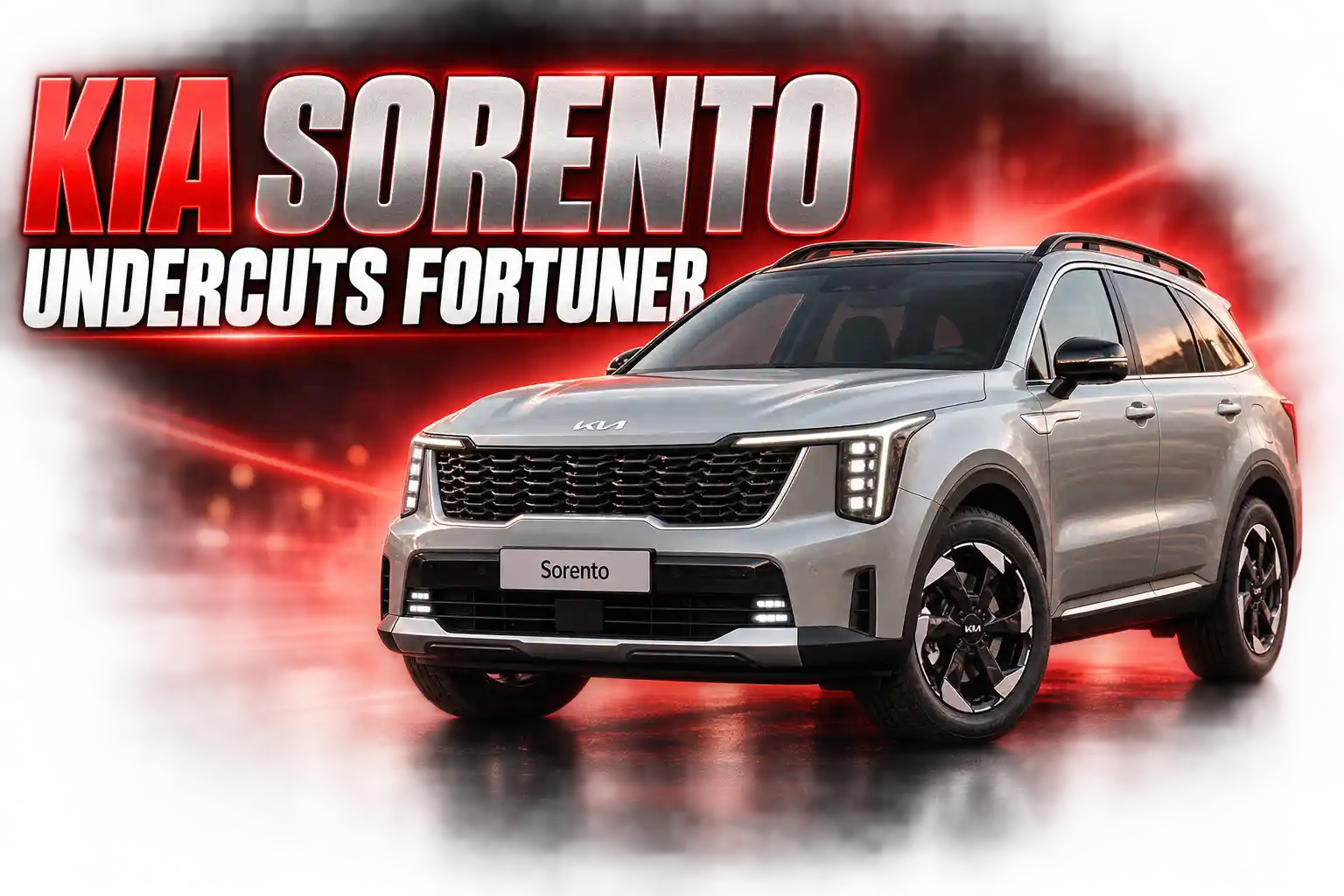
Kia’s India-built Sorento undercuts the Fortuner from ₹27.99 lakh, with 32 diesel and hybrid trims, while the third row and 179-litre boot cap the family brief.

Kia India has put the Sorento on sale from ₹27.99 lakh, a locally built three-row SUV that undercuts the Toyota Fortuner and offers a hybrid with all-wheel drive. Official prices start at ₹27,99,000 for the diesel HTE seven-seater and climb to ₹40.39 lakh for the hybrid HTX(A) Black Line six-seater with AWD. Deliveries and dealer dispatches have already begun from the Anantapur plant.
The wager is not a straight Fortuner clone. It is a 4,815 mm monocoque, packed with screens and a 32-strong trim maze, aimed at families who will pay Fortuner money without buying a ladder-frame Toyota.
Kia Priced a Gap Toyota Left Open
On 4 September 2026 Kia launched the facelifted fourth-generation Sorento as its flagship petrol and diesel SUV in India, sitting above the Seltos. Diesel seven-seaters open at ₹27.99 lakh and top out at ₹38.89 lakh. The strong hybrid, Kia’s first for this market, opens at ₹29.49 lakh and finishes at ₹40.39 lakh. That puts the whole range below a Fortuner that now lists from ₹34.76 lakh to ₹50.46 lakh, a gap of ₹6.77 lakh at the bottom of each ladder.
The India-spec car is 4,815 mm long, 1,900 mm wide and 1,785 mm tall with the bridge-type roof rails, on a 2,815 mm wheelbase. Toyota’s own Fortuner sheet still has the ladder-frame SUV 4,795 mm long on a 2,745 mm wheelbase, 1,855 mm wide and 1,835 mm tall, with an 80-litre tank. The Sorento is 20 mm longer, 45 mm wider and 70 mm longer in wheelbase, and 50 mm shorter, which is why it never quite reads as a Fortuner in a hotel porch.
Kia had already framed a strike at India’s Fortuner class when bookings opened at ₹25,000. The price list that followed is more precise than that slogan. It undercuts the Fortuner, undercuts the Skoda Kodiaq’s ₹36.99 lakh floor, and stays well below the Volkswagen Tayron. The Innova Hycross, at ₹18.70 lakh to ₹31.84 lakh, still owns the cheaper hybrid family slot, and it does so on a 2,850 mm wheelbase, 35 mm longer than the Sorento’s.
HOW THE SORENTO SITS ON PRICE
| SUV | Ex-showroom span | Seating on sale |
|---|---|---|
| Kia Sorento | ₹27.99 lakh to ₹40.39 lakh | 6 or 7 |
| Toyota Fortuner | ₹34.76 lakh to ₹50.46 lakh | 7 |
| Toyota Innova Hycross | ₹18.70 lakh to ₹31.84 lakh | 7 or 8 |
| Jeep Meridian | ₹23.33 lakh to ₹38.26 lakh | 5 or 7 |
| Skoda Kodiaq | ₹36.99 lakh to ₹46.99 lakh | 5 or 7 |
| Volkswagen Tayron | ₹41.99 lakh to ₹47.74 lakh | 5 or 7 |
Those floors are not equivalent three-row cars. Kodiaq Lounge and Tayron Life are five-seaters, so a family shopping all three rows has to step into Kodiaq Sportline or Tayron R-Line money. Sorento sells six- and seven-seat layouts across diesel and hybrid from the HTK trim up, which is the one layout trick none of those Europeans copy at this price.
Thirty-Two Trims Cover Diesel, Hybrid and AWD
Six broad grades do the work: HTE, HTE(O), HTK, HTK(A), HTX and HTX(A). Diesel or hybrid, six or seven seats, front- or all-wheel drive, then Convenience, ADAS and Black Line packs, and the matrix reaches 32 variants. HTE is seven seats only. Captain chairs arrive at HTK. AWD is locked to HTX and HTX(A). Black Line, a ₹20,000 blacked-out kit, sits on HTK(A), HTX and HTX(A). Eight paints are listed, including Dark Gun Metal for HTX and up, plus Glacier White Pearl, Gravity Grey, Imperial Blue, Magma Red, Pewter Olive, Ivory Silver Gloss and Aurora Black Pearl.
HOW THE 32-VARIANT MAZE IS BUILT
- Diesel 7-seat: Nine cars from the ₹27.99 lakh HTE to the ₹38.69 lakh HTX(A) Black Line AWD.
- Diesel 6-seat: Seven cars from the ₹32.69 lakh HTK, with no HTE six-seater.
- Hybrid 7-seat: Nine cars from the ₹29.49 lakh HTE to the ₹40.19 lakh HTX(A) Black Line AWD.
- Hybrid 6-seat: Seven cars from the ₹34.19 lakh HTK, peaking at ₹40.39 lakh.
That spread is the hedge. A diesel HTE at ₹27.99 lakh is a loaded family haulage tool with a 12.3-inch screen, dual-zone climate control and a 26-item safety pack with seven airbags. HTX adds AWD with Snow, Sand and Mud, ten airbags, dual 12.3-inch curved displays, a 12-speaker Bose system, a head-up display, digital IRVM, 220 V inverter, remote parking assist and Kia’s generative AI assistant. Buyers who only wanted a Fortuner-shaped diesel can leave at HTK money. Buyers who wanted every screen can stay to ₹40.39 lakh without crossing the Fortuner GR-S.
The car is made at Anantapur, Andhra Pradesh, where Kia has built vehicles since 2019 on a 400,000-unit line. Local production is what lets this much variant complexity sit under ₹41 lakh. A CBU flagship at this length would have landed in Kodiaq territory before the first option pack.
America’s Plug-In Pack Stayed in the US
India gets a self-charging 1.6-litre turbo petrol hybrid, not the plug-in sold in North America. The Smartstream 1.6 T-GDi is rated at 132.4 kW (180 hp) and 265 Nm, joined by a 47.7 kW (65 hp) motor with 264 Nm, through a six-speed torque-converter automatic. The traction battery in the India car is a 1.49 kWh pack. Electric drive appears at low speed and in gentle loads; there is no usable pure-electric range to quote.
The US plug-in uses the same 1.6 turbo layout with a 14 kWh battery and an EPA-rated 30 miles of electric range. That is the version that would have matched Indian city errands on electricity. Kia did not certify it here. What India does get, and almost nobody else in this class offers, is hybrid AWD, with the same Snow, Sand and Mud modes as the diesel. It is also the only strong hybrid on sale here that uses a turbo petrol rather than a naturally aspirated engine.
Claimed economy, posted after the launch, is 19.60 km/l for hybrid 2WD and 17.70 km/l for hybrid 4WD. Diesel is quoted at 17.66 km/l (2WD) and 15.79 km/l (4WD). The tank is 67 litres, against 80 litres in the Fortuner, so the diesel’s torque advantage still has to live with a smaller fill. A tank-to-tank hybrid loop covering city, highway and hills found city economy the pleasant surprise and the highway stretch the weaker one, which is the usual pattern for a small-battery strong hybrid once the motor stops filling gaps.
CLAIMED SORENTO ECONOMY
- Hybrid 2WD: 19.60 km/l, the headline figure Kia is using to sell the new powertrain.
- Hybrid 4WD: 17.70 km/l, still ahead of the diesel 2WD claim.
- Diesel 2WD: 17.66 km/l from the 2.2-litre, eight-speed wet DCT used in the Carnival.
- Diesel 4WD: 15.79 km/l, the thirsty end of the range and the one farm-road buyers will actually pick.
Atul Sood, senior vice president for sales and marketing at Kia India, has tied this hybrid to a wider mix rather than a single-fuel push. He wants diesel and strong hybrid on the same floor, because the D-SUV class is still small and the hybrid count in India is still tiny beside the EV shelves.
We are introducing Sorento with diesel and strong hybrid variants. We are giving options to the customers. From a strong hybrid perspective, we feel that we have good scope to grow in times to come.
Atul Sood, Senior Vice President, Sales and Marketing, Kia India
Sood counted about 26 mass-market EVs on sale against five strong hybrids, most of those Japanese. His 2030 sketch is battery EVs at about 15 percent of the passenger-vehicle market and strong hybrids at a similar share. The Sorento is the first Kia in India asked to prove that hybrid half of the mix at a price people already associate with Toyota diesels.
Third-Row Space Stops at Occasional Use
The cabin is the part of the bet that still looks unfinished. Soft-touch pads and stitching on the dash sit above plastics that feel a grade above Seltos and Syros, with a simple centre stack and a rotary shifter that has hard stops at each end. Dual 12.3-inch screens run wireless Android Auto and Apple CarPlay, built-in maps and Kia Connect 2.0. The 5-inch climate panel from Seltos is gone; a strip of mixed physical and capacitive controls under the screen flips between media and air-con. A 12-speaker Bose system is on the upper cars. Bass is polite rather than heavy. Ambient lighting runs to 64 colours.
Front chairs are the strongest seats in the car. The ten-way powered driver’s chair gets memory and an ergo-motion massage that is closer to fatigue relief than a spa programme, working on back and base. The eight-way passenger chair has a one-button relaxation recline. Rear riders in the six-seat layout get captain chairs with inboard armrests; the seven-seat bench gets a centre armrest. Second-row ventilation, sun shades, a 220 V three-pin socket, USB ports and a powered Boss mode for the seat behind the co-driver are the chauffeur-row kit buyers at this money expect. One-touch second-row fold-and-slide opens a decent hole to the third row, though raising those seats again is manual, and it only works if bases, headrests and the front seat-back sit in the right place.
Third-row adults are a pinch. Headroom and knee room shrink hard, winged headrests do not adjust on the second row, and the third row is the right answer for children or a short airport run. Kia’s India brochure puts luggage at 179 litres with the third row up and 813 litres with that row folded. There is no parcel shelf when the third row is down. Rear air vents sit in the floor, which is a poor place for them in Indian heat, and there are no cornering lamps and no full-screen maps in the instrument cluster. Door pockets are unlined. The panoramic sunroof is there anyway, on a subcontinent that did not ask for one.
The Hycross comparison is the one that stings. A 2,850 mm wheelbase MPV still offers a more honest third row than a 2,815 mm SUV that costs more once you leave the diesel HTE. Paying past ₹35 lakh for this car is a harder ask than the well-loaded base diesel, because that band is already held by the Fortuner, the Hycross and luxury badges. The Sorento’s natural step-up is a Seltos family that wants more length and a quieter cabin, not a Fortuner owner giving up height and a ladder frame.
The Udaipur Drive Exposed a Diesel Quirk
Media drives ran in Udaipur on both powertrains. Kia’s own account was still posting from that loop on 3 October 2026, shifting the pitch from cabin tech to time behind the wheel.
Another day of discovering the Kia Sorento and what it brings to the road.
As the Media Drive moves ahead, the focus shifts from getting to know the Sorento to experiencing it where it matters most. Behind the wheel.
The Kia Sorento
Global Icon. Reimagined for India. pic.twitter.com/M6grq5Ea6N— Kia India (@KiaInd) October 3, 2026
The hybrid is the quicker of the two in this size class, unless you bring in a Tayron R-Line or Kodiaq RS. The electric motor covers turbo lag, so the 1.6 builds speed in one smooth shove, and the four-cylinder stays quiet. The 2.2 diesel, the same 142 kW (193 hp) and 442 Nm unit used in the Carnival, has the torque for overtakes and a wet eight-speed DCT that shifts cleanly. It also hangs onto revs for about a second or a second and a half after you lift, a throttle-lag habit carried over from the people-mover. AWD on either engine is for a farm track and a wet ghat, not a dune programme. Prospective buyers of a 1,785 mm-tall monocoque were never going to take it where a Fortuner earns its badge.
Ride is the piece that justifies the money. A multi-link independent rear axle on 19-inch wheels (18-inch on HTE) soaks broken Indian tarmac without the bounce a body-on-frame seven-seater brings to the same ruts. There is body roll and some nose-dive, which a 4.8-metre family SUV should have. Brakes on the test loop were reassuring. Kia’s Level 2+ ADAS pack, up to 29 functions on HTX(A), behaved. High-voltage hybrid coverage is eight years or 160,000 km; the rest of the car is three years with unlimited kilometres, extendable to five.
In the metal the SUV reads larger than photographs suggest, which is useful in a market that still buys height as status. It still sits 50 mm under the Fortuner, and no amount of Tiger Face chrome changes that at a farmhouse gate.
The Upgrade Path Runs Through Seltos Owners
Jeep’s Meridian undercuts on price and offers seven seats, but it does not offer this hybrid. Kodiaq and Tayron offer the cabin finish some buyers still want from Europe, at a premium that now looks steep beside a ₹27.99 lakh diesel HTE with dual-zone climate control and a powered tailgate on the next trim. MG’s Majestor lives above ₹40 lakh. The Fortuner remains the car you buy if you need 1,835 mm of height, a 2.8-litre diesel with 500 Nm on the automatic, and a dealer network that has been servicing ladder frames for 17 years.
Sorento wins the kit war and the ride war. It loses the third-row war to Hycross and the image war to Fortuner. That split is why 32 trims exist. Diesel HTE is the volume tool. Hybrid AWD is the conversation piece. Six-seat HTK is the chauffeur spec. If those three do not move, the rest of the matrix is noise.
FROM PLANT TO PRICE LIST
- 20 August 2026: First India-built Sorento rolls off the Anantapur line, with pre-bookings already open.
- 4 September 2026: Kia publishes the introductory list from ₹27.99 lakh and starts dealer despatch.
- 1 October 2026: Claimed economy figures are posted, 19.60 km/l at the hybrid 2WD end.
- 3 October 2026: The Udaipur media drive is still on the brand’s official channel as testers cycle diesel AWD and hybrid AWD.
Kia India’s September wholesale tally hit 32,017 units, up 41 percent from 22,700 a year earlier, with Seltos and Sonet still doing the heavy lifting and Sorento described only as an encouraging response. That is the right tone for a car that has been on sale for a few weeks in a class Sood still puts at about 45,000 cars a year.
The D-SUV Class Is Still Only 45,000 Cars
Sood told interviewers he expects that D-SUV slice to grow from 45,000 units to 100,000 by 2030. Gwanggu Lee, managing director and chief executive of Kia India, set an internal monthly aim of up to 4,000 Sorentos and then cut the romance out of it himself. Even 3,000 a month, he said, is “very, very ambitious.” Four thousand a month would be 48,000 a year, which is more than the entire class Sood just sized. The entry price under ₹30 lakh is how they think they get there.
Warranty on the hybrid pack, local assembly, and a diesel that fleets already understand from the Carnival are the practical props under that number. The third row, the 179-litre hole behind it, and a 1.49 kWh battery that cannot match the US plug-in’s 30 electric miles are the props that still look thin. For a Seltos household that wants a quieter, longer car with a choice of diesel or hybrid AWD, the Sorento is already on the shortlist. For a Fortuner household, the extra 50 mm of height and the 80-litre tank have not moved.

TCS Opens Q2 as Mid-Cap IT Keeps the Growth

The Heat Turn a Bucks Rematch Into Vice City Night

The G7 Opens Diesel Tanks While Carriers Head East

Kia Bets Fortuner Money on a Made-in-India Sorento

Citi’s $240 MSTR Target Still Prices a Dilution Cut

Volkswagen Sells the Osnabruck Plant to Clear a Board Fight

Saksham Gaur Finds He Is His Own Company’s Client

Tata Motors’ Iveco Tender Opens as Holders Still Decide

Onimusha Way of the Sword Preload Hits a Windows 11 Wall

The Rs 4.66 Lakh Crore IPO Queue Is Mostly Paper
-
 AUTO4 weeks ago
Volkswagen Sells the Osnabruck Plant to Clear a Board Fight
-
 AUTO4 weeks ago
Tata Motors’ Iveco Tender Opens as Holders Still Decide
-
 BUSINESS4 weeks ago
Saksham Gaur Finds He Is His Own Company’s Client
-
 GAMING1 month ago
Onimusha Way of the Sword Preload Hits a Windows 11 Wall
-
 BUSINESS4 weeks ago
The Rs 4.66 Lakh Crore IPO Queue Is Mostly Paper
-

 NEWS1 month ago
Apple’s Foldable iPhone Hinges on Samsung Display Supply
-

 BUSINESS4 weeks ago
Hyderabad 22-Carat Gold Jumps After a False Bargain
-

 AUTO4 weeks ago
Simple Wave Chases Range as Ather Konarc Cuts Price