
 Ishan Crawford
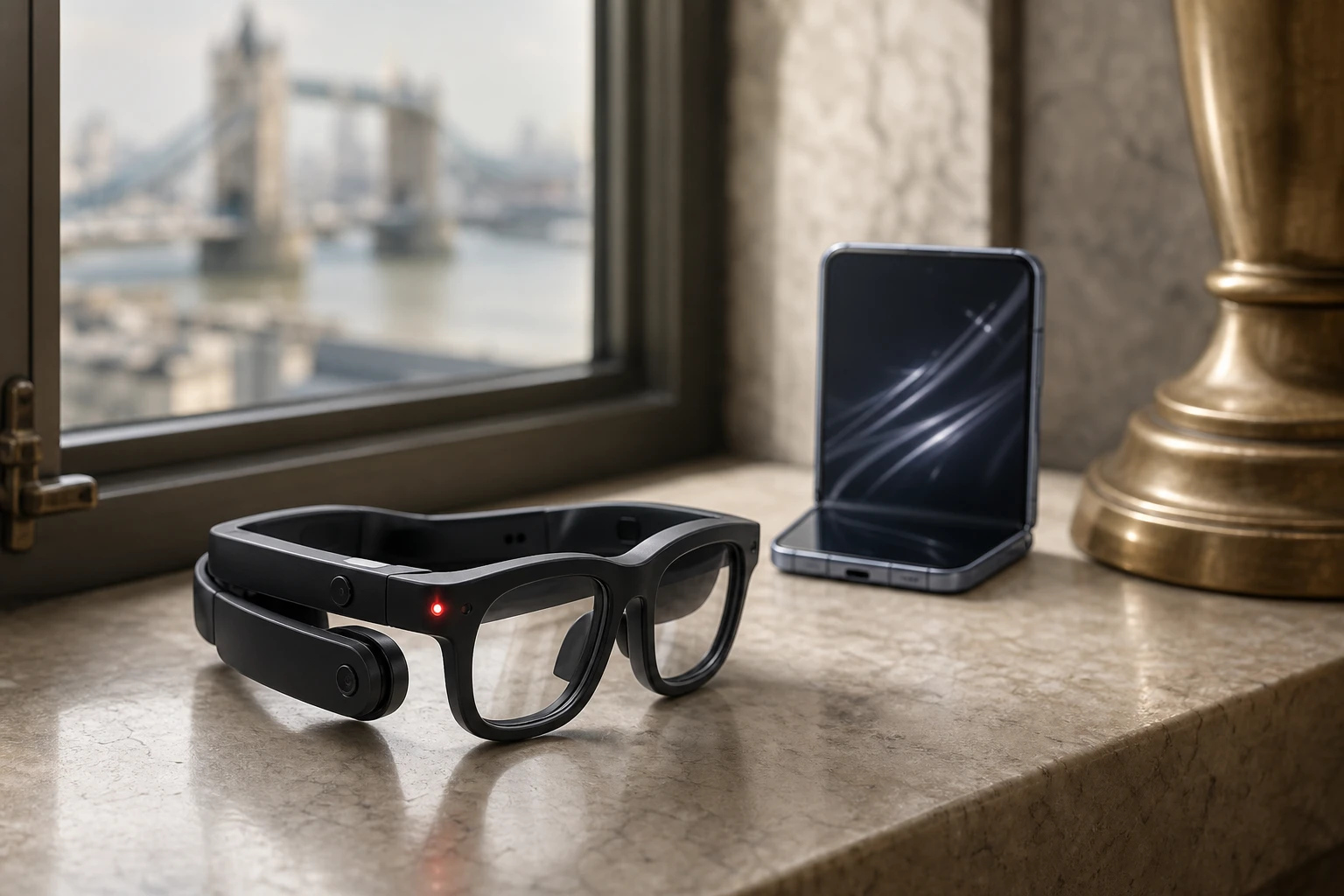
 Samsung Electronics will step onto a stage in London on July 22. It plans to unveil three foldable phones and its first true pair of smart glasses. The company confirmed this month that Galaxy Unpacked is leaving Korea and the United States for the first time in its history.
The glasses are the bigger swing. They walk straight into a market Meta already owns, and they inherit a data pipeline that currently has Meta fighting a federal lawsuit over what happens to video its own glasses record. Samsung and Google have not said whether their arrangement will work any differently.
Samsung Sets July 22 for Its Biggest Unpacked Yet
The event runs under the banner “A New Shape Unfolds” and streams live at 2 p.m. BST. Samsung is also expected to lay out how Galaxy AI will work across its phones, watches and the new glasses together.
The date and location are locked. Samsung confirmed Galaxy Unpacked would land in London on July 22, its second flagship event of the year after February’s Galaxy S26 launch. It is the first time the show has left Korea or the United States.
Three foldables are expected on stage: the Galaxy Z Fold 8, a wider Z Fold 8 Ultra, and the Galaxy Z Flip 8. Samsung will not confirm specifics until the stage lights come up. Leaked marketing materials, a store sighting and component filings have converged on the same picture for weeks. That makes this one of the most accurately telegraphed lineups Samsung has ever brought to a launch.
Two Folds, One Ultra Price Tag
Samsung is splitting its book style foldable into two distinct shapes this year. One is a wider, more square Z Fold 8. The other is a taller, narrower Z Fold 8 Ultra that keeps the silhouette Fold owners have carried since 2019.
Samsung has not confirmed pricing, but leaked marketing materials have produced consistent numbers across multiple reports for weeks. If the leaks hold, the Fold 8 Ultra becomes Samsung’s first foldable to start above $2,000. A fully loaded 1TB version could climb toward $2,899. Leakers blame the jump on the memory chip shortage squeezing the whole phone industry.
| Model | Starting Price (Leaked) | Main Display | Battery | Main Camera |
|---|---|---|---|---|
| Galaxy Z Fold 7 (2025) | $1,999 | 7.6 inch foldable | 4,400 mAh | 200MP, 12MP ultrawide, 10MP telephoto |
| Galaxy Z Fold 8 | $1,899 | 7.6 inch foldable | 4,800 mAh | 50MP, 50MP ultrawide, no telephoto |
| Galaxy Z Fold 8 Ultra | $2,099 | 8 inch foldable | 5,000 mAh | 200MP, 50MP ultrawide, 10MP telephoto |
The camera trade off is the clearest signal of how Samsung is positioning each phone. The standard Fold 8 gives up the telephoto lens for a lighter, wider body. The Ultra keeps the 3x zoom and adds a sharper ultrawide sensor. Samsung has already opened reservations on its own site, offering credit toward a future purchase. Full pre-orders do not start until after the reveal.
Galaxy Glasses Walk Into Meta’s Backyard
Samsung and Google have spent more than a year building Android XR, a shared software platform for AI wearables the two companies unveiled together at Google I/O. Fall 2026 is the target for the first consumer version. Google describes it as an audio only frame, with a camera, microphones and speakers built in but no display inside the lens.
Google frames the pitch around convenience. A wearer can get turn by turn directions, manage calls and translate speech in real time, just by talking to Gemini. A single voice command can also snap a photo and edit out background clutter.
- Navigation – turn by turn directions and nearby recommendations without opening a maps app
- Hands free messaging – calls, texts and summarized notifications through voice alone
- Live translation – spoken and written translation matched to the speaker’s own tone
- Instant capture – photos and video shot and edited by voice command
Samsung is building the hardware, in partnership with eyewear brands Warby Parker and Gentle Monster, while Google supplies Android XR and the Gemini assistant behind it. Shahram Izadi, Google’s vice president and general manager of Android XR, said the collaboration is “helping users stay connected and fashionable in a more natural, hands-free way.”
Whatever Samsung ships in London will land in a market Meta already dominates. Meta holds roughly 76 percent of the global smart glasses market after selling more than seven million Ray-Ban pairs in 2025 alone. Meta’s glasses have been on shelves at $299 for months. Estimates for Samsung’s version swing anywhere from under $400 to $900, since neither company has named a price.
The Kenya Pipeline Behind Meta’s Rival Product
Samsung’s timing lands close to a scandal still working through Meta’s own smart glasses business. In February, Swedish journalists at Svenska Dagbladet and Göteborgs Posten broke the story. They reported that a Nairobi based contractor called Sama employed workers to manually review video and images captured by Ray-Ban Meta glasses. That footage was used to help train Meta’s AI models.
We see everything, from living rooms to naked bodies.
A worker at the Nairobi facility described the material that way to Swedish reporters, in an account later carried by Fortune’s report on the investigation.
The fallout moved fast. Plaintiffs Gina Bartone and Mateo Canu filed a class action against Meta Platforms and eyewear parent EssilorLuxottica in California’s Northern District in March. They argue Meta’s marketing promise that its glasses were “designed for privacy, controlled by you” misled buyers. The suit says that promise obscured a human review pipeline routing footage overseas. The case, filed as Bartone et al. v. Meta Platforms Inc., remains active.
Meta ended its Sama contract within about two months of the report, a decision that affected roughly 1,100 workers overnight. The UK’s Information Commissioner’s Office called the findings concerning and opened its own inquiry. Kenya’s data protection regulator launched a parallel investigation of its own.
What Google Hasn’t Said About Its Own Glasses
Samsung and Google have not published a data policy specific to the new glasses. What exists instead is Google’s broader Gemini Apps Privacy Hub, updated on May 5, which explicitly lists Gemini on Android XR as a covered service.
What We Know
- 18 months – the default window Google stores Gemini activity in a user’s account before it is deleted
- 3 years – how long conversations flagged for human review are kept, separate from a user’s own deletion requests
- One opt out – manually disabling Gemini Apps Activity is the only way to stop future conversations from reaching a human reviewer
What’s Unconfirmed
- Whether a stricter, glasses specific policy will replace the general Gemini terms
- Battery life, charging method and prescription lens options for the first models
- An official price, beyond analyst guesses ranging from under $400 to $900
Neither company has said publicly whether footage from the new glasses could ever reach a human reviewer the way Meta’s did.
London Puts Samsung Two Months Ahead of Apple
Apple is expected to reveal its first foldable iPhone, tipped as the iPhone Ultra, at a September event, about two months after Samsung’s London show. Landing first, in Europe, lets Samsung own the conversation about wide foldables before Apple gets a say.
The rest of the lineup fills out Samsung’s push to sell a connected system rather than a single phone. A refreshed Galaxy Watch9 and Watch Ultra2 carrying new chips and higher prices are expected alongside the phones and glasses. Samsung has also been layering AI into devices already on the market. A software update called HomeUp recently added multi-finger gesture controls to existing Galaxy phones. It is the kind of incremental work Samsung tends to fold into whatever bigger message it delivers on stage.
Samsung will confirm all of it, prices included, when the lights come up in London on July 22.
Frequently Asked Questions
Will Samsung’s Galaxy Glasses Work With an iPhone?
Yes. Unlike Meta’s Ray-Ban glasses, which stay tied to Meta’s own apps, Samsung and Google built their glasses to pair with both Android phones and iPhones. That is a deliberate move to widen the buyer base beyond existing Galaxy owners.
Is the Galaxy Z Flip 8 the Last Flip Phone Samsung Will Make?
Possibly. Tom’s Guide has reported speculation that the Z Flip 8 could be Samsung’s final flip phone, pointing to soft sales next to the book style Fold line. Samsung has not confirmed or denied it. The phone is still expected to ship with seven years of software support, keeping it current through 2033.
What Happened to the Kenya Based Workers Who Reviewed Ray-Ban Footage?
Meta ended its contract with Sama, the Nairobi firm at the center of the scandal, affecting 1,108 contract workers who received six days notice. Sama has disputed Meta’s account of why the contract ended, telling reporters it was never informed of specific performance failures.
What Specs Have Leaked for Samsung’s Smart Glasses?
Leaks tied to a Samsung prototype codenamed Jinju describe a 12 megapixel camera sensor and a Qualcomm Snapdragon AR1 chip, the same silicon used in Meta’s Ray-Ban glasses. The same leaks point to a 155mAh battery and a frame weighing about 50 grams. Samsung and Google have not confirmed any of it.
What Is Android XR?
Android XR is the shared operating system Google built with Samsung and Qualcomm for headsets, glasses and other AI wearables. It runs on Google’s Gemini assistant, letting devices answer questions, translate speech and give directions without a phone in hand.
 ONGC licence frees Venezuela cash and operatorship talks
  Anthropic Hits $65 Billion Run Rate and Flips the AI Cash Test
  Supreme Court grounds the fare free-for-all with three-week clock
  Gold Nears $4400 as Soft Data Meets Oil Inflation Risk
  Nifty Slips as Zaggle Circuits and Dhoot Debuts Big
  Diesel Crack Tops $100 as Iran Rhetoric Lifts Crude