
 Ishan Crawford
 A Tyrannosaurus rex named Gus sold for $50.1 million at Sotheby’s in New York on July 14, the most expensive dinosaur skeleton ever auctioned. Seven bidders pushed the price past its $20 million to $30 million estimate in a ten minute bidding war, and the winning phone bidder still has not been named.
Gus joins a fossil market where hedge fund billionaires, fast food founders and national museums now compete for prehistoric bones. The market’s favorite origin story has a hole in it, though. Shen, the Tyrannosaurus long cited as the moment dinosaur skeletons became a billionaire obsession, never actually sold. Christie’s yanked it from a Hong Kong auction days before the hammer was due to fall in 2022, after a rival fossil company said most of its skeleton was cast from another T. rex entirely.
Ten Minutes, Seven Bidders, $50.1 Million
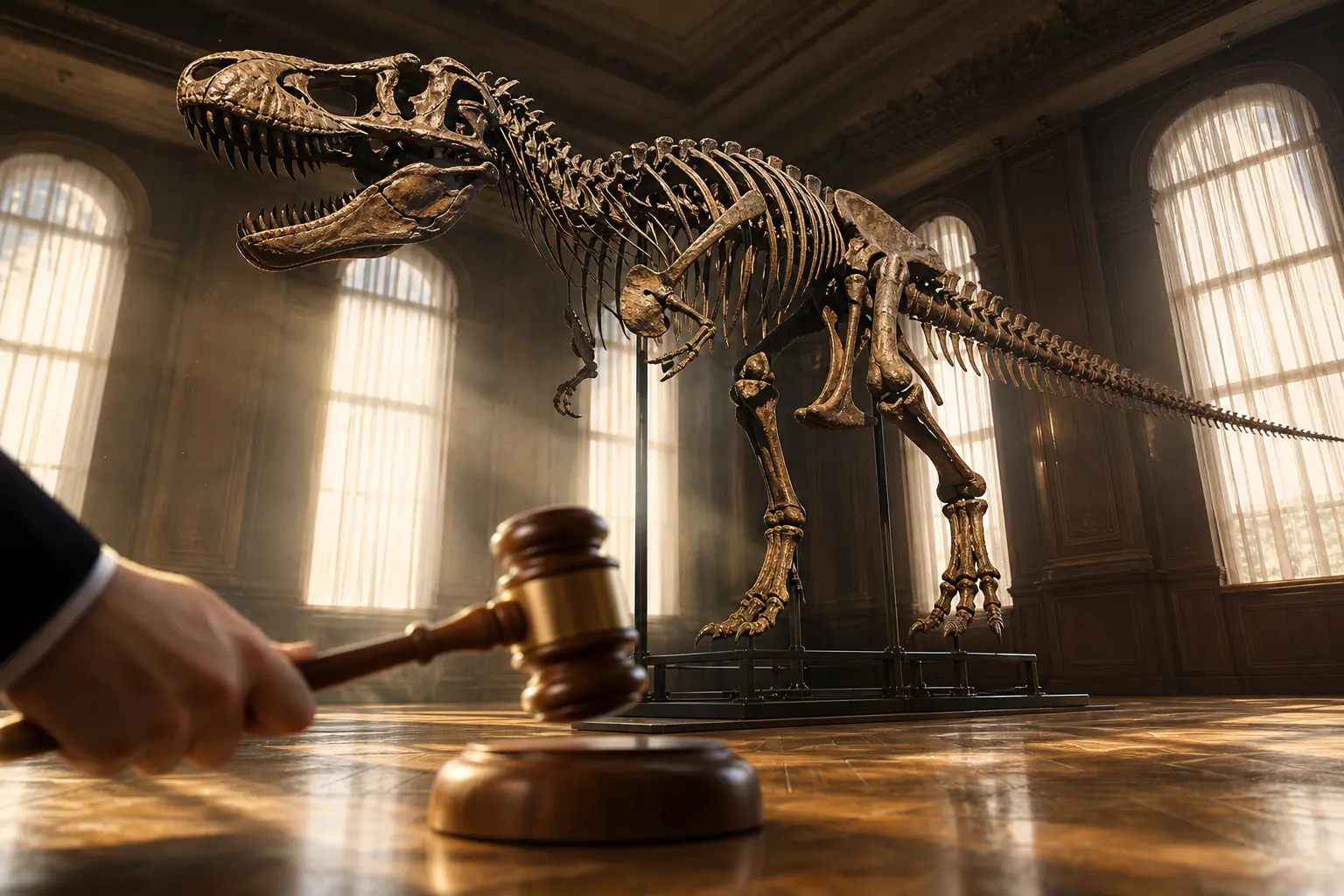
Gus was discovered in 2021 on a ranch in Harding County, South Dakota, owned by Gary “Gus” Licking, and was excavated over the following years. The dinosaur stands about 12.5 feet tall and approximately 38 feet long. Touted as one of the most complete dinosaur specimens ever found, Gus has 183 fossil bone elements and is about 61% complete by bone count.
The skull alone was too heavy to mount for display, so a lightweight replica stood in on the skeleton while the real head sat separately in the auction house’s lobby. “Gus is not only an exceptional find, but a specimen that’s been excavated, documented, prepared and cared for with real excellence,” said Cassandra Hatton, Sotheby’s vice chairman and worldwide head of science and natural history.
Licking did not live to see the sale completed, according to Sotheby’s. Proceeds will be split three ways, among the auction house, Theropoda Expeditions, which excavated the fossil, and the owners of the land where Gus was found.
No major museum entered the bidding. The Smithsonian and three other large natural history museums that NPR contacted said they did not bid on it.
The Billionaire Showcase That Fell Apart
Before Gus, the market’s marquee story was Shen. Christie’s was auctioning off Shen in November 2022, alongside works by Picasso, and it was expected to sell for $15 million to $25 million. It toured Singapore ahead of a planned Hong Kong sale billed as the first Tyrannosaurus auction in Asia.
Days before the hammer was due to fall, a dispute surfaced. “I’d say probably 95% or more is actually Stan,” said Peter Larson, president of the Black Hills Institute of Geological Research, a South Dakota fossil preparation company that still holds intellectual property rights to Stan, a T. rex Christie’s had sold in 2020 for $31.8 million. Christie’s catalog listed Shen at 79 original bones, against 190 for Stan.
Christie’s withdrew the lot, and the unidentified owner opted to loan the skeleton to a museum instead. Larson told the New York Times it had been “very misleading” to sell Shen using Stan’s likeness, and that Christie’s had done “the right thing” by pulling it.
| Fossil | Year | Result | Note |
|---|---|---|---|
| Sue (T. rex) | 1997 | $8.4 million | First dinosaur ever auctioned, bought by a Field Museum led group |
| Stan (T. rex) | 2020 | $31.8 million | Sold by Christie’s, later promised to an Abu Dhabi museum |
| Deinonychus antirrhopus | 2022 | $12.4 million | Sold by Christie’s, the raptor genus from Jurassic Park |
| Shen (T. rex) | 2022 | Withdrawn | Pulled days before sale over replica bone dispute |
| Apex (Stegosaurus) | 2024 | $44.6 million | Bought by Ken Griffin, loaned to a New York museum |
| Ceratosaurus (juvenile) | 2025 | $30.5 million | Sold for five times its high estimate |
| Gus (T. rex) | 2026 | $50.1 million | Buyer undisclosed, current record holder |
The Shen episode did not slow the market down. It kept climbing.
Why Do Dinosaur Skeletons Cost More Than a Picasso?
A dinosaur’s price rests on the same handful of factors that price a painting or a rare watch: provenance, authenticity, rarity and buyer demand, with authenticity the hardest of the four to pin down and, at auction, largely left to the buyer to verify. Unlike art, no regulator checks a fossil’s paperwork, and there is no licensing system standing between a landowner and a saleroom.
When Sotheby’s held the first dinosaur auction in 1997, selling Sue to a Field Museum led consortium for $8.4 million, barely around 20 tyrannosaurus rex fossils had come out of the ground since they were first discovered in 1905. Since then, paleontologists have nearly tripled the confirmed T. rex tally since 1905, yet prices have climbed even faster than the supply of new skeletons.
- Provenance – who found the fossil, where, and under what legal claim to the land it sat on.
- Authenticity – how much of the mounted skeleton is original bone versus cast or reconstructed material.
- Rarity – how many comparable specimens of that species and completeness level are already known.
- Demand – how many wealthy bidders, museums or foundations want that specific specimen at that moment.
Gus’s sale was legal for a simple reason. The fossil, dug up on Gary “Gus” Licking’s South Dakota ranch between 2021 and 2023, is legal to sell because in the US you own whatever you find on your own land. No license, permit or export review required.
Scientists Say Their Data Is Walking Out the Door
Paleontologists have grown blunt about what record prices mean for their field.
The auction houses like Sotheby’s and Christie’s are complicit in removing data from the scientific process.
Stuart Sumida, vice president of the Society of Vertebrate Paleontology (SVP, North America’s main professional body for the field), told NPR after the Gus sale. He added that such sales place valuable specimens into private hands and away from public view for years at a stretch.
Richard Butler, a paleontologist at the University of Birmingham, put it more plainly to the Guardian: “A fossil not in a recognised museum collection cannot be studied and is therefore lost to research.”
Top journals tend to agree with him. Sumida says this is because no reputable journal would accept a study based on a privately owned specimen as it may be unavailable for future review. To date, no scientific work has been formally conducted or published on Gus.
The SVP used to send letters of protest before major sales. The Society of Vertebrate Paleontology has written letters of protest to auction houses in the past, but Sumida says it no longer plans to.
Griffin’s Loan Shows the Best Case, and Its Limits
Some buyers take a different approach than the anonymous phone bidder who bought Gus. Ken Griffin, the hedge fund billionaire who leads Citadel, paid $44.6 million for Apex, the Stegosaurus, at Sotheby’s in July 2024. He then loaned it to Apex’s four year residency at the Gilder Center, where the skeleton greets roughly five million visitors a year.
Griffin’s gift also funded a three year postdoctoral fellowship studying Stegosaurus growth, working with museum paleontology director Roger Benson, and allowed scans of the bones to be shared with researchers worldwide. He had already given $16.5 million to Chicago’s Field Museum for a gallery built around “Sue” the Tyrannosaurus rex, “Maximo” the Titanosaur, and “Sobek” the Spinosaurus.
“Griffin brings a strong sense of civic responsibility, a deep love of and support for science, and an understanding of the power of museums, including ours, to inspire wonder and spur innovation,” said Sean M. Decatur, president of the American Museum of Natural History.
Even a generous loan does not solve paleontology’s underlying problem. The specimen remains private property. Smithsonian magazine quoted one paleontologist who asked what happens if an owner loses interest, dies or divorces, noting that specimens have disappeared from private hands before, even after being formally described in scientific journals.
- Cassandra Hatton (Sotheby’s) says big sales are “helping us find fossils that would otherwise be lost to everyone.”
- Scott Persons (South Carolina State Museum) argues a buyer could instead “endow a research program at a public museum of your choosing” for a similar sum.
- Stuart Sumida and Richard Butler say once a specimen leaves a museum’s hands, it is effectively lost to science no matter the owner’s intentions.
The Buyer Pool Keeps Getting Bigger
The circle of buyers has widened well past Wall Street. Last year at Sotheby’s a juvenile Ceratosaurus, smaller than a T. rex but just as carnivorous, sold for $30.5 million, five times its high estimate.
Abu Dhabi’s new natural history museum and German biotech investor Christian Angermayer are funding teams of bone hunters to scour the fossil rich western US. Todd Graves, the billionaire behind Raising Cane’s Chicken Fingers, emerged as a collector when he lent his triceratops skull to the Louisiana Art & Science Museum.
Sotheby’s own data backs up the shift. “The dinosaur market today is broader than most people realize,” Hatton told Artnet, adding that interest increasingly comes from foundations, overseas museums and individual collectors building attractions of their own, beyond the traditional pool of American institutions.
Frequently Asked Questions
What happened to Stan, the T. rex that once held the price record?
Stan sold for $31.8 million at Christie’s in 2020. Another auctioned giant dinosaur, known as Stan, disappeared for nearly two years, until a National Geographic reporter tracked it down. Christie’s has said fossils sold at auction are often made available to the public, citing the sale of Stan, which will go on display at the new Natural History Museum in Abu Dhabi when it opens.
Are Tyrannosaurus rex skeletons the only dinosaurs selling for millions?
No. In May of 2022, Christie’s sold the remains of a Deinonychus antirrhopus raptor, the kind made popular in the blockbuster movie Jurassic Park, for $12.4 million, well before Gus or Apex made headlines.
How many bones does a complete T. rex skeleton have?
A T. rex has around 300 to 380 bones in total, which is why completeness percentages, like Gus’s 61% by bone count, are such a central part of an auction estimate.
Do buyers get to rename the dinosaurs they purchase?
Yes. Christie’s made clear that the winning bidder would also get renaming rights, a tradition in which T. rexes in circulation are often given human names, which is why the market’s biggest sales carry names like Stan, Sue, Shen and Gus instead of catalog numbers.
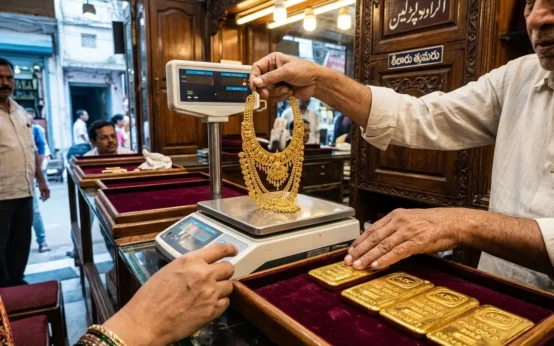 Hyderabad Gold Dip Freezes Buying as Duty Talk Hits Wedding Season
  India Pushes Japan CEPA Review After 15 Years of One-Way Gains
  HDFC Bank’s US Class Action Turns Deposit Scheme Into Securities Reckoning
  Gold Holds Above $4600 as Treasury Buybacks Fuel Debasement Bid
  Scotland’s Prevention Push Leaves Community Groups Squeezed
  Amazon Locks Three Million Nvidia GPUs Even as Trainium Grows