
 Ishan Crawford
 A meteorite crashed through a New Jersey bedroom ceiling in July 2024, and the homeowner’s first move was to pull on a pair of disposable gloves. Scientists reported July 15 in the journal Science Advances that this instinct, followed by aluminum foil and glass jars, helped preserve one of the most pristine meteorites ever recovered from a witnessed fall. Inside it: amino acids and a form of ancient asteroid brine chemistry nobody had documented before.
The rock’s two year detour from the asteroid belt to a New Jersey mattress made headlines on its own. Researchers now say that chemistry might have gone unreadable within days if the fragments had been left out in the rain.
A Hole in the Ceiling, a Chain of Custody
The homeowner was inside when the rock hit. It tore through the roof and the master bedroom ceiling, scattering black fragments, grit and a sharp smell across the room.
I was at home at the time, heard a loud crash and found a hole in the ceiling of the master bedroom. I smelled a strong, sulfur-like odor and saw many black fragments, along with debris and black dust that covered my bed, carpet and surrounding areas.
That is how the homeowner described the moment in a statement released by the SETI (Search for Extraterrestrial Intelligence) Institute. Nobody was hurt. The homeowners, who asked to remain anonymous, quickly pulled on disposable gloves and gathered the black fragments and dust from the bed and carpet using aluminum foil and glass jars.
They also reached out fast to Mike Hankey, an operations manager at the American Meteor Society and a co-author of the eventual study, who walked them through preserving the sample and keeping contamination to a minimum. The roof went back on before it rained, a detail that mattered because the meteorite is porous enough to soak up moisture from the air.
“We knew almost immediately that what happened to us was incredibly rare and we felt a responsibility to preserve the meteorite for the scientific community,” the homeowners said in emailed comments carried by CNN. “It’s still surreal to think that this meteorite traveled through space for millions of years before ending its journey in our home.”
Peter Jenniskens, a meteor astronomer with the SETI Institute and NASA’s Ames Research Center who led the study, said the payoff was immediate. Researchers now call Hillsborough the most pristine CM1/2 meteorites known, a subtype so rare that only one other witnessed fall has ever produced it. Denton Ebel, a curator at the American Museum of Natural History, where some fragments will be kept, said in the same statement that “we are thrilled that nature delivered such a precious asteroid sample on our doorstep.”
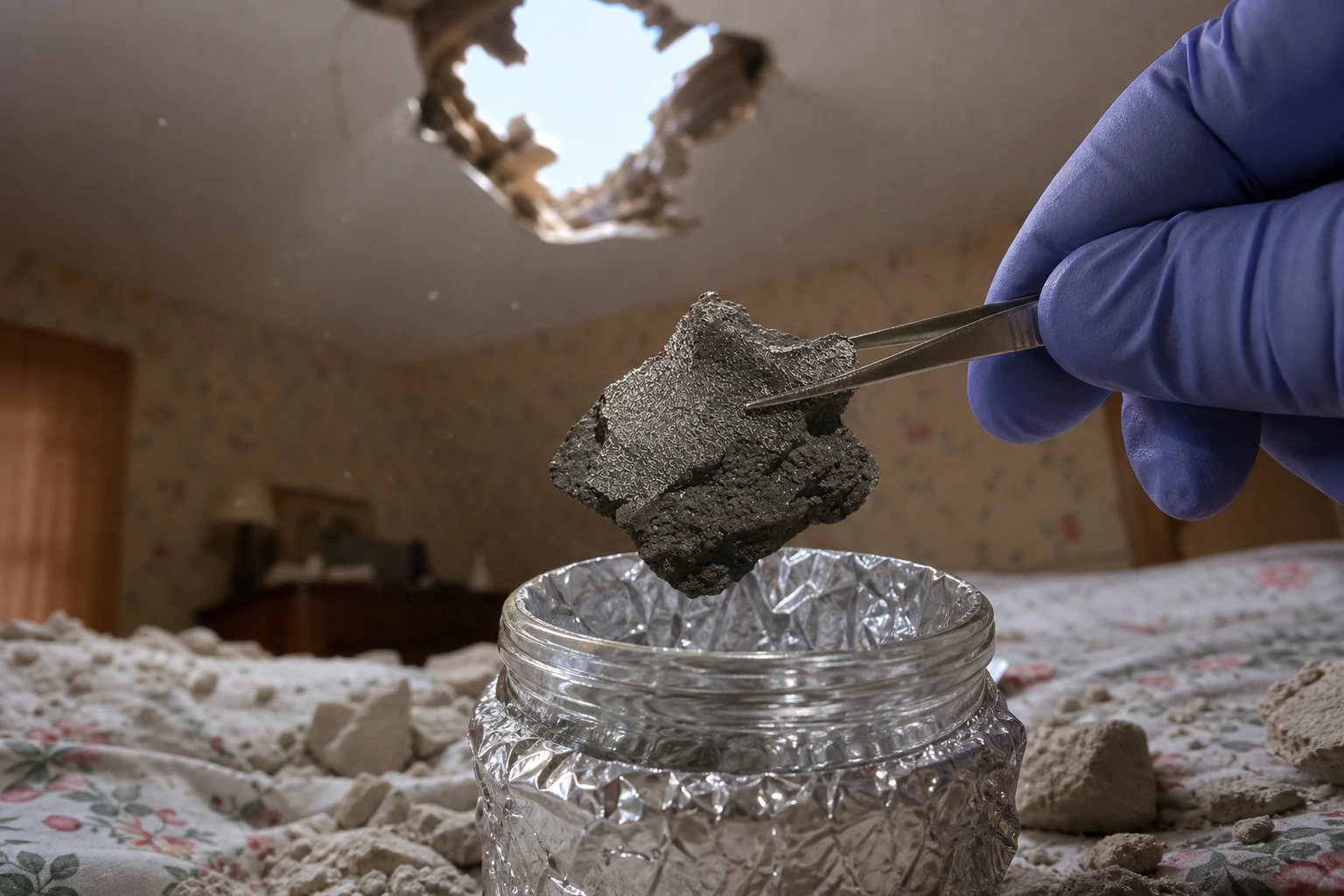
Why Is Collecting a Meteorite Quickly So Important?
Carbonaceous chondrites like Hillsborough start changing the moment they land. Salts and clays inside them react with humidity in the air, and rain can strip out water-soluble minerals within days. A fall recovered within hours and sealed away from moisture still carries a readable record of its parent asteroid. A fall left outside for even a few days usually does not.
Study co-author Danny Glavin, an astrobiologist at NASA’s Goddard Space Flight Center, said analyzing a sliver of the meteorite turned up unexpected chemical complexity. “One of the big surprises for me when we analyzed a small chip of the Hillsborough meteorite was the complexity of amino acids and other organic compounds,” Glavin said in a NASA statement. He added that his team “detected a complex suite of amino acids, the fundamental building blocks of proteins, in water extracts of the Hillsborough meteorite.”
Researchers classified Hillsborough as a CM, or Mighei-type, carbonaceous chondrite, a family named for a meteorite that fell in Ukraine in 1889. Within that family, CM2 stones show partial alteration by ancient water, while CM1 stones show more extensive alteration. Mike Zolensky, a meteoriticist at NASA’s Johnson Space Center and a study co-author, found that Hillsborough’s fragments had been altered more heavily than typical CM2 material, placing it in a rare intermediate category.
Only one other witnessed fall has ever produced that classification, a 2020 meteorite that landed in Kolang, North Sumatra. Jenniskens has noted that the Kolang fall was seen but never studied in anything close to pristine condition. Hillsborough, recovered within hours and sealed from the weather, became the first CM1/2 meteorite scientists could examine while still close to its original state.
- CM1 versus CM2 – the number describes how far ancient water reactions went inside a carbonaceous asteroid before it broke apart. CM2 stones show partial alteration; CM1 stones show more extensive alteration. Hillsborough sits at the boundary between the two, an intermediate class researchers label CM1/2.
Zolensky and colleague Jangmi Han, another study co-author, found small, salt-rich CM1 fragments embedded within the meteorite, evidence that this part of the rock formed near the surface of its parent body, where ancient water evaporated and concentrated salt behind. Cosmochemist Queenie Chan of Royal Holloway, University of London, measured the meteorite at 1.8 percent carbon and 0.07 percent nitrogen by weight, isotope ratios she said are typical of CM-type material that delivered organic matter to the early Earth.
Tracing a Fireball From Newark to the Asteroid Belt
Just after 11 a.m. on July 16, 2024, a fireball outshining Venus blazed across the sky over the New York metropolitan area. At least 60 observers across New York, New Jersey and other Northeastern states reported it, and at least 16 people said they felt its shock wave.
The object was moving at roughly 32,000 mph (51,500 km/h) and broke apart in midair. Ground observers lost sight of it at about 22 miles (35 kilometers) up. Newark Liberty International Airport’s Doppler weather radar then briefly picked up a long cloud of falling pebbles stretching from Staten Island into New Jersey, with Hillsborough at the far end, where the largest rocks came down.
Researchers rebuilt the fireball’s path using a mix of dedicated equipment and household technology, including:
- American Meteor Society cameras in Northford, Connecticut
- American Meteor Society cameras in Douglassville, Pennsylvania
- A doorbell camera in Wayne, New Jersey
“Our cameras in Northford, Connecticut, and Douglassville, Pennsylvania, as well as a doorbell camera in Wayne, New Jersey, captured the meteor, and from that we measured its trajectory,” Hankey said in the SETI Institute statement. “The path traced back to low in the asteroid belt.” Only one fragment from that entire falling cloud was ever recovered, because it happened to hit a house. Researchers believe rain likely dissolved any other pieces that landed in the open before anyone could find them.
Daytime fireballs bright enough to draw dozens of witnesses are uncommon. A meteor’s dazzling streak over Scotland’s night sky drew its own crowd of stargazers, a sign that a bright fireball stops people in their tracks wherever it appears.
Same Trick, Five Years Apart
Hillsborough is not the first time a fast, careful recovery has changed what scientists could learn from a meteorite. In February 2021, a fireball broke apart over Winchcombe, England, and searchers collected the meteorite’s main mass within about 12 hours, with more recovered inside a week and no rain in between.
That speed kept the Winchcombe stone close to its original state. A later analysis found water inside it with a hydrogen signature closely resembling water found on Earth, along with amino acids researchers called fundamental to the origin of life.
Volunteers and academics had formalized that kind of rapid response through the UK Fireball Alliance, a partnership created in 2018. The group won the Royal Astronomical Society’s Group Achievement award in 2022 for the Winchcombe recovery. Fast civilian response to a fireball has become something close to a repeatable method, not just a one-off stroke of luck.
| Meteorite | Fall Date and Location | Type | Recovery | Signature Finding |
|---|---|---|---|---|
| Hillsborough | July 16, 2024, New Jersey, U.S. | CM1/2 carbonaceous chondrite | Sealed in jars within hours by the homeowners | Concentrated ancient brine tied to a wide range of amino acids |
| Winchcombe | February 28, 2021, England, U.K. | CM2 carbonaceous chondrite | Main mass collected about 12 hours after the fireball | Water closely resembling Earth’s, plus amino acids |
| Kolang | 2020, North Sumatra, Indonesia | CM1/2 carbonaceous chondrite | Witnessed, but not recovered in comparably pristine condition | First confirmed CM1/2 material from a witnessed fall |
Response time links all three falls.
What the Salt Reveals About a Broken World
The Hillsborough team’s central finding is that briny, salt-saturated water once moved through cracks near the surface of the parent asteroid, evaporating and leaving concentrated minerals behind. Organic mass spectrometry specialist Phil Schmitt-Kopplin of the Technical University of Munich, a study co-author, said “a high fraction of compounds were the product of organic chemistry with minerals.”
That finding lines up with what sample-return missions found when they physically brought asteroid material home instead of waiting for it to fall. Samples of asteroid Bennu, returned by NASA’s OSIRIS-REx (Origins, Spectral Interpretation, Resource Identification and Security-Regolith Explorer) mission, contained needles of trona, a hydrated sodium carbonate never observed before in an asteroid or meteorite. Samples from asteroid Ryugu, brought home by Japan’s Hayabusa2 mission, showed similar signs of ancient briny fluid near the surface of its parent body.
Zolensky and Han now plan to compare Hillsborough’s salt minerals directly against those Ryugu and Bennu samples. Both asteroids are considered a related type of carbonaceous chondrite that formed earlier in solar system history than Hillsborough’s parent body did, so lining up the mineral records could help researchers sketch a timeline for when brine chemistry first appeared in the early solar system.
A Rock With a Long Paper Trail
Jenniskens traced Hillsborough’s history through several violent chapters. Long ago, a large collision formed an asteroid family in the inner asteroid belt. About 6 million years ago, a second, smaller collision destroyed one member of that family, and a fragment drifted into near-Earth orbit.
“That piece experienced heat/cold cycles from spinning in the sunlight and fragmented about 200,000 years ago,” Jenniskens wrote in the study, as quoted by CNN. “Then it still took that long to hit the small target of Earth.”
Researchers suspect the debris trail points to 163 Erigone, a 45-mile-wide asteroid in the inner belt. That same Erigone family includes Donaldjohanson, a small, oddly shaped asteroid that NASA’s Lucy spacecraft photographed up close in April 2025 on its way toward Jupiter’s Trojan asteroids.
- What we know: Just one fragment, weighing a little over two pounds, was ever recovered from the Hillsborough fall, and it is classified as a CM1/2 carbonaceous chondrite.
- What we know: Some fragments will be curated at the American Museum of Natural History, where researchers plan to compare Hillsborough’s salt minerals against samples from Ryugu and Bennu.
- What’s unconfirmed: Whether Hillsborough’s parent body really is 163 Erigone or another member of the same asteroid family; researchers describe the link as their best reconstruction rather than a confirmed match.
- What’s unconfirmed: Whether any other fragments from the same fall survived the rain that swept the region later that day.
The fragments set aside for the American Museum of Natural History give researchers a direct point of comparison to Ryugu and Bennu, two asteroid samples that took years of spaceflight and billions of dollars to bring home.
Frequently Asked Questions
What is a carbonaceous chondrite?
It is a primitive, carbon-rich meteorite that has never fully melted since the solar system formed, so it still holds original minerals, water-altered clays and organic compounds. The “C” stands for carbonaceous, and the “M” in CM chondrites refers to the Mighei meteorite, which fell in Ukraine in 1889 and gave the group its name.
How do scientists know a meteorite’s amino acids came from space and not contamination?
Researchers studying meteorites typically check the chirality, or handedness, of each amino acid. Life on Earth builds proteins almost entirely from left-handed amino acids, while extraterrestrial amino acids often show close to an even mix of left and right-handed forms. That even mix is a strong sign the molecules formed in the parent asteroid rather than leaching in from soil, skin or lab handling.
Why did scientists compare Hillsborough to asteroids Ryugu and Bennu?
Ryugu and Bennu are carbonaceous asteroids sampled directly by spacecraft, Japan’s Hayabusa2 and NASA’s OSIRIS-REx, and both showed evidence of ancient brine and salt minerals like the ones found in Hillsborough. Comparing the exact minerals could show whether the same salty chemistry appeared across separate, unrelated parts of the early solar system rather than just once.
What is the Erigone asteroid family?
It is a group of asteroids formed when a larger parent body shattered in a collision roughly 155 million years ago. Its largest member, 163 Erigone, measures about 45 miles across and orbits in the inner asteroid belt between Mars and Jupiter, the region researchers suspect produced the Hillsborough meteorite.
How many meteorites are recovered soon after they are seen falling?
Very few. Scientists have recovered tens of thousands of meteorites overall, but most were picked up long after they landed, once weathering had already altered their chemistry. That scarcity is why fast, careful recoveries like Hillsborough and Winchcombe carry outsized scientific value.
 ONGC licence frees Venezuela cash and operatorship talks
  Anthropic Hits $65 Billion Run Rate and Flips the AI Cash Test
  Supreme Court grounds the fare free-for-all with three-week clock
  Gold Nears $4400 as Soft Data Meets Oil Inflation Risk
  Nifty Slips as Zaggle Circuits and Dhoot Debuts Big
  Diesel Crack Tops $100 as Iran Rhetoric Lifts Crude