
 Ishan Crawford
 NASA has identified near-Earth object 1998 SH2, tracked since its discovery in 1998, as a rare dark comet quietly venting gas without the tail or coma that usually gives comets away. Astronomers at NASA’s Jet Propulsion Laboratory (JPL) caught it in the act during a close pass on August 28, 2025, when the object swept safely within 3 million kilometers of Earth, close enough for the world’s biggest telescopes to take a look.
The finding, published in the journal Nature Astronomy, settles one specific mystery. It also feeds a stranger idea gaining ground at JPL: a hidden population of comets may be sitting inside the asteroid catalog undetected, and two new telescopes are about to go looking for the rest of them.
A Radar No-Show Tips Off NASA’s Trackers
The puzzle started with a no-show. Researchers pointed NASA’s Deep Space Network planetary radar at 1998 SH2 during its 2025 approach, expecting to find it precisely where nearly three decades of tracking data said it should be.
It wasn’t there. Scientists had projected the object’s position using data from its earlier orbits and the gravitational pull of the Sun and planets. When the object missed that mark, they turned to optical astrometry, precisely measuring its location in the sky, to work out what was pulling it off course. Brazil’s Southern Observatory for Near-Earth Asteroids Research eventually reacquired it, well off the spot radar had predicted, one of the first clues something was wrong.
“After we measured the nongravitational perturbations affecting the motion of 1998 SH2 and recognized they weren’t compatible with the object being an asteroid, we suspected the object could be an active comet,” said Davide Farnocchia, a navigation engineer with NASA’s Center for Near-Earth Object Studies at JPL and the study’s lead author.
Part of the problem was neglect rather than error. The object’s orbit had been closely tracked from 1998 to 2016, then it slipped through two full solar orbits with no fresh telescope observations before DSN tried again in 2025.
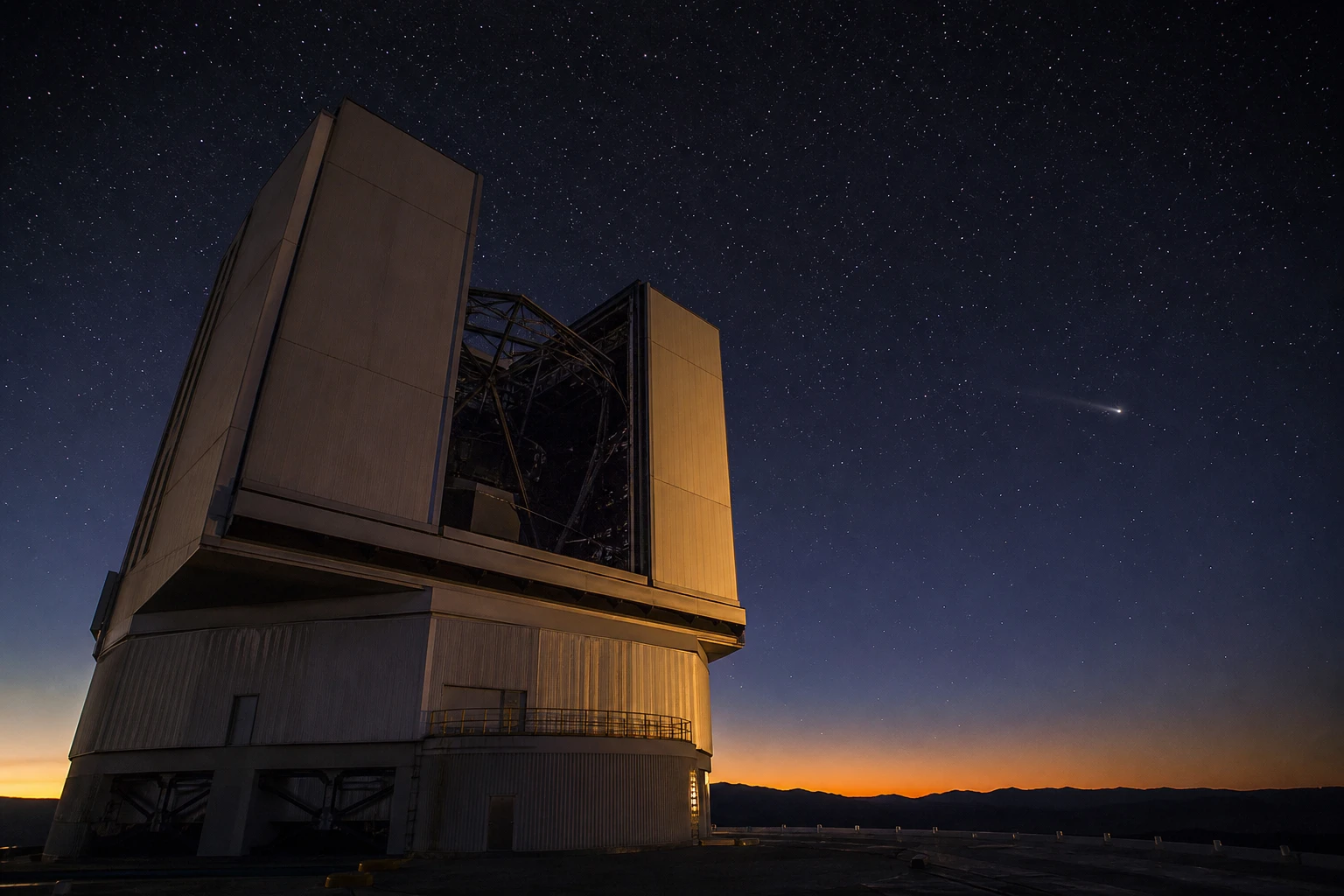
Three Telescopes Catch the Tail It Wasn’t Supposed to Have
The August close approach gave scientists a rare window to gather direct evidence instead of just orbital hints. JPL reached out to astronomers running three of the world’s most sensitive observatories, instruments built to image objects too faint for routine sky surveys to register.
- Canada-France-Hawaii Telescope – a 3.6-meter optical and infrared telescope near the summit of Mauna Kea, Hawaii
- European Southern Observatory’s Danish Telescope – a 1.5-meter instrument at La Silla, Chile
- Very Large Telescope – ESO’s 8.2-meter flagship on Cerro Paranal, Chile
All three came back with the same answer.
The images we collected from these observatories showed a weak but clear tail, thus confirming that 1998 SH2 is, in fact, a comet.
Olivier Hainaut, an astronomer with the European Southern Observatory and a coauthor of the study, said the observatories had settled the question. The object picked up a second, formal designation, P/1998 SH2, with the “P” marking it as a periodic comet.
A Short, Strange List of Space’s Secret Comets
Astronomers call objects like this dark comets, and the name has nothing to do with color. It describes a mismatch: the object’s path bends the way a comet’s does, nudged by escaping gas, but no coma or tail shows up in ordinary images.
The idea traces back to 2017, when the interstellar visitor 1I/’Oumuamua sped through the solar system pushed by a nongravitational force with no visible dust or gas to explain it. That anomaly sent astronomers back through near-Earth object catalogs looking for closer-to-home versions of the same puzzle. A 2023 study in The Planetary Science Journal, built on nongravitational acceleration data from six inactive asteroids, was the first formal attempt to define the pattern.
The first candidate had actually turned up a year earlier: 2006 RH120, an object briefly captured by Earth’s gravity as a temporary mini-moon, was flagged in 2016 for pushing itself off course in a way no plain asteroid should. About a dozen more candidates have joined the list since, splitting into two families, larger objects on wide, Jupiter-family-comet-like orbits, and smaller ones that stay closer to the Sun.
| Object | Population Type | Key Evidence | Status |
|---|---|---|---|
| 2006 RH120 | Small, near-Earth | Anomalous drift flagged in 2016, after a stint as a temporary mini-moon | First dark comet candidate identified |
| 1998 KY26 and five others | Small, near-Earth | Statistically significant nongravitational accelerations reported in 2023 | Candidates, no visible activity confirmed |
| 1998 SH2 | Large, Jupiter-family-like orbit | Faint tail imaged by three observatories in August 2025 | Confirmed comet, redesignated P/1998 SH2 |
1998 SH2 belongs to that larger, wide-orbit group, the one researchers think is most likely to give itself away if a big enough telescope happens to be watching at the right moment.
Why Does It Matter If an Asteroid Is Secretly a Comet?
Because gas jets push back. An outgassing object drifts off the path pure gravity would predict, complicating long-range forecasts of where a hazardous object will actually be. NASA scientists say catching that difference early makes near-Earth object tracking far more reliable, with real consequences for planetary defense and for models of the solar system’s own history.
“This work shows the importance of continuously tracking near-Earth objects,” Farnocchia said. “Because of outgassing, the motion of comets is more significantly perturbed than that of asteroids. Detecting these perturbations can be an important diagnostic tool for planetary defense that will help understand which objects may be comets rather than asteroids, how their orbits evolve, and how that influences their Earth impact risks.”
The stakes reach back billions of years, too. A study on the two dark comet populations suggested some of these objects could be carriers of volatile material to the early Earth, tying a modern tracking puzzle to the much older question of where the planet’s water came from.
Bigger Telescopes Are About to Flood This List
1998 SH2 got lucky. Astronomers had a close pass, clear skies, and three of the planet’s best telescopes lined up at once. Most dark comet candidates never get that opportunity, which is why NASA is building hardware specifically designed to remove luck from the equation.
During a preview run last summer, Rubin’s cameras picked out previously unknown asteroids faster than any ground survey in history, a small taste of what its decade-long sky survey is built to do. The observatory’s own projections point to a mountain of near-Earth objects still sitting undetected, exactly the kind of quiet backlog where more dark comets are likely hiding.
NASA is building a second, complementary tool aimed at the same blind spot. NEO Surveyor, an infrared telescope scheduled for launch no earlier than September 2027, will read heat instead of reflected sunlight, a method built to catch asteroids and comets too dark for ordinary cameras to register.
- 2,100-plus new asteroids, seven of them near-Earth objects, turned up in just seven nights during Rubin’s mid-2025 preview run
- 100,000 near-Earth objects remain undetected by Rubin’s own estimate
- Two-thirds of near-Earth objects over 140 meters wide are NEO Surveyor’s five-year target once it reaches its Sun-Earth outpost
For now, 1998 SH2 carries two designations at once, asteroid and comet, and NASA expects it will not be the last object that needs both.
Frequently Asked Questions
What’s the Difference Between a Comet and an Asteroid?
Comets are icy bodies that typically formed in the colder outer solar system, where ice stays frozen, while asteroids are rockier and hold little to no ice. Comets originally formed in the chillier outer solar system where ice is more stable, and as their orbits swing closer to the Sun, that ice rapidly turns to gas and drags dust along with it, building the coma and tail people recognize. Asteroids, lacking that ice, simply do not do this.
Does 1998 SH2 Pose Any Risk to Earth?
No. NASA says the object passed safely about 3 million kilometers away in August 2025, roughly eight times the distance between Earth and the Moon. Nothing in the new study changes that safety assessment; it only changes what astronomers call the object.
How Rare Are Confirmed Dark Comets?
Extremely rare, and even harder to confirm outright. Dark comets remain a tiny fraction of the near-Earth object catalog: the Minor Planet Center alone tracks the orbits of some 38,000 known near-Earth objects, director Matthew Payne told a congressional hearing in May 2025. 1998 SH2 is one of the few backed by an actual image of its tail, rather than orbital math alone.
Why Wasn’t 1998 SH2’s Comet Activity Obvious From the Start?
Because the outgassing was too weak to register on routine equipment. Ordinary comets throw off enough gas and dust to build a bright coma and tail visible to standard sky surveys. Objects like 1998 SH2 release so little material that the activity stays below the detection threshold of all but the largest instruments, which is why it took an 8.2-meter telescope like the VLT, trained on the object during its closest approach, to catch the faint tail at all.
What Is a Dark Asteroid, and How Is It Different From a Dark Comet?
The two terms describe different problems. A dark asteroid simply has low reflectivity and is hard to spot in visible light no matter how it moves. A dark comet, like 1998 SH2 until 2025, behaves gravitationally like an active comet but shows no visible coma or tail. NASA’s incoming NEO Surveyor is built to catch both categories at once, capable of detecting both bright and dark asteroids by reading infrared heat instead of reflected sunlight.
 Scotland’s Facial Recognition Push Sparks Mask Ban Call
  Galaxy Z Flip 8 Hits $799 Only If Your Trade-In Qualifies
  If England Had Kept Water Public Like Scotland
  Samsung Smart Switch Now Moves Passwords and eSIM From iPhone
  Old Firm Spend Pulls Clear as Premiership Rivals Patch Squads
  Chinese Studios Quietly Seize the Gamescom Stage