
 Ishan Crawford
 Toyota will price and unveil the ninth-generation Hilux in India on July 28, nine days from now, the first of five SUVs the Japanese carmaker has queued up for Indian roads through 2028. Toyota Kirloskar Motor, the company’s Indian arm, has confirmed the date, and dealers are already teasing the truck’s redesigned face ahead of showroom day.
Further down that pipeline sits a stranger story. For the Taisor Hybrid, Toyota is set to run on a hybrid system engineered by Maruti Suzuki, the same partner that has spent eight years absorbing Toyota’s hybrid know-how, not the other way round. That direction of traffic has not run this way before.
Five SUVs, One Timeline Running to 2028
Between the Hilux and 2028, Toyota’s India order book covers nearly every price bracket the country’s SUV buyers shop in, from an entry-level compact SUV under Rs 15 lakh to a Land Cruiser badge above Rs 35 lakh. Expected pricing below is quoted on-road for Mumbai, matching how Toyota’s own India dealers frame these vehicles today.
| Model | Expected Price (on-road, Mumbai) | Expected Timing |
|---|---|---|
| Toyota Hilux | Rs 30-40 lakh | July 28, 2026 |
| New-gen Fortuner | Rs 45-65 lakh | Early 2027 |
| Land Cruiser FJ | Rs 35-50 lakh | By 2028 |
| Hyryder facelift | Rs 13-25 lakh | Mid to late 2027 |
| Taisor Hybrid | Rs 11-15 lakh | Second half of 2027 |
Three of the five lean on Toyota’s own hybrid systems. Two, the Hyryder and the Taisor, lean instead on engineering that started life at Maruti Suzuki. That split did not exist five years ago.
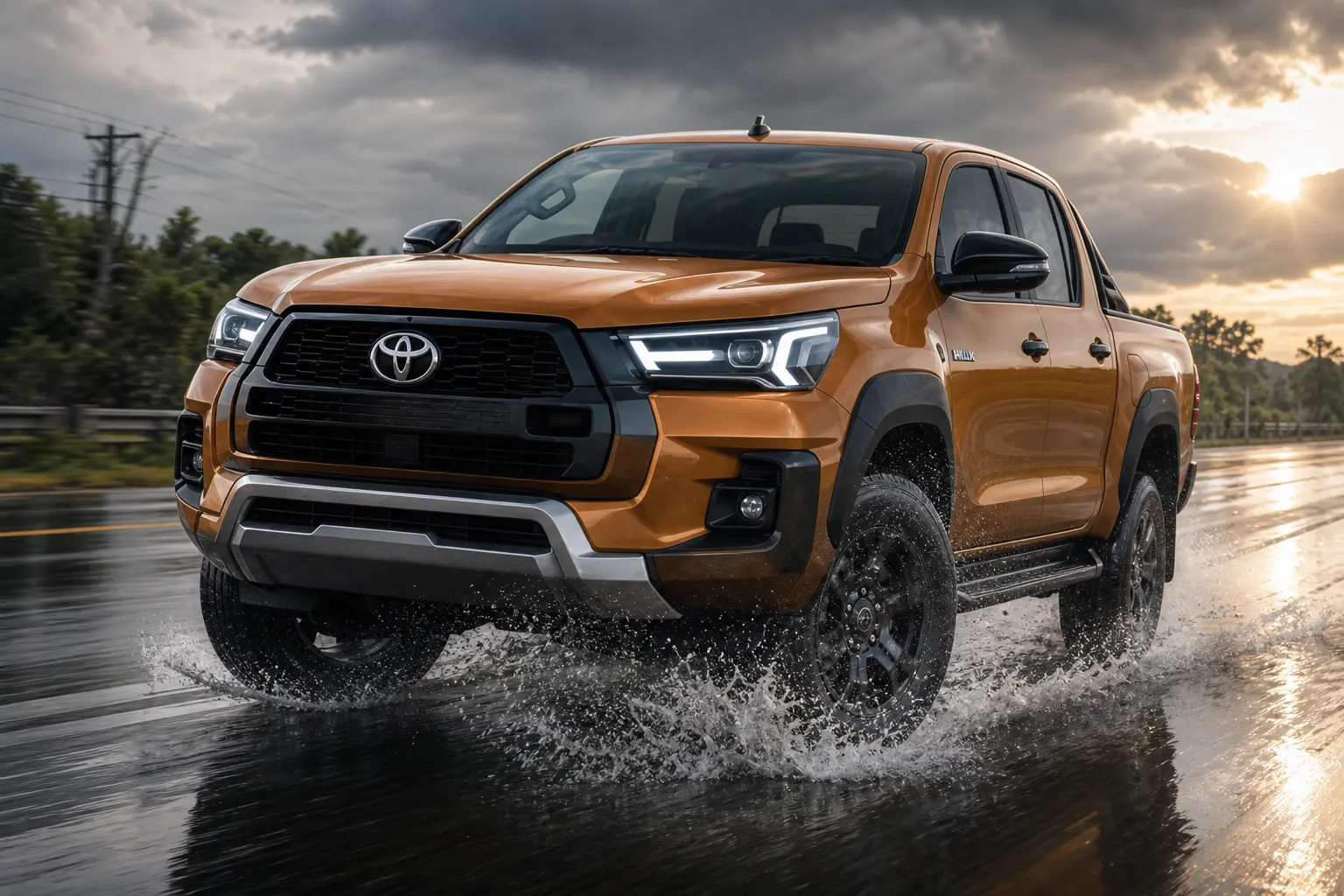
Nine Days Separate India From the New Hilux
The current Hilux sells in India for Rs 28.52 lakh to Rs 36 lakh, ex-showroom. The new generation is expected to land between Rs 30 lakh and Rs 38 lakh, ex-showroom, roughly $36,000 to $46,000 at current conversion.
Toyota is carrying over the 2.8-litre diesel engine, tuned to 204 PS and 500 Nm, paired with a 48V mild-hybrid system already sold on the Fortuner. Payload runs close to a tonne, with towing capacity around 3,500 kg. Four-wheel drive stays standard, with buyers choosing between a 6-speed manual and a 6-speed automatic.
Inside, the truck gets dual 12.3-inch displays, ventilated front seats and a 360-degree camera, on top of a bolder face already teased ahead of the July 28 reveal. The cabin redesign is said to borrow cues from the Land Cruiser Prado, a step up from the utilitarian dashboard the current truck has carried for years.
When Toyota Was the One Handing Down Technology
A 2017 Handshake Sealed With a Cash Stake
Toyota and Suzuki signed a memorandum of understanding for a business alliance in 2017, agreeing to pool Toyota’s electrification strength with Suzuki’s compact-car expertise. Two years later, the companies deepened that tie with equity. Toyota took a $908 million stake in Suzuki, while Suzuki put $454 million into Toyota.
The arrangement has already produced a run of rebadged siblings on Indian roads. Buyers can walk into a Toyota or a Maruti Suzuki showroom and effectively buy the same car under a different badge:
- Toyota Glanza – a rebadged Maruti Suzuki Baleno, sharing its 1.2-litre petrol and CNG options.
- Urban Cruiser Hyryder – engineered alongside the Maruti Suzuki Grand Vitara, splitting hybrid duty between the two firms.
- Toyota Invicto – a Toyota-engineered MPV sold by Maruti Suzuki as the Invicto, built off the Innova Hycross.
- Urban Cruiser Ebella – an electric SUV riding on the same Heartect-e platform as the Maruti Suzuki e Vitara.
For years, the flow of engineering inside that badge-sharing ran mostly one direction. Toyota supplied hybrid systems; Maruti Suzuki supplied small-car manufacturing scale and its far larger dealer count. Toyota’s own leadership was candid about wanting the reverse skill too, saying at the time that the goal was to learn small-car selling from a partner that already ran thousands of showrooms Toyota did not have.
The Taisor Flips the Direction of Traffic
That is what makes the Taisor Hybrid notable. Reports suggest the underlying Fronx, sold by Maruti Suzuki, will get a new series-hybrid system built around the 1.2-litre Z-series petrol engine already used in the Swift and Dzire. In a series hybrid, the petrol engine never drives the wheels directly. It only spins a generator to charge the battery, while an electric motor alone moves the car, a different layout from the parallel hybrids Toyota’s own Hyryder and Fortuner run today.
Toyota’s version, the Taisor, is expected to carry that same system into Indian showrooms in the second half of 2027, alongside carryover features like a 360-degree camera, a head-up display and a 9-inch infotainment screen. The Ebella’s shared electric platform points the same direction: increasingly, Toyota’s cheaper end of the lineup runs on Suzuki-originated engineering.
Why Is Toyota Moving This Fast in India?
Toyota Kirloskar Motor just closed its best year on record in India, crossing 4 lakh annual units for the first time and keeping that pace through the first half of 2026. A five-model pipeline is the natural next step for a business that is currently outgrowing its own history.
- 4,06,081 units – Toyota Kirloskar Motor’s total sales in FY26 (April 2025 to March 2026), its highest ever and up 20% year on year.
- 2,01,338 units – cumulative domestic and export sales from January to June 2026, up 15% over the same period in 2025.
- 300,000 units – cumulative strong-hybrid electric vehicle sales in India that Toyota crossed in May 2026.
Toyota’s own numbers back that up. The company’s official filings show 34,034 units sold in February alone, against 28,414 units a year earlier. Sabari Manohar, the company’s executive vice president for sales, service and used cars, has repeatedly credited the growth to what he calls sustained demand across Toyota’s SUV, MPV and compact portfolio.
That momentum sits oddly against Toyota’s position back in Tokyo. In June, Toyota lost a crown it had held for 22 years when SoftBank’s stock rally pushed the tech group’s market value past Toyota’s for the first time since 2003. Analysts pointed to a specific culprit for Toyota’s side of that swing.
Toyota, meanwhile, has been hit by rising oil prices stemming from the Iran war, which raises the cost of operating vehicles and weighs on global auto demand.
Tomo Kinoshita, a global market strategist at Invesco Asset Management Japan, offered that read on Toyota’s stock slide even as he noted the valuation gap with SoftBank could narrow again if crude prices ease. India, growing at double-digit rates and largely insulated from that specific pressure, is exactly where Toyota would want to be pushing hardest right now.
Fortuner and Land Cruiser FJ Chase the Big-Ticket Buyer
The Fortuner is due for its biggest update in years, expected early in 2027. Toyota is set to swap in a 12.3-inch infotainment screen, a matching 12.3-inch digital driver display and a new cabin layout, alongside Level 2 driver assistance and a panoramic sunroof. Styling should shift toward Toyota’s newer global look, with slimmer headlights and connected tail lamps.
The familiar 2.7-litre petrol and 2.8-litre diesel engines are expected to continue, with the 48V mild-hybrid diesel possibly trickling down to lower variants for the first time.
Below that sits the bigger leap: an entry-level Land Cruiser, badged FJ, expected in India by 2028. Globally, the FJ ships with a 2.7-litre petrol engine as standard and no diesel option, though Toyota could add the 2.8-litre diesel later if local demand pushes hard enough. Even at entry level, the FJ is expected to carry dual 12.3-inch displays, wireless Android Auto and Apple CarPlay, Level 2 assistance and standard four-wheel drive, letting a nameplate once reserved for Rs 1 crore-plus buyers reach an entirely different customer.
Hyryder and Taisor Take On Their Own Cousins
The Hyryder facelift, expected by mid to late 2027, brings a larger 10.1-inch infotainment screen, a fully digital driver display, an electric tailgate and Level 2 assistance, plus underbody CNG technology borrowed from Maruti Suzuki’s Victoris. The existing 1.5-litre naturally aspirated petrol and 1.5-litre hybrid petrol engines are expected to carry on unchanged.
This is the segment where the badge-sharing gets competitive rather than cooperative. Maruti Suzuki has been fighting to hold its own SUV share against Hyundai, Kia and Tata Motors, a battle that once dragged its passenger-vehicle share to an eight-year low. The same engineering bench that is now feeding Toyota’s Taisor Hybrid is also behind a leaked turbocharged engine for the Brezza facelift, a sign Maruti Suzuki’s own compact-SUV research and development has picked up pace well beyond what Toyota originally supplied it.
Toyota’s Taisor already sells in India today without the hybrid badge. The hybrid variant, expected in the second half of 2027, is meant to sharpen mileage without touching the feature list, which is expected to keep its 360-degree camera, head-up display and wireless smartphone mirroring from the standard car.
Toyota’s Own Habits Are the Real Risk to This Timeline
Nearly every date on this list carries a qualifier: expected, could, rumours suggest. Toyota has a long-standing reputation in India for taking its time between reveals and showroom day, and every one of these five vehicles is still officially unconfirmed beyond the Hilux.
Rivals are not waiting. Mahindra’s XUV700 and newer XUV 7XO continue to press Toyota and Maruti Suzuki on features and price in the same brackets the Hyryder and Fortuner occupy, and Hyundai’s Venue has already posted record monthly sales this year in the segment the Taisor is aiming at. A slip of even a few months on any of these four unconfirmed launches hands that window to a competitor that already has metal in showrooms.
For now, the only fixed date on Toyota’s five-SUV calendar is July 28.
Frequently Asked Questions
What is the cheapest Toyota SUV you can buy in India right now?
The Urban Cruiser Hyryder’s entry-level E variant is currently Toyota’s most affordable SUV in India, priced at around Rs 11.34 lakh ex-showroom, ahead of any of the five upcoming launches covered above.
Does the new Toyota Hilux come with a petrol or electric engine option?
India is expected to get only the 2.8-litre diesel engine. Globally, Toyota also builds a fully electric Hilux with a 59.2 kWh battery, dual motors and full-time all-wheel drive, though its towing capacity of around 1,600 kg is well below the diesel’s 3,500 kg, and there is no confirmation it is coming to India.
Which existing Toyota models sell the most in India today?
The Innova Hycross, Urban Cruiser Hyryder and Fortuner remain Toyota’s primary volume drivers in India, according to the company’s own sales commentary through 2026.
Is Toyota bringing a fully electric SUV to India beyond this lineup?
Yes. The Urban Cruiser Ebella, built on the same Heartect-e platform as the Maruti Suzuki e Vitara, is expected with 49 kWh and 61 kWh battery options, priced roughly between Rs 16 lakh and Rs 20 lakh, separate from the five SUVs detailed above.
What does SHEV mean in Toyota’s Indian sales reports?
SHEV stands for strong hybrid electric vehicle, Toyota’s term for its self-charging petrol-hybrid models like the Hyryder and Innova Hycross. Toyota Kirloskar Motor crossed 300,000 cumulative SHEV sales in India in May 2026.
 ONGC licence frees Venezuela cash and operatorship talks
  Anthropic Hits $65 Billion Run Rate and Flips the AI Cash Test
  Supreme Court grounds the fare free-for-all with three-week clock
  Gold Nears $4400 as Soft Data Meets Oil Inflation Risk
  Nifty Slips as Zaggle Circuits and Dhoot Debuts Big
  Diesel Crack Tops $100 as Iran Rhetoric Lifts Crude