
 Ishan Crawford
 Maruti Suzuki will reveal prices for the facelifted Brezza on July 24, and the leaked spec sheet shows something the compact SUV has never had before: a turbo engine. Documents circulating ahead of launch point to a new 1.0-litre Boosterjet turbo-petrol unit sitting alongside the existing 1.5-litre engine, plus a longer features list borrowed from Maruti’s newer Victoris SUV.
Brezza sales have slid from four straight years atop India’s SUV charts to fifth place in the last fiscal year. This facelift lands as rivals tighten their grip and a tougher emissions regime looms in 2027.
The Turbo Engine the Brezza Never Had
Two Engines, One New
The outgoing Brezza runs a single 1.5-litre naturally aspirated petrol engine, good for roughly 103bhp and 137Nm, sold with a five-speed manual or a six-speed torque-converter automatic. Leaked documents and dealership bookings both point to that engine carrying over largely unchanged, alongside a CNG version.
Joining it is a 1.0-litre, three-cylinder Boosterjet turbo-petrol, the same 998cc unit already sold in the Fronx. Leaked configuration sheets described the new engine’s output as 109bhp and 170Nm. That figure runs hotter than what the same turbo triple makes in the Fronx today, which independent trade outlets have measured at closer to 100bhp and 148Nm, a gap nobody has explained yet. What every report agrees on is the gearbox: the turbo will launch paired only with a manual, a six-speed unit spotted on test mules, while buyers who want a self-shifting Brezza will still have to pick the older 1.5-litre engine.
| Engine | Displacement | Power | Torque | Transmission |
|---|---|---|---|---|
| 1.5-litre petrol (carryover) | 1,462cc | ~103bhp | ~137Nm | 5-speed MT or 6-speed AT |
| 1.0-litre Boosterjet turbo-petrol (new) | 998cc | ~100 to 109bhp* | ~148 to 170Nm* | 6-speed MT only at launch |
*Figures vary between leaked documents and the engine’s known output in the Fronx; Maruti has not published official numbers.
Cabin Gets the Victoris Treatment
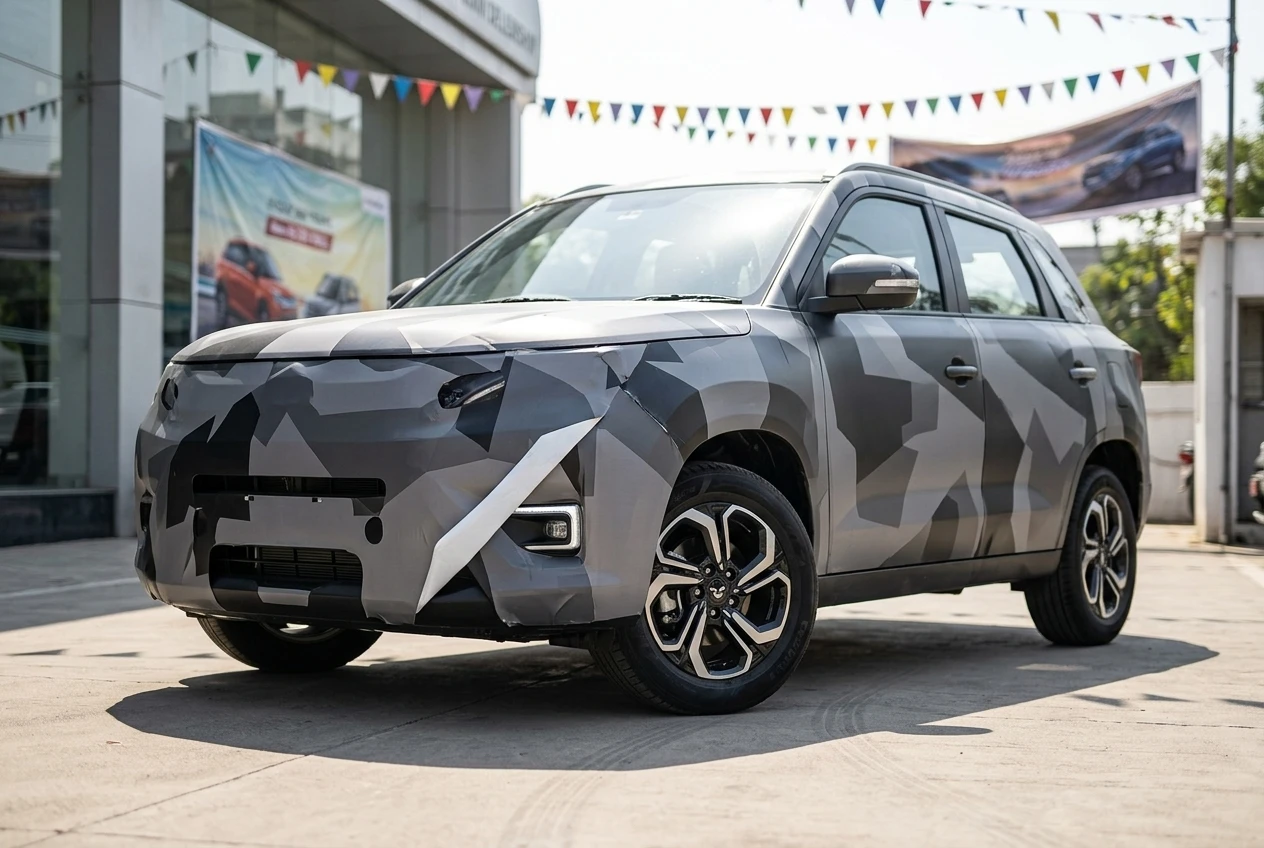
Outside, the facelift adds LED fog lamps, a redesigned alloy wheel and an underbody-mounted CNG tank in place of the current boot-mounted cylinder, which should free up usable luggage space. Inside, the bigger jump is a 10.1-inch infotainment touchscreen, ventilated front seats and 64-colour ambient lighting, all lifted from the Victoris, Maruti’s newer midsize SUV. Those features are expected to sit mostly on the top trims rather than across the whole range.
A Tax Bracket Now, a Deadline by 2027
There is a practical reason Maruti chose a sub-1.0-litre turbo rather than simply tuning the existing 1.5. A smaller-capacity, sub-4-metre petrol engine keeps the Brezza inside India’s lower 18 percent GST slab reserved for compact cars under 1,200cc, instead of the higher rate that applies once an engine crosses that line. That is the near-term math. The longer-term one is bigger.
From April 2027, India’s next fuel-efficiency rulebook, CAFE-III (Corporate Average Fuel Efficiency, phase three), starts forcing automakers to cut their fleet-average fuel consumption year over year through 2032. Regulators have proposed a relaxation for small petrol cars under 1,200cc, and Maruti Suzuki has been one of its loudest backers, along with Toyota, arguing that uniform targets would price out entry-level buyers. Tata Motors, Hyundai and Mahindra have pushed back, saying efficiency rules should apply the same way to everyone. Small-car buyers who already face that tighter compliance math are the subject of India’s CAFE-III emission rules squeezing small-car pricing, a fight that is still being drafted in Delhi even as Maruti ships product built around its outcome.
Compliance will raise costs, especially for price-sensitive segments.
Abhik Mukherjee, an automotive analyst at Counterpoint Research, a market research firm, made that point after regulators published their draft norms tightening fleet fuel-consumption targets, speaking to ACKO Drive, an automotive research and buying platform. Small-car specialists, he noted, run on thinner margins than premium brands and have less room to absorb the cost of new powertrain tech.
From Segment King to Fifth Place
The Brezza was India’s number one SUV for four straight fiscal years, from FY2017 through FY2020. It has not held that spot since. In the fiscal year that just ended, it finished fifth among the country’s top-selling utility vehicles, its sales down 5 percent year over year even as the overall SUV market hit a record.
| Rank | Model | FY2026 Sales | Year-on-Year Change |
|---|---|---|---|
| 1 | Tata Nexon | 216,054 units | +32% |
| 2 | Hyundai Creta | 201,921 units | +4% |
| 3 | Tata Punch | 183,980 units | -6% |
| 4 | Maruti Brezza | 180,104 units | -5% |
| 5 | Mahindra Scorpio (N and Classic) | 178,800 units | +8% |
Tata Nexon reclaimed the top spot after climbing from sixth place the year before, helped by GST rate cuts that landed mid-fiscal and by a lineup that already covers petrol, diesel, CNG and electric power. The Brezza, priced roughly between Rs 8.26 lakh and Rs 12.86 lakh (about $9,500 to $14,700), has never offered a diesel or an electric variant.
The Rival List Keeps Growing
Even before this facelift arrives, the sub-4-metre SUV segment it competes in is arguably India’s most contested car category. The line-up a shopper cross-shops against the new Brezza includes:
- Tata Nexon, the segment’s current sales leader and the only model offering petrol, diesel, CNG and EV power in one body.
- Maruti Fronx, Maruti’s own Nexa-channel crossover that already outsells the Brezza some months and shares its new turbo engine.
- Toyota Taisor, a rebadged Fronx sold through Toyota’s network.
- Mahindra XUV 3XO, built on Mahindra’s global platform with a strong diesel option.
- Kia Sonet and Kia Syros, the latter a newer model whose EV bookings are open ahead of its own price reveal.
- Hyundai Venue, one of the segment’s fastest-growing nameplates through 2026.
- Upcoming entries from Renault and its Nissan alliance partner, plus a Honda sub-compact SUV expected in 2027.
Across just the compact SUV bracket, 21 separate nameplates compete for the same buyers, with more than 1,000 variants between them. None of the individual feature additions on the new Brezza, the fog lamps, the ambient lighting, the bigger screen, are unusual for the segment anymore. They are closer to entry stakes than upgrades.
What Hasn’t Maruti Confirmed Yet?
Maruti Suzuki has confirmed a July 24 reveal and opened bookings for a refundable Rs 11,000 token, but has not confirmed a single spec, feature or price. Everything else below comes from leaked documents, spy shots and dealer chatter picked up by the trade press.
- What we know: a new 1.0-litre turbo-petrol engine is coming, the 1.5-litre and CNG options continue, the CNG tank moves underbody, and the cabin gains a 10.1-inch screen, ventilated seats and ambient lighting.
- What’s unconfirmed: the turbo engine’s exact power figures, whether a Level 2 ADAS (advanced driver assistance systems) suite will be offered given Nexon already has one on its top trim, and final pricing across the range.
Just last month, the current Brezza sold 13,425 units, a decline of nearly 14 percent from a year earlier, according to a 13.75% sales drop from a year earlier tracked in monthly segment data. Whatever Maruti announces on July 24 has to answer that slide, not just add a spec sheet.
Frequently Asked Questions
How can I book the new Maruti Brezza facelift?
Bookings are open now for a token of Rs 11,000, paid online or at any Maruti Suzuki Arena dealership, the same network that sells the Swift, Dzire and Alto. The token is refundable and does not fix a final price.
Will the turbo-petrol Brezza come with an automatic gearbox?
Not at launch. Every leaked report agrees the new 1.0-litre turbo pairs only with a six-speed manual to start, while the carryover 1.5-litre engine keeps its five-speed manual and six-speed torque-converter automatic options for buyers who want to skip the clutch.
Does the 2026 Brezza facelift get ADAS?
It hasn’t been confirmed either way. Tata added a Level 2 ADAS suite to the top-spec Nexon during the last fiscal year, and whether Maruti matches that on the Brezza remains one of the biggest open questions ahead of the July 24 reveal.
How much extra boot space does the underbody CNG tank free up?
No outlet has published an exact figure yet. The principle is straightforward: today’s boot-mounted CNG cylinder eats into the load floor, while an underbody tank sits beneath the car, so the full boot should become usable again, similar to the setup already offered on the Victoris.
How much tighter are India’s CAFE-III fuel rules compared to today?
Under the draft rules, automakers must cut fleet-average fuel consumption from 3.73 litres per 100km when the rules start in 2027 to 3.01 litres per 100km by 2032, roughly a 19 percent cut over five years. That is the regulatory backdrop pushing manufacturers, Maruti included, toward smaller, more efficient engines like the one leaking out of the Brezza facelift now.
 ONGC licence frees Venezuela cash and operatorship talks
  Anthropic Hits $65 Billion Run Rate and Flips the AI Cash Test
  Supreme Court grounds the fare free-for-all with three-week clock
  Gold Nears $4400 as Soft Data Meets Oil Inflation Risk
  Nifty Slips as Zaggle Circuits and Dhoot Debuts Big
  Diesel Crack Tops $100 as Iran Rhetoric Lifts Crude