
 Ishan Crawford
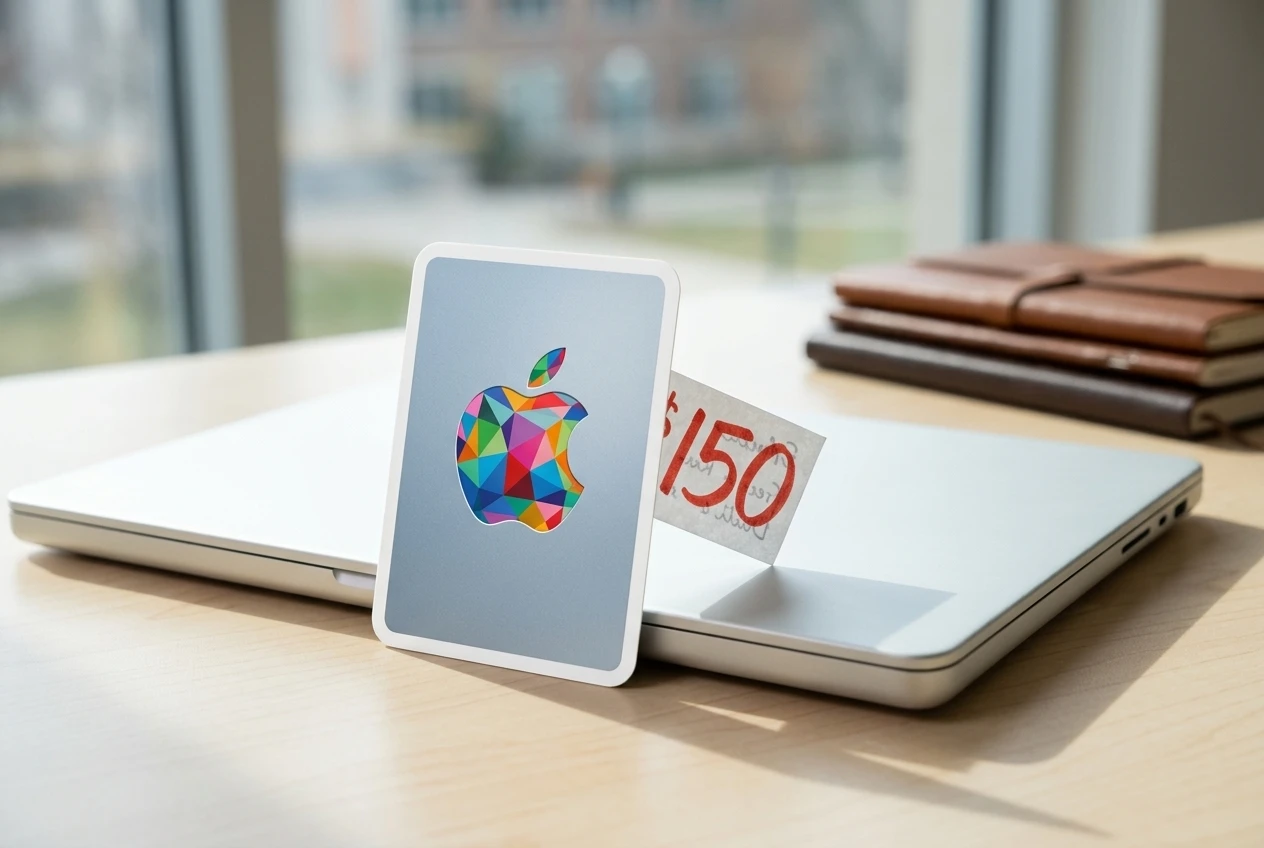
 Apple switched on its 2026 Back to School promotion this week, offering a gift card worth up to $150 to students who buy a new Mac or iPad. The catch: those same machines got $150 to $300 more expensive just three weeks earlier.
Run the numbers on any of the four eligible devices and the card never fully erases what Apple added to the sticker price in June. On a MacBook Pro, the math actually runs backward: buyers still land $150 higher than they would have paid before the increase, gift card and all.
Four Devices Make the Cut, and the MacBook Neo Doesn’t
The offer covers exactly four products. A MacBook Pro purchase earns a $150 gift card. A MacBook Air, iPad Pro, or iPad Air earns $100. Apple’s own education storefront states the terms plainly, advertising gift cards ranging from $100 to $150 for verified buyers who shop through education pricing.
Everything else misses out. The MacBook Neo, Apple’s entry level laptop launched in March, doesn’t qualify. Neither do the iMac, Mac mini, Mac Studio, iPad mini, the base iPad, iPhone, Apple Watch, or accessories. The gift card can still be spent broadly once earned, on Apple hardware, App Store purchases, or subscriptions like Apple Music and iCloud+, but the list of products that actually trigger it is short.
The promotion runs through August 27 in the United States, Canada, and Mexico. It reached several Asian markets, including Malaysia, the Philippines, Thailand, Taiwan, China, India, Singapore, and Vietnam, in the days before the US rollout.
A Gift Card Lands Three Weeks After a Price Shock
The timing traces back to June 25, when Apple raised prices across nearly its entire hardware lineup. The MacBook Air jumped $200 to $1,299. The MacBook Pro jumped $300 to $1,999. The iPad Air rose $150 to $749, and the iPad Pro rose $200 to $1,199. Even the Mac Studio’s priciest configuration climbed, by a $1,300 jump on its priciest Mac Studio configuration alone.
Apple’s online store briefly went offline that morning before the new prices appeared. The reaction on Wall Street was immediate. Apple’s shares closed more than 6% lower that Thursday, its worst single day in more than a year.
Apple framed the increase as forced by a global memory chip shortage, driven by AI data centers competing for the same DRAM and NAND flash supply that goes into every laptop and tablet. Tim Cook, Apple’s chief executive, had warned the previous week that the shift was unavoidable.
We’re doing our best to mitigate the huge increases that are being passed to us, and we’ve been trying to shield our customers from the increases, but the situation has become unsustainable.
Cook said that to the Wall Street Journal days before the increase took effect. Apple’s own statement afterward struck a similar note, saying the company had never seen a component price increase move this fast. The pattern isn’t isolated to Apple, either. The same cost pressure is a factor in its foldable iPhone lifting category prices across the wider smartphone market, according to separate reporting on Apple’s upcoming device plans.
Does the Gift Card Cover Apple’s Price Hike?
No, not for the device most students actually want. A MacBook Pro buyer using the promotion still pays $150 more than the pre hike price once the gift card is factored in. The other three eligible devices land close to breakeven against their old sticker prices, not below them. None of the four ends up cheaper than it was before June 25.
- MacBook Pro: price rose $300 in June; the $150 card leaves buyers $150 above the old price.
- MacBook Air: price rose $200; the $100 card leaves buyers $100 above the old price.
- iPad Pro: price rose $200; the $100 card leaves buyers $100 above the old price.
- iPad Air: price rose $150; the $100 card leaves buyers $50 above the old price.
Spend the card on something other than a future Apple purchase and the math gets worse. A HomePod and an Apple TV also got more expensive in June, up $50 and $70 respectively, so a gift card redeemed there buys less than it would have a month ago.
Verification Gets Tougher This Year
Getting the card at all now takes more paperwork than it used to. Until this spring, students in the US could unlock education pricing with little more than a school email address. Apple has since routed verification through UNiDAYS, a third party service that checks name, date of birth, and school enrollment before granting access.
Eligibility itself hasn’t narrowed. The offer is open to:
- Current and newly accepted higher education students
- Faculty and staff at higher education institutions
- Parents or guardians buying on behalf of an eligible student
- Employees of K-12 schools, including teachers and school board members
Most verifications clear within minutes. Some get flagged for manual review, which can take up to a day, so waiting until checkout to sign up for UNiDAYS risks missing a purchase window.
The Reward Changes Depending on Your Country
The gift card figure isn’t universal. It scales by market, and the currency swings are large enough that a straight dollar comparison undersells how differently the promotion reads outside North America.
| Country | MacBook Pro | MacBook Air | iPad Pro | iPad Air |
|---|---|---|---|---|
| United States | USD 150 | USD 100 | USD 100 | USD 100 |
| Canada | CAD 210 | CAD 140 | CAD 140 | CAD 140 |
| Malaysia | MYR 600 | MYR 400 | MYR 400 | MYR 400 |
| Philippines | PHP 9,000 | PHP 6,000 | PHP 6,000 | PHP 6,000 |
| Thailand | THB 5,100 | THB 3,400 | THB 3,400 | THB 3,400 |
| Taiwan | NTD 4,800 | NTD 3,200 | NTD 3,200 | NTD 3,200 |
Malaysia’s top tier, MYR 600, works out to roughly USD 140 at current exchange rates, close to parity with the US figure once converted. A handful of markets skip the cash entirely. Students in China, Singapore, and Vietnam get a four pack of AirTags instead of a gift card, while buyers in India can choose between AirTags or AirPods with a Mac purchase. Apple hasn’t explained why the reward structure splits along these lines, though the accessory swap tends to appear in markets where the January and March Southern Hemisphere promotion also skipped cash rewards.
Why Is This Year’s Window So Much Shorter?
Six weeks, start to finish. That’s the entire life of this year’s promotion, a fraction of what students got in recent years. Last year’s version ran from June into October, more than three months of shopping time. This year’s countdown started July 16 and ends August 27, squeezing the decision into the last stretch of summer break for most US students.
The shrinking window lines up with how late the whole thing arrived. Apple typically has its Back to School offer running by mid June. This year the launch slipped into the middle of July, a delay several reporters tied directly to the scramble following the June price hikes. Bloomberg’s Mark Gurman, who covers Apple and had accurately flagged the offer’s timing in prior years, spent weeks signaling the promotion was close before it actually went live.
The format changed too. Last year, eligible buyers picked a free accessory, AirPods, an Apple Pencil Pro, or a Magic Keyboard, worth as much as $199. In 2024, the reward was a gift card similar to this year’s, except the MacBook Air alone was worth $150 then, $50 more than the $100 it earns now, and desktop Macs like the iMac and Mac mini were still part of the deal. Both have since been dropped. Averaged across every product Apple repriced in June, the increase came to an average hike of $246.67 across product lines, according to tech outlet GadgetBond’s tally of the June changes.
Apple has held the iPhone and Apple Watch out of the price increases so far. Whether that holds through the iPhone 18 Pro’s tipped September 8 debut is a separate question, and industry analysts have already floated increases of $150 to $200 on future iPhone models tied to the same memory shortage. For now, the offer closes August 27. After that date, whatever discount remains reverts to Apple’s standard, year round education pricing.
Frequently Asked Questions
When does Apple’s 2026 Back to School promotion end?
In the United States, Canada, and Mexico, the offer runs through August 27, 2026. Europe is expected to launch later, likely running from mid July into October based on past years, while Apple’s separate Southern Hemisphere promotion for Australia and New Zealand already closed, having run from January 7 to March 11.
Who actually qualifies for the discount?
Current and newly accepted higher education students qualify, along with faculty and staff at colleges and universities, parents or guardians purchasing on a student’s behalf, and employees of K-12 schools. Every applicant now has to confirm status through UNiDAYS rather than simply using a school email address.
Does the MacBook Neo qualify for a gift card?
No. The Neo is excluded from the promotion entirely, along with every desktop Mac and the iPad mini and base iPad. It still carries Apple’s standard education discount year round, priced at $599 through the Education Store even though its regular list price rose to $699 in June.
What can the gift card actually be spent on?
The card isn’t restricted to another Mac or iPad. It can go toward any Apple product or accessory, App Store purchases, or subscriptions including Apple Music and iCloud+ storage, redeemable at any point after the purchase closes.
Is the promotion the same everywhere in the world?
No. Gift card totals scale by local currency across markets like Canada, Malaysia, the Philippines, Thailand, and Taiwan. Several countries skip cash rewards altogether. China, Singapore, and Vietnam offer a four pack of AirTags instead, while India lets buyers choose between AirTags or AirPods with a Mac purchase.
Why did Apple raise Mac and iPad prices right before this promotion?
Apple pointed to a global shortage of memory and storage chips, worsened by AI data centers buying up the same DRAM and NAND supply used in consumer laptops and tablets. Tim Cook told the Wall Street Journal the increases had become unavoidable after the company spent months trying to absorb the cost itself.
 Hyderabad Gold Dip Freezes Buying as Duty Talk Hits Wedding Season
  India Pushes Japan CEPA Review After 15 Years of One-Way Gains
  HDFC Bank’s US Class Action Turns Deposit Scheme Into Securities Reckoning
  Gold Holds Above $4600 as Treasury Buybacks Fuel Debasement Bid
  Scotland’s Prevention Push Leaves Community Groups Squeezed
  Amazon Locks Three Million Nvidia GPUs Even as Trainium Grows