
 Ishan Crawford
 JSW MG Motor India rolled out a new vehicle platform on Thursday that can be built as a pure electric car, a hybrid, a plug-in hybrid or a range extender EV, depending on what comes off the line. The architecture, called MG ADAPT, is what the company calls India’s first platform engineered to carry all four powertrain types on one shared design. The first two products, an electric SUV and a plug-in hybrid SUV, are due within the 2026-27 financial year.
The reveal landed next to a number MG cannot spin away. Its electric vehicle registrations rose 18% in the first half of 2026, to 31,741 units, yet that growth trailed the broader electric passenger vehicle market, according to Federation of Automobile Dealers Associations (FADA) Research data cited by Business Standard. ADAPT spreads the company’s chips across four powertrains instead of waiting for EV demand alone to close that gap.
Four Powertrains, One Shared Platform
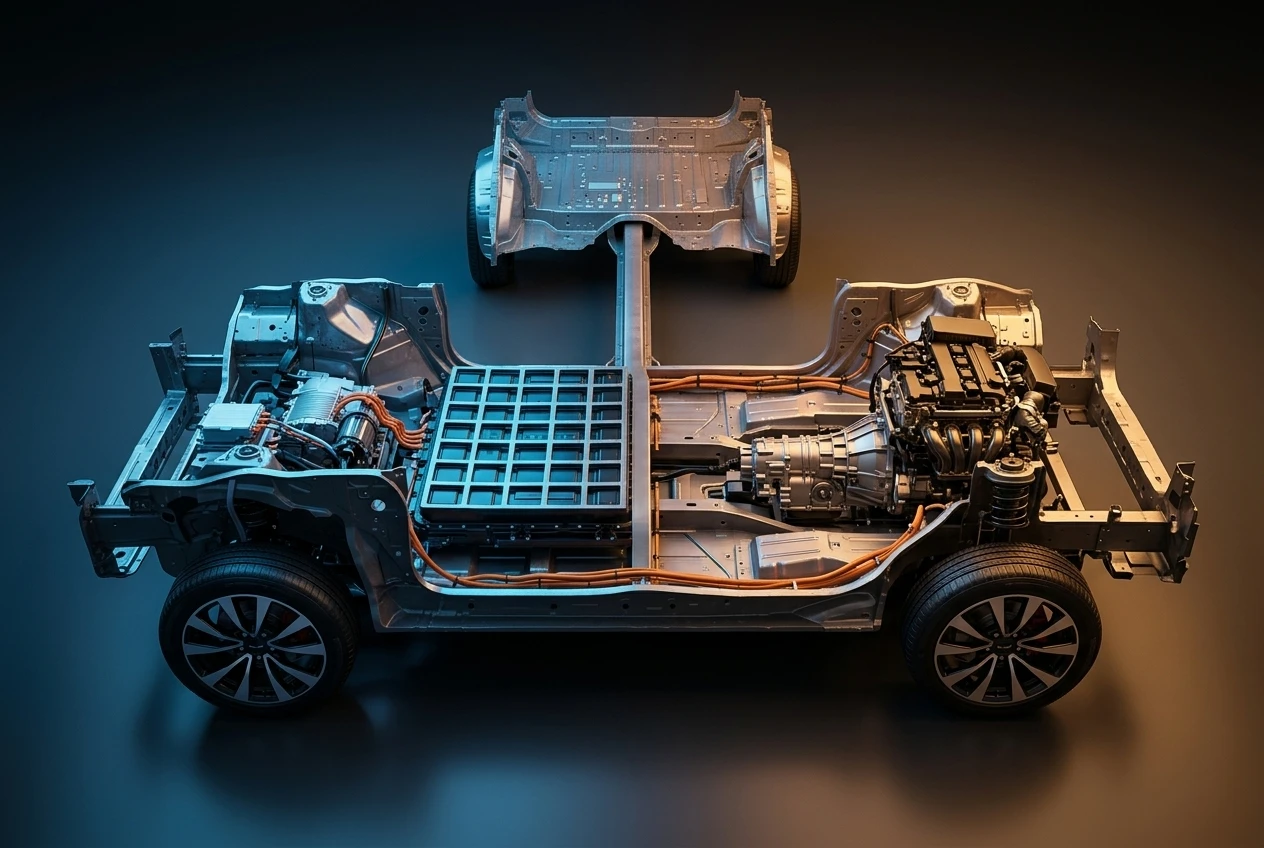
MG ADAPT stands for Advance Drive Architecture Platform Technology. JSW MG Motor India is calling it India’s first Multi New Energy Vehicle platform, a single modular architecture built to underpin electric vehicles, hybrid electric vehicles, plug-in hybrids and range extender electric vehicles. Announced in Gurugram on July 16, the platform is meant to replace the old approach of engineering a separate base for every propulsion type.
- EV – runs entirely on battery and electric motor, with no engine on board.
- HEV – a self-charging strong hybrid that blends engine and motor without ever plugging in.
- PHEV – a plug-in hybrid with a bigger battery for real electric-only driving before the engine joins in.
- REEV – wheels are driven only by the electric motor, while a small petrol engine works purely as a generator to recharge the battery.
Anurag Mehrotra, managing director of JSW MG Motor India, said the company weighed building separate platforms for each powertrain and rejected that approach on cost grounds. “We had the option of doing multiple platforms, but that is not very capital efficient,” Mehrotra said, according to Business Standard. By his account, nearly 80% of the engineering work is already finished across all four propulsion types, leaving future teams to focus mainly on body styles rather than rebuilding the mechanicals each time.
Why Is MG Diversifying Beyond Pure EVs Right Now?
Mehrotra’s growth is real but slower than the segment around it, and he has said India’s 2030 target for new energy vehicles cannot be hit through battery power alone. ADAPT is built to spread that bet across hybrids, plug-in hybrids and range extenders as well as EVs.
- 31,741 – electric passenger vehicles MG registered in India between January and June 2026, per FADA Research data cited by Business Standard.
- 18% – year-on-year growth in those registrations, up from 26,894 units in the same period of 2025, though slower than the wider EV market’s pace.
- 30% – the share of new energy vehicles India wants in new car sales by 2030, the government goal Mehrotra pointed to as ADAPT’s underlying driver.
Mehrotra laid out the reasoning behind the platform at the unveiling.
The goal that has been set to get to 30 per cent new energy vehicles by 2030 will not be achieved through one technology alone. Multiple technologies will be required simply because there are different consumer cohorts in the country.
Some buyers will jump straight to EVs, Mehrotra told Business Standard, while others need a hybrid as a stepping stone before they commit to a plug.
The Hybrid Engine Doing ADAPT’s Heavy Lifting
Hybrid models on ADAPT get a new naturally aspirated petrol engine built specifically for hybrid duty, paired with a dedicated battery and what MG calls a 10-in-1 Intelligent Electric Drive Unit, a claimed first for India. MG says the engine reaches a thermal efficiency of up to 43%, well above the 20 to 35% range typical of conventional petrol engines, according to Autocar India. The company has not disclosed displacement, cylinder count or power output.
Sitting alongside the engine is what MG describes as the world’s first Electromagnetic Dedicated Hybrid Transmission, using an electromagnetic e-clutch the company says reacts four times faster than the hydraulic clutches used in conventional hybrid gearboxes. An Intelligent Energy Management System reads driving conditions and switches between modes automatically, with no input from the driver.
Four Drive Modes on Autopilot
| Drive Mode | What It Does |
|---|---|
| Pure Electric Drive | Battery and motor alone power the car for quiet city driving |
| Series Hybrid Drive | Petrol engine generates electricity while the motor turns the wheels |
| Parallel Hybrid Drive | Engine and motor work together for maximum output |
| Engine Direct Drive | Engine powers the car directly for efficient highway cruising |
The driver never picks a mode manually. The system decides based on speed, battery charge and how much power is being demanded at that instant.
Where the Range Extender Fits In
On ADAPT-based REEV models, the electric motor alone drives the wheels at all times. The petrol engine never touches the driveline directly; it only spins a generator to top up the battery when needed, aiming to feel like an EV while erasing range anxiety on longer trips. Even so, MG has indicated that range extenders will not lead its rollout. Company representatives have said REEV’s share of India’s new energy vehicle market remains small for now because the technology is still new to the country, with plug-in hybrids and strong hybrids expected to arrive first.
The Starlight SUV Already Caught Testing in India
MG has not named a production model yet, but the trail points in one direction. Test mules of both an EV and a PHEV based on the Wuling Starlight 560, a seven-seat SUV sold globally in electric and plug-in hybrid form, have been spotted on Indian roads over recent weeks, and the design was patented in India in March 2026, Autocar India reported. Some pre-launch reports have floated the Hector Hawk nameplate for the plug-in version, though MG has not confirmed any model name.
Globally, the Starlight 560 PHEV pairs a 1.5-litre petrol engine rated at 105PS and 130Nm with a front electric motor and a 20.5kWh battery for a combined 197PS and 230Nm. Depending on which test cycle and market spec is quoted, MG’s own materials point to somewhere between 100km and 125km of electric-only range and a combined range near 1,100km with its 52-litre fuel tank. The electric-only variant uses a 56.7kWh battery driving a front motor rated at 136PS and 200Nm, per specifications reported by GaadiFy.
Autocar India expects the electric variant to reach Indian showrooms within about a month of the platform’s unveiling, with the plug-in hybrid following on a timeline the company has not fixed. CarLelo separately reported the Starlight 560 could land in India sometime between July and October 2026.
MG Would Rather Fund Factories Than Build a New Platform
Mehrotra put a number on the speed ADAPT is supposed to buy. “Typically, an OEM takes anywhere between four and five years to bring a new platform or product. In our case, given that the platform is fully engineered, our ability to bring a new product could be anywhere between 12 and 24 months,” he told Business Standard.
That speed is backed by real money. JSW MG Motor India plans to spend ₹3,000 to 4,000 crore (roughly ₹30 to 40 billion) over the next few years, including about ₹1,400 crore (about ₹14 billion) during FY27 alone, split across localisation, new products and plant expansion, Mehrotra said. Rival Tata Motors is running its own multi-technology wager, earmarking ₹40,000 crore through FY31 for a mix of combustion and electric models, a reminder that MG is not the only Indian carmaker refusing to bet on one technology alone.
| Metric | Figure |
|---|---|
| Typical OEM platform timeline | 4 to 5 years |
| MG’s claimed ADAPT product timeline | 12 to 24 months |
| FY27 capital expenditure | ₹1,400 crore (about ₹14 billion) |
| Halol capacity, phase one, by March 2027 | 160,000 units a year, up from 120,000 |
| Halol capacity, phase two | 300,000 units a year |
The company is targeting 70% localisation for ADAPT-based vehicles. “The remaining 30 per cent is essentially battery cells and certain proprietary systems, which most other original equipment manufacturers also do not localise,” Mehrotra said. The plant is already running three shifts, and the company plans to grow its headcount there by 40%, according to Outlook Business.
The KKR Question JSW MG Won’t Answer
JSW MG Motor India is the joint venture between India’s JSW Group and China’s SAIC Motor, converted into its current structure in 2024, according to Outlook Business. When asked about reports of a potential investment by KKR, the global private equity firm, Mehrotra declined to comment, Business Standard reported, leaving open exactly who might help fund the next phase of MG’s expansion.
Money aside, Mehrotra has pointed to a simpler problem: MG says it cannot make new energy vehicles fast enough for the demand already in front of it. “New energy vehicle demand is outstripping supply at the moment, and the supply is not in terms of cars produced, it is the model introduction that is required,” he told Outlook Business. That is the gap ADAPT is designed to close, one model at a time rather than one platform at a time.
MG has not set a public date for the plug-in hybrid version. Autocar India reported the electric variant of the Starlight-based SUV is expected in Indian showrooms within about a month.
Frequently Asked Questions
What Does MG ADAPT Stand For?
ADAPT stands for Advance Drive Architecture Platform Technology. It is a modular vehicle architecture, not a single model, and MG has indicated it will not be used to build pure combustion-only vehicles, according to Autocar India, since every configuration on the platform carries some form of electrification.
Which MG Model Will Use ADAPT First?
The first vehicles are expected to be electric and plug-in hybrid versions of the Wuling Starlight 560, a seven-seat SUV already spotted testing on Indian roads. Some pre-launch reports point to the electric variant arriving with a large touchscreen and more than 500km of range, though MG has not confirmed specifications.
What Is a Range Extender EV (REEV) and How Common Is It in India?
In an REEV, the electric motor always drives the wheels while a small petrol engine only generates electricity to recharge the battery. The format is still new to India, and company representatives have said REEV’s share of the new energy vehicle market remains small because the technology has not yet matured locally.
How Much of the ADAPT Platform Will Be Made in India?
JSW MG Motor India is targeting 70% localisation for ADAPT-based vehicles. Mehrotra has said the remaining 30% is largely battery cells and certain proprietary systems that most other automakers also import rather than build locally.
Could MG Launch New ADAPT Models Around Diwali?
An unnamed company official told Deccan Chronicle that new plug-in hybrid and electric models on the ADAPT platform could arrive around the Diwali festival, though MG has not officially confirmed that timeline. Diwali-period sales typically account for close to 20 to 25% of India’s total annual car sales, which explains the commercial pressure to time a launch around it.
 ONGC licence frees Venezuela cash and operatorship talks
  Anthropic Hits $65 Billion Run Rate and Flips the AI Cash Test
  Supreme Court grounds the fare free-for-all with three-week clock
  Gold Nears $4400 as Soft Data Meets Oil Inflation Risk
  Nifty Slips as Zaggle Circuits and Dhoot Debuts Big
  Diesel Crack Tops $100 as Iran Rhetoric Lifts Crude