
 Ishan Crawford
 India has proposed its toughest fuel efficiency rules yet for passenger cars, with fleet-wide targets that tighten every year from April 2027 to 2032. The draft, released by the Bureau of Energy Efficiency (BEE) under the Ministry of Power, would cut the permitted carbon output of a manufacturer’s average car from 94.76 grams of CO2 per kilometer in 2027-28 to 78.90 grams by 2031-32. Automakers that beat their target can sell the difference as credits to rivals who miss theirs.
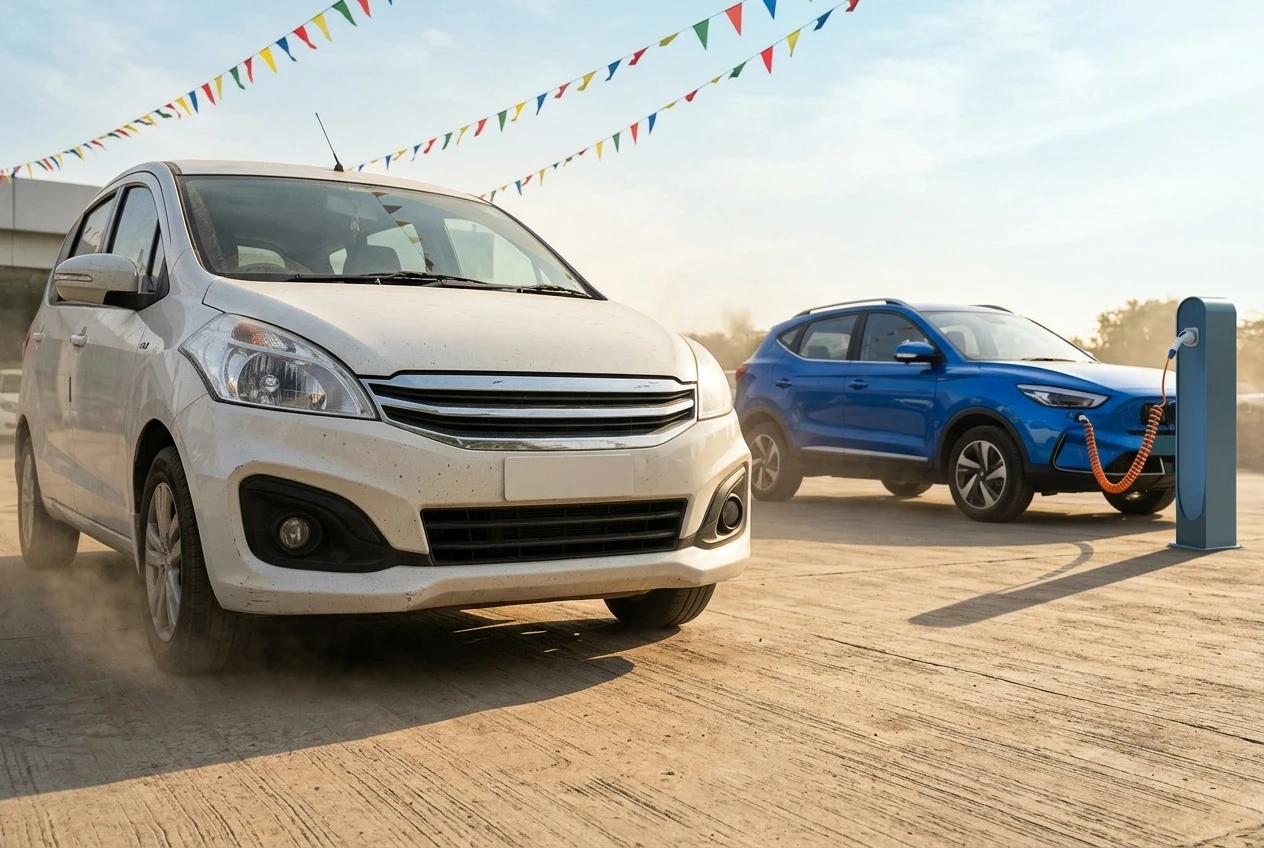
The system already has clear winners. Companies selling electric, hybrid and flex-fuel cars get a lighter compliance load and something to trade. The buyers most exposed to the cost of getting there are the ones who can least afford it: shoppers for the cheap, small cars that still make up a large share of first-time purchases in India. The draft also lands five weeks after regulators forgave carmakers roughly ₹2,700 crore (around $300 million) in penalties they racked up for missing the previous set of targets.
A Fuel Formula That Tightens Every Year
The draft, known as CAFE-III, applies to M1 category vehicles: hatchbacks, sedans, SUVs and MPVs weighing up to 3,500 kilograms and carrying no more than eight seats besides the driver’s. It replaces CAFE-II, which expires on March 31, 2027, after five years of policing the same fleet-wide math.
The current regime tests cars on the Modified Indian Driving Cycle, a lab cycle written decades ago. CAFE-III switches type approval to the Worldwide Harmonised Light Vehicles Test Procedure, a global standard already used across Europe and much of Asia that pushes vehicles through higher speeds and harder accelerations closer to how people actually drive.
Compliance runs in two blocks, a three-year stretch followed by a two-year one, covering 2027-28 through 2031-32. Manufacturers that fall short can carry forward past surpluses, pool credits with other automakers, or buy compliance credits directly from the BEE. The draft also adds compliance incentives of up to nine grams of CO2 per kilometer for approved fuel-saving technology, capped at one gram per technology, stacked on top of the headline targets.
| Metric | CAFE-II (current) | CAFE-III (proposed) |
|---|---|---|
| Effective period | 2022-23 to 2026-27 | 2027-28 to 2031-32 |
| Test cycle | Modified Indian Driving Cycle | Worldwide Harmonised Light Vehicles Test Procedure |
| Fuel consumption target | 4.78 litres/100 km | 3.996 down to 3.327 litres/100 km |
| CO2 target | 113 grams/km | 94.76 down to 78.90 grams/km |
| Compliance mechanism | Fixed penalty under the Energy Conservation Act | Tradable credits priced ₹2,500 to ₹4,500 |
The jump between the two regimes is steep. A car that met CAFE-II’s baseline comfortably will need real hardware changes, not just tuning, to clear CAFE-III’s opening year.
Energy Security Is Driving the Deadline
The stated goal behind CAFE-III is simple: cars that burn less fuel mean fewer dollars spent on imported crude. India’s dependence on imported oil exceeded 90% in FY26, up from roughly 55% in the late 1990s, according to an EY (Ernst & Young) analysis of the country’s petroleum economy.
That exposure puts India in a bind every time crude prices swing. India ranks as the world’s third-largest crude oil importer, behind only the United States and China, based on figures from the country’s Ministry of Petroleum and Natural Gas. Every barrel a more efficient car does not burn chips away at that exposure.
The draft rewards alternative fuels for the first time too. It introduces Carbon Neutrality Factors that lower the declared tailpipe emissions of cars running on ethanol, biofuels and Compressed Bio-Gas, dovetailing with the government’s parallel push for 100% ethanol capable, or E100, vehicles.
Who Gets Paid Under the New Credit Market
The credit system is where the winners take shape. Manufacturers that beat their fleet average earn compliance credits denominated in grams of CO2 per kilometer, which they can bank or sell to competitors running behind. Battery electric vehicles, plug-in hybrids, strong hybrids and flex-fuel models all keep “super credit” weighting in the fleet-average calculation, meaning each one counts for more than a single ordinary sale.
That is a familiar model elsewhere, with a twist. China’s dual-credit policy forces automakers short on electric-vehicle credits to buy from rivals, not from the state, while the European Union skips trading altogether and fines manufacturers directly for every excess gram.
Automakers are already repositioning around the new math:
- Maruti Suzuki is leaning on strong hybrids such as the Victoris and its CNG lineup, the largest of any Indian automaker, to pull down its fleet average.
- MG is building plug-in hybrids on new multi-energy platforms designed to give buyers long highway range without a pure petrol car’s running costs.
- Tata Motors and Mahindra are expanding electric SUV lineups that already anchor their fastest-growing sales categories.
- The wider industry is planning more than 15 new EV models between them, which would push the total number of electric models on sale in India past 35.
Every one of those bets generates credits under the new system. None of them fixes the small end of the market.
Small Cars Absorb the Steeper Climb
Weight decides who struggles most under the new curve. Small, light hatchbacks used to get a built-in edge under CAFE’s weight-based targets, since lighter cars clear low fuel-consumption numbers more easily. That edge has been narrowing with each phase.
Ajay Mathur, a former director general of the BEE who now teaches public policy at IIT Delhi, argues the newer rules no longer favor small cars the way earlier versions did. SUVs face relatively less disadvantage under the new weighting, he says, while smaller vehicles lose part of the compliance benefit they once enjoyed.
Maruti Suzuki Chairman R C Bhargava raised the same complaint about an earlier draft of the rules, arguing the norms unfairly favored bigger vehicles despite the smaller resource footprint of compact cars. “The CAFE norms were based on the European car market, where small car sales have declined,” he said.
The strain already shows up in electric vehicles, the exact segment CAFE-III is trying to grow. EVs priced below ₹10 lakh shrank to 6% of the electric market in FY26, down from 12.5% two years earlier, even as overall EV volumes nearly doubled, according to data Jato Dynamics shared with Business Standard. Anurag Singh of Primus Partners, a consulting firm, said electric cars are already reaching cost parity with petrol models in heavy city driving, but “growth will be uneven across segments due to upfront cost sensitivity and range limitations.”
A Penalty Waiver Still Fresh in Memory
CAFE-III does not arrive onto a clean slate. Weeks before the draft, the government waived roughly ₹2,700 crore in CAFE-2 penalties owed by carmakers including Hyundai, Kia, Mahindra, Honda, Renault, Nissan, Skoda and Force Motors. That figure had already been cut once, down from an initial estimate near ₹7,800 crore across nine manufacturers.
Mathur said waiving the penalties “weakens the effectiveness and credibility of future CAFE norms.” The Energy Conservation Act was supposed to make non-compliance costly. Forgiving one round of penalties right before a stricter round begins tests how firm that threat still is.
- Ajay Mathur says the waiver signals penalties may ultimately be negotiable, weakening the deterrent CAFE norms depend on.
- Industry-side commentary cited by Business Standard calls it a one-time reset that will not derail clean-mobility goals if CAFE-III arrives with clear, predictable rules.
- R C Bhargava frames the deeper problem as structural rather than about enforcement, since the underlying weighting still tilts toward heavier vehicles.
All three views can be true at once, which is precisely why the draft’s fine print matters as much as its headline targets.
What Happens Before August 6?
The Bureau of Energy Efficiency is collecting public comments on the CAFE-III draft until August 6, 2026, before it finalizes the rules. Industry groups are expected to push for softer small-car weighting and a slower ramp, replaying the same fight that shaped CAFE-2, before the notification becomes binding law.
Costs are likely to rise regardless of how that fight ends. Meeting steadily tighter targets means more hybrid hardware, lighter materials and electrified drivetrains on cars that used to compete purely on price, and manufacturers typically pass at least part of that bill on to buyers.
The upside is real too. Buyers should see a wider spread of hybrids, EVs and flex-fuel models to choose from, lower fuel bills over a car’s life, and cleaner air in cities that already struggle with it. Buyers shopping above ₹10 lakh will likely feel those gains first. Buyers below that line, the segment already struggling most, are the ones absorbing the steeper compliance cost.
Frequently Asked Questions
How Many Carmakers Are Exempt From CAFE-III?
Manufacturers selling fewer than 1,000 passenger vehicles a year in India are exempt from the CAFE-III targets, the same threshold used to shield small-volume and niche automakers under the current CAFE-II rules.
What Is WLTP and How Is It Different From India’s Old Test?
The Worldwide Harmonised Light Vehicles Test Procedure runs cars through higher speeds, harder acceleration and longer test phases than the Modified Indian Driving Cycle it replaces, producing fuel-consumption numbers closer to what drivers actually see on the road instead of a forgiving lab result.
Where Do Comments on the Draft Go, and by When?
The Ministry of Power is accepting written feedback through August 6, 2026, addressed to the under secretary for energy conservation, before the BEE finalizes the CAFE-III notification.
What Happens After CAFE-III Ends in 2032?
The BEE has already flagged a fourth phase, CAFE-IV, covering 2032 to 2037, signaling that the fuel-efficiency ratchet running since the early 2020s is expected to continue rather than reset.
 ONGC licence frees Venezuela cash and operatorship talks
  Anthropic Hits $65 Billion Run Rate and Flips the AI Cash Test
  Supreme Court grounds the fare free-for-all with three-week clock
  Gold Nears $4400 as Soft Data Meets Oil Inflation Risk
  Nifty Slips as Zaggle Circuits and Dhoot Debuts Big
  Diesel Crack Tops $100 as Iran Rhetoric Lifts Crude