
 Ishan Crawford
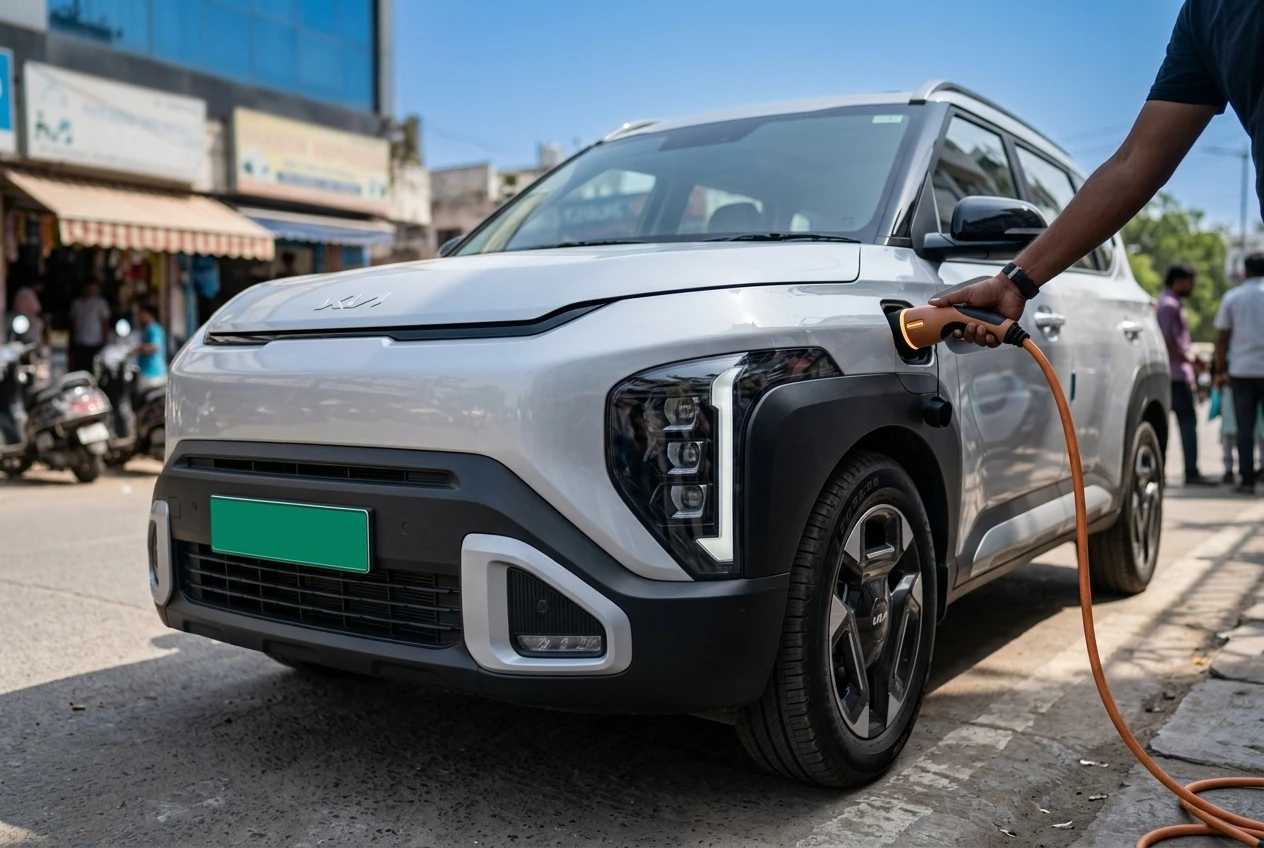
 Kia has opened bookings for the Syros EV, its second mass-market electric SUV in India, without saying what it will cost. The automaker began collecting token payments of Rs 25,000 (roughly $290) on July 15, and a full price reveal is expected within days, alongside the car’s showroom launch.
On paper, the numbers already crowd the two SUVs that have defined this price band for three years, the Tata Nexon EV and the Mahindra XUV 3XO EV. Kia is promising longer range, quicker acceleration and faster charging than both, built using the exact approach Tata popularized first: take a combustion engine platform and convert it to run on batteries.
Bookings Open, Price Still Unspoken
Kia pulled the wraps off the Syros EV in mid-July, publishing full specifications, colours and a five-trim lineup while leaving the one number every buyer actually wants blank. Multiple dealer and industry estimates place the range between Rs 14 lakh and Rs 20 lakh ex-showroom, with the entry HTK trim most commonly pegged near Rs 14 lakh to Rs 15 lakh.
That is not official yet. Here is where things actually stand.
- What we know: The full variant, colour and feature list is public. Bookings have been open since July 15 for a Rs 25,000 token via Kia’s website or any dealership. Kia has confirmed a lifetime battery warranty, a buyback programme and battery-as-a-service financing.
- What’s unconfirmed: Ex-showroom pricing for any of the seven variant and battery combinations. The exact nationwide launch date, beyond a widely reported window around July 22 to 23. Whether the claimed 526 km range holds up on Indian roads, given how far rival claims have slipped in real-world testing.
That last point matters. Independent range testing on the Nexon EV’s 45 kWh version returned a real-world figure well below its ARAI-claimed number, a gap every claimed-range figure in this segment carries until it is tested outside a lab.
Five Trims Split Across Two Battery Packs
Kia is building the Syros EV on the K1 platform, shared with the petrol and diesel Syros already on sale. A front-mounted motor produces 135 PS with the 42 kWh battery and 171 PS with the larger 51.4 kWh pack, with torque fixed at 255 Nm regardless of which battery is fitted.
The base HTK comes only with the smaller battery. HTK+ and HTX step up to offer either battery. HTX+ and the range-topping X-Line are sold exclusively with the bigger 51.4 kWh pack. That splits five named trims into seven distinct variant and battery combinations.
| Trim | Battery Options | Power Output | Notable Additions |
|---|---|---|---|
| HTK | 42 kWh only | 135 PS | Dual 12.3 inch screens, Star Map LED DRLs, wireless Android Auto and CarPlay, paddle shifters, auto hold EPB |
| HTK+ | 42 kWh or 51.4 kWh | 135 or 171 PS | Rear camera with dynamic guidelines, cruise control, 100 W Type-C charger, R17 aero alloys on the extended range version |
| HTX | 42 kWh or 51.4 kWh | 135 or 171 PS | Dual-pane sunroof, rear wiper and washer, power windows all round, OTA updates and Kia Connect 2.0 IRVM on the extended range version |
| HTX+ | 51.4 kWh only | 171 PS | Leatherette seats, 8-speaker Harman Kardon audio, dual-cam dashcam, battery heating, front and rear ventilated seats, wireless charger |
| X-Line | 51.4 kWh only | 171 PS | 64-colour ambient lighting, Level 2 ADAS with 16 features (extended range only), V2L, digital key, side parking sensors |
What is easy to miss in that ladder is what Kia did not hold back on the base trim. All 25 of its standard safety features, including six airbags, electronic stability control, hill start assist, tyre pressure monitoring and rollover sensors, apply to the cheapest HTK variant, not just the trims further up.
The Spec Sheet That Should Worry Tata
The Nexon EV has led this segment since 2023 and became the first electric car in India to cross 1 lakh units sold. It has never faced a rival that beats it on every major spec at once. The Syros EV, on paper, does.
| Model | Battery | Claimed Range | DC Fast Charging (10-80%) | Ex-Showroom Price |
|---|---|---|---|---|
| Kia Syros EV | 42 / 51.4 kWh | 443 to 526 km (ARAI, MIDC Full) | 100 kW, about 39 minutes | Rs 14 to 20 lakh (estimated, unconfirmed) |
| Tata Nexon EV | 30 / 45 kWh | 275 to 489 km (ARAI/MIDC) | 60 kW, about 56 minutes | Rs 12.49 to 17.69 lakh |
| Mahindra XUV 3XO EV | 39.4 kWh | 285 km (Mahindra’s real-world claim) | 50 kW, about 50 minutes | Rs 13.89 to 14.96 lakh |
The Mahindra figure is a real-world claim rather than an ARAI-certified number, so it is not a perfect match against the other two, but it is the only range figure Mahindra has published. Even accounting for that, the Syros EV’s 526 km ARAI rating is the first in this segment to clear 500 km on paper.
Kia’s own motor output, 171 PS on the bigger battery, also tops the segment. Autocar India’s own testing found the XUV 3XO EV undercuts the Nexon EV’s range-topping trim by roughly Rs 2.33 lakh while beating it on power, which means Kia arriving with more power than both cars at once is not a marginal claim.
The Battery Pack Doing Triple Duty
Strip away the badge and the Syros EV’s drivetrain is not new to Kia at all. The same 42 kWh and 51.4 kWh packs, paired with the same 135/171 PS motor, already sit under the Carens Clavis EV’s battery-as-a-service financing plan, Kia’s first mass-market EV in India, and under the mechanically related Hyundai Creta Electric from Kia’s sister brand.
The Carens Clavis EV, a three-row MPV, launched at Rs 17.99 lakh in July and tops out near Rs 25 lakh. Its ARAI range on the same 51.4 kWh pack is 490 km. The smaller, lighter Syros EV squeezes 526 km from the identical battery and is expected to undercut the Clavis EV’s entry price by roughly Rs 3 lakh to Rs 4 lakh.
That is the real mechanics behind Kia’s affordable-EV push. It is not new battery chemistry or a dedicated small-EV architecture. It is one expensive drivetrain, engineered once, spread across three body shells and three price points until the cheapest one lands in Nexon EV territory.
The Warranty Pitch Behind the Range Numbers
Kia is not only selling range and speed. It is bundling ownership guarantees aimed squarely at what keeps first-time EV buyers hesitant in India.
- Battery longevity: a Lifetime High Voltage Battery Warranty covering the pack for as long as the original owner has the car.
- Resale confidence: an Assured Buyback programme that locks in a guaranteed resale value at a set point in ownership.
- Upfront cost: a Battery-as-a-Service option that separates the chassis loan from a per-kilometre battery charge, the same structure Kia already runs on the Carens Clavis EV.
None of the three is entirely new to the segment. Tata already backs select Nexon EV and Curvv EV trims with their own lifetime battery warranty, so Kia is matching a benchmark Tata set first rather than inventing one. The difference is Kia is offering it across the board on a cheaper car, at least on paper, before a single rupee of pricing is public.
Who Else Is Coming for This Segment?
At least four more electric SUVs are aimed at the same Rs 12 lakh to Rs 20 lakh band within the next year or so, including MG’s Windsor, Maruti Suzuki’s e Vitara, VinFast’s VF6 and a sub-4 metre Hyundai. Kia’s timing gets the Syros EV through the door first, but the gap will not last long.
Hyundai, Kia’s sister brand under the same South Korean parent, is separately working on a sub-4 metre electric SUV already spotted testing in South Korea, with an India launch already being planned. If it eventually draws from the same battery and motor pool as the Creta Electric and Carens Clavis EV, the Hyundai-Kia group could end up competing against itself in the exact price band the Syros EV is entering now.
Meanwhile, Tata’s own Nexon EV listing was updated this week to reflect a price climbing toward Rs 17.69 lakh at the top end, a sign Tata is not standing still while it waits to see what Kia actually charges.
Frequently Asked Questions
Does the Kia Syros EV come with all-wheel drive?
No. Every variant uses a single front-mounted motor driving the front wheels only. Kia has not indicated any plans for an all-wheel-drive version at launch.
What driver assistance features come with the Level 2 ADAS suite?
The 16-feature suite, exclusive to the extended-range X-Line, includes front collision avoidance for cars, pedestrians and cyclists, smart cruise control with stop and go, lane keeping and lane following assist, and driver attention warning.
How does Kia’s battery warranty compare with Tata’s?
Tata already offers a lifetime battery warranty on its Nexon EV 45 and Curvv EV trims. Kia’s Lifetime High Voltage Battery Warranty on the Syros EV matches that benchmark rather than beating it, but applies across the lineup.
What does the Syros EV’s claimed range figure actually measure?
The 443 km and 526 km figures come from the MIDC Full test cycle, the same standardised ARAI methodology used for the Nexon EV and most Indian-market EVs, which is why the numbers can be compared directly on paper.
What is Kia’s K-Charge system?
K-Charge is Kia’s charging ecosystem for the Syros EV, pairing a 10.8 kW onboard AC charging capacity with an integrated route planner and flexible charging controls accessed through Kia Connect.
What do buyers give up by choosing the base HTK variant?
The base HTK skips the rear camera with dynamic guidelines, cruise control, the panoramic sunroof, OTA updates and any access to the 51.4 kWh battery, though it keeps all 25 standard safety features and both 12.3 inch screens.
 ONGC licence frees Venezuela cash and operatorship talks
  Anthropic Hits $65 Billion Run Rate and Flips the AI Cash Test
  Supreme Court grounds the fare free-for-all with three-week clock
  Gold Nears $4400 as Soft Data Meets Oil Inflation Risk
  Nifty Slips as Zaggle Circuits and Dhoot Debuts Big
  Diesel Crack Tops $100 as Iran Rhetoric Lifts Crude