
 Ishan Crawford
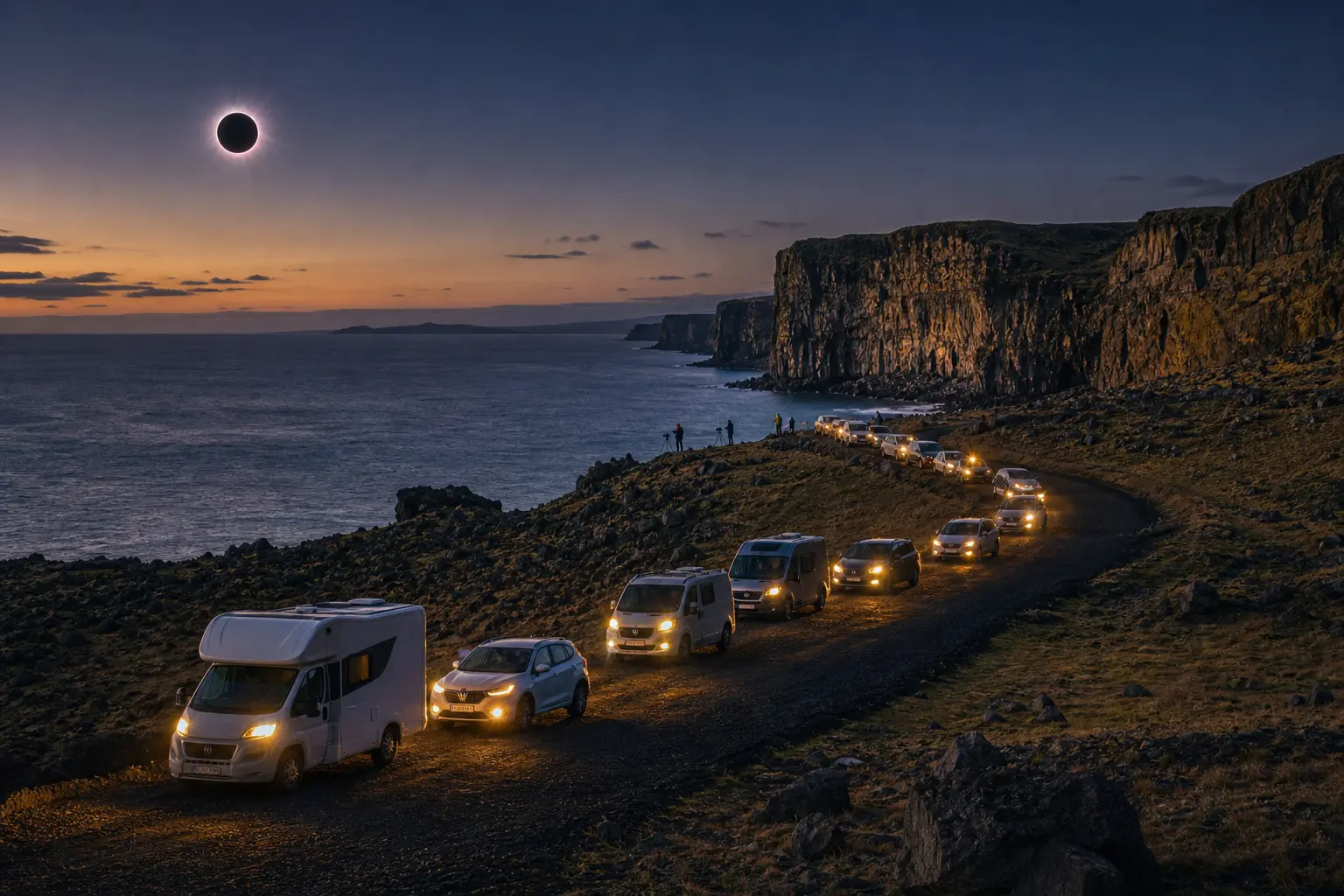
 Guesthouse rooms across western Iceland are going for more than $700 a night, and there is barely anything left at any price. On August 12, 2026, a total solar eclipse will sweep over the Snæfellsnes Peninsula and the Westfjords, and the crowds racing to stand under it have already emptied out the region’s hotels, rental cars and campsites months before the Moon gets there.
Iceland’s tourism industry is treating the sellout as pure upside. The last time a small North Atlantic nation hosted an event like this, the Faroe Islands in March 2015, the actual crowd ended up more than double what organizers had planned for.
Iceland’s Western Fjords Sell Out Months Before the Shadow Arrives
Western Iceland was not built for a crowd like this. About 17,000 people live inside the corridor where the eclipse reaches totality, according to eclipse2026.is’s regional viewing guide. That covers the Snæfellsnes Peninsula, the Westfjords, the Reykjanes Peninsula and the western edge of Reykjavík, the exact stretch of coastline where guesthouse beds have vanished from booking sites.
Basic guesthouse rooms in the area have been listed above $700 a night. Luxury lodging is nearly impossible to find, and last-minute cancellations disappear within hours.
Rental cars, already stretched thin during Iceland’s peak summer season, have grown scarcer as visitors plan self-drive routes to the best cliffside viewpoints. Domestic and international airfares have climbed too, pushed up by chasers locking in seats before prices rise again.
Tour operators report the same story. Guided eclipse packages across the region have been selling out well ahead of the event, leaving little room for travelers who did not book early.
The Faroe Islands Already Ran This Experiment
Fly two hours northeast of the Westfjords and you reach islands that already lived through a smaller version of August 12. On March 20, 2015, the Faroe Islands, a community of just 50,000 people with 800 hotel beds, sat inside the path of totality, one of only two land based viewing spots on Earth that year.
Local tourism officials had planned for a manageable crowd. They were wrong.
We’re asking locals to rent out spare rooms.
Susanna Sorensen, the Faroese tourism manager at the time, described the scramble to house eclipse crowds as television crews flew in from around the world to cover the tiny capital’s predicament.
The actual numbers blew past every forecast. Organizers had planned for roughly 5,000 eclipse tourists.
In the end, 11,400 eclipse tourists arrived over five days, generating an estimated $9.5 million for the local economy and another $22 million in press coverage value from 62 international media crews.
Set beside each other, the two events look like this.
| Measure | Faroe Islands, March 2015 | Iceland, August 2026 |
|---|---|---|
| Population inside the path | About 50,000, the whole territory | About 17,000 residents in the corridor |
| Lodging stock | 800 hotel beds in the capital | Guesthouses and hotels largely sold out for months |
| Visitor forecast | Roughly 5,000 expected | Not published; rental cars and flights already scarce |
| Actual turnout | 11,400 arrived over five days | Not yet known |
| Economic signal | $9.5 million generated locally | Guesthouse rooms above $700 a night |
Iceland’s own viewing corridor holds fewer residents than the entire Faroese population did in 2015, even though Iceland is a much bigger country overall. The regions drawing the biggest eclipse crowds, Snæfellsnes and the Westfjords, look more like scattered fishing communities than a capital city.
Roads Built for Fishing Trucks Now Face a Tourist Crush
Iceland’s road authority is not treating eclipse day like a normal Wednesday. Vegagerðin, the Icelandic Road and Coastal Administration, has mapped out closures and one way systems across the west of the country, warning that “very heavy traffic is expected on key routes in West Iceland and the Westfjords.”
The specific measures read like a small scale traffic operation:
- Útnesvegur, Route 574 – becomes one way from noon on eclipse day as it loops through Snæfellsjökull National Park.
- Öndverðarnesvegur, Route 579 – closes to private cars entirely, with shuttle buses ferrying visitors to the viewing point instead.
- Freight, fish and fuel transport – asked to stay off western routes for the day to keep lanes open for emergency vehicles.
- Search and rescue teams, firefighters, rangers and medical staff – deployed in extra numbers across West Iceland for the day.
Extra personnel are only part of the response. Iceland’s official safety authority warns of a high chance of serious delays and notes flatly that restaurants across the affected areas are already fully booked.
Why Are Eclipse Chasers Also Eyeing Spain?
Iceland is not the only place to catch totality on August 12, 2026. The Moon’s shadow also crosses northern Spain and the Balearic Islands that same evening, the first time mainland Spain has stood inside a total eclipse path since 1905. Iceland offers the longer darkness of the two; Spain offers better odds of a clear sky.
The same eclipse that is emptying Icelandic guesthouses will sweep across Greenland, Iceland, northern Russia and Spain before ending near sunset over the Balearic Sea, according to NASA. It is the first total solar eclipse to reach mainland Europe since 1999, and its path touches A Coruña, Bilbao, Zaragoza, Valencia and Palma, though Madrid and Barcelona fall just outside it.
Iceland still wins on duration. Látrabjarg, at the western tip of the Westfjords, gets 2 minutes and 13 seconds of totality, the longest of any land based site on the entire path. Spain’s best inland spots, like León, run closer to a minute and 45 seconds, with the sun already low on the horizon when the sky goes dark there.
Iceland carries the bigger weather risk of the two. Cloud cover research on the eclipse track shows August cloud chances near Ireland’s latitude running around 85 percent, dropping to roughly 60 percent by the time the shadow reaches Spain’s coast, according to eclipse meteorologist Jay Anderson.
A Festival Capped at 3,333 People
Some organizers are capping their own crowds on purpose. The Iceland Eclipse Festival runs August 12 through 15 in Hellissandur, on the western tip of Snæfellsnes.
Organizers IMXP and Secret Solstice built it as a small, leave no trace gathering of music, art and science talks, deliberately limiting how many people can attend. Blue Lagoon, the geothermal spa near Keflavík, took the opposite approach to scarcity, pricing a guaranteed eclipse day spot rather than capping numbers.
- 3,333 attendees – the hard cap organizers set for the four day Hellissandur festival.
- 89,900 krónur – the price of a package that guarantees a viewing spot with certified glasses at Blue Lagoon on eclipse day.
- 90 days – the advance notice Blue Lagoon requires to cancel an overnight eclipse booking.
- Same week – the annual Perseid meteor shower peaks around the same nights, giving stargazers a reason to stay through the weekend.
After the Shadow Passes
The crush will not end when the Moon moves on. Visit West Iceland flags the post eclipse hour as peak congestion risk, warning that thousands of visitors may try to leave the peninsula at the same time.
Many visitors are not leaving right away regardless. Travelers are extending their stays to explore Iceland’s glaciers, waterfalls and geothermal attractions well beyond eclipse day, spreading the tourism benefit far past the handful of peninsulas that will actually go dark.
Iceland will not stand in the Moon’s shadow again until June 26, 2196.
Frequently Asked Questions
Can I still find a place to stay for the eclipse?
Most hotels and guesthouses inside the path of totality have been booked for months, but cancellations do appear. Campsites in some areas still have room, and bases just outside the path, including the south coast, remain reachable by car on eclipse day itself.
What if clouds block the view in western Iceland?
Staying mobile is the standard advice. Checking forecasts from the Icelandic Meteorological Office and being ready to drive 30 to 50 kilometers can make the difference between clouds and a clear sky, and the flat Reykjanes Peninsula is often cited as a reliable backup location.
Do I need eclipse glasses for the entire event?
Yes, for every part of the event except the brief seconds of full totality itself. Certified ISO 12312-2 glasses are required during all partial phases, and regular sunglasses, no matter how dark, do not offer enough protection.
How long will Reykjavík go dark, and when did that last happen?
Reykjavík will see just over a minute of totality starting around 17:48 GMT. The capital has not experienced a total solar eclipse since June 17, 1433, nearly 600 years ago, even though the wider country saw one as recently as 1954.
Can I fly a drone to photograph the eclipse?
No. Drones are banned in Iceland’s protected natural areas, which cover much of the prime viewing corridor, and organizers discourage flying them anywhere near the crowds gathering for the event.
 ONGC licence frees Venezuela cash and operatorship talks
  Anthropic Hits $65 Billion Run Rate and Flips the AI Cash Test
  Supreme Court grounds the fare free-for-all with three-week clock
  Gold Nears $4400 as Soft Data Meets Oil Inflation Risk
  Nifty Slips as Zaggle Circuits and Dhoot Debuts Big
  Diesel Crack Tops $100 as Iran Rhetoric Lifts Crude