
 Ishan Crawford
 OnePlus has lifted the India price of the Nord 6 for the second time in three weeks, pushing the entry 8GB/256GB variant to Rs 42,999 (roughly $516) on May 28 from a launch tag of Rs 38,999 set in April. The top 12GB/256GB trim now reads Rs 47,999, a full Rs 6,000 above its launch price.
That is a 10.3% jump on the base model in 23 days. Festival-season swaps or a tax change would explain it. Neither applies here, which is why this hike matters well beyond one phone.
The Two-Step Price Climb in 23 Days
The first revision arrived quietly on May 20, when both variants gained Rs 3,000. A week later, on May 28, OnePlus added another Rs 1,000 on each storage tier. The cumulative move is Rs 4,000 on the base unit and Rs 6,000 on the top trim, with no change to specifications, no bundled accessory, no warranty extension to soften the optics.
| Variant | April Launch | May 20 Revision | May 28 Revision | Total Increase |
|---|---|---|---|---|
| 8GB + 256GB | Rs 38,999 | Rs 41,999 | Rs 42,999 | Rs 4,000 |
| 12GB + 256GB | Rs 41,999 | Rs 46,999 | Rs 47,999 | Rs 6,000 |
The brand has not issued a press note for either revision. Listings on the company’s India storefront and major partner retailers updated overnight in both instances, and channel staff at offline outlets were told to apply the new MOP (Maximum Operating Price) the same day. Buyers who pre-booked at the launch tag in April received their units at the original price; everyone since the first revision is paying the new sticker.
Why the Hike Is Bigger Than OnePlus
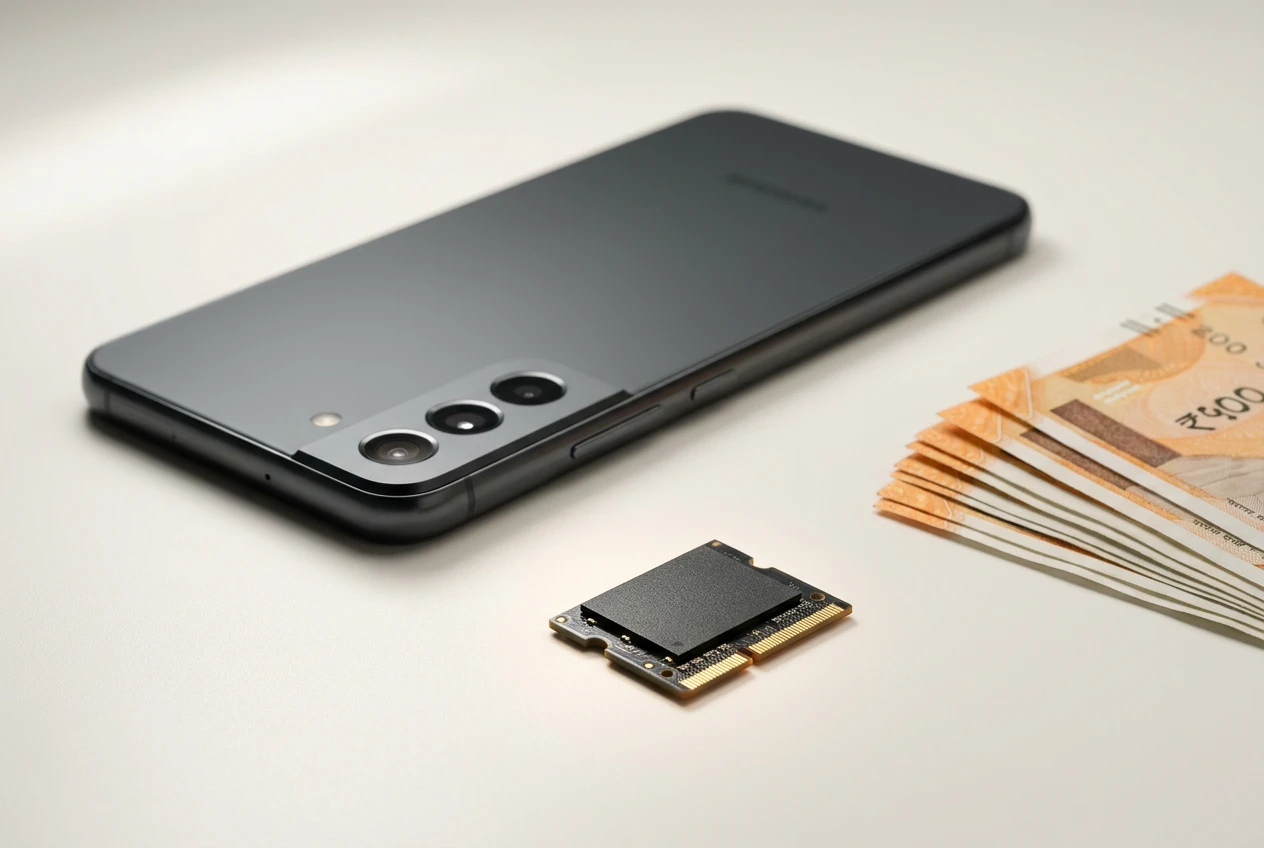
The component bill of a 2026 mid-range Android phone is moving in one direction, and quickly. Memory, both DRAM (Dynamic Random Access Memory, the working RAM) and NAND (the flash chips that hold storage), accounts for a larger share of the bill of materials than at any point in the last decade, and the makers of those chips have been pulled toward a more lucrative customer set.
The HBM Pull on DRAM Capacity
Samsung Electronics, SK Hynix, and Micron Technology have shifted wafer capacity toward HBM (High Bandwidth Memory, the stacked DRAM that feeds Nvidia and AMD AI accelerators). The three suppliers serve hyperscalers like Microsoft, Google, Meta, and Amazon, and HBM now consumes roughly 23% of total DRAM wafer output. IDC’s smartphone and PC market outlook projects DRAM and NAND supply growth at just 16% and 17% year-on-year in 2026, well below historical norms.
NAND’s Steeper Climb
NAND has moved harder than DRAM. Spot prices climbed roughly 246% between the start of 2025 and December, and Samsung has raised contract pricing on certain memory parts by as much as 60% versus September levels. Sourceability tracking shows quarter-on-quarter NAND contract jumps in the 80% to 90% band moving from Q4 2025 into Q1 2026.
The pressure points sitting under every mid-range Android launch this quarter:
- LPDDR5X DRAM contract pricing up sharply since Q4 2025, with no near-term capacity relief signalled by the top three suppliers.
- UFS 4.1 NAND in 256GB and 512GB densities, the spec band most mid-range flagships now ship, taking the steepest hit.
- Rupee weakness against the dollar, which is the invoicing currency for almost all imported smartphone components, compounding the chip-side increase.
- Festival inventory pull-in ahead of August through October, when Indian brands stockpile and push prices up before discount season.
What Rs 42,999 Buys You Today
The hardware is unchanged from the April spec sheet. The Nord 6 still ships with a 6.78-inch AMOLED panel running at a 165Hz refresh rate, a Qualcomm Snapdragon 8s Gen 4 processor, and a 9,000mAh battery paired with 80W wired charging. The supporting cast includes LPDDR5X RAM, UFS 4.1 storage, Wi-Fi 7, and IP69/IP69K dust and water ingress ratings, which is unusually aggressive durability certification at this price.
The camera stack is the weaker corner of the sheet: a 50MP primary sensor, an 8MP ultrawide, and a 32MP selfie front. There is no telephoto and no high-megapixel periscope, which is consistent with how OnePlus has positioned the Nord line for several generations. The package is still a battery and performance pitch first, a camera pitch a distant second.
Where the Nord 6 Sits in the Rs 40,000 Bracket Now
At Rs 38,999 the Nord 6 was a clear value pick against most sub-Rs 40,000 alternatives. At Rs 42,999 it walks into a different fight. The bracket from Rs 40,000 to Rs 50,000 is where camera-heavy mid-flagships and last-generation true flagships live, and the buyer is making a harder choice.
The Xiaomi 17T global launch on May 28 introduced a 12GB/256GB variant priced near Rs 83,950 in India, which slots higher than the Nord 6 by design and is not a like-for-like competitor. The pressure on the Nord 6 comes from below: Realme, iQOO, and Motorola each have a device in the Rs 32,000 to Rs 42,000 band offering similar chipsets with different camera or battery emphasis.
The Motorola Edge 70 Pro, for example, launched at Rs 38,999 with a 6,500mAh battery and a 5,200-nit display. Motorola’s India trade-off on the Edge 70 Pro dropped one camera versus its predecessor to hold that price, the exact kind of spec-side trim the memory squeeze is forcing on every brand.
The new Nord 6 sticker also lands inside the discounted-flagship corridor. Last year’s Snapdragon 8 Gen 3 flagships from Vivo and Oppo are now sitting in the Rs 45,000 to Rs 50,000 zone on Flipkart and Amazon, and shoppers cross-shopping spec sheets will notice.
The Squeeze Is Repricing the Whole Mid-Range
OnePlus is the loudest example this week, not the only one. TrendForce’s latest memory note signalled that smartphone brands targeting mid- and low-end segments would have to raise launch prices for new 2026 models, and that some base specs in the lowest tier are reverting to 4GB of RAM. That is a downgrade the Indian sub-Rs 15,000 segment has not seen in five years.
A phone that might have shipped with 12GB of RAM and 256GB of storage a year ago may now debut with 8GB of RAM and 128GB of storage at the same price point, or worse.
That line, from IDC’s smartphone and PC outlook published this month, captures the second-order move: where brands cannot raise prices, they cut specs. OnePlus picked the price route because the Nord 6 was already shipping and its memory tiers cannot be swapped mid-cycle.
Indian Brands Have Started Adjusting Quietly
Realme, iQOO, and Vivo have all revised at least one SKU upward in the last 60 days, with adjustments ranging from Rs 1,000 to Rs 3,000. None has been announced through a formal price-change press release; all moved through quiet listing updates. The wider India consumer-goods market is also feeling the squeeze, with Hyundai India’s June 1 price increase showing the same playbook in a different category.
The Spec-Reduction Alternative
The other lever, used heavily in budget Android, is to ship lower memory tiers at the original price band. A device that would have launched at 8GB/256GB in 2025 reappears at 6GB/128GB at the same sticker, with the higher-memory SKU sitting Rs 4,000 to Rs 6,000 above the old top trim. The Nord 6’s hike effectively pushes the 12GB/256GB into the slot the brand’s older T-series used to occupy.
Apple sits at the other extreme. The iPhone 18 Pro Max preview for September points to a $1,099 starting tag held flat against component cost pressure, leaning on scale and margin to absorb the memory increase. Mid-range Android brands do not have the gross margin to do that, which is why the Nord 6 is the price that moved this week and the iPhone is not.
Should the Nord 6 Still Be on Your Shortlist?
For buyers whose top priorities are battery endurance, sustained gaming performance, and a high refresh-rate panel, the Nord 6 still holds. A 9,000mAh cell with 80W charging and a 165Hz AMOLED at this size remains rare under Rs 50,000, and the IP69/IP69K rating is a genuine differentiator if rough handling matters to you.
For buyers leading with the camera, the math has changed. At Rs 47,999 for the top variant, last-cycle flagships from Vivo and Oppo with periscope telephotos and larger primary sensors are within reach on EMI, and one or two retailer bank offers can close the gap further.
If memory pricing continues at TrendForce’s projected trajectory, expect at least one more revision before festival season. If supply growth surprises to the upside, the current sticker is a near-term peak rather than a new floor; if it does not, every 2026 launch from Rs 30,000 upward starts further north than the same brand’s 2025 equivalent, and the Nord 6 sticker is simply the first price the market is being asked to accept.
Frequently Asked Questions
Why has the OnePlus Nord 6 been hiked twice in three weeks?
The brand has not issued a public reason, but the timing aligns with sharp increases in DRAM and NAND contract pricing reported by TrendForce and IDC. Memory components are a larger share of a mid-range Android’s bill of materials than ever, and brands without the margin headroom to absorb the increase pass it through.
Will the Nord 6 price come back down later this year?
Unlikely as a listed price cut. Discounts during Amazon and Flipkart festival sales between August and October could pull the effective price down by Rs 2,000 to Rs 4,000 through bank offers and exchange bonuses, which is the normal seasonal pattern in India.
Are other smartphone brands also raising prices in India?
Yes. Realme, iQOO, and Vivo have each adjusted one or more SKUs upward in the last 60 days by Rs 1,000 to Rs 3,000, and TrendForce expects new mid-range launches in 2026 to debut at higher tags than equivalent 2025 models.
Is the OnePlus Nord 6 hardware still worth Rs 42,999?
The 9,000mAh battery, 80W charging, 165Hz AMOLED, and IP69/IP69K rating are class-leading at the new price for battery and durability-first buyers. Camera-first buyers will get a stronger sensor stack from older flagships sitting around Rs 45,000 to Rs 50,000.
Should I wait for the next OnePlus Nord launch instead?
The next Nord device is not expected before late 2026, and given current memory pricing it will almost certainly debut higher than the Nord 6’s April launch price. Waiting for a successor may not deliver a lower sticker, only a different spec mix.
 Scotland Reader Photos Capture Eclipse Week Beyond the Sky
  Scotland’s Rare World Cup Win Over Haiti Still Echoes
  Scottish Morning Roll Campaign Echoes Baguette Path to Unesco
  Samsung Passport Fold8 Turns Apple Fans Into Switchers
  Android’s Quiet Shift to Ambient AI Hardware This Week
  Poco F9 Leak Hands Global Buyers Less Battery for More Money