
 Ishan Crawford
 John O’Neill caught the eclipsed Sun through a gap in the clouds from his back garden in Shotts. Across the same mid-August week, BBC Scotland readers also sent a two-week-old seal pup, the last of the spring barley, and a squirrel nicknamed Spider-Squirrel. The deep partial solar eclipse of 12 August sat inside a living portrait of the country.
The weekly “Your pictures of Scotland” selection for 7-14 August arrived just after one of the strongest partials visible from the UK this century. What the frames actually hold runs wider than the sky event.
That wider hold is the point of the gallery. A single rare alignment drew the eye upward, yet the same seven days still produced beaches, barns, stained glass and wildlife. The selection treats both registers as ordinary Scottish material rather than ranking one above the other.
A Week of Frames from Shotts to Orkney
More than twenty reader images fill the gallery. A handful freeze the Moon’s bite out of the Sun. The rest keep ordinary midsummer Scotland in view: beaches after wind, stained glass on Bute, a misty puffer boat, and sunlight through Stirling trees.
| Photographer | Location | Subject |
|---|---|---|
| John O’Neill | Shotts | Eclipse through cloud gap |
| Anastasiia Petruk | Woodland Bay, near Girvan | Cosmic event after a wait |
| Mateusz Sztajnert-Bluj | Heartlands, Whitburn | Eclipse called “magical” |
| Mark Grierson | Loch Ewe near Poolewe | Two-week-old seal pup |
| Bill Hodgson | Stronsay, Orkney | Kestrel on a power line |
| Rob Barrie | (farm setting) | Father harvesting spring barley |
Elaine Sheard added the soft hazy colours of the morning after. Dwight McAnear, visiting from Durango, Colorado, found quiet in Edinburgh’s Dean Village. The mix is deliberate: one rare sky moment held beside the places people actually walk and work.
Geography does quiet work across the set. Shotts, Whitburn and Girvan sit on the mainland corridor; Loch Ewe and Stronsay pull the eye north and to the islands; Bute, Troon and Inveraray keep the west coast in play. The map of submissions is itself a portrait of how widely people were outside that week.
Farm and harbour shots steady the tone. Barley at the end of its spring cycle, a puffer in mist, and a harbour in afternoon sun remind readers that mid-August still means harvest, boats and coastal walks whether or not the Moon covers the Sun.
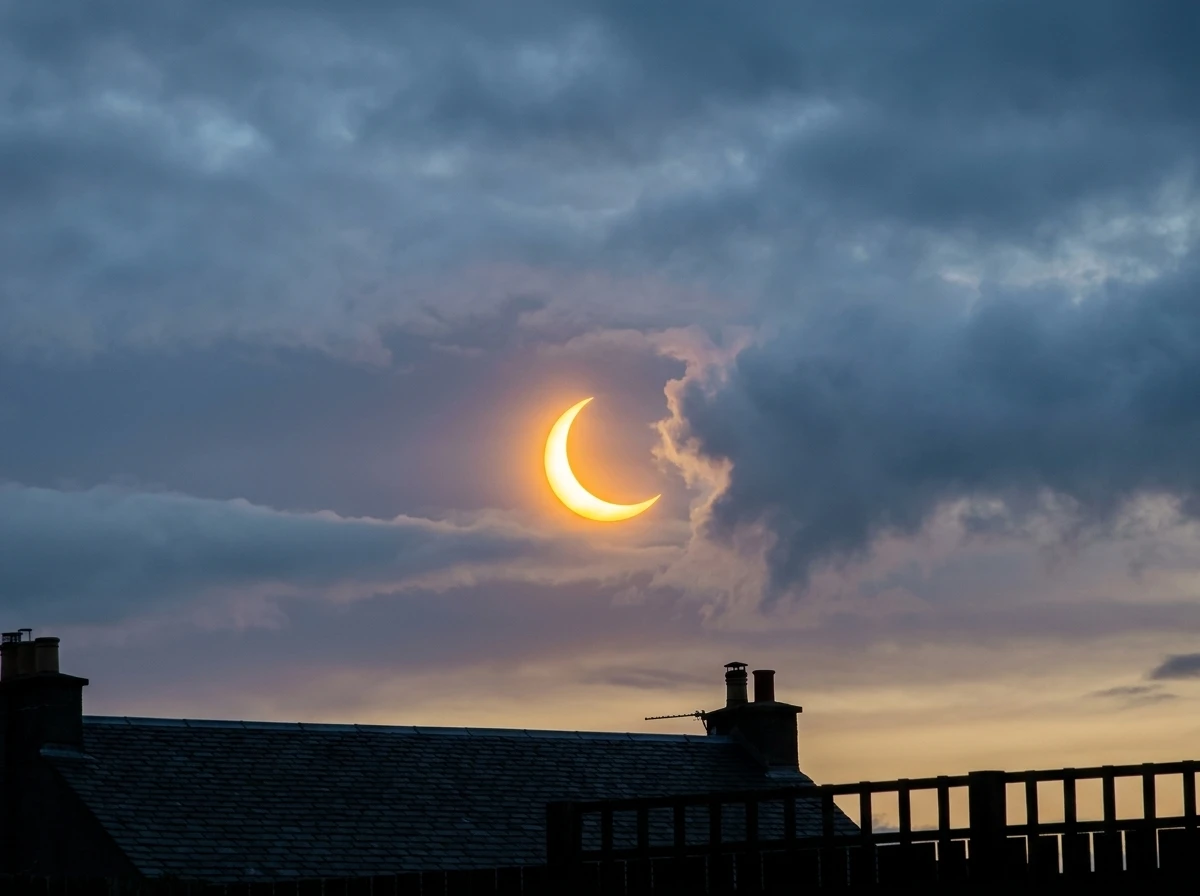
The Eclipse That Slipped Through Cloud Gaps
On 12 August the Moon covered roughly 90 to 93 percent of the Sun across Scotland. Glasgow reached 91.4 percent coverage in Glasgow at about 19:06 BST. Edinburgh sat near 90.7 percent a minute earlier. Maximum arrived with the Sun already low in the western sky.
- First contact: around 18:08 BST in central Scotland
- Greatest eclipse: 19:05-19:06 BST for Edinburgh and Glasgow
- Last contact: near 20:00 BST
- Altitude: low enough that a clear west-northwest horizon mattered more than local overhead cloud
| City | Coverage | Timing note |
|---|---|---|
| Glasgow | 91.4 percent | About 19:06 BST |
| Edinburgh | Near 90.7 percent | About a minute earlier |
| Scotland overall | Roughly 90 to 93 percent | Sun already low in the west |
BBC Weather had flagged the risk. High pressure favoured much of the UK, yet cloud and some rain pushed into western Scotland and the north-west. Many residents reported the classic west-coast lottery: darkness that felt deeper for a spell, then light returning under solid grey. Gaps still opened. O’Neill, Petruk and Sztajnert-Bluj all found them. Crowds gathered at sites such as Whitelee Windfarm, and time-lapse footage from the Astronomical Society of Edinburgh later showed the Moon’s steady track once the clouds parted.
The event ranked among the deepest partials for the UK and Ireland since 1999. Totality itself stayed offshore, crossing Greenland, Iceland and northern Spain. For Scots the reward was a thick crescent low on the horizon when the sky cooperated.
Low altitude changed the practical problem. Overhead breaks helped only if the western horizon stayed open at the same moment. Distant cloud banks could erase the crescent even when local skies looked workable. That is why coastal edges, raised ground and windfarm viewpoints drew people who wanted a clean line of sight.
Seal Pups, Barley and a Spider-Squirrel
The non-eclipse frames carry equal weight. Mark Grierson spotted the seal pup on a boat ride on Loch Ewe. Bill Hodgson found a kestrel resting on a power line in Stronsay. Aileen Gillies came face to face with Snoopy the barn owl at Kintail Birds of Prey. Adrian Plumb recorded a red-footed falcon on a rare Scottish visit. Stuart Powles watched a friendly neighbourhood squirrel help itself to a garden snack in Hamilton.
- Dramatic waves at Dalmore Beach after windy weather (Wendy Greenstreet)
- Colourful sunflowers at the Scottish Sunflower Experience in the Clyde Valley (Mairi Robinson)
- Zodiac-themed stained glass over Mount Stuart’s marble hall on Bute (Steven Neish)
- The Jacobite train heading for Mallaig (Eugene Rutter)
- A “shower of schnauzers” on the beach at Troon (Yvonne Keeling)
- The Vital Spark puffer at misty Inveraray (Charlotte McAllister)
Christina Cox stood at the Devil’s Beeftub near Moffat, the deep valley once used to hide stolen cattle. Kirsty White made a “new pal” in the Pentland Hills. Neil Halley caught the River Tay in reflective mood. These are the textures that outlast any single evening’s sky show. They also echo earlier Scottish landscape and wildlife frames that readers and photographers keep sending in.
Wildlife threads run through the week without forcing a theme. A two-week-old seal, a kestrel on a wire, a barn owl, a red-footed falcon on a rare visit, and a garden squirrel share the same casual attention. None of the captions strain for drama. They note what appeared and where.
Human routes sit beside the animals. The Jacobite heading for Mallaig, schnauzers on Troon sand, and sunflowers in the Clyde Valley keep transport, pets and planted colour in the same gallery as the crescent Sun. The edit refuses to quarantine the sky event from the rest of midsummer.
Locals, Visitors and the Places They Stood
Some contributors live here. Others were passing through. McAnear’s quiet Dean Village shot came on a visit from Colorado. Shanti Nelson did a “night crawl” through the University of Glasgow cloisters. George Moffat sailed calm water under blue skies at Drummuir. Graham Christie met a sunny afternoon at North Berwick Harbour. Cindy Forbes Cameron found sunlight beaming through trees on a Stirling morning walk.
seeing the eclipse from Heartlands in Whitburn was “magical”
Mateusz Sztajnert-Bluj said that after the view opened. Anastasiia Petruk waited at Woodland Bay near Girvan and decided the glimpse was worth it. The captions stay plain and personal. No one claims the perfect shot. They simply stood somewhere and pressed the shutter when the light or the animal or the train appeared.
Visitor frames and local frames share the same plain voice. A Colorado guest in Dean Village, a night crawl through university cloisters, and a morning walk under Stirling trees all read as stops along ordinary routes. The gallery does not separate tourist luck from resident habit.
Place names do steady work in the captions. Whitburn, Girvan, North Berwick Harbour, Drummuir and the Pentland Hills locate each shutter press without extra flourish. Readers can map the week as a set of short stands rather than a single spectacle venue.
How Safe Viewing Worked on a Low Sun
UK Health Security Agency guidance stayed consistent: never look at the Sun with ordinary sunglasses or bare eyes. The dimmed light during a partial can override the natural blink reflex and still burn the retina without pain. After the 1999 eclipse the Royal College of Ophthalmologists logged around 70 cases of vision problems; roughly 40 percent of those people had looked for less than a minute.
Proper protection meant ISO 12312-2 certified eclipse glasses or fully filtered optics. Indirect methods worked too: pinhole projectors, colander shadows, or the dappled light under trees. Because maximum came late and low, many people treated the evening like a special sunset and chose elevated or coastal spots with open western horizons. Cloud hundreds of miles away could still block the view even when the sky overhead looked promising.
The low Sun added a timing discipline. First contact near 18:08 BST left nearly an hour before greatest eclipse around 19:05 to 19:06, with last contact near 20:00. People who arrived late still had a window, yet the western horizon had to stay clear through that whole slide toward sunset.
- Around 18:08 BST: first contact in central Scotland
- 19:05-19:06 BST: greatest eclipse for Edinburgh and Glasgow
- Near 20:00 BST: last contact as the Sun sat low
Indirect tricks suited mixed cloud. Colander shadows and tree-dappled crescents let groups share the shape of the bite without anyone staring upward. Filtered glasses and optics remained the rule for any direct look, especially once the light fell and the blink reflex grew less reliable.
Why This Partial Stood Out for Scotland
Royal Museums Greenwich noted it delivered the most coverage since the 1999 eclipse for the UK and Ireland. The 2015 deep partial had reached 98 percent in parts of Scotland while totality crossed the Faroes and Svalbard. This one sat lower and later, pairing naturally with the Perseid meteor shower peak the same night under dark new-moon skies. Typical Perseid rates from a UK dark site run 20-40 meteors per hour after midnight.
| Eclipse reference | What Scotland saw | Extra context |
|---|---|---|
| 1999 | Benchmark for deep UK and Ireland partials | Later eye-safety cases logged after unprotected views |
| 2015 | Up to 98 percent in parts of Scotland | Totality over the Faroes and Svalbard |
| 12 August 2026 | Roughly 90 to 93 percent; 91.4 percent in Glasgow | Low evening Sun; Perseids the same night |
The next total solar eclipse visible from British soil does not arrive until 2090. Smaller partials will come sooner, including 2027 and 2028, yet few will match the depth and summer timing of 12 August 2026. That rarity helps explain why people still turned out despite the cloud forecasts and why the successful gap shots travelled quickly.
Summer timing softened the ask. An evening maximum let people finish work or meals and still reach a west-facing open spot. New-moon darkness the same night kept the Perseids in play for anyone who stayed out after the crescent faded, with typical dark-site rates of 20-40 meteors per hour after midnight.
Cloud and Coast Shaped Who Saw the Crescent
High pressure across much of the UK did not erase the west-coast lottery. Cloud and some rain pushed into western Scotland and the north-west, so darkness could deepen for a spell and then give way to solid grey. Success depended less on a perfect forecast than on brief gaps at the right azimuth.
O’Neill in Shotts, Petruk near Girvan and Sztajnert-Bluj in Whitburn each found an opening. Crowds at Whitelee Windfarm and time-lapse work from the Astronomical Society of Edinburgh recorded the same pattern: wait, lose the Sun, then catch the Moon’s track when the cover thinned. Elevated and coastal ground simply improved the odds on a low western target.
Totality’s path stayed offshore across Greenland, Iceland and northern Spain. Scotland’s prize was never a dark umbra. It was a thick crescent low on the horizon, and only for those whose west-northwest line of sight lined up with a gap at greatest eclipse.
What the Mixed Gallery Still Shows
Held together, the week’s frames argue for range rather than a single peak image. Eclipse crescents share space with a seal pup on Loch Ewe, spring barley on a farm, zodiac stained glass on Bute, and a squirrel at a Hamilton snack. The edit treats the sky event as one more midsummer fact.
That choice matches how the captions read. People name the place, note the wait or the luck, and stop. “Magical” at Whitburn and a worth-it glimpse at Woodland Bay sit beside plain records of trains, owls and morning haze. The voice stays local even when the geometry is celestial.
- Rare sky: deep partial near 90 to 93 percent, caught through cloud gaps
- Working land and water: barley harvest, puffer boat, harbour sun
- Wildlife: seal pup, kestrel, barn owl, red-footed falcon, garden squirrel
- Built and planted colour: Mount Stuart glass, Clyde Valley sunflowers, Dean Village quiet
Future partials in 2027 and 2028 will bring people out again, and 2090 still holds the next total on British soil. Between those dates the weekly invitation keeps collecting the same blend: whatever the sky does, and whatever else Scotland was already doing that week.
The Archive Keeps Growing
BBC Scotland invites fresh pictures every week to scotlandpictures@bbc.co.uk under clear rules: own work only, written parental permission for any children, no endangering yourself or others. Contributors keep copyright while granting a royalty-free licence. The 7-14 August set joins a long run of these collections, much as nostalgic Glasgow Fair holiday photographs once froze an earlier season of ordinary Scottish days.
Clouds won some of the eclipse lottery. The gallery still filled. Seal pups, barley fields, stained glass and a squirrel with a snack sat beside the crescent Sun. That is the quieter story the frames keep telling: midsummer Scotland does not pause for the sky. It simply adds the sky to everything else already happening.
Each new week extends that record under the same rules. Own work, care around children, and no risky climbs or stops keep the door open without turning the gallery into a stunt board. The 7-14 August set now sits in that longer line, another midsummer folder where a deep partial and a two-week-old seal can share the same page.
 Adobe Bets on Experience Cloud’s Anil Chakravarthy as CEO
  The Quiet Architect Behind Akshay Oberoi’s Karjat Home
  PaperCut Rushes a Third Patch as Print Servers Fall
  Apple’s Foldable iPhone Hinges on Samsung Display Supply
  Farah Calls the Evoluto F355 Restomod a Costly Triumph
  Onimusha Way of the Sword Preload Hits a Windows 11 Wall