
 Ishan Crawford
 Apple’s iPhone 18 Pro Max, widely expected at the company’s September event in Cupertino, will look almost identical to last year’s iPhone 17 Pro Max once it surfaces. Almost everything else about the device, from its silicon process down to the aperture blades inside its main camera, is set for a generational reset.
Leaks aggregated across the past four weeks point to four headline shifts: a 2 nanometre A20 Pro chip with Taiwan Semiconductor Manufacturing Company’s (TSMC) new Wafer-Level Multi-Chip Module (WMCM) packaging, a variable-aperture main camera, a battery that pushes past 5,100 milliamp-hours, and an India launch price likely held close to the current Pro Max’s starting tag of just under Rs 1.5 lakh.
The Sleeper Inside the A20 Pro Package
Cameras and colours are getting the leak-cycle attention this cycle. The deeper change sits one layer below the rear glass, in a chip package Apple has never built quite this way.
The A20 Pro, the silicon expected to power both the iPhone 18 Pro and the Pro Max, is reported to be built on TSMC’s 2-nanometre (2nm) logic process and to debut Wafer-Level Multi-Chip Module packaging. That is the first commercial smartphone use of a process placing the random-access memory (RAM) onto the same silicon wafer as the central processing unit, graphics unit, and Neural Engine, eliminating the interposer layer used in current iPhone chips.
- 15% peak performance gain claimed for the new chip versus the A19 Pro, per supply-chain leaks circulating since April.
- 30% efficiency improvement at iso-performance, the larger of the two paired claims.
- 12 GB RAM ceiling enabled by the new packaging, up from 8 GB on the previous generation.
- $280 estimated bill-of-materials cost for the chip itself, roughly 80% higher than the silicon inside the iPhone 17 Pro.
How the New Packaging Changes the Chassis Math
Pulling the RAM onto the same wafer as the rest of the system on a chip (SoC) does two things at once. It shrinks the chip’s footprint inside the chassis, which is where Apple is expected to recover space for a slightly larger battery. And it shortens the signal path between memory and processor, the architectural lever that decides how quickly an on-device large language model can swap layers in and out of memory.
Why Apple Intelligence Sits at the Centre
Apple’s on-device AI stack has been bottlenecked by two constraints: how much RAM the chip can hold without thermal blowback, and how fast it can move data between memory and the Neural Engine. The 12 GB headroom is enough room for a meaningfully larger on-device model than the one shipped with iPhone 17, and the shorter signal path drops latency on the kind of multi-step prompts Apple has been previewing since June 2024.
If the rumours hold, the iPhone 18 Pro Max will be the first Apple device whose hardware is genuinely designed around the assumption that a useful generative model lives on the phone, not in the cloud. Our earlier coverage of the iPhone 18 Pro launch pricing and chip-cost picture tracked the financial side of that bet.
A Mechanical Iris Returns to the Pro Camera
Variable aperture is the headline camera upgrade, and it is the first time a Pro iPhone will use a physical iris rather than a fixed lens opening.
Variable Aperture from f/1.6 to f/22
Supply-chain leaks describe a main lens that can step its opening between f/1.6 to f/22 using mechanical iris blades, the same kind of light control still used in standalone cameras. Wider openings will improve low-light capture and shallow-depth portraits. Narrower openings preserve detail in bright scenes and give Apple finer control over computational depth maps.
The practical payoff is fewer blown highlights in harsh daylight and cleaner bokeh after dark, both of which have been weak spots in iPhone photography since the iPhone 14 Pro.
Samsung’s Three-Layer Stacked Sensor
Beneath the new lens, Apple is reported to be qualifying a three-layer stacked image sensor from Samsung’s image-sensor division, internally codenamed PD-TR-Logic. That would mark the first time a Pro iPhone uses a Samsung image sensor; Sony has been the sole supplier across every iPhone generation since 2011.
The sensor stacks photodiodes, transfer transistors, and logic circuits on three separate silicon layers connected by through-silicon vias. The architecture delivers faster readout (helping fast-action capture), lower noise, and higher dynamic range, the three metrics that consistently separate flagship Android cameras from Pro iPhones today.
The telephoto lens is reported to get a wider maximum aperture and, according to a Ming-Chi Kuo note circulated in April, possibly a teleconverter element to extend optical zoom. The form-factor mechanics for that last claim remain unclear, and Apple has a habit of dropping the most ambitious component plans late in the qualification window.
Design Choices Stay Subtle but Visible
The chassis story is one of inches and millimetres rather than reinvention. The iPhone 18 Pro Max keeps the rear camera plateau that arrived with iPhone 17 Pro, with a refined finish on the rear glass and titanium rails. Under-display Face ID has been pushed to a future cycle. What ships in September is a smaller Dynamic Island.
Shrinking the pill at the top of the display gives back a useful slice of screen real estate, particularly in landscape gameplay and video editing. It also makes room for a redesigned status-bar layout that has been spotted in early iOS 26 builds, though the visible system UI has not yet been confirmed by Apple.
Thickness is the other subtle move. The chassis grows from 8.75 mm to 8.8 mm, a 0.05 mm increase no one will feel in the hand but enough to seat a larger battery cell. Weight is reported to be flat versus the outgoing model at around 233 grams.
One physical button change has surfaced in case-maker leaks: the Camera Control button introduced with iPhone 16 Pro is staying. The Action button is also unchanged. Apple’s last two button experiments have both stuck, which is rare for the company.
Battery and Display Math Moves Forward
The battery cell is reported to land between 5,100 and 5,200 mAh, up from the outgoing model’s 5,088 mAh. The headline figure understates the gain because the A20 Pro’s claimed 30% efficiency improvement compounds with the cell increase. Real-world endurance, especially for video playback and on-device AI tasks, could move further than the cell-capacity number suggests.
Wired charging is expected to stay near 40 W and MagSafe wireless to inch up to 30 W on Apple’s own pucks. The 6.9-inch Super Retina XDR panel keeps its 120 Hz ProMotion and stays on LTPO oxide backplane technology, with peak HDR brightness reported to step from 3,000 nits to around 3,500 nits in highlights.
Here is how the headline figures compare with the current generation:
| Spec | iPhone 17 Pro Max (Current) | iPhone 18 Pro Max (Expected) |
|---|---|---|
| SoC | A19 Pro, 3nm N3P | A20 Pro, 2nm N2 |
| RAM | 8 GB | 12 GB |
| Main camera aperture | f/1.78 fixed | f/1.6 to f/22 variable |
| Battery | 5,088 mAh | 5,100 to 5,200 mAh |
| Thickness | 8.75 mm | 8.80 mm |
| Peak HDR brightness | 3,000 nits | 3,500 nits (expected) |
| India launch price (256 GB) | Rs 1,49,900 | Rs 1,49,900 to 1,54,900 (expected) |
Four Colours and a Dark Cherry Outlier
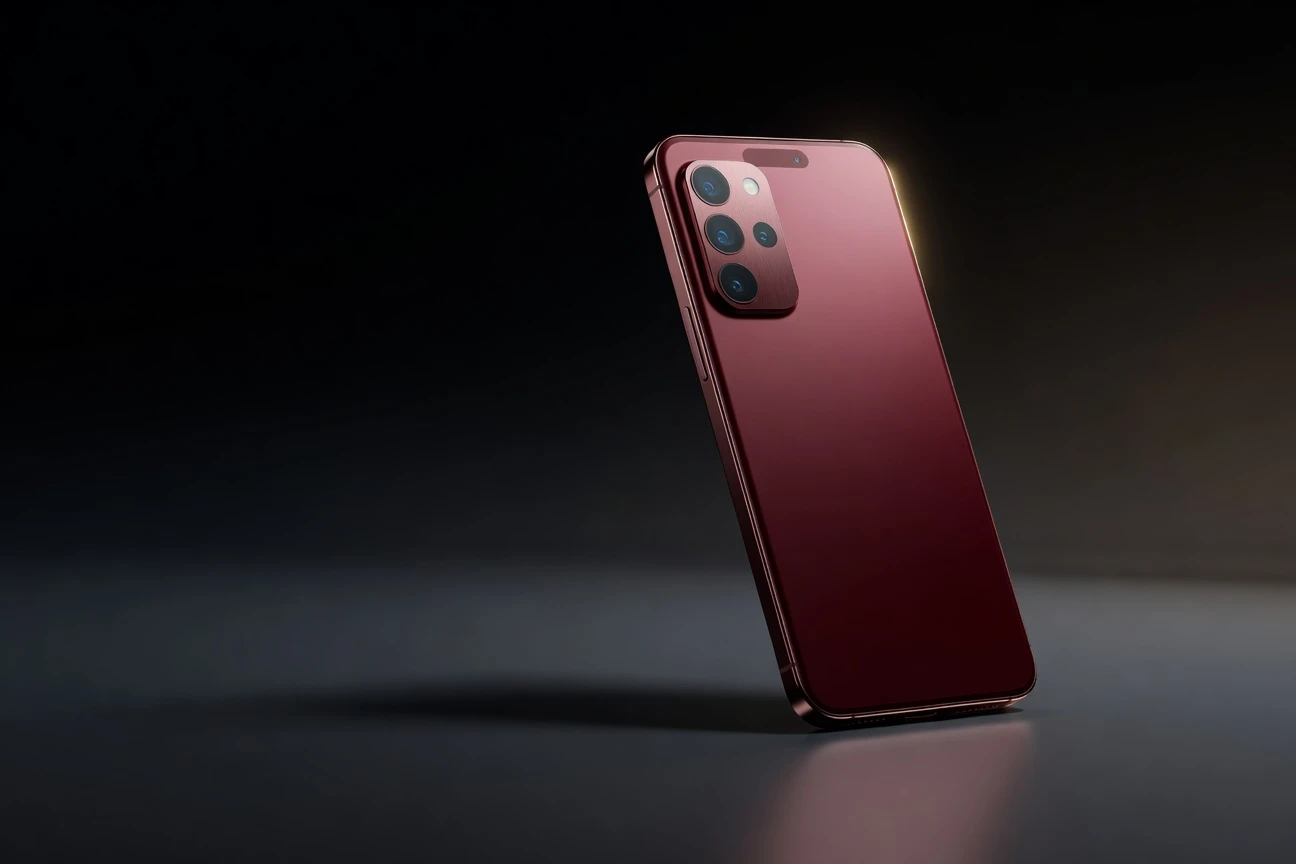
Apple’s Pro line has used colour as a quiet signalling device since the iPhone 14 Pro’s Deep Purple, and the iPhone 18 Pro Max is reported to follow the same playbook. Four finishes are expected, with one of them already getting most of the leaked-render attention.
- Dark Cherry: a deep wine-red finish, the most-discussed colour of the lineup and the closest Apple has come to a true red on a Pro since the iPhone 7 Plus’s PRODUCT(RED).
- Sky Blue: a soft, washed-out blue read by leakers as the cycle’s fresh Pro colour, similar in restraint to the iPhone 15 Pro’s Natural Titanium.
- Silver: the line’s evergreen, kept as the safe choice for buyers replacing older devices.
- Dark Grey: the staple anchor, expected to be the highest-selling SKU in most markets including India.
The Pro-exclusive colour tradition matters more than it sounds. Cosmic Orange on the iPhone 17 Pro pulled measurable colour-share at launch, with Counterpoint analysts noting in November 2025 that orange units accounted for nearly a quarter of Pro Max pre-orders globally. The wine-red finish is the candidate to repeat that pattern this cycle.
India Pricing Sits Under a Tariff Cloud
The India number is the one the local upgrade cycle hangs on. The iPhone 17 Pro Max opened at Rs 1,49,900 for the 256 GB variant in September 2025, with the 512 GB at Rs 1,69,900, the 1 TB at Rs 1,89,900, and a new 2 TB variant at Rs 2,29,900. Pre-orders opened on 12 September 2025 and units shipped from 19 September. Apple’s India business has been growing at double-digit volumes for two years on the back of locally assembled units.
Leaks suggest the iPhone 18 Pro Max will hold close to that starting price, give or take a few thousand rupees. That was not the consensus view six months ago, when a meaningful hike was expected on the back of an 80% costlier A20 Pro chip. The shift in expectations is being driven by two things: Apple’s expanding Foxconn and Tata assembly capacity in Tamil Nadu and Karnataka (which absorbs more of the iPhone 18 Pro Max bill-of-materials into rupee-denominated costs), and a strong rupee environment in early 2026 that gives Apple’s India team room to absorb component inflation.
The risk to that math is United States tariff policy. President Trump’s April 2026 floated reciprocal tariff on iPhones assembled outside the US has not yet been implemented but remains the single variable that could force a global price reset. If the levy lands before September, the India price holds only if Apple absorbs the cost. If the levy slips into 2027, the current anchor survives and India’s upgrade momentum continues into the festive quarter.
If Apple holds the line at the current price tag, the iPhone 18 Pro Max launches into a friendly Indian market where Pro-grade phones now move 250,000 units in their first quarter. If the tariff lands and the starting price moves to Rs 1,59,900 or higher, the device becomes the first iPhone flagship in three years to test how price-sensitive India’s premium buyers really are.
 Scotland Reader Photos Capture Eclipse Week Beyond the Sky
  Scotland’s Rare World Cup Win Over Haiti Still Echoes
  Scottish Morning Roll Campaign Echoes Baguette Path to Unesco
  Samsung Passport Fold8 Turns Apple Fans Into Switchers
  Android’s Quiet Shift to Ambient AI Hardware This Week
  Poco F9 Leak Hands Global Buyers Less Battery for More Money