
 Ishan Crawford
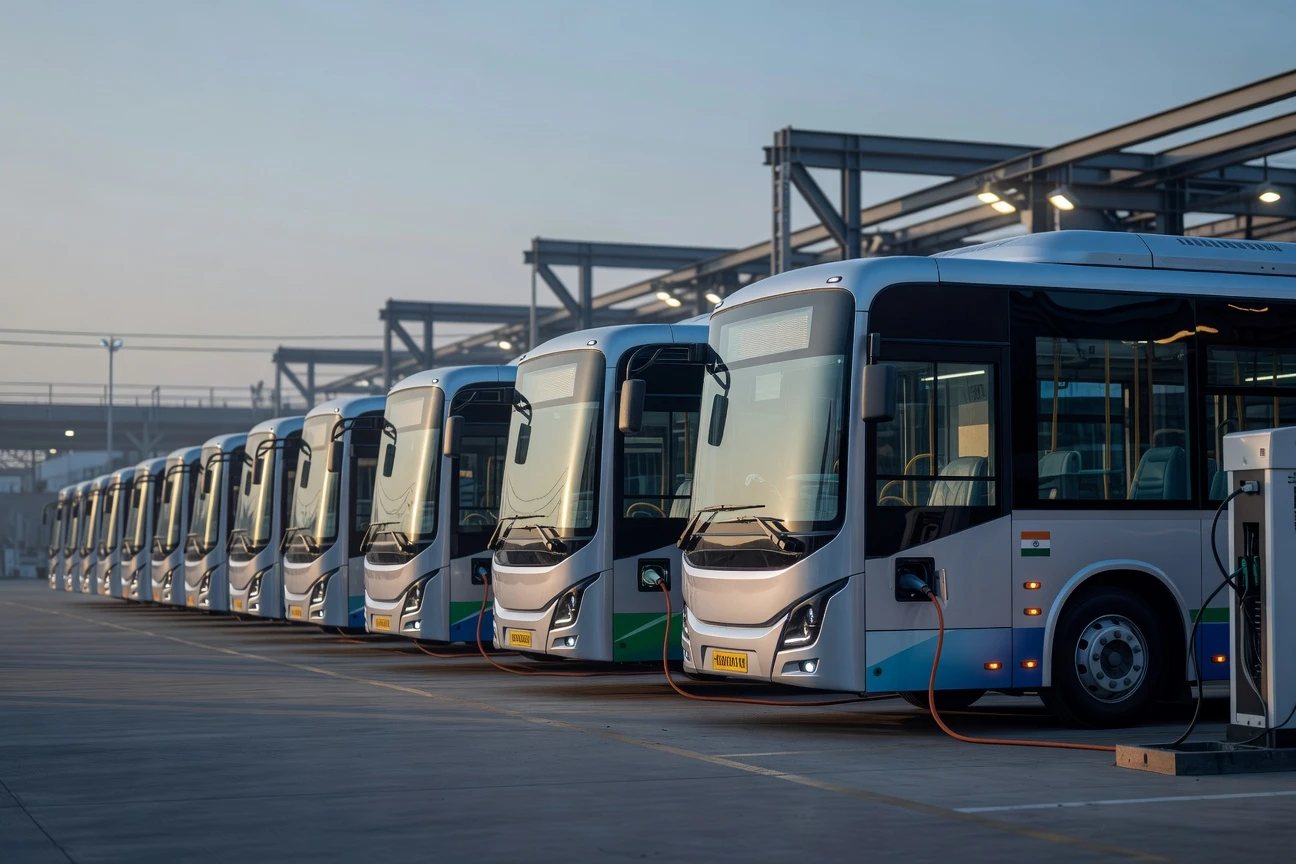
 India is weighing more than $1 billion in fresh incentives to push private fleet operators into electric buses and trucks, a proposal that pulled JBM Auto, Olectra Greentech and Ashok Leyland into focus on the morning of May 20. The plan would run for a decade and direct most of its firepower at intercity bus operators, the long-haul private fleets that have largely sat outside the country’s existing public-sector electric vehicle (EV) subsidy umbrella.
The Prime Minister’s Office is expected to finalise the scheme later this month, against a backdrop where diesel still powers more than 85% of India’s commercial vehicle base and a West Asian war is rewriting the country’s fuel-import math.
What the $1 Billion Aid Plan Actually Covers
The proposed package, first reported by Bloomberg and confirmed by industry stakeholders attending pre-decisional meetings, is structured as an interest subvention rather than a direct purchase subsidy. The headline number is the incentive cap of ₹15 lakh per vehicle (about $17,500) spread over a vehicle’s lifetime, with support tapering as adoption matures.
Most of the corpus would go to intercity bus operators, the privately owned coach fleets that link Tier-2 and Tier-3 cities. Trucks fall under the program too, but the existing electric truck framework already runs separately, through the Ministry of Heavy Industries’ PM E-DRIVE umbrella scheme, which earmarks up to ₹9.6 lakh per truck and targets a deployment of about 5,600 e-trucks by March 2028.
Where the New Money Sits Versus the Old
The new $1 billion proposal sits alongside two existing programs. PM-eBus Sewa, with a Payment Security Mechanism corpus of ₹3,435.33 crore notified in October 2024, supports the rollout of more than 38,000 electric buses through public transport authorities. PM E-DRIVE, with a ₹10,900 crore outlay through March 2026 and an extension to 2028 for trucks and buses, handles a wider basket including two-wheelers, three-wheelers, and charging infrastructure.
The Numbers, Stacked
- $1 billion+: proposed corpus for the new private-fleet incentive plan
- 10 years: program duration under discussion
- ₹15 lakh: maximum lifetime interest subvention per vehicle
- 5,600 e-trucks: existing deployment target under the PM E-DRIVE truck scheme launched earlier this year
Why the Energy Crisis Is Forcing the Move
Prime Minister Narendra Modi used a Telangana rally earlier this month to lay out citizen-side measures aimed at conserving foreign exchange, including carpooling, expanded metro use, and a one-year deferral on gold purchases and overseas travel. The political signalling was unusual in its directness, and the new aid plan is the supply-side counterpart.
The math is unforgiving. India imports roughly 88% of its crude oil, and commercial vehicles account for a disproportionate share of diesel demand because of how many kilometres a truck or intercity coach covers in a year. Pulling even a slice of that fleet onto electrons does two things at once: it shrinks the import bill and it creates demand certainty for domestic battery and bus manufacturing capacity.
That logic was always there. What changed is the West Asian conflict and the fuel-price pass-through that came with it. Government planners now have political cover to spend on a segment that has been politically dull for years: privately owned trucks and coaches, which do not vote and do not appear on city skylines the way an electric metro fleet does.
The Three Listed Names in the Frame
The market read on Wednesday morning was that this aid plan is a fresh demand signal layered on top of an already-fat order pipeline. The three names cited most often, JBM Auto, Olectra Greentech and Ashok Leyland, each occupy a different slot in the electric commercial vehicle (CV) value chain.
| Company | FY26 Order Position | FY26 E-Bus Market Share | Marquee Government Win |
|---|---|---|---|
| JBM Auto (JBM Ecolife) | 11,000+ e-bus backlog, ₹6,500 cr FY26 revenue target | 24% (top by volume) | ₹5,500 cr PM-eBus Sewa-2 order for 1,021 buses |
| Olectra Greentech | 10,000+ vehicle order book | 22.3% in calendar 2025 | 1,785 buses under PM E-DRIVE mega-tender, 1,085 LoI from Telangana SRTC |
| Ashok Leyland (Switch Mobility) | 2,000+ e-buses, 1,200 e-LCVs | 24.8% in FY26 | 500 EiV12 e-buses from Chennai MTC |
JBM Auto: Volume Leader With the Biggest Backlog
JBM Ecolife Mobility, the EV arm of JBM Auto, has emerged as the volume leader in FY26 with a 24% share of the Indian electric bus market. The company says it operates one of the largest integrated e-bus plants outside China in the Delhi-NCR region with a 20,000-unit annual production line. Its backlog of more than 11,000 buses underpins management’s ₹6,500 crore FY26 revenue target.
Olectra Greentech: The Tender Specialist
Olectra has spent the cycle stacking tender wins. The company secured 1,785 buses out of the 10,900-bus PM E-DRIVE mega-tender awarded in December 2025, and added a 1,085-bus Letter of Intent from Telangana State Road Transport Corporation in February 2026 worth roughly ₹1,800 crore. Its deployment count crossed 3,600 vehicles earlier this year.
Ashok Leyland: The Legacy CV Player Catching Up
Switch Mobility, Ashok Leyland’s electric arm, registered the highest FY26 market share at 24.8%, a six-fold leap from 136 units in 2024 to 1,466 units. The company hit EBITDA (earnings before interest, taxes, depreciation, and amortisation) break-even for FY25 and posted double-digit EBITDA margins in the fourth quarter. Its 500-bus Chennai MTC order anchors the FY26 delivery schedule.
PM E-DRIVE Already Tilted the Playing Field
The new $1 billion idea does not arrive in a clean room. The December 2025 PM E-DRIVE mega-tender for 10,900 electric buses, run through Convergence Energy Services Limited (CESL, the central government’s EV aggregator), already redrew the competitive map and the result was not what the market expected.
Who Won the December Tender
PMI Electro Mobility took the largest slice at 5,210 units. Eka Mobility followed with 3,485 units. Olectra Greentech came in third with 1,785 units. Together those three split the entire allocation.
Who Walked Away With Nothing
Tata Motors, VE Commercial Vehicles, and JBM Auto walked away with zero. The pricing in the CESL tender was reported as well below incumbent margins, which is part of why legacy names either declined to bid aggressively or were outbid by leaner challengers. Tata Motors’ calendar 2025 numbers tell the rest of the story: registrations collapsed 84% year-on-year to 223 units, dropping its market share to 5% from a 39.2% peak.
What That Means for the New Plan
If the $1 billion scheme is structured as a tender-led demand pull, the December result is the more reliable forward indicator than headline order backlogs. Outside the public tender process, private fleet operators have more discretion on which OEM (original equipment manufacturer) they pick, and that is where the listed three may have a structural edge: brand, dealer reach, and balance-sheet credibility for fleet financing matter more to a private operator than to a state transport corporation chasing lowest-quoted price.
Why the Private Truck Math Still Misses
The bullish case rests on an assumption that needs scrutiny: that private fleet operators will buy electric trucks once the incentive arrives. The unit economics still do not close cleanly.
An electric medium or heavy commercial truck in India costs roughly four times its diesel equivalent at the showroom door, even after current PM E-DRIVE incentives. Total cost of ownership math improves over a five-to-seven-year horizon, with annual fuel savings of ₹50,000 to ₹1 lakh per vehicle and energy efficiency 65% above diesel. But Indian fleet financing rarely underwrites that horizon at the rates private operators need.
The friction points show up in three places:
- Capital cost: medium and heavy electric trucks at roughly 4x diesel sticker price, only partially offset by the existing ₹9.6 lakh PM E-DRIVE cap
- Charging gaps: highway and Tier-2/Tier-3 fast-charging coverage is too thin for long-haul intercity operations, the exact segment the new scheme is targeting
- Financing depth: no concessional pooled-fund mechanism yet exists to align e-truck loan rates with diesel parity
The IEEFA (Institute for Energy Economics and Financial Analysis) has flagged that without a multilateral-development-bank-anchored pooled financing facility, even fully funded purchase incentives leave the rate of monthly repayment higher than diesel cash-flow can service. An interest subvention helps on rate, but does not by itself close the upfront capital gap.
Calendar Risk Before the Scheme Lands
The next clean read on policy direction comes from the PMO’s stakeholder meetings expected by the end of May. The scheme’s final shape, whether it lands as pure interest subvention, a direct demand subsidy, or a hybrid with a payment security mechanism similar to PM-eBus Sewa, will decide how quickly listed OEMs can convert announcement into bookings.
Three numbers will tell the story over the next two quarters. Whether the FY27 Budget, due in February, ring-fences the corpus inside an existing line item or creates a new one. Whether JBM Auto’s e-bus production line hits its 20,000-unit nameplate run-rate. And whether India’s 2026 electric bus registrations data shows the private-fleet segment crossing 1,000 units for the first time.
If the PMO finalises the scheme this month and the first private-fleet disbursements clear before the festive buying window in October, the listed three convert this morning’s tailwind into a multi-quarter order cycle. If the scheme slips to the post-Budget cycle, the same backlog gets repriced against a softer macro and a charging-infrastructure gap that has not moved.
Disclaimer: This article is for informational purposes only and does not constitute investment advice. Shares of electric vehicle manufacturers carry policy, execution, and competitive risks that can change quickly. Readers should consult a Securities and Exchange Board of India (SEBI) registered financial advisor before acting on any of the information above. All figures and policy details are accurate as of publication on May 20, 2026.
 ONGC licence frees Venezuela cash and operatorship talks
  Anthropic Hits $65 Billion Run Rate and Flips the AI Cash Test
  Supreme Court grounds the fare free-for-all with three-week clock
  Gold Nears $4400 as Soft Data Meets Oil Inflation Risk
  Nifty Slips as Zaggle Circuits and Dhoot Debuts Big
  Diesel Crack Tops $100 as Iran Rhetoric Lifts Crude