
 Ishan Crawford
 Eleven years after pulling the plug on the consumer version of Google Glass, Google walked back on stage in Mountain View on Tuesday and handed its smart-glasses problem to two fashion houses. At Google I/O on May 19, the company unveiled Intelligent Eyewear, a Gemini-powered line built on Android XR (extended reality, Google’s headset and glasses platform) and designed by Warby Parker and Gentle Monster. The audio version is scheduled for shops this fall in select markets; a separate version with an in-lens display will follow later.
The headline is a hardware reveal. The subtext is a corporate apology. Glass died in 2015 because almost nobody wanted to be seen wearing it, and the camera on the temple turned wearers into walking privacy disputes. This time the camera, the microphone, and the AI live behind a Warby Parker rounded square or a Gentle Monster elongated oval, with the fashion brand’s logo riding above Google’s.
What Google and Samsung Showed in Mountain View
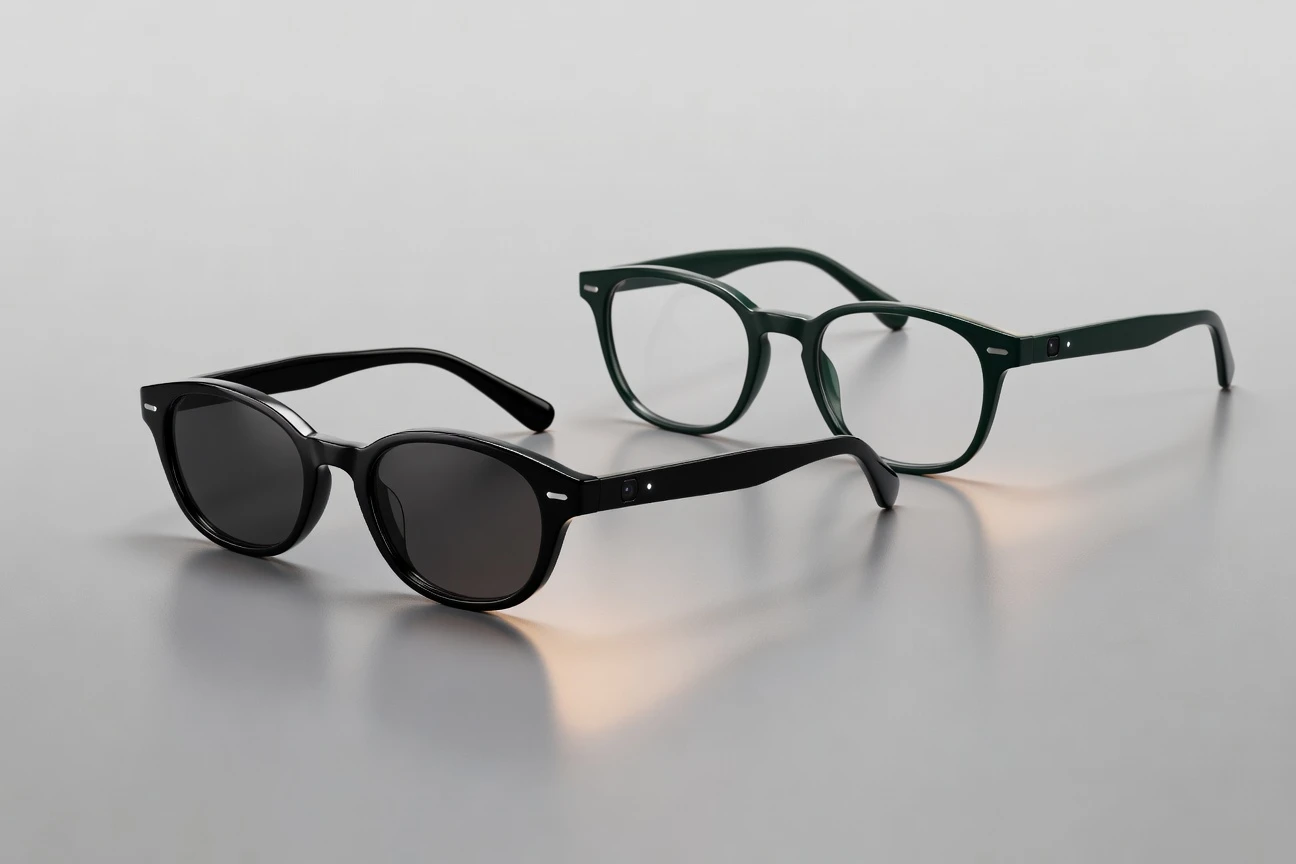
Shahram Izadi, Google’s vice president and general manager of Android XR, used his I/O stage time to position Intelligent Eyewear as the next milestone for the platform, after the Samsung Galaxy XR headset that shipped at $1,800 in October 2025. Two styles surfaced first: a black-framed Gentle Monster sunglass in an elongated oval, and a dark-green Warby Parker eyeglass in a classic rounded square.
Both pairs carry a front-facing camera, a microphone array, and the touch-and-voice controls that Google has been refining inside the Galaxy XR. The audio model speaks Gemini into the wearer’s ear through bone-conduction or near-ear speakers. The display model overlays text, navigation arrows, and visual answers onto the right lens, the same heads-up pattern Meta’s Ray-Ban Display introduced last year.
Google and Samsung confirmed the glasses pair with phones running either Android or iOS, a deliberate olive branch to iPhone households where Meta’s Ray-Ban line already has a foothold. Pricing was not disclosed at the keynote, nor was the exact launch market list.
AI continues to unlock all new experiences on headsets, glasses and everything in between. The next big milestone for Android XR is Intelligent Eyewear.
That was Izadi, on stage in Mountain View on May 19. The line did some of the heavy lifting that pricing usually does: it told the room that this product is the headline act for Android XR through the back half of 2026, not a footnote to the headset.
The Glass Inheritance Google Is Trying to Outrun
Glass launched in 2013 at $1,500, sold through an invitation-only Explorer Program, and became a punchline within a year. Restaurants banned wearers. Critics coined “Glassholes” for users who refused to take them off in private settings. By January 2015 the consumer programme was shuttered. A 2017 Enterprise Edition aimed at warehouses and operating theatres kept the name alive in industrial settings, but the brand never recovered with shoppers.
Three things broke the first attempt, and Google has spent the last eleven years quietly fixing each one. The first was visibility: the prism over the right eye was unmissable and unflattering. The second was utility: Glass could not do anything a phone could not do better in 2013, and battery life was thin. The third was social trust: the camera looked aimed at whoever the wearer was talking to, and there was no obvious recording indicator.
The Fashion Outsource
Hankook Kim, the Gentle Monster founder, said in a video shown at I/O that he wanted the line “to look prettier than normal eyewear” and to carry a feeling of bravery and rebelliousness. David Gilboa, Warby Parker co-founder and co-chief executive, said he wanted “a beautiful pair of glasses” that did not hide the technology but celebrated it. Translation: Google does not get to set the design language any more. The brands that already sell frames to design-literate buyers do.
The AI Use Case
Gemini is the second fix. The 2013 glasses had to invent reasons to exist. The 2026 glasses inherit a multimodal assistant that can identify a building, summarise a menu in a second language, and route the wearer around a closed street, all without unlocking a phone. The use cases are no longer hypothetical; they are the same ones Meta Ray-Ban users have spent two years validating.
The Recording Tell
Meta added a hardware indicator LED to its Ray-Ban frames after the first wave of recording complaints, and Google is expected to follow the same pattern, though the company has not yet detailed its capture-notification system in public. Whether that lone LED is enough to settle the conversation is a separate question, addressed later in this piece.
Audio Glasses Now, Display Glasses Later
Google split the line in two for a reason. Audio-only frames are cheaper to manufacture, lighter on the face, and survive a full day on battery. A binocular waveguide display, which is what Meta is still struggling to mass-produce affordably, drives weight and cost up sharply. Splitting the catalogue lets Google ship something this autumn and stage the more ambitious version for a later release window.
| Feature | Audio Intelligent Eyewear | Display Intelligent Eyewear | Meta Ray-Ban Display |
|---|---|---|---|
| Launch window | Autumn 2026 | Later, no date set | Late 2025 |
| In-lens display | No | Yes, monocular overlay | Yes, monocular overlay |
| Camera | Front-facing | Front-facing | Front-facing |
| AI assistant | Gemini | Gemini | Meta AI |
| Phone pairing | Android and iOS | Android and iOS | Android and iOS |
| Frame partners | Warby Parker, Gentle Monster | Warby Parker, Gentle Monster | Ray-Ban (EssilorLuxottica) |
What the audio model does on day one reads like a stripped-down phone interface that lives on the bridge of your nose. The capability list Google ran through on stage included:
- Voice-activated Gemini via “Hey Google” or a tap on the temple
- Visual queries about surroundings, including restaurant ratings, signage translation, and object identification
- Turn-by-turn walking directions with route modifications spoken aloud
- Hands-free calls, dictated texts, and spoken summaries of incoming messages
- Photo and short-video capture, with edits applied through paired-phone apps
- Real-time speech and text translation that attempts to preserve speaker tone
The display model adds a heads-up layer on top: navigation arrows in the lens, subtitle-style captions for a translated conversation, and inline answers to Gemini queries that would otherwise need a screen. Google has not published a field-of-view spec for the display, the brightness rating, or the price, which makes it impossible to compare directly with Meta’s existing $799 Ray-Ban Display.
Meta’s Seven-Million Head Start
The market Google is walking into is no longer empty. EssilorLuxottica, Meta’s manufacturing partner and the parent of Ray-Ban, told investors in February that the two companies sold more than seven million Ray-Ban and Oakley smart glasses in 2025 alone, more than tripling the prior year’s volume. From the October 2023 launch through early 2025, the line had moved about two million units; the 2025 surge took the cumulative total close to nine million.
That is the running tally Intelligent Eyewear has to chase. The relevant numbers, in one snapshot:
- 7 million Meta smart glasses shipped in 2025
- ~9 million cumulative Ray-Ban Meta and Oakley Meta units since October 2023
- $799 launch price for the Meta Ray-Ban Display, the closest comparable to Google’s display version
- $1,800 price of the Samsung Galaxy XR headset that anchors the Android XR platform Intelligent Eyewear runs on
Meta has told suppliers it wants to roughly double output to twenty million units a year by the end of 2026, which puts Google in a race for component allocation as well as shelf space. Waveguide displays, custom silicon for low-power AI inference, and battery cells thin enough for a temple arm are not unlimited. The same Qualcomm chips power both companies’ near-term roadmaps.
What Google brings that Meta cannot is a search graph and a billion-user assistant already running on most of the world’s phones. What Meta has that Google does not is a two-year operational record of selling, returning, replacing, and updating real glasses on real faces, with the bug reports and the warranty data that follow. Samsung’s recent push to layer pro-grade imaging features into Galaxy hardware hints at the deeper ambition: a single Android XR stack that runs across phones, the Galaxy XR headset, and the glasses, sharing the same Gemini pipeline.
Privacy Is the Loaded Question
The seven-million figure obscures a parallel story. In 2025, Reuters reported that Meta routinely streamed user video recordings to support workers in Kenya, where contractors reviewed footage to improve the company’s AI models. The disclosures revived the same arguments that buried Google Glass: who is being recorded, who can see the footage afterwards, and what counts as consent when the camera is the size of a freckle.
Google has not yet detailed how Intelligent Eyewear will handle recording indicators, on-device versus cloud processing, or the contractor-review pipelines that Gemini relies on for training. The company’s privacy track record on Glass is the comparison shoppers and regulators will reach for. In 2013, the original device had no LED, no obvious sign that a recording was active, and no published policy on how long captured frames sat on Google servers. The 2026 product cannot ship with the same gaps and survive the first review cycle.
European regulators are already circling. The EU AI Act’s high-risk classification rules took effect in February, and biometric-capable wearables fall inside the scope. Whether Intelligent Eyewear’s facial-recognition features are switched off in EU markets, the way Meta switched off real-time AI search in some jurisdictions, is one of the unanswered questions from Tuesday’s stage.
The Fall Launch and What Sits in Footnotes
The audio glasses arrive in the autumn. Google did not name a price, a launch country list, or a second-wave date for the display version. Samsung, working under the internal codename Jinju for its glasses programme, is expected to release more details at its own Galaxy Unpacked event later this year. Qualcomm sits behind both: the same silicon partner powering the Galaxy XR headset is supplying the SoC (system-on-chip, the main processor) for the glasses.
What is unresolved matters more than what was announced. Pricing decides whether this is a Ray-Ban Meta competitor at $300, a Ray-Ban Meta Display competitor at $800, or a luxury Gentle Monster product at $1,200. Battery life on a temple arm is still the binding constraint, and Google did not publish a runtime number. The display version’s field of view, brightness, and waveguide design were all withheld.
If the audio glasses ship in October at a Meta-adjacent price and an LED that satisfies regulators, Google has a chance to redirect a chunk of the Ray-Ban pipeline before the holiday window. If the audio model slips into 2027, the display model still has no firm date, and EU regulators flag the camera before launch, then Intelligent Eyewear becomes the second Google glasses product that the market remembers more for what it promised than what it shipped. The first version of that story is already eleven years old; the company has the rest of this year to write a different ending.
Disclaimer: This article is for informational purposes only and reflects publicly disclosed details as of May 20, 2026. Product specifications, pricing, launch dates, and regulatory treatment may change before the eyewear reaches consumers. Readers considering a purchase or pre-order should consult the official Google, Samsung, Warby Parker, and Gentle Monster channels for confirmed availability and any region-specific privacy disclosures.
 SEBI CAS Forces Options Traders to Recalibrate Closing Risk
  Sensex Drops 400 Points as Oil Spike Tests Market Resilience
  Ardee Industries IPO Rides Lead Recycling Boom at Discount
  Gold Nears 4300 but Iran Risks Cap Gains Ahead of NFP
  Scotland Construction Stalls as Skills and Tariffs Blunt Infra Gains
  Lok Sabha Bill Opens UPI Charges Path for Banks Over Merchants