
 Dayna Bass
 Hidden beneath the still waters of a remote Scottish loch, a small stone island has just revealed a secret 5,000 years in the making. Archaeologists confirmed it sits on a massive timber platform built long before the first stones of Stonehenge were ever raised. The find is rewriting the story of who shaped Britain’s first great structures, and how they did it.
Divers Uncover Ancient Timber Platform on Isle of Lewis
The site, known as the Loch Bhorgastail crannog, lies in shallow waters on the Isle of Lewis in Scotland’s Outer Hebrides. It was first discovered in 2009, but its full scale stayed buried until divers began digging in 2021.
University of Southampton divers have now confirmed the Loch Bhorgastail crannog was built on a 23-metre Neolithic timber platform laid down between 3500 and 3300 BC, well before Stonehenge.
The discovery flips a long-held belief on its head. This remarkable find reveals that these artificial islands in the Outer Hebrides are significantly older than Stonehenge, pushing the timeline of complex construction in the region back to the Neolithic period. The revelation that timber, rather than stone, was the primary load-bearing element of these structures highlights the advanced capabilities of the communities that built them.
Lead researcher Dr Stephanie Blankshein said: “When we actually started excavating is when we realised that it was actually this coherent, quite large timber structure that was under what you would see as the stone island today. “So that was a big surprise, and that was in 2021 when we actually started digging down.”
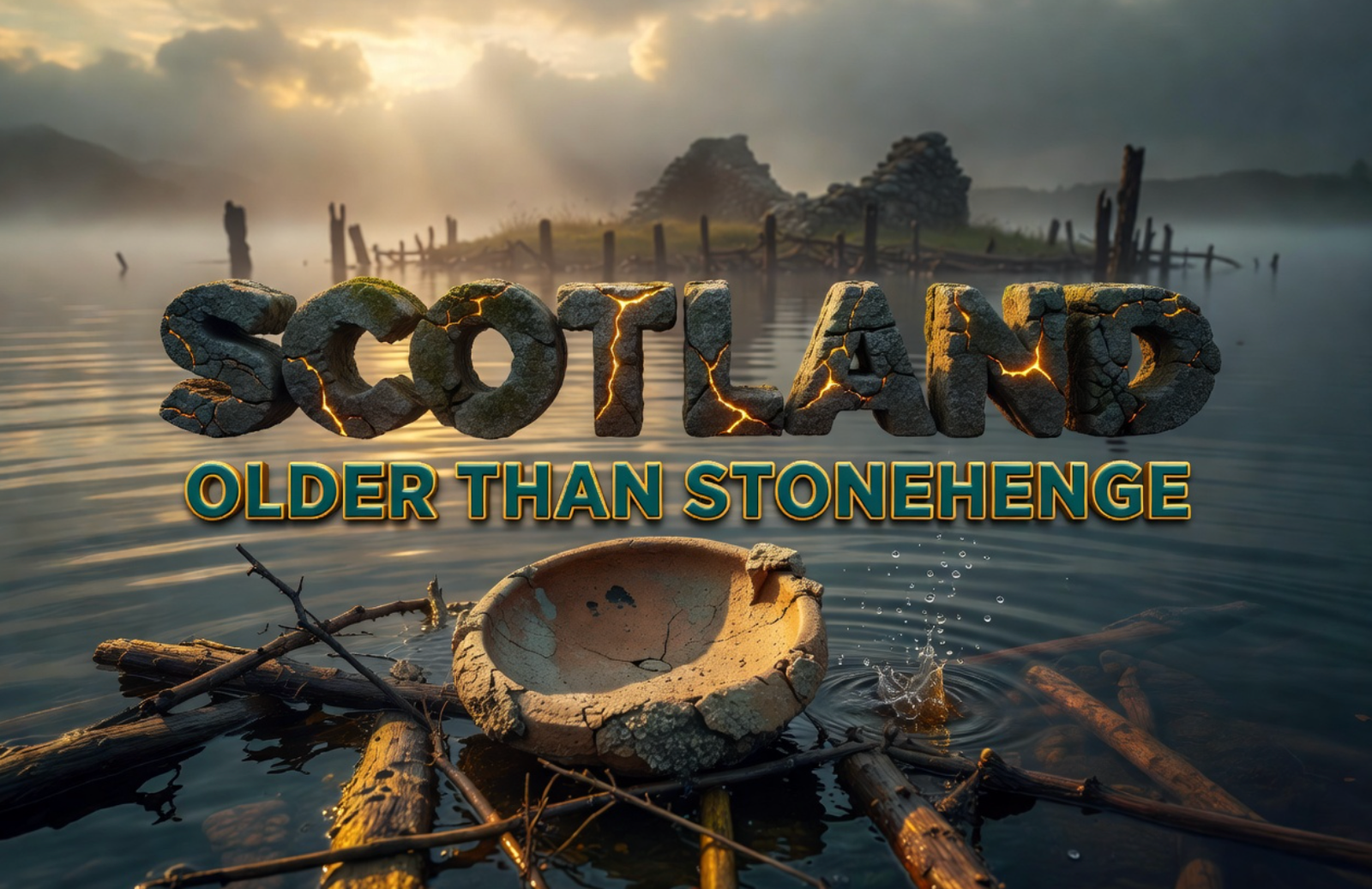
Three Building Phases Shaped the Mysterious Island
What looks today like a quiet stone mound is actually the product of three different generations of builders, separated by thousands of years.
Each phase tells a different story about how people kept returning to the same spot in the loch.
| Phase | Time Period | What Was Added |
|---|---|---|
| 1. Neolithic Base | 3500 to 3300 BC | Circular timber platform, 23 metres wide, topped with brushwood |
| 2. Middle Bronze Age | Around 1500 BC | Another layer of brushwood and stone |
| 3. Iron Age | Around 500 BC | More activity and reshaping of the island |
A stone causeway, now underwater, leads from the loch shore to the island. On a sunny day, you can still spot it just below the surface, like a ghostly stone road leading nowhere.
The fact that people kept coming back across millennia suggests this small patch of water held real meaning. It was a place worth rebuilding, again and again.
Neolithic Pottery Points to Feasting and Ritual Gatherings
During fieldwork, archaeologists uncovered a layered wood and brushwood construction under the stone, and found hundreds of pieces of Neolithic pottery submerged in the surrounding water.
Many of the pots still carried traces of what people once ate there. The clues point clearly to communal meals.
Here is what researchers have pulled from the loch bed over the years:
- Fragments of jars, bowls and cooking vessels
- Burnt residue suggesting food was heated inside the pots
- Lipids from cereals, milk products and meat-based dishes
- Worked stone tools used during gatherings
- Decorated pots that may have served a ceremonial role
Of the estimated 170 crannogs in the island chain, several have yielded large collections of near-complete Neolithic vessels, suggesting systematic, possibly ritualistic, deposition into the water.
“While we still don’t know exactly why these islands were built, the resources and labour required to construct them suggests not only complex communities capable of such feats, but also the great significance of these sites. Large quantities of pottery, often still containing food residue, and worked stone found on and around the islands, suggest their use for communal activities such as cooking or feasting.” Dr Stephanie Blankshein, University of Southampton
Some pots were intact. Some were broken. Many were placed in the water on purpose. That single fact changes the whole picture.
How Scientists Cracked the Shallow Water Puzzle
Studying the crannog was not easy. Shallow water has long been a nightmare zone for archaeologists, too wet for land tools and too murky for deep diving methods.
Principal investigator and director of the Southampton Marine and Maritime Institute, Professor Fraser Sturt, said: “Fine sediments, choppy conditions, floating vegetation and distorted or reflected light all hinder shallow water imaging. “Photogrammetry is very effective in deep water but runs into problems at depths of less than a metre. This problem is a well-known frustration for archaeologists.”
So the team built their own fix. The researchers used two small waterproof cameras with low-light performance and a wide field of view. Locked at a set distance apart on a frame, this “stereo” method provides precise overlapping of imagery, to help compensate for any missing or disrupted data. The cameras were maneuvered through the water by a diver with positioning controlled to centimeter accuracy, matching that achieved by an aerial drone.
The result was a single, seamless 3D model of the island, above and below the waterline. Nothing like it had been done before in such tricky water.
This innovative surveying work represents the first publication from the University of Southampton’s Coastal & Inland Waters Heritage Science Facility. The team’s findings, which reveal how the island looks both above and below the waterline as a unified structure, have been published in the journal Advances in Archaeological Practice.
What This Discovery Means for Prehistoric Scotland
For decades, textbooks placed crannogs firmly in the Iron Age. That picture is now breaking apart.
Although for a long time it was thought that these islets were built, used, and reused mainly between the Iron Age and the post-medieval period, it is now known that some were erected much earlier, during the Neolithic, between 3800 and 3300 BCE.
The dates from Loch Bhorgastail line up with similar finds at other lochs across the Outer Hebrides, suggesting island building was a shared cultural practice, not a one-off project.
“A lot of work went into it, we’ve had a lot of really good dates come out of it, and all the dates are aligning to about 3500 to 3300 BC across all the sites we’re seeing. “So we know that this was an activity that wasn’t just taking place at this site, but other sites nearby and even on other islands throughout the Outer Hebrides.”
The work was triggered by a local. Wood Central understands the academic work was triggered by Lewis resident and local archaeologist Chris Murray, who in 2012 recovered extraordinarily well-preserved Early and Middle Neolithic pots from a loch bed, and who later worked with Mark Elliot of Museum nan Eilean to identify similar collections at five further crannog sites across the island.
That community link matters. Without one curious person spotting something odd in the water, this discovery may never have happened.
The new shallow-water photogrammetry technique will now be applied to other crannogs across the Outer Hebrides, promising to shed further light on these enigmatic “islands of stone” and the ancient people who built them. With hundreds of crannogs still unexplored across Scotland, the method could help reveal more early human activity preserved beneath shallow waters.
The story of the Loch Bhorgastail crannog is more than a tale of old wood and broken pottery. It is a quiet reminder that the people who walked these windswept islands 5,000 years ago were planners, builders and dreamers. They moved logs, hauled stones, lit fires, shared meals and made something that has outlived everything they knew. Standing beside that loch today, knowing what lies beneath, feels like meeting them halfway. What do you think this little island was really used for, a sacred meeting place, a chief’s home, or something we have not yet imagined? Share your thoughts in the comments below.
 ONGC licence frees Venezuela cash and operatorship talks
  Anthropic Hits $65 Billion Run Rate and Flips the AI Cash Test
  Supreme Court grounds the fare free-for-all with three-week clock
  Gold Nears $4400 as Soft Data Meets Oil Inflation Risk
  Nifty Slips as Zaggle Circuits and Dhoot Debuts Big
  Diesel Crack Tops $100 as Iran Rhetoric Lifts Crude