
 Ishan Crawford
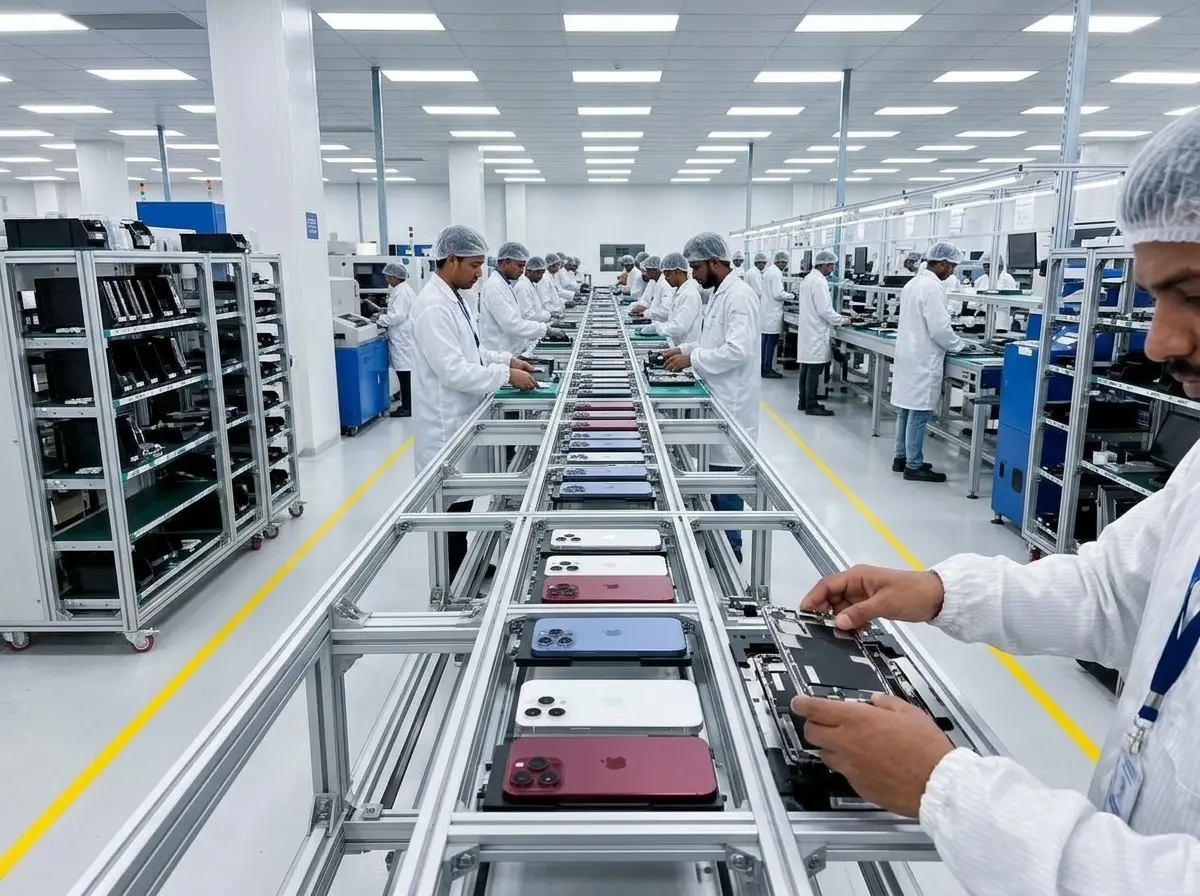
 Apple has started ramping production of the iPhone 18 Pro and Pro Max at its India factories weeks ahead of the expected September launch, directing much of the output toward the US and Europe. Local plants are lifting volumes to match demand and pre-orders, with Foxconn still carrying the bulk and Tata Electronics set for a larger slice of the Pro work than last cycle.
The move deepens India’s role as an export base that can ease tariff pressure on China-sourced phones. At the same time, Apple’s first foldable, expected as the iPhone Ultra, will skip India for its opening production run because of the technical demands of the new form factor.
The early Pro start is not a one-off surge. It fits a pattern in which mature premium models move into Indian lines sooner each cycle, while the newest mechanical designs stay with partners that already hold the deepest process knowledge. Export orientation remains the through-line: factories scale to Western orders first and fill domestic channels from the same runs.
Pro Models Hit Indian Lines Early
Production of the higher-end iPhone 18 Pro and Pro Max is already under way across the five Indian sites. Factories in Tamil Nadu and Karnataka are scaling further in the coming weeks based on orders from India, the United States and parts of Europe. Most of the India-built units are earmarked for export, especially the US, while still covering domestic needs.
Foxconn continues to manage the majority of overall volumes, particularly the units headed overseas. Tata Electronics, by contrast, is moving straight into Pro-model work this year. Last cycle it began with base and consumer variants and only later shifted to Pros. The earlier entry this time gives it a comparatively larger share of the premium lineup even as Foxconn keeps the volume lead.
That split keeps the system balanced. Foxconn’s established lines absorb the heaviest overseas loads. Tata’s earlier Pro start raises the value of the units leaving its three plants without forcing a sudden change in who ships the largest absolute numbers.
- Primary export destinations: United States and parts of Europe
- Domestic channel: still supplied from the same Indian runs
- Volume lead: Foxconn on overall and overseas units
- Premium share gain: Tata through earlier Pro allocation
Tarun Pathak, research director at Counterpoint, said the US and Europe remain two major markets where iPhone demand stays strong. India’s rising export share, he noted, supplies an added cushion against tariff-related pressures.
Pre-order signals will keep guiding weekly output. Plants already running Pro lines can add shifts or open further capacity as those signals firm, rather than waiting for a single global start date to unlock Indian production.
Tata Steps Into Pro Work Sooner
Tata’s faster climb into higher-value assembly sits at the center of the shift. The company now accounts for about a third of iPhone manufacturing inside India and is gaining faster on value and export orders. Pathak described its ramp as one of the quickest among electronics manufacturing services suppliers. Breaking into Apple’s supply chain required a steep learning curve that Tata met through targeted deals.
- Acquisition of Wistron’s India operations in Karnataka
- Controlling 60% stake in Pegatron Technology India announced in January 2025
- Entry into the iPhone 17 Pro lineup last year and rapid model starts after global announcements
Those steps left Tata with two plants in Tamil Nadu and one in Karnataka. Pathak expects the firm to keep posting double-digit growth in production volumes as India’s overall share expands. The earlier Pro assignment this cycle is the clearest sign yet that Apple trusts the local partner with more complex, higher-margin work from day one.
The sequence matters as much as the share. Last cycle Tata proved it could handle base and consumer builds, then stepped into Pros only after that base was secure. This cycle compresses the ladder. Pro work begins with the ramp itself, so value and export mix rise together instead of trailing unit growth by a full generation.
Double-digit volume growth on top of an earlier premium mix compounds the effect inside India. Even while Foxconn holds the volume crown, Tata’s third of local output carries a heavier share of the higher-margin devices that Western markets absorb first.
India’s Share Climbs Toward One in Four
Counterpoint Research projects India will account for 26% of global iPhone production in 2026, up from 6% four years earlier. The five active factories sit in Tamil Nadu and Karnataka. They include Tata’s Hosur site and Foxconn’s hub near Bengaluru airport. Additional capacity expansions at both partners keep feeding the climb.
| Metric | Figure | Source context |
|---|---|---|
| India share of global iPhone output 2026 | 26% | Counterpoint Research |
| Share four years earlier | 6% | Counterpoint Research |
| Tata share inside India | about one third | report cited by Communications Today |
| Active iPhone factories | five | Tamil Nadu and Karnataka |
The progression tracks Apple’s broader diversification away from single-country concentration. Volume still flows heavily through Foxconn’s established lines, yet the mix of partners and the rising export orientation change the risk profile for the whole chain.
A jump from 6% to a projected 26% in four years is steep by handset-assembly standards. It implies sustained capital and process transfer into the same two southern states rather than a thin spread across many regions. Hosur and the Bengaluru-airport hub anchor that concentration, so further expansions there multiply output without rewriting the logistics map each cycle.
Partner mix reinforces the same trend. Foxconn’s scale keeps global fulfilment steady. Tata’s rising third of Indian output adds a second full-stack route for premium devices. Together they turn India from a marginal overflow site into a planned share of worldwide supply.
Exports Build the Real Buffer
Smartphone exports from India, driven largely by iPhones, hit a record $9.84 billion in smartphone exports in the first quarter of the current fiscal year. That marked a 23.4% rise from a year earlier. The United States remained the largest destination. Foxconn’s export shipments rose sharply on the back of iPhone volumes. Smartphones made up 64.8% of India’s $15.2 billion electronics exports in the same April-June window.
Key export markers
- $9.84 billion smartphone export value in Q1 FY27
- 23.4% year-on-year growth
- US as top market
- iPhones more than 75% of recent full-year smartphone export value in earlier data
Pathak’s tariff-cushion point lands here. India-made units headed to the US and Europe give Apple another route if duties on China production climb. The same channel already turned smartphones into the dominant slice of the country’s electronics export total. The Pro ramp simply adds higher-value units to an export machine that is already running hard.
| Export measure | Level | What it shows |
|---|---|---|
| Smartphone exports, Q1 | $9.84 billion | Record quarterly value |
| Year-on-year change | 23.4% | Fast growth on a large base |
| Share of electronics exports | 64.8% of $15.2 billion | Smartphones dominate the category |
| iPhone weight in smartphone exports | more than 75% (earlier full-year data) | Apple drives the run-rate |
When smartphones already account for nearly two-thirds of electronics exports, any shift in iPhone mix toward higher-value Pro units lifts the entire category. The US as top destination means that lift lands first in the market most often cited in tariff discussions. Europe’s share of the same Indian runs widens the buffer beyond a single Western buyer.
Foxconn’s sharp rise in export shipments shows the volume engine is already in place. Tata’s earlier Pro work layers margin onto that engine. The combination matters more than either fact alone: high unit flow plus a richer model mix.
The Foldable Stays Offshore for Now
Apple’s first foldable phone, expected to carry the Ultra name, is unlikely to be built in India during its initial production cycle. Sources cited in the report say the choice rests on the technical expertise required for the new form factor, not on doubts about demand. That approach differs from the Apple Air, which began Indian production in its launch year.
The foldable is still expected to arrive alongside the iPhone 18 Pro models. The standard iPhone 18 is slated for a March 2027 launch. On X, Moneycontrol journalist Danish Khan summarized the same reporting: the decision is driven primarily by the technical expertise required rather than uncertainty over demand. Crowd discussion around the posts treated the deferral as confirmation that India has mastered volume Pro assembly yet still sits behind on the newest mechanical and process challenges.
That gap does not reverse the export gains. It simply marks the current ceiling. Complex new assemblies remain concentrated where the deepest process knowledge already exists, while mature premium models move more freely into the Indian base.
- Apple Air: Indian production in its launch year
- iPhone 18 Pro and Pro Max: Indian lines active weeks before the expected September launch
- Foldable (Ultra): opening run kept outside India on technical grounds
- Standard iPhone 18: separate March 2027 launch window
The contrast is deliberate. Air and the Pro family are extensions of known assembly flows. A first foldable introduces hinge, display and yield problems that Apple prefers to solve in plants that already carry that process depth. Once yields stabilize, later cycles can reopen the location question. For the opening run, the priority is control, not geographic spread.
India Masters Volume Before New Form Factors
The production map now draws a clear line between scale and novelty. India holds five active factories, a projected 26% of global iPhone output by 2026, and an early grip on this cycle’s Pro models. Those assets serve high-volume premium phones bound for the US and Europe. They do not yet absorb the first build of a mechanically novel device.
That ordering is consistent with how the local base grew. Tata moved from base and consumer work into the iPhone 17 Pro lineup last year, then into day-one Pro work this cycle. Foxconn carried bulk export volume throughout. Neither path required solving a brand-new form factor on Indian lines. The foldable deferral simply extends the same logic: prove the process elsewhere, then consider transfer.
Crowd reaction to Danish Khan’s summary treated the split as evidence of maturity rather than failure. Volume Pro assembly is no longer the open question. The open question is when hinge-and-fold process knowledge will follow the same route the Pro models already took. Until then, export value still rises on the phones India does build.
Launch Timing Pulls Production Forward
The September launch window is already framed by the August 26 invite window for the Ternus debut. Starting Indian Pro output weeks ahead of that window gives logistics teams time to move finished units into US and European channels before opening weekend demand hits.
- Weeks before September: Pro and Pro Max lines active across the five Indian sites
- August 26: invite window for the Ternus debut event
- September: expected iPhone 18 Pro launch alongside the foldable’s arrival
- March 2027: standard iPhone 18 launch window
Early calibration to pre-orders reduces the risk of empty shelves in the two largest Western markets. It also lets Foxconn and Tata adjust mix between export and domestic allocations while there is still runway, rather than after the event date freezes expectations.
The foldable’s parallel arrival does not change the Indian schedule. Its offshore build means Indian plants can stay focused on Pro volume through the same window. The standard iPhone 18’s later March 2027 date keeps a second, separate ramp on the horizon once the premium wave is absorbed.
Who Gains Ground and Who Holds the Line
Tata gains the clearest near-term lift: earlier Pro allocation, rising value share, and double-digit volume growth expectations. Foxconn keeps the overall volume crown and the bulk of global-market units. India as a whole locks in a larger slice of Apple’s premium output and a stronger export buffer. US and European buyers receive phones assembled farther from single-country tariff risk. Advanced foldable specialists outside India retain the first-cycle work.
India’s share of iPhone exports is rising, and the ramp-up in production from India would provide additional cushion against tariff-related pressures.
Pathak’s assessment captures the second-order effect. The Pro ramp is not only about meeting September demand. It hardens a supply route that already delivered record export numbers and gives Apple more flexibility on the highest-volume premium devices. Parallel supply-chain moves, such as Apple’s tests of CXMT memory chips amid shortage pressures, show the company testing multiple hedges at once.
Geography and components move on separate tracks. Indian assembly hedges tariff and concentration risk on finished phones. Memory tests hedge supply stress inside the bill of materials. Neither replaces the other; together they widen the set of options Apple can use when any single input tightens.
The September launch window itself is already framed by the August 26 invite timing. India-built Pros will form part of the stock that reaches those markets. The foldable’s offshore start keeps one premium tier elsewhere, yet the volume and export engine in India continues to expand underneath it.
Factories will keep calibrating output to pre-orders in the weeks ahead. The numbers already show the direction of travel: higher Indian share, earlier Tata Pro work, and a growing cushion for the two largest Western markets.
What holds steady is the division of labour. Foxconn defends scale. Tata climbs the value ladder. India deepens its role as an export platform. The foldable waits on process depth that has not yet transferred. Each piece reinforces the others without erasing the limits still in place.
 Hormuz Stalemate Masks Products Squeeze Toward $120 Oil
  Shiprocket IPO Heat Masks Float Risk and Adjusted Losses
  Oil Relief Meets Drone Tariffs as Nifty Turns Macro
  Scotland’s Drug Deaths Drop Then Rebound as Recovery Lags
  FPIs Exit 60% of IPO Anchors in a Year as Domestic Funds Hold Firmer
  Domestic Winners Outrun Tata PV Drag on Friday Focus List