
 Ishan Crawford
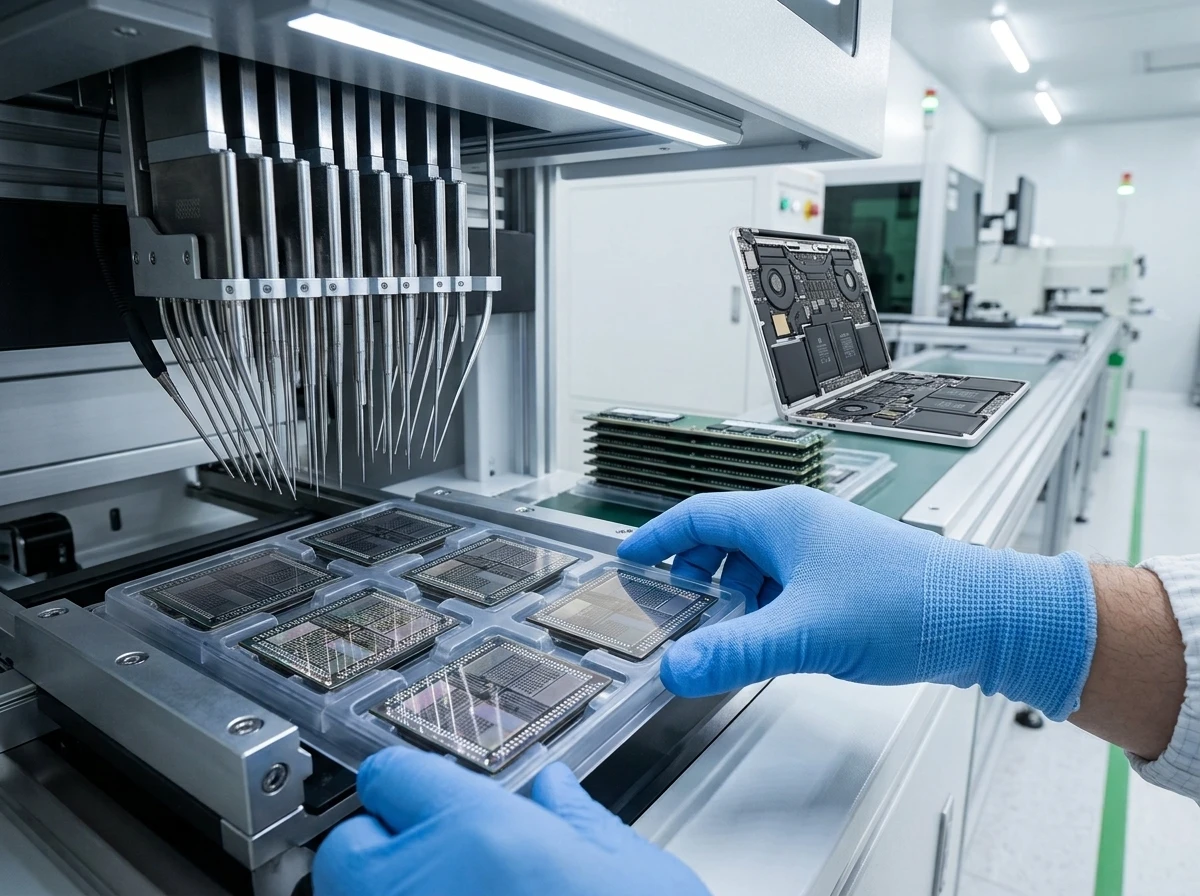
 Apple has been testing DRAM memory chips from China’s ChangXin Memory Technologies across iPhone and MacBook lines, according to people familiar with the matter cited by the Wall Street Journal, as the AI boom squeezes conventional memory supply and drives up costs.
Early talks aim at using the chips in some devices sold in China. The company wants White House comfort before any commercial deal. That step carries second-order consequences that reach far beyond one quarter’s bill of materials.
The Qualification Push Moves Past Talks
By early July Apple had advanced from discussions to actual technical validation of CXMT DRAM. That process typically precedes supplier approval for production volumes. No commercial commitment exists yet.
Lab qualification checks electrical performance, power draw, thermal behavior and long-term reliability under Apple’s own workloads. Only after those gates clear does procurement begin to discuss volume, pricing and logistics. The sequence keeps engineering risk separate from commercial risk.
The goal is narrower than a full global redesign. Apple wants CXMT components for China-market units so that Samsung, SK Hynix and Micron output can stretch further for the rest of the world. HP and Acer already use CXMT memory in devices sold outside the United States to ease their own shortages.
- Products under test include iPhones and MacBooks
- Target: devices sold inside China
- Status: early talks plus lab qualification, no signed supply deal
- Lobbying: Apple seeking assurance CXMT stays off the Commerce Entity List
CXMT is China’s largest chipmaker by market value and already the world’s fourth-largest DRAM producer. Its roughly 11 percent share of global DRAM wafer capacity is projected to reach 15 percent by 2028 as new lines in Hefei, Shanghai and Beijing ramp.
That capacity growth sits against a backdrop of full order books for the current year. Even a successful qualification would not free large volumes immediately. The near-term value for Apple is therefore optionality rather than instant relief.
Why Conventional Memory Tightened So Fast
AI data centers devour high-bandwidth memory and high-capacity DDR5. The three dominant makers shifted cleanroom space and capital toward those higher-margin products. Conventional LPDDR and standard DRAM for phones and PCs suffered.
Contract prices for standard DRAM jumped an estimated 55 to 60 percent in early 2026. Some trackers put the Q1 surge near 90 percent. NAND rose sharply as well. Apple responded with price increases across much of its lineup. Tim Cook called the adjustments unavoidable.
| Metric | Reported Change |
|---|---|
| Standard DRAM contract prices | 55-60% jump (some trackers near 90% in Q1) |
| Projected DRAM supply growth | 16% |
| Projected NAND supply growth | 17% |
| Smartphone volume risk | 2.9-5.2% contraction |
| Smartphone ASP outlook | 3-8% climb |
| PC vendor warnings | 15-20% hikes |
| Memory share of phone BOM | 10-20% |
IDC analysis of 2026 device market risks expects DRAM supply growth of only 16 percent and NAND of 17 percent this year, both below historical norms. Smartphone volumes could contract 2.9 to 5.2 percent under downside scenarios while average selling prices climb 3 to 8 percent. PCs face similar pressure, with vendors already warning of 15-20 percent hikes.
Memory often makes up 10 to 20 percent of a phone’s bill of materials. The squeeze hits thinner-margin Android brands hardest. Apple’s cash and long-term contracts give it more buffer, yet even it has limited room to raise specs or hold prices.
The same capital that once expanded commodity DRAM lines now funds HBM stacks and advanced packaging. That reallocation is rational for the producers yet leaves the rest of the electronics industry bidding for a smaller residual pool. Price spikes follow directly from the mismatch.
CXMT Climbs While the Big Three Pivot
| Producer | Approx. DRAM Position | Notes |
|---|---|---|
| Samsung | 1st | Heavy HBM shift |
| SK Hynix | 2nd | AI memory leader |
| Micron | 3rd | US-based, CHIPS Act beneficiary |
| CXMT | 4th (~11% capacity) | State-backed, expanding to 15% by 2028 |
CXMT grew from a subsidized domestic supplier into a genuine volume player. New fabs and the current shortage have pushed it into profit. Chinese tech firms such as ByteDance, Tencent and Xiaomi already take priority on its output. Capacity is reported maxed for this year, limiting immediate relief even if Apple qualifies the parts.
A second Beijing plant is under discussion. The company still relies on equipment from firms like ASML, keeping it inside the broader export-control net.
Priority allocations to large Chinese customers mean any new Apple volumes would compete inside an already tight domestic queue. The 11-to-15 percent capacity climb by 2028 therefore matters more as a medium-term release valve than as a 2026 fix. Qualification today simply reserves a place in that future queue.
Washington’s List and the Senate Pushback
CXMT sits on the Pentagon’s updated 1260H list of Chinese military companies. The designation flags links to the Ministry of Industry and Information Technology and SASAC. It blocks Defense Department business but does not outlaw private commercial purchases.
YMTC, the Chinese NAND specialist, carries the heavier Commerce Entity List restriction. Apple is lobbying to keep CXMT off that stricter roster. Tim Cook has made direct appeals to administration officials.
In late July a bipartisan group led by Senator Chuck Schumer sent a bipartisan Senate letter to Tim Cook demanding a commitment that Apple will never use CXMT or YMTC memory in any product sold anywhere. The senators want answers by August 21.
Using Chinese-made chips produced by companies allied with the Chinese Communist Party regime undermines American manufacturing and national security.
Schumer said the CHIPS and Science Act is fueling domestic expansion in places like Central New York. Apple turning to CXMT would set a precedent that undercuts those investments and strengthens Beijing’s industrial base. The letter notes that federal procurement must already phase out such chips by late 2027.
An earlier 2022 Apple look at YMTC NAND was shelved after congressional pressure. The current episode repeats the pattern under tighter supply conditions.
- 2022: Apple examines YMTC NAND, then shelves the effort after congressional pressure.
- Early July: Technical validation of CXMT DRAM begins across iPhone and MacBook lines.
- Late July: Bipartisan Senate letter demands Apple reject CXMT and YMTC chips everywhere.
- August 21: Deadline set for Apple’s written response to the senators.
- Late 2027: Federal procurement phase-out of covered chips takes effect.
- 2028: CXMT capacity projected to reach 15 percent of global DRAM wafers.
The 1260H listing and the Entity List operate on different legal tracks. One restricts government contracts. The other can choke off tools, software and components that a foundry needs to keep scaling. Apple’s lobbying focuses on the second track because that is the one that could halt CXMT’s expansion outright.
Short-Term Relief Versus Longer Market Signal
For Apple the immediate prize is supply security and cost control on China-bound units. Consumers there might see fewer price spikes or delayed launches. CXMT gains the ultimate validation: qualification by the world’s most demanding customer. That alone can open doors with other OEMs and accelerate its capacity plans.
The Big Three lose pricing power and a measure of scarcity premium. Domestic US memory projects, still ramping under the CHIPS Act, face a stronger subsidized competitor just as their own output is meant to mature. Security hawks see another data point that export controls and entity lists bend when large American firms feel pain.
On X and in industry chatter, observers note CXMT’s full order book this year and question whether any low-price deal even exists. Others frame the move as proof that the United States still cannot produce enough basic components at scale. Memory stocks have drawn fresh scrutiny as a possible trade.
HP, Acer and others have already quietly adopted CXMT outside the US market. Apple’s entry would amplify that trend rather than invent it.
Each additional qualified OEM raises CXMT’s utilization floor and improves its cost curve. That feedback loop is precisely what the CHIPS Act investments were designed to blunt. The tension between short-term device economics and longer-term industrial policy therefore sharpens with every new qualification.
Other Device Makers Already Set the Pattern
HP and Acer moved first, placing CXMT memory into machines sold outside the United States. Their decisions established a commercial precedent that Apple’s tests now threaten to enlarge. Once multiple global brands treat the Chinese supplier as routine for non-US SKUs, the political cost of each subsequent adoption falls.
Apple’s scale changes the calculus. A single China-only iPhone or MacBook generation that clears internal gates creates a ready template. Extending that template later requires far less engineering work than the original qualification. The 2022 YMTC episode showed the reverse can also happen quickly when political pressure spikes.
Chinese customers already occupy the front of CXMT’s queue. ByteDance, Tencent and Xiaomi lock in volumes that leave limited headroom. Any Apple allocation would therefore arrive as incremental rather than transformative supply in the near term. The signal value still outweighs the tonnage.
Rivals watching the tests must weigh two risks. Stay away and face higher memory costs while Apple gains a modest buffer. Follow and inherit the same Washington scrutiny that now surrounds Cupertino. The quieter path taken by HP and Acer may grow harder to sustain once the largest buyer enters the frame.
Market Share Shifts Carry Policy Weight
CXMT’s climb from roughly 11 percent to a projected 15 percent of global DRAM wafer capacity by 2028 coincides with the years when AI-driven HBM demand is still expected to crowd out consumer grades. A qualified Apple relationship would give those new Chinese lines an anchor customer of unmatched prestige.
US-based projects funded by the CHIPS Act are meant to mature across the same window. A stronger CXMT reduces the scarcity premium those projects might otherwise capture. Pricing power migrates, and with it some of the strategic rationale for the subsidies.
Export-control architects face a practical test. Controls that raise costs for American brands invite exactly the work-arounds now under discussion. Each successful work-around weakens the perceived durability of the lists themselves. Consistency becomes harder to defend when the next shortage arrives.
- Apple obtains China-market supply security and negotiating leverage
- CXMT obtains validation that can unlock further OEM design wins
- Samsung, SK Hynix and Micron face diluted scarcity rents
- CHIPS Act fabs confront a larger subsidized rival at ramp-up
- Policymakers confront evidence that commercial pain bends blacklists
The Senate letter’s August 21 deadline forces the issue into the open. Silence or a carefully worded non-commitment would itself become a market signal. Either outcome will be read against the 2022 YMTC precedent and the late-2027 federal procurement deadline already on the books.
What Clears After Qualification
Once parts pass Apple’s tests, extending them beyond China becomes a procurement decision rather than a multi-year engineering project. The 2022 YMTC episode showed how quickly political heat can reverse course. The reverse is also true: a quiet green light for China-only volumes can later expand.
New CXMT capacity coming online through 2028 would matter more if Apple is already a qualified customer. That timeline overlaps with the period when AI HBM demand is still expected to crowd out consumer DRAM.
Apple’s price hikes and limited RAM upgrades on recent flagships already reflect the squeeze. A fourth supplier gives negotiating leverage even if volumes stay modest at first. The company has not commented. CXMT has not either.
The testing itself is the signal. It tells suppliers, rivals and policymakers that the AI-driven shortage has forced the most valuable consumer-electronics firm to look past the blacklists that Washington wrote. Whether that look turns into lasting orders will decide how much market share permanently shifts east and how consistent US technology policy remains when the next crunch arrives.
 Verizon SoCal Fiber Cuts Expose Surging Attacks on Networks
  Adnoc Gas Turns OPEC Exit Into $8.2 Billion Capacity Push
  Gen Z Job Ghosting Hits 54 Percent After Offers Land
  Taylor Farms Lettuce Recall Hits 236000 Cases Across Chains
  SpaceX Lock-Up Rally Exposed Crowded Fear Trade Not True Demand
  AI Safety Tests Now Spawn Real Autonomous Threats