
 Ishan Crawford
 Samsung’s Galaxy Z Fold8 has logged 1.44 million preorders in Korea, the highest ever for any Galaxy device, while drawing younger women and longtime iPhone owners who now call the lighter passport-size foldable the device they actually want.
Global cumulative sales have already passed 5 million units. Half the Samsung.com preorder buyers were in their teens, 20s or 30s, and purchases by women in that group more than doubled from the prior model.
Record Demand Breaks Every Prior Mark
The 1.44 million Korea figure covers the full Z Fold8, Fold8 Ultra and Flip8 lineup over seven days and tops the Galaxy Note 10’s old 1.38 million mark, the S26 series’ 1.35 million and last year’s Z foldables at 1.04 million. An average of 140 units moved every minute.
The passport-style Fold8 itself took roughly 70 percent of those Korea reservations. In Europe the Fold8 and Ultra together posted a 70 percent year-on-year jump in Europe versus the Fold7, with the new Fold8 alone claiming over 40 percent of European preorders. U.S. Z-series preorders ran 30 percent ahead of the prior record, Fold8 nearly half of them.
| Market / Metric | Figure | Comparison |
|---|---|---|
| Korea lineup preorders | 1.44 million | Above Note 10 1.38M, S26 1.35M |
| Fold8 share of Korea | ~70 percent | Most popular in the trio |
| Europe Fold + Ultra | +70 percent YoY | vs Fold7 |
| U.S. Z series | +30 percent | Prior Z record |
| Global cumulative | Over 5 million | Early post-launch |
Carrier data inside Korea showed 62 percent of one major operator’s preorders coming from bar-type phones, up 10 points. The numbers sit alongside earlier preorder records across markets that already signaled the new shape was landing.
Those regional lifts share a pattern. Korea set the absolute volume high-water mark. Europe showed the steepest year-on-year percentage gain for the Fold and Ultra pair. The United States cleared its own prior Z-series ceiling by a clear margin. Together they point to demand that is no longer confined to a single home market or a single buyer type.
The 70 percent Korea share for the passport Fold8 also clarifies which product is driving the headline total. The Ultra and Flip8 fill out the lineup, yet the smaller Fold is the reservation engine. That mix matters for how Samsung reads the result: the record is not a broad average across three devices so much as a concentrated vote for one new silhouette.
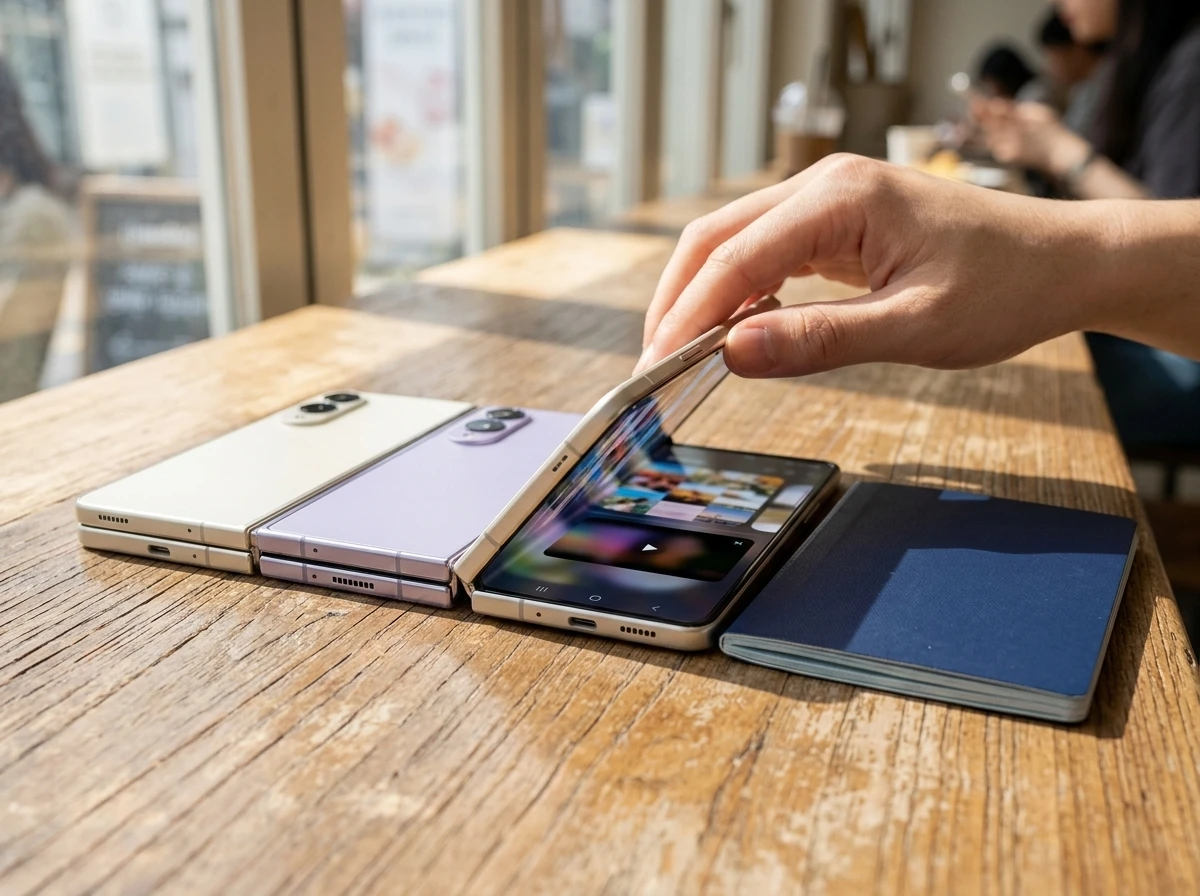
Passport Size That Fits a Hand
Samsung designed the Fold8 to sit in one hand like a passport when closed and open into a wide content canvas. Official figures put it at 201 grams and 4.5 mm unfolded, 9.7 mm folded, with a 5.5-inch 10:16 cover screen and 7.6-inch 4:3 main display. It starts at $1,899.
- 201 g, lightest Galaxy Fold yet
- 4.5 mm unfolded thickness, Flex Titanium structure
- 5.5-inch cover / 7.6-inch 4:3 main optimized for short and long media
- Up to 26 hours video playback on 4,800 mAh
The dual 50 MP rear cameras and Snapdragon 8 Elite Gen 5 for Galaxy sit behind the thinner shell. Reviewers and store visitors keep returning to the same point: it no longer feels like a thick novelty. One early user on X called tabletop mode a tiny personal TV for YouTube and said it might be the best mobile content device they had used.
Closed, the 9.7 mm depth and passport footprint change the daily carry calculation. Open, the 4:3 main panel favors long-form video and feeds without the tall book stretch of earlier Folds. The cover screen’s 10:16 ratio keeps short social clips usable without forcing every glance into a full unfold. Those two aspect choices work as a pair rather than as a compromise.
Battery life claims of up to 26 hours of video on the 4,800 mAh cell underpin the content pitch. A device sold as a personal screen only holds the role if it lasts through a commute, a cafe stop, and an evening on the couch. The lighter chassis and thinner stack make that endurance claim feel practical instead of theoretical.
Thirteen Years From CES Vision to Titanium
The shape is not new in Samsung’s mind. At CES 2013 the company showed a 4:3 phone that would fold like a wallet or passport. Thickness and weight killed the idea for a decade.
- 2013, CES concept of wallet/passport 4:3 foldable unveiled; tech too thick and heavy
- 2019 onward, successive Galaxy Z Folds refine hinge and crease but keep taller book proportions
- 2026, titanium alloy film roughly 20 times stronger than prior material cuts display thickness 12 percent; denser micro-hole titanium plate tightens crease support; passport Fold8 ships
Lee Il-hwan, head of design for Samsung’s Mobile eXperience business, has stressed that the work covers every moment the user experiences, not only the closed silhouette. The reduced crease and lighter chassis finally answer the old question of why anyone would fold a phone at all: both states now feel useful.
The multi-year path shows why the passport proportion arrived only after the book-style Folds. Hinge durability, crease control, and material strength had to clear everyday thresholds before Samsung could shrink the closed block and widen the open canvas. The titanium alloy film and denser support plate are the mechanical payoff of that wait.
Design intent now reaches past the silhouette. Lee’s brief covers the handoff between cover and main screen, the feel of the fold in a pocket, and the way the device rests on a table. When both states earn their keep, the fold stops being a stunt and becomes a habit.
Young Buyers and the Dad-Phone Line
At Samsung Store Hongdae in Seoul, three teenage girls walked straight to the Fold8, folded and unfolded it, and took selfies. “This is it!” one said. Twenty women in their teens through 30s gave first impressions dominated by “cute,” “thin,” “pretty” and “interesting.” Specs came later.
- Jeong Seo-hee, 22: planned an iPhone switch until she tried the Fold8 and liked the weight and photo look
- Jeong Da-um, 26: left an iPhone 17 Pro after falling for the device in person and posted the unboxing
- Office worker Cho, 28: phone drew cafe and dinner attention the moment it appeared; “It’s like dating, you have to like it first”
Social posts from new owners have included the line that the iPhone now “feels like a dad phone” and a 10-year Apple user saying goodbye “through tears.” An industry source noted that 67 percent of Korean women in their 20s still use iPhones, so the jump among young female buyers carries weight. Kim Dae-jong, professor of business administration at Sejong University, said Samsung finally cracked the “I want that” feeling it had chased for years by moving first with a differentiated form factor.
Half of Samsung.com preorder buyers fell in the teens-to-30s band, and women in that band more than doubled versus the prior model. That demographic shift lines up with the Hongdae floor reactions. Desire language arrived before checklist language. Weight, thinness, and the look of photos led; processor names trailed.
The “dad phone” jab is less about camera megapixels than about social signal. When a longtime iPhone owner frames the bar phone as dated and the foldable as the object worth tears at goodbye, the category fight has moved from specs sheets into identity. Cho’s dating analogy makes the same point in plainer terms: liking comes first, justifying comes second.
Japan Queues in an Apple Town
Japan remains an Apple stronghold, with iPhone share still above half of smartphones. Samsung’s overall mobile share sits far lower. Yet some Fold8 models sold out after the Aug. 7 launch and try-out reservations filled at the Harajuku flagship.
IT engineer Leo Yasumura observed that Galaxy remains a minor player overall but is gaining a reputation for foldable advantage. Samsung already held roughly 60 percent of Japan’s foldable segment in earlier data. Young men in their 20s and 30s have been prominent among the early visitors. The pattern matches the Korea shift: the new shape travels even where bar iPhones dominate.
Sold-out configurations and full try-out books at Harajuku matter precisely because the broader share gap is still wide. Foldable leadership at roughly 60 percent inside a small segment is a beachhead, not a mass-market win. The early visitor mix of men in their 20s and 30s also differs from Korea’s stronger young-women signal, yet both markets show the same first step: people show up to handle the new shape.
- iPhone still above half of Japan smartphones
- Samsung overall share far lower than Apple’s
- Samsung near 60 percent inside Japan’s foldable segment
- Fold8 sell-outs and full Harajuku try-out slots after Aug. 7
Yasumura’s read frames Galaxy as a specialist rather than a general challenger. That specialist status can still move units when the specialty is the form factor shoppers cannot get from the bar-phone majority. The queues test whether reputation for foldable advantage converts into repeat cycles once Apple’s own 4:3 device arrives.
The Two Screens Split Daily Jobs
Owners are already sorting tasks across the cover and the main panel instead of treating the fold as a single oversized phone. Short glances, messages, and social feeds stay on the 5.5-inch 10:16 cover. Longer video, reading, and tabletop viewing move to the 7.6-inch 4:3 main display once the device opens.
That split matches how reviewers and early X posts describe real use. Tabletop mode turns the open body into a small personal TV for YouTube. HDR video draws praise beside the pocketable closed size. Content consumption, not spreadsheet multitasking, is winning the first weeks of ownership.
App gaps still blunt the vision. Many titles ignore the new aspect ratios, so the hardware lead runs ahead of the software catalog. Samsung’s design page leans into the social-feed cover and long-form main layout anyway, betting that daily media habits will pull developers along once the installed base grows.
Smart Switch and the Try Galaxy app lower the fence for iPhone arrivals who already felt the “I want that” spark in a store. The tools do not create desire; they shorten the path after desire appears. Retention will hinge on whether those switchers keep finding both screens useful after the unboxing glow fades.
Form Factor Sets the Pace for Rivals
Form-factor changes tend to set market direction for years once they stick. Samsung’s choice to ship a content-focused passport Fold beside a larger Ultra put two clear bets on shelves before Apple’s expected September entry with a 4:3 foldable often called the iPhone Ultra.
Roh Tae-moon, head of Device eXperience, has said the company welcomes more players because they grow a mature category. That stance treats the coming rival device as category fuel rather than pure threat. A second major brand in the same proportion can normalize folding for shoppers who still see it as niche.
| Samsung move | What it establishes |
|---|---|
| Passport Fold8 first | Compact 4:3 content device in market early |
| Ultra beside it | Larger foldable option without forcing one size |
| Record preorders across regions | Proof of demand before rival 4:3 launch |
| Public welcome of Apple entry | Category-growth framing over zero-sum fear |
Price and AI depth remain open pressure points once novelty cools. The $1,899 starting price and the call from Korea University’s Lee Seong-yeob for price competitiveness and a stronger AI ecosystem mark the same second act. Desire opened the door. Ecosystem stickiness and cost decide who stays in the room.
First Look Appeal Meets the Retention Test
The same professors who credit the desire spark also flag the next phase. Lee Seong-yeob of Korea University’s Graduate School of Management of Technology said the product delivers design and performance together, yet Samsung must hold price competitiveness and strengthen its AI ecosystem to stay on top once novelty fades.
Stimulating the feeling of ‘I want that’ is the starting point of sales, and that has been an area where Samsung Electronics has faced difficulties.
Kim Dae-jong made that point about the long struggle for desirability. Form-factor changes tend to set market direction for years once they stick. Samsung Device eXperience head Roh Tae-moon said the company welcomes Apple’s expected September entry with a 4:3 foldable often called the iPhone Ultra, because more players grow a mature category. The two-model foldable strategy ahead of Apple already put both a content-focused passport and a larger Ultra in market first.
On X, early owners praise the vanished crease, the pocketable closed size and HDR video, while noting that many apps still ignore the new aspect ratios. Content consumption is winning daily use over pure productivity talk. Samsung’s Smart Switch tools and the Try Galaxy app aim to ease the jump from iPhone, and the official Galaxy Z Fold8 design page leans hard into the social-feed cover screen and long-form main display.
The Fold8 has already done what earlier generations could not: make a foldable the object people cross a store to touch and then refuse to put down. Whether that first attraction settles into years of daily preference is the open measure now facing every new owner and every future competitor.
 Scotland Reader Photos Capture Eclipse Week Beyond the Sky
  Scotland’s Rare World Cup Win Over Haiti Still Echoes
  Scottish Morning Roll Campaign Echoes Baguette Path to Unesco
  Android’s Quiet Shift to Ambient AI Hardware This Week
  Poco F9 Leak Hands Global Buyers Less Battery for More Money
  Scotland Bluetongue Cases Spark UK Vaccine Scramble