
 Ishan Crawford
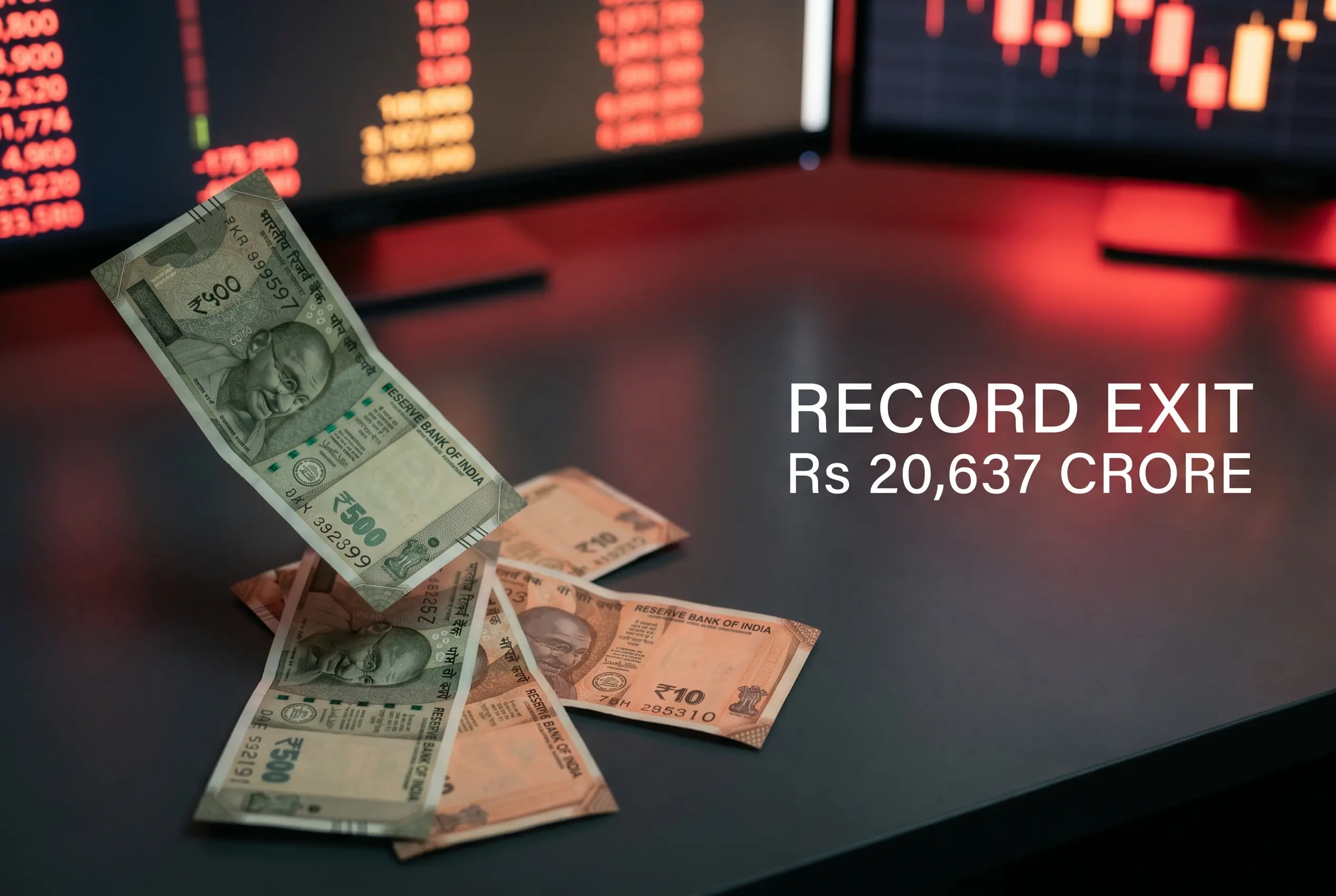
 Foreign investors dumped a net Rs 20,637 crore (roughly $2.3 billion) worth of Indian shares on Friday, the largest single-session selloff by foreign portfolio investors (FPIs, the overseas funds that trade Indian equities) on record, as a close-of-trade rebalancing by index provider MSCI forced passive funds to reshuffle holdings worth billions. The Sensex closed down 1,092 points, or about 1.44%, at 74,776, and the Nifty50 shed roughly 1.5% to settle near 23,548.
The headline number hides as much as it shows. By the estimate of the brokerage that tracks these flows most closely, only about Rs 8,000 to Rs 8,500 crore of Friday’s exit reflected genuine index-driven repositioning. The rest sits in a grey zone of high-speed churn that has some of India’s biggest fund managers asking what they actually witnessed.
A Record Outflow Built on Record Turnover
The Rs 20,637 crore figure narrowly beat the previous record set on April 2, when FPIs pulled Rs 19,837 crore in a day, according to ACE Equity data. What made Friday stand out was not just the net number but the volume that produced it.
FPIs accounted for Rs 198,465 crore of trading on the National Stock Exchange (NSE), out of a total market turnover of Rs 287,452 crore. That is nearly 69% of the entire day’s traded value flowing through foreign hands, per provisional NSE figures. Yet the net selling of Rs 20,637 crore was a fraction of that gross activity. Foreign desks traded close to 9.6 times their net position during the session.
Domestic institutional investors (DIIs, the mutual funds and insurers that anchor local demand) moved very differently. They bought a net Rs 16,260 crore on Rs 53,772 crore of gross trades, or about 3.3 times their net purchases. The gap between the two ratios is the whole story.
| Metric | FPIs | DIIs |
|---|---|---|
| Net position (Friday) | Sold Rs 20,637 crore | Bought Rs 16,260 crore |
| Gross turnover | Rs 198,465 crore | Rs 53,772 crore |
| Turnover-to-net ratio | 9.6x | 3.3x |
| Share of NSE turnover | Nearly 69% | About 19% |
How Much of the Exit Was Genuine Repositioning
This is where the consensus reading falls short. A record outflow implies foreigners decided, in one session, to cut their India exposure by Rs 20,637 crore. The flow data says otherwise.
Abhilash Pagaria, head of alternative and quantitative research at Nuvama Wealth, put the rebalancing-driven outflow at around Rs 8,000 to Rs 8,500 crore. He described it as a one-time adjustment, somewhat larger than usual because of free-float changes (the portion of a company’s shares actually available to public investors) in heavyweight names. When MSCI tweaks how it measures free float, every passive fund tracking the benchmark has to follow, all at once.
That leaves a wide gap between the genuine index flow and the Rs 20,637 crore print. Market estimates pegged the passive selling tied to the reshuffle at close to $1 billion, or a little over Rs 9,000 crore. Everything beyond that was the by-product of how the trade got executed, not a verdict on Indian equities.
- Rs 8,000 to 8,500 crore in genuine MSCI repositioning, per Nuvama’s estimate
- Around $1 billion in passive selling tied to the index change
- 9.6x the net figure traded gross by FPIs during the session
- Free-float adjustments in Bajaj Finance, Hindustan Unilever and Tata Consultancy Services drove the larger-than-usual flow
What the MSCI Review Changed
The reshuffle that triggered all this took effect at the close of trade on May 29. On paper, the changes were modest. India’s overall weight in the MSCI Standard Index held broadly steady at about 12.3%, down a notch from 12.4%, and the country’s constituent count stayed at 165.
The Standard Index Reshuffle
Four stocks joined the Standard Index and four left it. The additions and weight bumps drove the inflow side; the deletions drove the selling.
- Added: Federal Bank, MCX, NALCO and Indian Bank
- Removed: Hyundai Motor India, Jubilant FoodWorks, Kalyan Jewellers and Rail Vikas Nigam
- Weight increases: Adani Power, BPCL, Nykaa, Trent and Oracle Financial Services Software
The four new entrants were expected to draw passive inflows of about $1.38 billion combined, with Federal Bank set to absorb roughly $491 million, MCX about $373 million, NALCO around $308 million and Indian Bank near $209 million, based on brokerage estimates circulated ahead of the review.
The Small Cap Cull
The bigger churn happened below the large-cap tier. MSCI cut its India Small Cap roster to 459 names from 474, a heavier-than-usual purge that reflected months of weakness in the smallcap segment. Newcomers included IREDA (Indian Renewable Energy Development Agency), Anthem Biosciences, Fractal Analytics, Pine Labs and Emmvee Photovoltaic. Among those dropped were Cello World, Redtape, Raymond Lifestyle, Indigo Paints, Balu Forge and Blue Jet Healthcare. You can track the live composition on the MSCI India Small Cap Index fact sheet.
The High-Frequency Trading Question
If only about Rs 8,500 crore was real repositioning, what explains the Rs 198,465 crore of foreign turnover? That question put high-frequency trading (HFT, the algorithm-driven strategies that fire thousands of orders a second) at the centre of the debate.
Nilesh Shah, managing director of Kotak Mahindra Asset Management, openly questioned whether Friday’s volumes made sense given that Indian equities are not currently a priority for foreign funds. He asked whether the surge was driven purely by the MSCI rebalancing or whether HFT activity around the reshuffle had amplified turnover, and how much of the reported Rs 20,637 crore net outflow could be pinned on those high-speed trades. The full breakdown of daily foreign and domestic activity is published on the exchange’s own daily FII and DII trading dashboard.
Market commentator Gurmeet Chadha went further, arguing that speed and money muscle were being used to distort price moves. He flagged the addition of 31,000 short contracts even as Brent crude hovered near $90 a barrel and hopes of a weekend deal persisted, calling the activity suspicious.
We need to act and trap this cartel.
That was Chadha’s call to regulators, and it captures the unease: when foreign desks control 69% of turnover on a rebalance day, the line between legitimate index tracking and opportunistic churn gets hard to draw.
Why Domestic Money Kept Markets From Breaking
For all the noise around the foreign exit, the index fell only about 1.5%. The reason sits on the other side of the ledger. Friday’s net DII purchase of Rs 16,260 crore was itself a record for a single session, and it absorbed most of what the foreigners threw out.
That pattern has defined 2026. FPI outflows crossed roughly Rs 1.92 trillion in the first four months of the year alone, already exceeding the full-year 2025 outflow and ranking among the worst stretches since foreign portfolio investing in Indian shares was permitted in 1993. Domestic funds, powered by steady systematic investment plan (SIP, the monthly retail mutual fund contributions) inflows, soaked up close to 90% of that selling.
The structural shift is the part that outlasts any single rebalance. Foreign ownership of Indian equities has slipped to roughly 16%, the lowest in nearly two decades, and now sits below domestic institutional ownership. A record one-day foreign exit that the market barely flinched at is the clearest evidence yet of how far the balance of power has moved toward local capital. The cumulative foreign tally is updated on the NSDL foreign portfolio investment reports page.
What the Next Index Review Will Show
Friday handed regulators a clean data point. A rebalance that moved India’s weight by a tenth of a percentage point still generated Rs 198,465 crore of foreign turnover and a record net outflow, most of which had little to do with anyone’s view on India.
If the next MSCI review lands without the free-float overhaul that inflated this print, the passive flow should shrink back toward its usual few thousand crore, and the cartel talk fades with it. If turnover spikes again on a quiet rebalance day, the case that high-speed trading, not foreign conviction, is driving these record numbers gets a lot harder to dismiss, and the Rs 198,465 crore becomes a figure someone has to explain.
 ONGC licence frees Venezuela cash and operatorship talks
  Anthropic Hits $65 Billion Run Rate and Flips the AI Cash Test
  Supreme Court grounds the fare free-for-all with three-week clock
  Gold Nears $4400 as Soft Data Meets Oil Inflation Risk
  Nifty Slips as Zaggle Circuits and Dhoot Debuts Big
  Diesel Crack Tops $100 as Iran Rhetoric Lifts Crude