
 Ishan Crawford
 Saudi Arabia’s only pipeline bypass around the Strait of Hormuz is running close to its practical ceiling, and markets are only now pricing in that it has almost no spare room left to absorb a second closure. Brent crude jumped nearly 15% last week to a five-week high of $88.3 a barrel. Gold barely held $4,000 an ounce and still lost 2.5% for the week, while silver fell more than 7%.
Most of the week’s coverage centered on the seventh straight night of US strikes on Iran and Tehran’s decision to formally suspend its memorandum of understanding with Washington. Fewer noticed that the one structural workaround built to keep Gulf oil flowing around any Hormuz blockade is already stretched thin, just as Iran-aligned Houthi forces in Yemen threaten to shut the only other route out to sea.
Saudi Arabia’s Only Detour Is Nearly Full
The East-West pipeline, known in the industry as the Petroline, runs 1,200 kilometers from the Abqaiq oil fields in Saudi Arabia’s Eastern Province to the Red Sea port of Yanbu. It was built in the 1980s so Saudi crude could avoid a repeat of the tanker attacks that plagued the Iran-Iraq war, and it spent four decades as a rarely used insurance policy.
That insurance policy is now the kingdom’s primary export route. Aramco converted the line to full capacity on March 11, redirecting flows west after Hormuz shipping seized up. Loadings at Gulf ports had collapsed to 3 million barrels that week, down from as much as 19.9 million barrels before the war, Aramco chief executive Amin Nasser said, warning of “catastrophic consequences” the longer the disruption lasted.
On paper, the pipeline can move 7 million barrels a day, with about 2 million of that feeding domestic refineries and roughly 5 million available for export, Nasser said in May. In practice, wartime conditions have cut that further still. Commodity analytics firm Vortexa estimated realistic wartime throughput at closer to 3 million barrels a day, well under half the line’s rated capacity. Since the conversion, the volume of oil moving out through the Bab el-Mandeb Strait has risen 21% compared with February, all of it bound for Asia, tying the two chokepoints directly together.
Saudi Arabia is now in early talks with Kuwait, Bahrain and Qatar about expanding the network further. Saudi Arabia’s plan to expand the pipeline by up to 2 million barrels a day would take years and cost billions of dollars, and would require changes to how Saudi crude is priced. That relief, if it ever arrives, comes years too late for this week’s market.
- March 11, 2026: Aramco converts the East-West pipeline to full capacity as Hormuz shipping collapses.
- April 9, 2026: An Iranian drone strike on a pumping station cuts pipeline throughput by 700,000 barrels a day.
- April 12, 2026: Saudi Arabia restores the line to full capacity within three days.
- June 17, 2026: The US and Iran sign a 14-point memorandum of understanding brokered by Qatar and Pakistan.
- July 2026: Iran formally suspends its MOU commitments as strikes resume and Houthi forces are told to stand ready on Bab el-Mandeb.
The Houthis Hold the Trigger on a Second Chokepoint
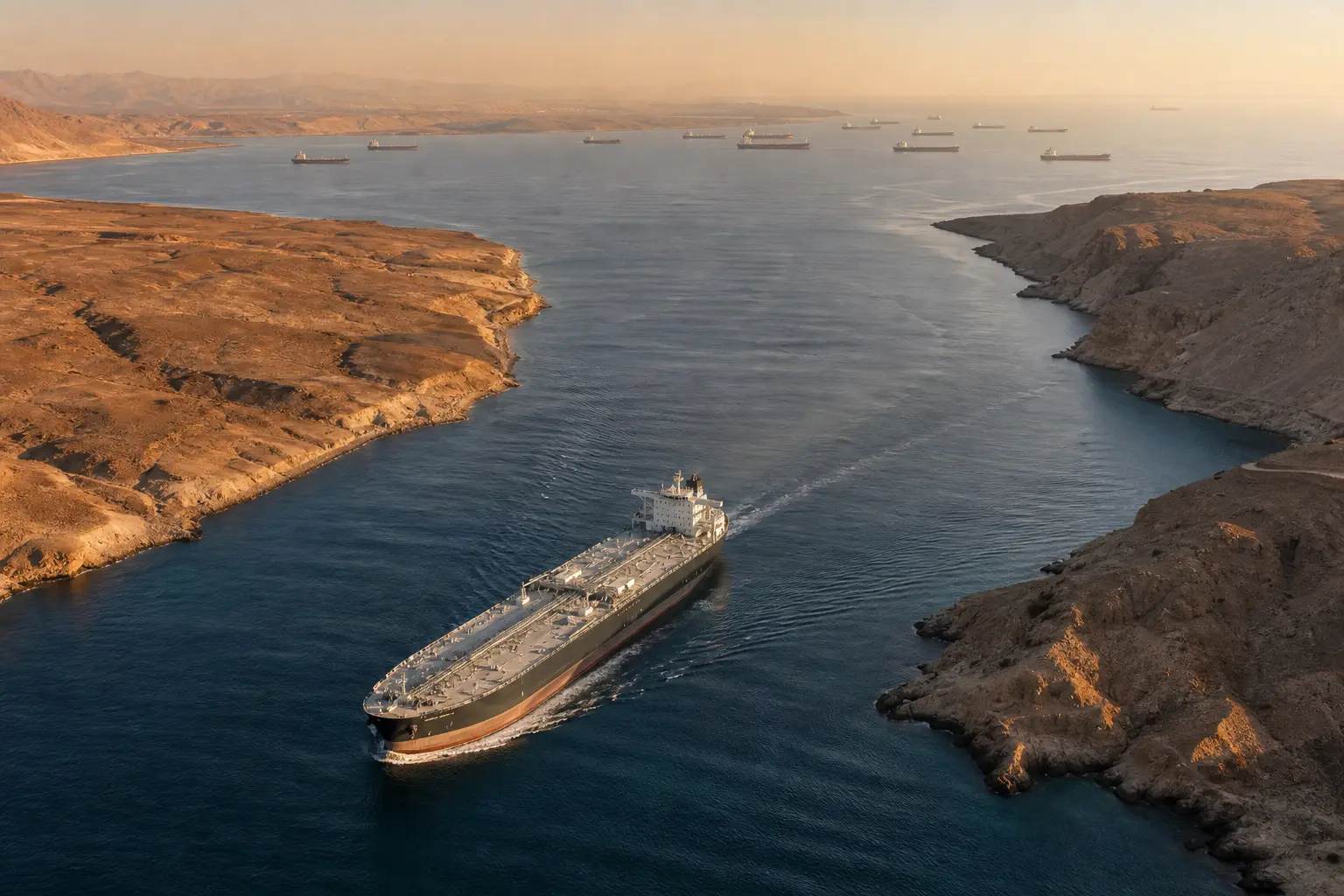
Every barrel that now moves west through the Petroline still has to reach buyers in Asia, and most of it travels back down through the Red Sea and the Bab el-Mandeb Strait, the narrow passage between Yemen and the Horn of Africa. Tehran has told Yemen’s Houthi movement to stand ready to close it if the US strikes Iranian power infrastructure directly.
The strait is not a new flashpoint for the group. Houthi forces earlier set a British oil tanker ablaze in Gulf of Aden waters, proof the group can hit commercial shipping along that coastline whenever it chooses.
Unlike Hormuz, the Bab el-Mandeb is not a complete dead end. Ships can still reach the Mediterranean through the Suez Canal, or divert around Africa via the Cape of Good Hope, a detour that adds roughly two weeks of sailing time. That is cold comfort for cargo bound for Asia, which would have to round the entire African continent to avoid the strait altogether.
The math on what is actually at stake varies by source. The International Energy Agency put crude and petroleum liquids crossing the strait at about 4.2 million barrels a day in 2025, close to 5% of global production. This week’s commodities reporting put the figure at 5% to 7% of global energy supply once the rerouted Saudi barrels are counted. Either way, a senior Houthi official has already floated shutting both straits “in an operational alliance,” warning oil could spike to $200 a barrel.
Warsh Tells Congress Not to Expect a Rescue
The macro backdrop briefly looked friendlier. June’s consumer price index rose 3.8% from a year earlier, down from 4.2% in May and below forecasts, thanks largely to a roughly 10% drop in retail gasoline prices. Producer prices softened too, and retail sales held up, a combination that would normally open the door to a rate cut.
Federal Reserve Chairman Kevin Warsh, who took over from Jerome Powell in May, closed that door anyway. Testifying before the House Financial Services Committee on July 14, he cautioned against reading too much into a single month of data.
The members of our Committee have no tolerance for persistently elevated inflation, and we share a resolute commitment to restoring price stability.
Warsh said in his prepared testimony to Congress, repeating the same message a day later before the Senate Banking Committee. Dallas Fed president Logan and Kansas City Fed president Schmid both pushed back on any dovish reading of the data, and their comments helped push the odds of a September rate hike to 53% on the CME FedWatch tool.
Warsh’s hawkish tilt has rattled more than metals and crude. It shows up too in how Bitcoin’s rebound has met a new Fed chair and an oil shock in recent trading, evidence the tighter-for-longer message is spreading well beyond commodities.
University of Michigan consumer sentiment climbed to a five-month high, with year-ahead inflation expectations easing to 4.2% from 4.6%. Both readings were collected before this week’s escalation, though, and largely miss the renewed strikes. US equities closed the week lower regardless, dragged down by a sharp pullback in semiconductor stocks.
Gold Clings to $4,000 While Silver Sheds 7%
Spot gold closed the week above $4,000 an ounce but still posted a 2.5% weekly loss. Silver fared worse, touching $54.7 an ounce, its weakest level since November 2025, before clawing back some ground to close down more than 7% for the week.
The pattern is familiar to anyone who has watched this war unfold. Gold surged to a record high in January, weeks before the fighting began, then gave up ground as dollar strength and rising Treasury yields overpowered the usual safe-haven bid. Morgan Stanley’s research desk calls it a reality check for gold’s safe-haven status, forecasting prices near $5,200 an ounce later this year only if the Fed eventually eases and central banks resume buying.
This week fit the same script. A milder CPI print lifted bullion briefly midweek, then Warsh’s testimony and the fresh wave of strikes pulled it back down. Gold is trading on what oil does to the Fed, not on how frightening the war looks on any given day.
Gold and silver had already trimmed their gains against the Fed’s hawkish hold once earlier this month, and the pattern has only hardened since. Every rally gets sold once traders refocus on where rates are headed.
Copper Holds, Zinc Slides, Aluminium Gets a Pass
Base metals on the London Metal Exchange ended the week mixed. Copper closed marginally higher around $13,525 a tonne. Zinc was the weakest performer, falling more than 2% to below $3,525 a tonne, as the same oil-driven inflation fears hitting gold reinforced bets on a longer stretch of restrictive Fed policy.
Aluminium held up better than either. Several forces are propping it up at once:
- Uncertainty over whether tankers can keep moving through Hormuz at all.
- Elevated natural gas prices, which raise the cost of aluminium smelting.
- China’s production cap on new smelting capacity.
- LME warehouse inventories that have fallen sharply this year.
Together, those forces have offset the same dollar strength and rate expectations weighing on the rest of the metals complex.
| Asset | Weekly Close | Weekly Change |
|---|---|---|
| Brent crude | $88.30/barrel | Up nearly 15%, five-week high |
| WTI crude | $82.70/barrel | Up nearly 15%, five-week high |
| MCX crude oil (India) | Rs 7,945/barrel | Up 4.35% |
| Spot gold | Above $4,000/oz | Down 2.5% |
| Silver | Recovered from a $54.7/oz low | Down over 7% |
| LME copper | Around $13,525/tonne | Marginally higher |
| LME zinc | Below $3,525/tonne | Down over 2% |
Every one of those moves traces back to the same two variables: how much Gulf oil can actually reach market, and how the Fed reads whatever inflation that produces.
Can Qatar and Pakistan Talk Iran Back From the Brink?
Qatari and Pakistani mediators brokered the 14-point memorandum of understanding that Washington and Tehran signed on June 17, and both governments are again working the phones to prevent a full collapse. But with the MOU formally suspended and escalation at its highest point since April, neither side has signaled it is ready to return to the table.
The a briefing on the US-Iran ceasefire talks from the House of Commons Library describes a memorandum built around freedom of navigation through Hormuz, limits on Iran’s nuclear and missile programs, and phased sanctions relief. Iran’s decision to call the current fighting an “existential war” and suspend its commitments under that framework leaves mediators with a far thinner document than they had a month ago.
Washington, for its part, has warned it could strike Iranian power infrastructure directly absent a diplomatic breakthrough, and briefly floated charging a 20% fee on cargo crossing Hormuz under US protection before dropping the idea within a day. That warning over Iranian power plants is precisely what triggered Tehran’s instruction to the Houthis to prepare to close Bab el-Mandeb, tying this week’s diplomacy directly back to the shipping risk.
The calendar next week does the negotiators no favors. Only preliminary PMI readings are scheduled from the US, leaving markets with almost no economic data to react to. Every signal will instead come from Doha, Islamabad or Washington, and oil, gold and dollar traders alike are set up to move harder on a diplomatic headline than on anything a spreadsheet could produce.
Frequently Asked Questions
What is Saudi Arabia’s East-West pipeline?
Also called the Petroline, it is a 1,200-kilometer pipeline built in the 1980s that carries crude from the Abqaiq fields in Saudi Arabia’s Eastern Province to the Red Sea port of Yanbu, letting Saudi oil reach export markets without passing through the Strait of Hormuz.
How much oil moves through the Bab el-Mandeb Strait?
The International Energy Agency estimated about 4.2 million barrels a day of crude and petroleum liquids crossed the strait in 2025, close to 5% of global oil production, a figure that has climbed since Saudi Arabia began routing more barrels through Yanbu and down the Red Sea.
Can the Bab el-Mandeb Strait be completely closed like Hormuz?
Not entirely. Unlike Hormuz, which has no alternate route out of the Gulf, ships can still reach the Mediterranean through the Suez Canal or sail around Africa via the Cape of Good Hope. That detour adds roughly two weeks of transit time and a steep fuel bill, but it keeps cargo moving.
When does the Federal Reserve meet next?
The Fed’s rate-setting committee is scheduled to meet July 28 and 29, its first gathering since Chairman Kevin Warsh’s mid-July testimony to Congress and the latest round of Gulf strikes.
What would happen to oil prices if both Gulf chokepoints closed at once?
No one can say with precision, since it has never happened. A senior Houthi official has publicly floated $200 a barrel if Hormuz and Bab el-Mandeb were shut down together, and traders are treating that number as a ceiling risk rather than a base case.
Disclaimer: This article is for informational purposes only and does not constitute investment advice. Commodity, currency and equity markets carry significant risk, and figures cited here are accurate as of publication and can change quickly. Consult a licensed financial adviser before making trading decisions.
 Billionaires Pay Record Sums for Dinosaur Bones Science Cannot Study
  How a New Jersey Homeowner’s Quick Thinking Preserved a Rare Meteorite
  Iceland’s Eclipse Boom Looks Like the Faroe Islands All Over Again
  NASA Confirms Near-Earth Object 1998 SH2 Is a Hidden Comet
  Bharatgas Lite ZIP Pushes India’s LPG Giants Into a Delivery Race
  Toyota’s Next Five SUVs Reveal a Quiet Role Reversal With Suzuki