
 Ishan Crawford
 Hero MotoCorp, India’s largest two-wheeler maker, is set to launch the country’s first flex-fuel motorcycle on June 3, 2026, a commuter bike built to run on ethanol blends ranging from E20 all the way to E85 and, in theory, pure E100. The two likely candidates are the Splendor Plus Ethanol and the HF Deluxe Flex Fuel, both of which have already cleared regulatory approval. The unveiling in New Delhi is scheduled to be attended by two Union ministers, signalling how much political weight Delhi is putting behind ethanol.
The launch is real and the engineering is finished. The problem sits one step downstream: the fuel the bike is designed to drink is barely sold anywhere in India yet. That gap, between a nationwide bike and a fuel found at fewer than a hundred stations, is the story underneath the headline.
Hero’s First Flex-Fuel Bike Arrives Before the Fuel Does
Hero has not confirmed which model wears the badge first, but the groundwork points to its best-selling commuters. Flex-fuel versions of both the Splendor and the HF Deluxe have received approval from testing authorities, and the company has been running trial production. The event in the capital is expected to draw Nitin Gadkari, the Minister of Road Transport and Highways, and Hardeep Singh Puri, the Minister of Petroleum and Natural Gas.
This will be a production bike, not a show-floor concept. Hero first displayed a flex-fuel prototype based on the HF Deluxe at the 2025 Bharat Mobility Global Expo, built around the proven 100cc BS6 (Bharat Stage 6, India’s current emission standard) engine developed at the company’s research centre in Jaipur.
The choice of model matters because of scale. Splendor has been India’s single best-selling motorcycle for years, and the HF Deluxe shares much of its mechanical core. Putting flex-fuel technology on a platform that already sells in the millions is exactly how the government wants a fringe fuel to go mainstream fast. For reference on the brand’s existing range, see Hero MotoCorp’s commuter motorcycle lineup.
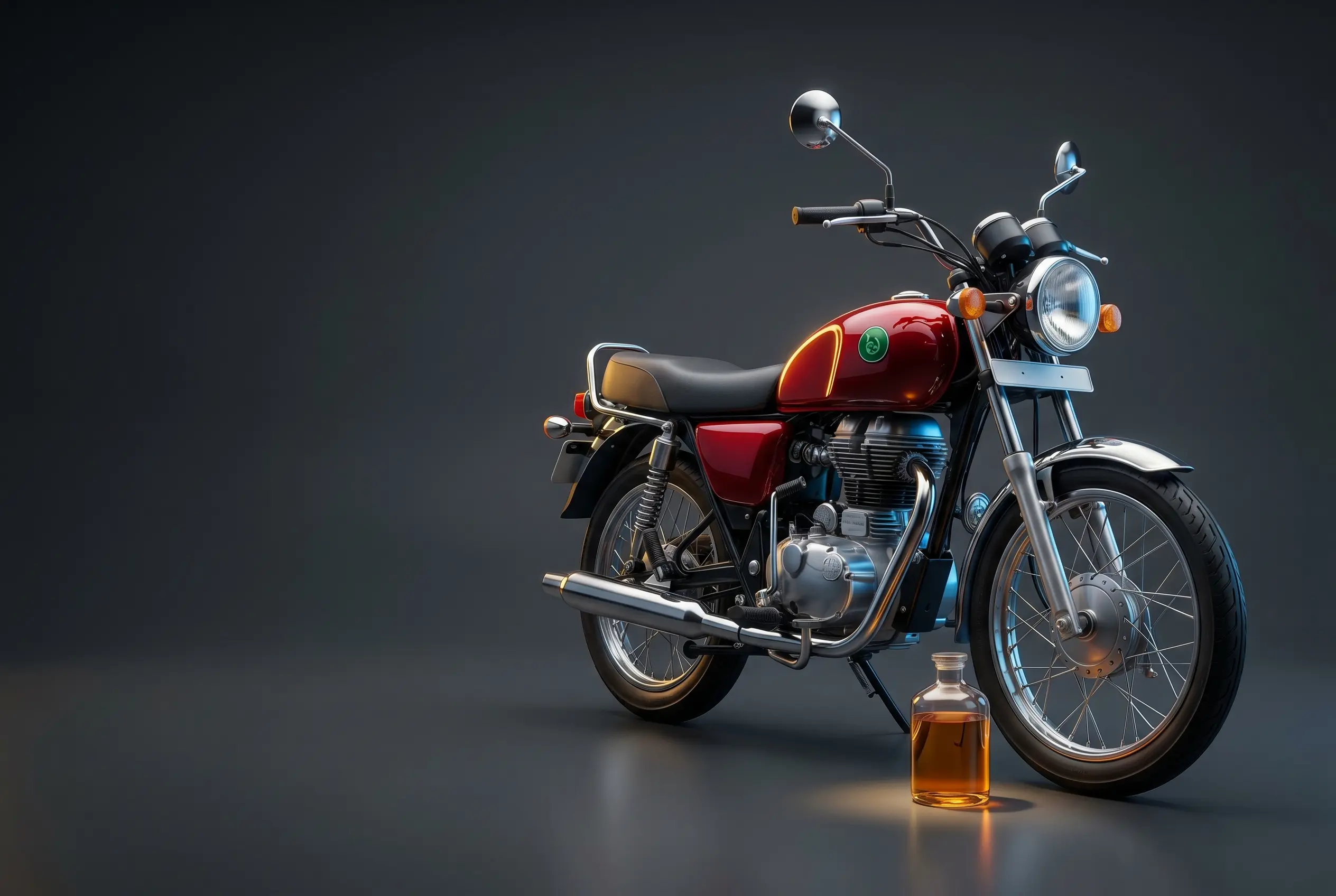
Splendor Plus Ethanol and HF Deluxe Flex Fuel, Side by Side
Reported ex-showroom prices are still unconfirmed estimates ahead of the launch, so treat the figures below as expectations rather than sticker prices. What is settled is the engineering family: both bikes use modified versions of Hero’s existing small-capacity petrol engines, with fuel-system parts swapped for corrosion-resistant components that can handle high-ethanol blends.
| Attribute | Splendor Plus Ethanol | HF Deluxe Flex Fuel |
|---|---|---|
| Base model | Splendor Plus (best-selling commuter) | HF Deluxe (entry commuter) |
| Engine class | ~100cc, BS6, flex-fuel calibrated | ~100cc, BS6, flex-fuel calibrated |
| Fuel compatibility | E20 to E85, up to E100 | E20 to E85, up to E100 |
| Approval status | Regulatory approval received | Regulatory approval received; prototype shown 2025 |
| Expected price (ex-showroom) | Around Rs 88,000 (about $1,030) | Around Rs 77,000 |
The price gap mirrors the existing petrol versions, with a flex-fuel premium layered on top. That premium is where the consumer math starts to bite, and it is covered further down.
Why Delhi Wants Ethanol in Your Petrol Tank
India imports more than 85% of the crude oil it burns, which makes the fuel bill one of the country’s biggest and most volatile expenses. Ethanol, distilled mostly from sugarcane and surplus grain, is the one liquid fuel India can grow at home. That is the political logic behind every flex-fuel launch this year.
The Import Bill Math
Every litre of ethanol blended into petrol is a litre of crude not bought abroad. The pressure intensified through the spring as global supply jitters pushed pump prices up; India’s recent run of increases is detailed in coverage of India’s repeated fuel price hikes during the Hormuz crisis. A domestically grown fuel insulates the budget from that kind of shock.
From E20 to E100
The roadmap has moved quickly. The government mandated nationwide sale of E20 petrol, blended with 20% ethanol, on April 1, 2026, years ahead of the original 2030 timeline. The targets and feedstock plans are laid out in the national ethanol blending roadmap published by NITI Aayog. With E20 now the floor, Delhi is reaching for E85 and E100, and the bikes and cars have to arrive first to justify building the fuel supply.
The Mileage Math on E85
Here is the trade-off no launch event will dwell on. Ethanol carries roughly two-thirds the energy of petrol by volume, so a tank of high-ethanol fuel pushes a bike fewer kilometres than the same tank of petrol.
Lower Energy, Fewer Kilometres
Government and testing-agency guidance already pegs the efficiency loss on E20 at around 3% to 4% for two-wheelers calibrated for lower blends. Step up to E85 and the math gets steeper. An E85 mix is about 72% as energy-dense as straight petrol, which works out to roughly a quarter to a third fewer kilometres per litre. A flex-fuel engine tuned for ethanol recovers some of that, but not all of it.
The Sticker Price and the Tax Gap
The hardware costs more too. Industry estimates put the added production cost of a flex-fuel 100cc to 125cc commuter at Rs 4,000 to Rs 7,000, money spent on ethanol-resistant fuel lines, pumps and seals. That premium lands on buyers who are among the most price-sensitive in the market.
- Roughly 28% fewer kilometres per litre is the ballpark energy penalty of E85 versus pure petrol, before engine tuning claws some back.
- Rs 4,000 to Rs 7,000 is the expected upfront cost rise for a flex-fuel commuter.
- 18% versus 5% is the GST (Goods and Services Tax) gap between a sub-350cc petrol bike and an electric two-wheeler.
Because ethanol is renewable, there is a live argument for cutting that 18% rate on flex-fuel bikes to soften the premium. No reduction has been confirmed, which leaves the buyer carrying both the higher sticker and the lower mileage for now. Rising compliance costs are already squeezing the segment, as seen in the ramp-up of India’s incoming two-wheeler ABS mandate.
Fewer Than 100 Pumps for a Nationwide Bike
The sharpest gap is at the pump. India has more than 90,000 fuel stations, and the overwhelming majority are not built to dispense E85. The few that do are clustered in Maharashtra and Uttar Pradesh.
The Infrastructure Catch-Up
There are fewer than 100 E85 pumps in the entire country today. Retrofitting a single outlet for high-ethanol blends costs an estimated Rs 2 lakh to Rs 3 lakh, which scales to a nationwide bill running past Rs 2,000 crore. Oil marketing companies, including Indian Oil, Bharat Petroleum and Hindustan Petroleum, have outlined plans for high-blend corridors, but the buildout trails the vehicles.
The saving grace for early buyers is that a flex-fuel bike is not stranded without E85. It runs perfectly well on the E20 now sold everywhere, so owners simply lose the cost upside until a higher-blend pump appears nearby. The rollout sequence looks like this:
- April 2026: E20 becomes the mandated nationwide blend, the default at every pump.
- Mid-2026: A Bureau of Indian Standards specification for high-ethanol blends takes effect, with final rules expected later in the year.
- 2027 onward: Oil marketers target a meaningful network of E85 stations along major corridors, the point at which a flex-fuel bike starts paying back its premium.
The Whole Two-Wheeler Industry Is Placing the Same Bet
Hero is first to a mass-market commuter, but it is not alone. The shift toward flex fuel has become an industry-wide hedge against energy uncertainty, and nearly every major maker is somewhere along the path.
- Honda launched the CB300F flex-fuel in 2024 and later discontinued it, proof the technology can be productionised quickly even if the market was not ready.
- Suzuki already sells the Gixxer SF 250 on E85 and is spreading its bets across CNG (compressed natural gas) and electric two-wheelers as well.
- Royal Enfield has been spotted testing a Classic 350 mule carrying E85 markings.
- TVS showcased a flex-fuel Raider 125 at the 2025 Bharat Mobility expo.
The four-wheeler side moves in lockstep. Maruti Suzuki, India’s biggest carmaker, is expected to unveil an E100 flex-fuel model, likely a Wagon R variant, on June 5, timed to World Environment Day, with the same ministers backing the rollout. Maruti’s wider plans sit on Maruti Suzuki’s official model and technology pages, and industry estimates put the flex-fuel cost premium on a small car far higher, in the Rs 50,000 to Rs 70,000 range.
If the pump network arrives on schedule and a GST cut closes the price gap, Hero’s flex-fuel Splendor becomes a genuinely cheaper bike to feed within two or three years. If the stations lag and the tax stays at 18%, the first owners will spend more to buy a bike that goes fewer kilometres on a fuel they cannot easily find, betting on a payoff that depends entirely on infrastructure they do not control.
Frequently Asked Questions
When is Hero launching its flex-fuel bike?
Hero MotoCorp is set to launch its first flex-fuel motorcycle on June 3, 2026, at an event in New Delhi expected to be attended by the Union ministers for road transport and for petroleum.
Which Hero model will be the flex-fuel bike?
Hero has not confirmed the name, but the two approved candidates are the Splendor Plus Ethanol and the HF Deluxe Flex Fuel, both based on roughly 100cc commuter platforms that already sell in large volumes.
What is E85 fuel?
E85 is a blend of 85% ethanol and 15% petrol. A flex-fuel bike can also run on lower blends such as the E20 sold nationwide, and Hero’s bikes are rated up to E100, or near-pure ethanol.
Will an E85 bike give lower mileage?
Yes. Ethanol holds about two-thirds the energy of petrol by volume, so E85 delivers roughly a quarter to a third fewer kilometres per litre than pure petrol, though engine tuning on a flex-fuel bike recovers part of that loss.
Where can I buy E85 fuel in India?
Availability is very limited. There are fewer than 100 E85 pumps nationwide, mostly in Maharashtra and Uttar Pradesh. A flex-fuel bike runs fine on regular E20 petrol everywhere else, so owners are never stranded.
Will a flex-fuel Hero bike cost more than a regular one?
Yes. Industry estimates suggest a flex-fuel 100cc to 125cc commuter costs about Rs 4,000 to Rs 7,000 more to build than its petrol equivalent. Final prices will be confirmed at or shortly after the launch.
 RBI’s Forex Swap Bet Hits $20.72 Billion, Still Trailing Its $70 Billion Goal
  Shelter Scotland Warns Burnham’s Pledge Won’t Fix Scotland’s Crisis
  How Scotland’s First 3D Exoscope Helped Teen Toby Peart Heal
  Scotland’s Wildfire Plan Puts Off the Helicopter Fix Until Next Season
  Loganair’s Electric Aircraft Deal Arrives as Scottish Routes Face Cuts
  How a 1983 TV Scare Still Shapes England’s Housebuilding Gap With Scotland