
 Ishan Crawford
 Scotland’s government published a national wildfire strategy in March, five months after the country’s worst fire season on record. One line inside it postpones a genuine fix for the helicopter shortage until after this year’s fires are already out.
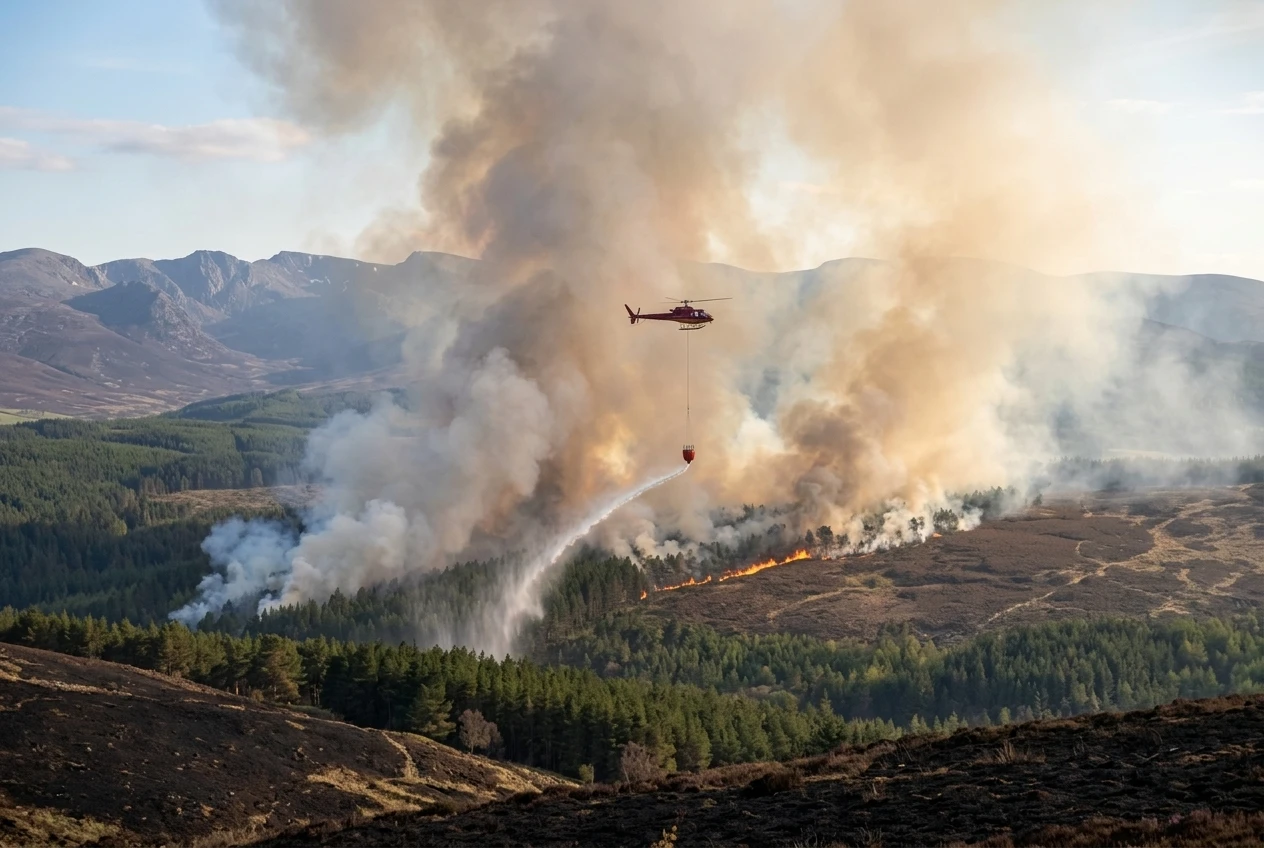
By the time the wildfire tearing through Glenmore Forest Park reached its seventh day on Tuesday, that line had already been tested. Two waterbombing helicopters were flying over the Cairngorms, but they had not arrived until nearly two days after the flames took hold, the same complaint residents raised about last summer’s Dava Moor fire.
Seven Days in Glenmore Forest
The fire broke out near Ryvoan Bothy, south of Nethy Bridge, in pine forest just south of Loch Morlich. Firefighters, gamekeepers and estate workers converged fast. The specialist aircraft needed for the hardest terrain did not.
RSPB Scotland, whose Loch Garten reserve sits inside the fire zone, called the eventual arrival of a helicopter a “game changer.” By the weekend the response had scaled up to six fire engines, two all terrain vehicles and a Wildfire Support Unit, working alongside gamekeepers and volunteers from neighbouring estates.
Five days in, the outlook brightened. The Cairngorms National Park Authority reported the blaze was largely surrounded, crediting fire crews, gamekeepers, RSPB and Cairngorm Mountain staff, and helicopter pilots working together. Gavin Miles, the park authority’s director of planning and place, called the news encouraging, while cautioning that teams were “taking nothing for granted.”
- 15 July: Fire breaks out near Ryvoan Bothy, south of Nethy Bridge.
- 17 July: Two waterbombing helicopters reach the scene, roughly two days after the flames took hold.
- 18 to 19 July: The response scales up to six fire engines, two all terrain vehicles, a Wildfire Support Unit and a water carrier.
- 19 July: The park authority reports the fire “largely surrounded.”
- 21 July: The blaze enters its seventh day, with crews still watching for hotspots on the ground.
None of the progress erases the two days the fire burned without air support, the exact gap that has residents asking the same question they asked last year.
The Sentence Buried in Scotland’s Own Wildfire Plan
The Scottish Fire and Rescue Service insists the operation was never short of resources. Deputy Assistant Chief Officer Michael Humphreys said helicopter support “can of course be beneficial, and we will use them as and when they are available, however it is not always essential.” He added that “where a helicopter is not available, the tactical plan to fight the fire will always account for this.”
That confidence follows a document the government itself published in March: a Strategic Action Plan for wildfires, written largely in response to the Dava Moor fire and developed with the fire service and His Majesty’s Fire Service Inspectorate.
Buried in its response chapter is Action 15. It commits the fire service and its partners only to weigh possible improvements to helicopter access, then hand recommendations to ministers once the 2026 wildfire season has already finished. Nothing in the plan promises a dedicated aircraft, dedicated funding, or crews on standby before then.
Action 14, in the same section, asks insurers, landowners and the fire service to keep talking about who actually pays when a helicopter is needed on private ground. Both actions describe a conversation still underway, not a resource that exists on the ground today.
Dava Moor Was Supposed to Be the Warning
Cairngorms is not Scotland’s first brush with a fire this size. Blazes at Carrbridge and Dava burned for four days last June and merged into the largest wildfire ever recorded in the UK. Community and estate accounts put the damage at more than 11,000 hectares (27,000 acres) of moorland and forestry, inside a wider tally of 241 recorded wildfires across Scotland that year.
The government later admitted, in writing, that there had been “an issue around the mobilisation” of firefighting helicopters at Dava Moor. The aircraft on call were already booked for commercial filming work when the fire broke out.
Scottish Land and Estates tallied what filled the gap. Rural estates and gamekeepers threw in close to £4 million worth of specialist equipment (about $5 million) and more than 110 personnel to help contain the blaze. A summary of that report recommended investment in bespoke SFRS aerial capability and faster authority for commanders to call in private helicopters.
Some of that money did arrive, just not for aircraft. The Cairngorms National Park Authority’s own climate fund bought ground equipment used to help extinguish the Dava blaze. Two years before that, firefighters from Australia, Portugal and Spain had already gathered in Aberdeen to trade techniques for fighting exactly this kind of fire, proof the risk was understood well before either megafire hit.
| Wildfire | Started | Scale | Helicopter Response | Status |
|---|---|---|---|---|
| Carrbridge and Dava Moor | Late June 2025 | More than 11,000 hectares (27,000 acres), the UK’s largest recorded wildfire | Delayed by a mobilisation “issue”; aircraft were booked for commercial filming | Took four days to bring under control; prompted the national wildfire strategy |
| Glenmore, Cairngorms | 15 July 2026, near Ryvoan Bothy | Stretched roughly six kilometres through Glenmore Forest Park | Two helicopters arrived after nearly two days | Reported “largely surrounded” by day five; still active on day seven |
Both fires drew on the same small pool of private helicopter operators.
Who Actually Pays for the Helicopter?
Scotland’s fire service cannot summon a helicopter on its own say so. A private operator needs approval from the incident commander, and the landowner, whether a private estate or a public body like Forestry and Land Scotland, needs a contractual arrangement or insurance cover confirmed before the aircraft lifts off.
- Assessment – the incident commander judges whether the terrain and fire behaviour justify calling in aircraft.
- Ownership check – on private land, insurers must confirm a policy covers helicopter costs; on public land, agencies such as NatureScot or Forestry and Land Scotland cover the bill from their own funds.
- Availability – only a handful of commercial operators hold the aircraft, buckets and trained pilots, and they may already be working another job.
- Deployment – once cleared, the pilot takes tactical direction from the incident commander while scooping up to a tonne of water at a time from lochs below.
The Scottish Fire and Rescue Service says that capability matters most in ground crews cannot easily reach. An additional operational capability across challenging terrain is how one area commander described it, particularly in spots crews on foot cannot access.
Skyhook, the operator flying the Cairngorms mission out of Fife Airport in Glenrothes, says its pilots stay on “high alert for the danger of wildfires” through the summer months. Its business still runs on other clients too.
“As a commercial operator, we often receive requests several hours after a wildfire has already taken hold,” a company spokesperson told the BBC. “In many cases, an earlier aerial response has the potential to support ground crews while a fire is smaller and more easily contained.”
The company was blunt about the limits of that goodwill: “As a commercial helicopter operator, we are not currently funded or contracted by any organisation to maintain a dedicated aerial firefighting capability or crews on permanent standby.”
“Lessons Will Be Learnt” Wears Thin in the Highlands
Sandy McCook, chairman of the Nethy Bridge and vicinity community council, has heard the government’s reassurances before. “Well I’m sorry, but the lessons have not been learnt,” he said. “It is untenable the position they are taking that they have enough equipment. It is helicopters that are needed.”
Andrew Baxter, the Liberal Democrat MSP for Skye, Lochaber and Badenoch, took the same complaint directly to Scotland’s Justice Secretary. “At the moment it takes too long to get support to where it is needed,” he said. “We risk seeing serious loss of life unless we have a robust fire plan with aircraft that can be called upon at short notice.”
- Scottish Fire and Rescue Service says the Cairngorms operation has been appropriately and proportionately resourced throughout, per Deputy Assistant Chief Officer Michael Humphreys.
- Local politicians and community leaders, including Sandy McCook and Highland Council convener Bill Lobban, say the same helicopter delays from Dava Moor have repeated and that Scotland needs its own aircraft on standby.
- Skyhook, the commercial operator flying the Cairngorms mission, says it has never been funded or contracted to keep a dedicated wildfire crew on permanent standby.
I’m fed up listening to lessons will be learnt. We don’t need lessons, we need action now.
Bill Lobban, the Highland Council convener, said that after the fire had already stretched roughly six kilometres across Glenmore with only one helicopter on scene.
Neil Gray, Scotland’s Justice Secretary, said fire chiefs had confirmed they had access to “all the resources needed” to contain the Cairngorms blaze. He said he would discuss any “requests and innovations” over the growing wildfire threat with the fire service, adding: “I’m incredibly proud of the response from officers.”
The Fix Scotland Keeps Postponing
Behind the scenes, the fire service says it is already introducing a new command and control mobilisation system, one meant to ease some of the frustrations stakeholders raised after Dava Moor. Insurers, landowners and government officials are still working through Action 14’s questions about who covers a helicopter’s costs on private ground.
What Action 15 actually promises for this season is a review that concludes only once the fires have already burned. Scotland’s wildfire season typically runs from March to September. Two months of it remain.
 ONGC licence frees Venezuela cash and operatorship talks
  Anthropic Hits $65 Billion Run Rate and Flips the AI Cash Test
  Supreme Court grounds the fare free-for-all with three-week clock
  Gold Nears $4400 as Soft Data Meets Oil Inflation Risk
  Nifty Slips as Zaggle Circuits and Dhoot Debuts Big
  Diesel Crack Tops $100 as Iran Rhetoric Lifts Crude