
 Ishan Crawford
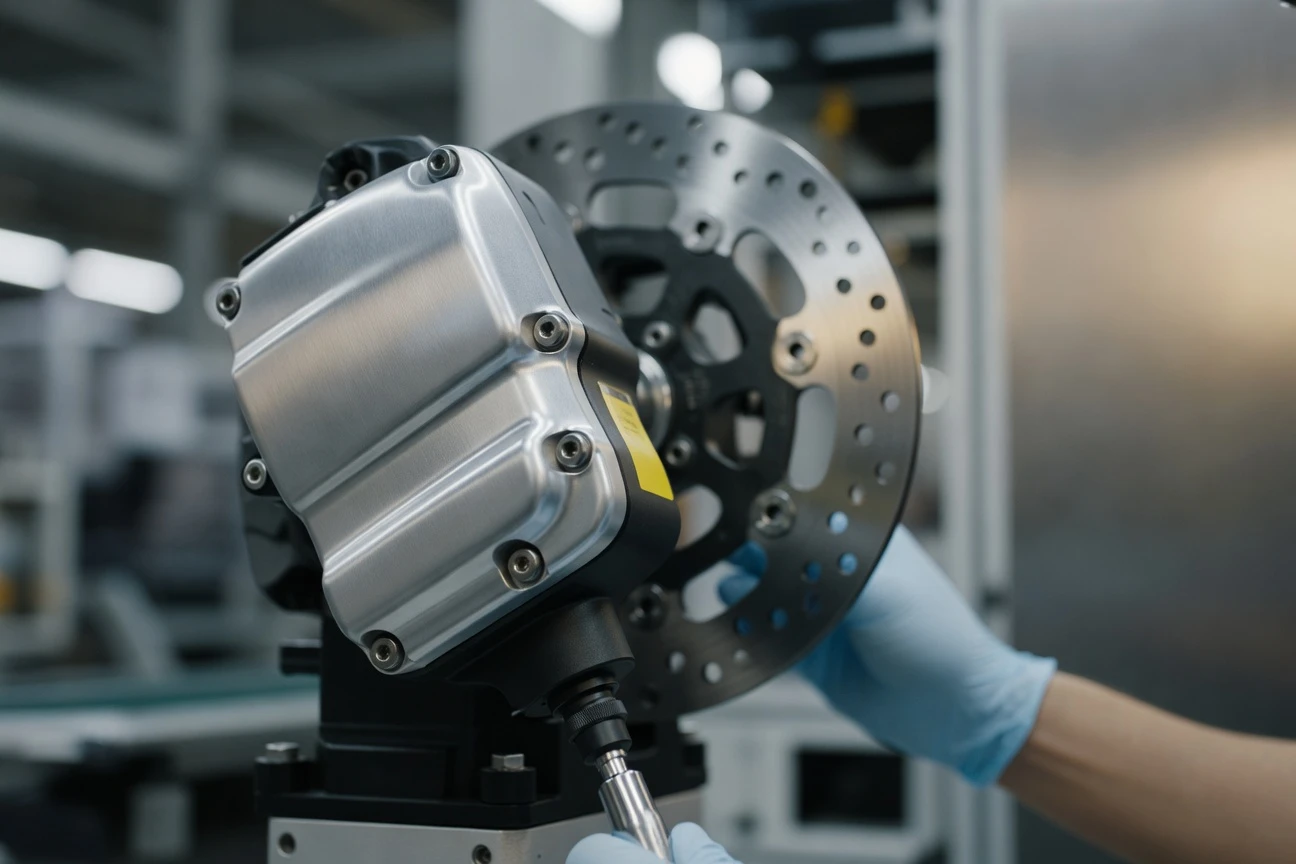
 Endurance Technologies will switch on 12 lakh new anti-lock braking system (ABS) units per year at its Aurangabad complex by September 2026, lifting total ABS capacity at the auto component maker to 18.4 lakh units a year from 6.4 lakh today. The line is being built before the government rule that justifies it has been finalised.
Managing Director Anurang Jain confirmed the September startup on the company’s Q4 FY26 analyst call, citing a draft guideline issued by the Ministry of Road Transport and Highways (MoRTH) in June 2025 that proposes extending ABS to lower-engine-capacity two-wheelers. The final notification has not been published. Endurance is wiring the factory floor anyway.
The Capacity Math at Waluj
The expansion is part of a Rs 135.6 crore (about USD 16 million) capex programme at the company’s Waluj site near Aurangabad, with roughly Rs 103 crore earmarked for the ABS lines alone. The fresh capacity slots in on top of the existing 6.4 lakh-unit annual line, which the company expects to run at full utilisation through FY26.
Endurance is also pulling more of the bill of materials in-house. The plant has started its own production of electronic control units (ECUs, the small circuit board that runs braking logic) for single-channel ABS. Dual-channel ECU production starts in June 2026, alongside a separate Bajaj Auto programme.
Jain’s framing on the call was straightforward: the company would benefit if the industry shifts more commuter segments to hydraulic combined braking, because that expands the addressable market for master cylinders, callipers, and brake discs already on Endurance’s product sheet.
The numbers across Endurance’s braking footprint, including the parallel disc brake expansion in Chennai, lay out the shape of the bet:
| Product Line | Current Capacity (per year) | Target Capacity (per year) | Trigger Date |
|---|---|---|---|
| ABS units (Waluj) | 6.4 lakh | 18.4 lakh | September 2026 |
| Dual-channel ABS for Bajaj Auto | 0 | 1.2 lakh | June 2026 |
| Disc brake assemblies (Chennai) | 0 | 30 lakh | July 2026 |
| Brake discs (Chennai) | 0 | 40 lakh | July 2026 |
| Group brake assemblies (planned) | n/a | 76 lakh | FY27 |
Why the Mandate Drives the Bet
India’s draft notification from MoRTH proposes that every two-wheeler manufactured on or after January 1, 2026, be fitted with ABS conforming to Indian Standard IS14664:2010. At present, ABS is mandatory only for two-wheelers with engines above 125cc; everything below uses combined braking systems, where front and rear activate together but neither resists wheel lock-up. ABS keeps the wheels turning under hard or panic braking, which on wet tarmac is the difference between a controlled stop and a slide.
The safety case is hard to argue with. MoRTH’s road accident statistics show two-wheelers account for roughly 41% of all road deaths on India’s national highways, the highest share of any vehicle category. Bosch India and Endurance, the two suppliers that between them hold an estimated 60% to 70% of the country’s two-wheeler ABS market, have both told investors they have the capacity headroom to absorb the shift.
The volume jump on the table is large. India sold 2.65 crore two-wheelers in FY26, up 12.52% on the previous year. If the draft becomes law in its current form, the addressable market for two-wheeler ABS inside the country could rise close to tenfold, with as many as 16 million units a year potentially needing the system from 2027 onward. That is the pool Endurance is pre-positioning against.
Bajaj Auto and the Dual-Channel Ladder
Above the volume play sits a margin play. Endurance is moving up the technology stack toward dual-channel ABS, which controls each wheel independently and prices at roughly twice the kit cost of a single-channel system. The first dual-channel programme, for Bajaj Auto, starts in June 2026 with annual sales potential of 1.2 lakh units. A second similar-sized programme is scheduled for the second quarter of FY27, which Jain did not name on the call.
The upmarket adds Endurance is rolling at the same time:
- Dual-channel ABS with independently controlled front and rear hydraulic circuits, opening with the Bajaj programme in June 2026
- In-house dual-channel ECU production from the same month, capturing the electronics value previously sourced from outside vendors
- Traction control modules sized for the 160cc to 250cc class, a segment that Royal Enfield, KTM, and the Bajaj-owned premium book have been growing aggressively
- Hydraulic combined braking systems (master cylinders, callipers, brake discs) for commuter categories shifting from cable-actuated to hydraulic brake actuation
Chennai Plant Targets Royal Enfield by July
The braking story does not stop at Aurangabad. A new Endurance assembly site for disc brake assemblies in Chennai is in advanced civil construction, positioned closer to southern original equipment manufacturers (OEMs, the bike makers buying the parts) to cut freight on what is, by weight, an expensive product to truck across the country.
First supplies from the Chennai plant are scheduled for Royal Enfield in July 2026. Other OEM customers are due to receive from the third quarter of FY27. The site will run at 30 lakh disc brake assemblies and 40 lakh brake discs per year at full capacity, slotting into a group-wide plan of 76 lakh assemblies and 86 lakh discs annually.
Behind the plant, Endurance has brought its integrated braking research and development centre at Chhatrapati Sambhajinagar (the renamed Aurangabad) fully online. The facility now does development and validation for two-wheeler brakes, two-wheeler ABS, and four-wheeler brake assemblies under one roof.
That integration is what lets Endurance pitch full braking systems to OEMs rather than discrete parts, the same play that vaulted Bosch into its dominant Indian position two decades ago.
The Battery Pack Side-Bet Near Pune
The second piece of news inside the same analyst call sits in a different building entirely. Endurance’s lithium-ion battery pack manufacturing line near Pune is days from its start of production (SOP, the first commercial shipment), with first packs intended for a two-wheeler EV programme. The company has booked a peak order value of Rs 300 crore a year from a leading two-wheeler OEM.
Regulatory compliance testing at the certification agency has been completed, and the improvement points flagged by the customer during reviews have been closed out. Jain told analysts the SOP timing was now a matter of weeks, not quarters.
Going forward, with regulatory approvals and customer validations nearing completion, we are planning to start the SOP in week four of this month.
That was Jain, on Endurance’s Q4 FY26 analyst call earlier this month. The pack programme moves the company further away from its historical product mix of aluminium die-castings, suspensions, transmissions, and brakes, and into the cell-level electrical architecture of two-wheeler EVs. Jain said the same capability is being lined up for three-wheelers and other high-potential segments. The investor relations page shows FY26 group capex running above Rs 800 crore, with the battery pack plant, the Chennai brakes site, and the AURIC Shendra-Bidkin expansions all booking spend in the same year.
The 125cc Question That Could Clip the Capex
The risk on Endurance’s bet sits in where the final regulation draws its line, not in technology or capacity. Multiple reports in late 2025 said the Centre was weighing a deferral of ABS fitment on two-wheelers up to 125cc beyond the January 1 deadline, after the Society of Indian Automobile Manufacturers (SIAM, the industry’s lobby body) flagged the cost impact on entry-level commuter motorcycles. Every Rs 3,000 to Rs 5,000 added to the bill of materials lands on the sticker price of a bike that already sells on monthly EMI affordability.
The 125cc segment is where the volume sits. Hero MotoCorp’s Splendor and HF Deluxe, Honda’s Shine, and Bajaj’s Platina, all clustered in or just below the 125cc band, make up a large slice of the 2.65 crore two-wheelers sold in FY26. If the final notification carves them out, Endurance’s 12-lakh-unit expansion still has a market in higher-capacity domestic segments and the export book, but the ramp curve flattens.
The managing director’s signal is that Endurance does not expect any carve-out to last. Bosch’s chassis systems unit has told investors much the same thing. Both suppliers are betting that a deferral, if it lands, is a phasing decision rather than an exemption, and that 125cc bikes get pulled into the mandate within 12 to 24 months of the larger rule taking effect.
If the final notification confirms the January 2026 cutoff across all engine sizes, the new ABS line at Waluj is full from week one and the second dual-channel programme in Q2 FY27 will look undersized. If MoRTH carves out 125cc and below for another year, the same line runs at half-utilisation through FY27, and the margin lift Endurance has guided to arrives later than its capex calendar suggests.
 ONGC licence frees Venezuela cash and operatorship talks
  Anthropic Hits $65 Billion Run Rate and Flips the AI Cash Test
  Supreme Court grounds the fare free-for-all with three-week clock
  Gold Nears $4400 as Soft Data Meets Oil Inflation Risk
  Nifty Slips as Zaggle Circuits and Dhoot Debuts Big
  Diesel Crack Tops $100 as Iran Rhetoric Lifts Crude