
 Ishan Crawford
 The Finance Ministry’s Department of Financial Services on Monday ordered every public-sector bank, regional rural bank, government insurer and state financial institution to cut costs at once, swap hired petrol and diesel cars for electric models where feasible, and shift most meetings to video link. The circular, effective the day it was signed, lands as the rupee closes at a record 96.35 against the dollar and India’s crude basket trades near $106 a barrel.
The list of targets reads like a directory of every balance sheet New Delhi directly controls: State Bank of India, Bank of Baroda, Life Insurance Corporation of India, and dozens of smaller state-owned lenders and insurers. The cost-trim looks symbolic on its own. Read alongside Prime Minister Narendra Modi’s May 10 appeal for citizens to defer gold purchases and foreign holidays, it becomes the first piece of policy plumbing under that appeal.
What the Finance Ministry Circular Tells PSU Lenders
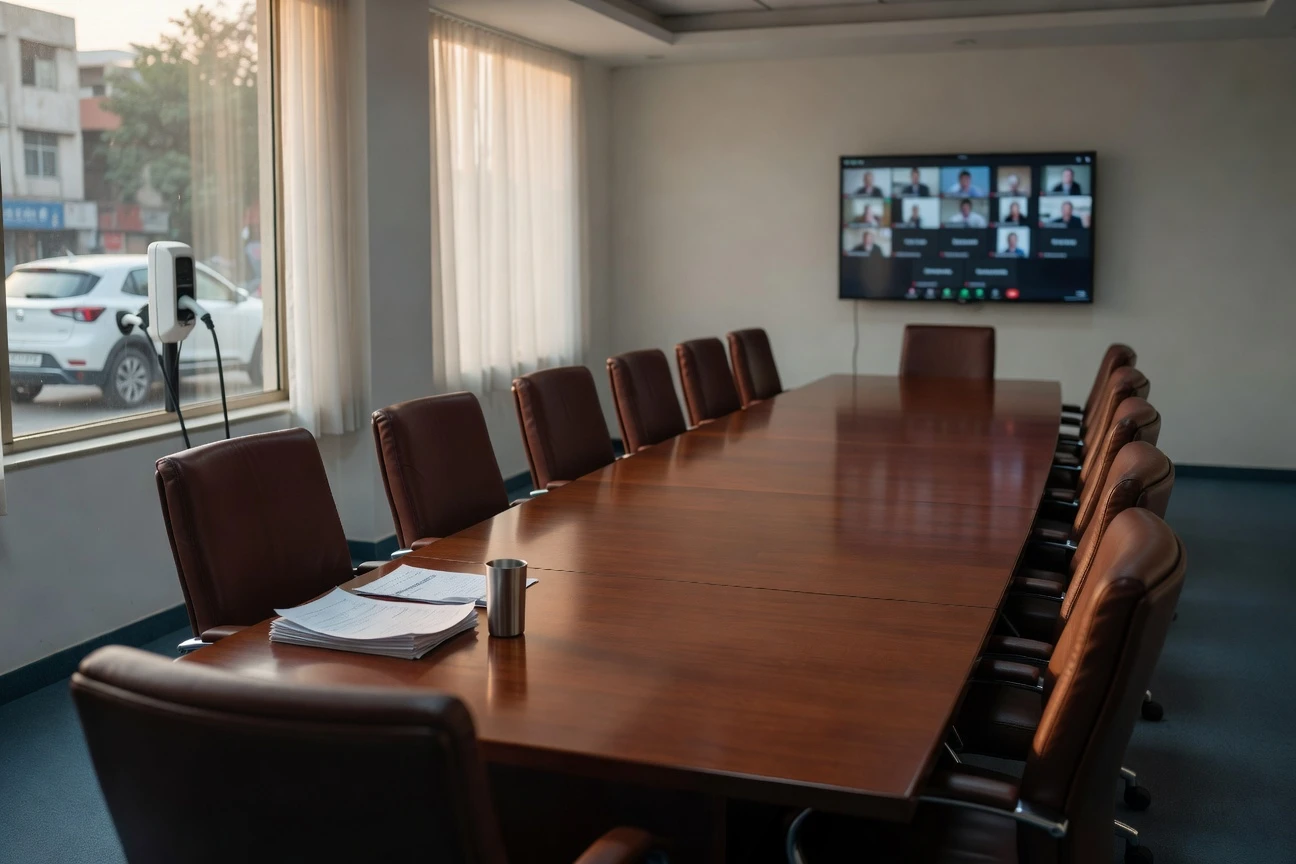
The directive came from the Department of Financial Services circulars page and covers public sector banks (PSBs), regional rural banks (RRBs), public sector insurance companies (PSICs) and public sector financial institutions (PSFIs). The instruction set is short and effective with immediate effect: travel where you must but virtualise the rest, replace hired cars with electric vehicles in head and branch offices, transition the existing diesel and petrol fleet in a phased manner, and keep foreign trips by chairpersons, managing directors, chief executive officers and whole-time directors below the prescribed limits.
The category names matter because they capture a workforce well above two million people, more than 1.5 lakh branches, and the country’s largest physical document-and-meeting culture. The state finance estate is also the easiest part of the Indian administrative machine to move on procurement: a single circular can change a tender clause across LIC’s regional offices, SBI’s circle heads and Bank of Baroda’s zonal hubs within weeks.
For a quick read on which institutions sit inside the order’s scope, and where each carries the most exposure to vehicle and travel spend:
| Institution | Category | Fleet and travel exposure |
|---|---|---|
| State Bank of India | PSB | 22,500+ branches, large internal travel budget |
| Bank of Baroda | PSB | 8,200+ branches, frequent international engagement |
| Life Insurance Corporation | PSIC | 2,000+ branch offices, large field-officer fleet |
| NABARD, SIDBI, EXIM Bank | PSFIs | Rural and trade-finance travel-heavy fleet |
| NIA, OIC, UIIC, National Insurance | PSICs | Branch-based vehicle pool nationwide |
| 43 regional rural banks | RRBs | Sponsor-bank fleets in tier-three districts |
The Forex Math Behind the Memo
The circular is dated the same week the rupee printed three consecutive record lows. It closed at 96.35 on Monday, after touching 95.86 the previous Thursday and 95.80 the Wednesday before that. Brent crude sits in the $105 to $107 band, and the Indian basket of crude oil averaged about $106 in May after touching $115 in April. Every $10 rise in the basket adds roughly $13 to $14 billion to India’s annual oil bill, according to a standing ICRA estimate that the Finance Ministry itself cites in budget briefings.
That ratio matters because India spent $174.9 billion on crude and petroleum products in the financial year ended March, or 22% of total imports. Petroleum imports have grown 111% in five years. The Reserve Bank of India has been defending the rupee through spot intervention, and reserves have fallen from $728.49 billion in February to about $690.69 billion in early May. The reserves drop is not large in percentage terms. It is the direction that has Delhi nervous, with the rate of decline accelerating since the Strait of Hormuz blockade began on February 28.
The headline numbers behind the move:
- 96.35 rupees to the dollar, the all-time intraday low set on Monday
- $174.9 billion spent on crude and petroleum products in FY26, the most recent full year
- $37.8 billion drop in foreign-exchange reserves between February and early May
- 50% of Indian crude imports normally transit the Strait of Hormuz, with 60% of LNG and almost all LPG using the same route
By itself, the foreign-travel and fuel bill of a few hundred state institutions will not move those macro numbers. The signalling matters more: to citizens absorbing the May 10 appeal, and to currency traders watching for the next step, whether that turns out to be import curbs, a fuel-duty hike, or both. The Petroleum Planning and Analysis Cell daily basket data is now the single most-refreshed page in Delhi’s policy circles.
EV Makers Get a Captive Government Buyer
The least-discussed line in the circular is the one most likely to outlast the war. Public-sector banks, insurers and financial institutions have been told to replace hired petrol and diesel cars with EVs as far as possible, and transition the existing fleet in phases. That is a procurement directive, not a slogan, and it lands on an electric-car market that has been begging for steady commercial demand.
Tata Motors and Mahindra Lead the Available Supply
Tata Motors sold 31,604 electric cars between January and April this year, retaining its lead in the segment with the Nexon EV, Punch EV and the recently launched Harrier EV. Mahindra is the fastest-growing player, with 18,153 units in the same window, up 170% year on year on the back of its BE 6 and XEV 9e models. Total leading-OEM EV sales in calendar 2026 stood at 79,063 units through April, a 69.5% gain. The procurement order opens a steady incremental layer of demand on top of that base.
CESL Already Runs the Procurement Pipeline
The plumbing for government EV procurement already exists. Convergence Energy Services Limited (CESL, the state-owned joint venture under the energy ministry that aggregates clean-mobility demand) ran India’s largest e-bus tender for 10,900 buses under Phase I of the PM E-DRIVE scheme, and opened a fresh tender for 6,230 electric buses across Delhi, Mumbai, Pune, Hyderabad and Ahmedabad earlier this year. The agency has historically aggregated four-wheeler demand for central ministries too, which makes it the natural channel for any branch-scale fleet conversion at SBI or a public general insurer. Its open live tender notices for clean-mobility procurement already include sedan and SUV lots.
Charging Infrastructure Is the Bottleneck
The constraint on a phased fleet swap is not vehicle supply. It is dwell-time charging at branch offices, especially RRBs in tier-three and tier-four districts where grid stability and public-charger density both lag the metros. The circular acknowledges this implicitly with the as-far-as-possible caveat. A realistic read: the metros and tier-one cities get a clean conversion within the next two annual fleet cycles. Beyond that, the bill comes due in branch-level capex on chargers that the banks did not budget for this year. NITI Aayog’s $200 billion EV-opportunity reference report puts the charger-density gap at the top of its near-term constraint list.
Video Conferencing Carries Bigger Savings Than the Cars
For a state insurer the size of Life Insurance Corporation, the line in the circular that actually moves money is the one telling executives to attend foreign engagements by video unless physical presence is specifically required. The cost stack on a single foreign trip by a CMD-grade officer with a small delegation, business-class airfare, foreign per diem and hotel, runs to several lakh rupees per trip. Across thousands of senior officers in the state finance estate, the annual line item is not trivial.
The circular’s exact instruction:
All meetings, reviews and consultations must be conducted through video conferencing unless physical presence is essential.
That sentence closes the loop on Modi’s May 10 appeal. The Prime Minister asked citizens to consider working from home and saving fuel. The Finance Ministry letter applies the same discipline to the state’s own meeting calendar. It is also the easiest part of the order to enforce; travel approvals already require sign-off, and tightening the approval threshold is an administrative change, not a procurement one.
Delhi Has Pulled This Lever Twice Before
Government austerity drives in India tend to follow currency stress, not the other way around. The current circular is the third major one in three decades, and the prior two are worth reading against this one.
- 1991: The forex crisis that ended with tonnes of Indian gold pledged to the Bank of England saw the Chandra Shekhar and then Rao governments cap government foreign travel, freeze new vehicle purchases and impose hard ceilings on non-plan expenditure. Reserves at the time covered barely three weeks of imports.
- 2013: During the taper-tantrum rupee slide, then-finance minister P Chidambaram ordered a 10% cut in non-plan expenditure, restricted government foreign travel, and froze new vehicle purchases for state agencies. The rupee had just crossed 68 to the dollar for the first time.
- 2026: The current order is narrower in scope, applying only to the state finance estate, but adds something the earlier two could not: a stated push to replace hired internal-combustion cars with electric models. The forex argument is the same; the procurement consequence is new.
Two patterns sit inside that history. Austerity orders in India tend to expire quietly once the currency stabilises; the 1991 freeze had loosened by 1993, and the 2013 cut by mid-2014. And the orders rarely move the macro numbers in any direct way. What they do is buy political cover for the harder steps that often follow, gold-import duty hikes, fuel-price adjustments, or a tightening of import licensing for non-essential goods.
That last point is the one to watch. The May 18 circular reads as the first step in a sequenced response. If crude stays above $110 a barrel and the rupee tests 97, the next moves will not be about meeting rooms and car fleets; if the Hormuz lane reopens within the quarter, the order will quietly join the list of memos that did their job and disappeared. The IBEF reference page on India’s EV industry will be the cleanest place to track whether the procurement clause outlives the rest.
Frequently Asked Questions
Who exactly does the Finance Ministry circular apply to?
It covers all 12 public sector banks including SBI and Bank of Baroda, 43 regional rural banks, public sector insurance companies including Life Insurance Corporation and the four PSU general insurers, and public sector financial institutions such as NABARD, SIDBI and EXIM Bank. Private banks, private insurers and central-government ministries are outside its scope, though several ministries have issued parallel orders for their own staff.
Is the EV mandate immediate or phased?
Replacing hired cars with electric vehicles is to begin at once wherever practical. The existing diesel and petrol fleet is to be transitioned in a phased manner, with no fixed end-date specified. The as-far-as-possible language gives local managers room to defer where charging or vehicle supply is genuinely unavailable.
Does the circular ban foreign travel by bank executives outright?
No. It tells chairpersons, managing directors, chief executive officers and whole-time directors to keep foreign trips below the prescribed limits and attend overseas engagements by video conference as far as possible. It is a tightening of existing approval norms, not a blanket ban.
How does this connect to Prime Minister Modi’s May 10 appeal?
The Prime Minister asked citizens to conserve fuel, postpone gold purchases and foreign trips, and use electric vehicles more. The circular applies the same discipline to the state’s own finance institutions and is the first concrete piece of policy attached to that appeal. Several government departments and state governments have since issued their own parallel orders.
What happens to the circular if the Hormuz crisis ends?
Past precedent suggests it would quietly lapse. The 1991 freeze had unwound by 1993, and the 2013 austerity orders by mid-2014. The EV-procurement component is the part most likely to survive a return to normal oil prices, because the fleet-transition rationale extends beyond the immediate currency shock.
 Scotland’s Facial Recognition Push Sparks Mask Ban Call
  Galaxy Z Flip 8 Hits $799 Only If Your Trade-In Qualifies
  If England Had Kept Water Public Like Scotland
  Samsung Smart Switch Now Moves Passwords and eSIM From iPhone
  Old Firm Spend Pulls Clear as Premiership Rivals Patch Squads
  Chinese Studios Quietly Seize the Gamescom Stage