
 Ishan Crawford
 Loganair signed a term sheet at the Farnborough International Airshow on July 20, 2026, ordering five electric aircraft it will not fly for three more years. The carrier’s deal with BETA Technologies covers five Alia CX300 aircraft, with options for five more, and is billed as the moment Loganair becomes Europe’s first commercial airline running an electric fleet. Entry into service is targeted for 2029.
Days before that announcement, the same airline confirmed it is cutting flight frequencies on two of the Highland routes that electric aircraft are supposed to rescue, because no government has yet agreed to pay for them.
Five Jets, Five Options, and a Deadline in 2029
The agreement is a term sheet, a non-binding framework rather than a firm purchase contract. Under it, Loganair will purchase five all-electric Alia CTOL aircraft, with options for five more, BETA Technologies said in its own announcement of the deal.
Luke Farajallah, Loganair’s chief executive, called it a defining moment. “This is a truly historic moment for Loganair and for European aviation,” he said, adding that the airline’s demonstration flights proved electric aviation is “no longer a future concept, it is a viable commercial opportunity.” He said the aircraft showed the potential to cut operating costs by up to 80% while keeping the regional links communities depend on.
That confidence rests on a March 2026 test campaign in which a BETA-flown CX300 completed 23 flights over 10 days, covering more than 1,000 nautical miles across six Scottish airports:
- Glasgow, Loganair’s main base
- Dundee, one of the shorter hops in the network
- Aberdeen, also of interest to offshore helicopter operator Bristow
- Inverness, the Highlands hub tied to the routes now facing cuts
- Wick, one of the Scottish mainland’s most remote airfields
- Kirkwall, gateway to Loganair’s only publicly subsidised route network
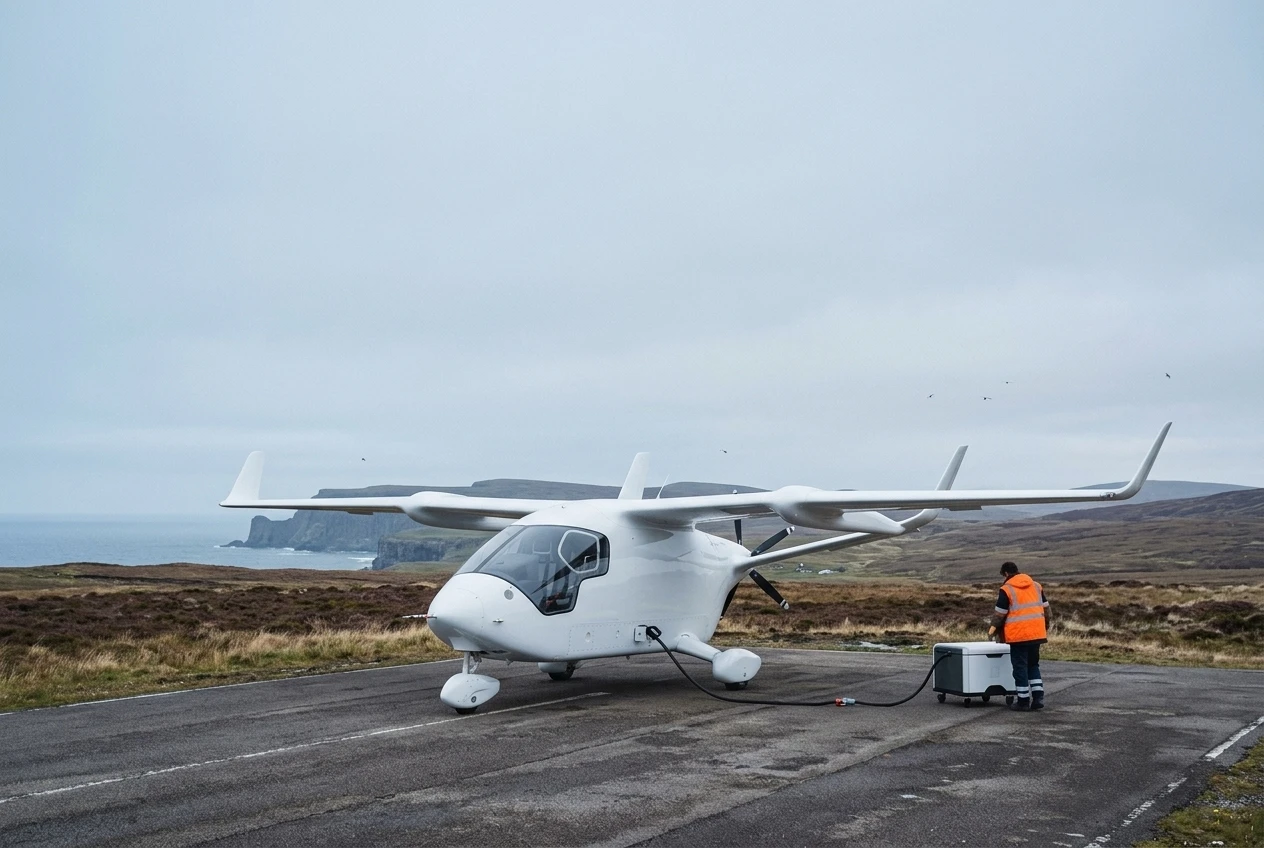
The CX300 is a conventional take-off and landing aircraft, not a vertical-lift design, built to carry up to five passengers and recharge in 20 to 40 minutes using BETA’s own fast-charging hardware. Most of Loganair’s regional sectors run under 100 miles, well within the aircraft’s stated mission profile.
The Routes This Fleet Is Supposed to Rescue Are Shrinking Now
Loganair has already cut frequencies on its Inverness to Stornoway route and its Inverness, Kirkwall and Sumburgh route, describing the reductions as a “last resort.” Neither route currently receives any public subsidy.
The airline says both have been loss-making for five to six years. It has asked the Scottish and UK governments to build a new financing model, and used the word “urgently” to describe the need.
The one exception is Kirkwall’s service to six outlying Orkney islands, which Orkney Islands Council funds directly through a public service obligation contract. Everywhere else in Loganair’s Highlands and Islands network, the airline is absorbing the losses itself, at least for now.
Loganair’s Fix Looks a Lot Like Norway
Loganair has pointed to Norway as the model it wants Scotland to follow, where the government subsidises regional carrier Widerøe to operate most rural air routes. The comparison is not new to Scottish transport policy circles.
HiTrans, the Highlands and Islands regional transport partnership, has floated a more specific version of the idea: a unified Scottish public service obligation network modelled partly on Norway and partly on Greece, whose co-financed archipelagic network links the mainland to more than 200 islands using joint Greek government and European Union funding.
HiTrans estimates the unified Scottish network, covering all of Loganair’s lifeline routes plus island council services, would cost around £30 to £32 million a year (about $39 to $41 million), only slightly above current spending. The pitch is that Highland and island connectivity should be treated as core infrastructure rather than discretionary spending, not a new argument, but one the electric aircraft order has given fresh visibility.
Loganair Joins a Long Queue for BETA’s Aircraft
Loganair is not BETA’s biggest customer, and it is not the airline’s first customer in Europe either.
| Airline or Operator | Alia Order | Region or Role | Status |
|---|---|---|---|
| Loganair | 5 firm, options for 5 more (CX300) | Scotland regional passenger routes | Term sheet signed July 2026, service targeted for 2029 |
| Surf Air Mobility | 25 firm, options for 75 more (CX300) | United States regional network | Firm purchase agreement signed March 2026 |
| Bristow Group | 5 firm A250s plus options for 50, and a deposit-backed order for up to 50 CX300s | Offshore energy transport, search and rescue, Norway and Aberdeen | Already flying the CX300 commercially in Norway |
| Air New Zealand | Undisclosed order | Regional flight trials, Hamilton Airport | Completed CX300 trials in February 2026 |
| United Therapeutics | Undisclosed order | US organ transport logistics | Early CX300 customer since 2023 |
Bristow has also floated its own plans to bring electric aircraft to Scotland within two years, positioning Aberdeen as a testbed for flights serving North Sea energy crews rather than island passengers. Bristow Norway also flew the CX300 between Stavanger and Bergen starting in August 2025, under a regulatory sandbox arrangement with Norwegian aviation authorities.
That timeline complicates the “first” claim. Bristow’s Norwegian flights predate Loganair’s own demonstration campaign by roughly seven months, though they carried cargo under a market-survey programme rather than fare-paying passengers, which is the distinction Loganair’s claim rests on.
BETA’s production facility in Burlington, Vermont, is built to produce up to 300 aircraft a year, with a second phase planned to double that. In its most recent annual results, founder and chief executive Kyle Clark said the company had expanded its commercial aircraft and component backlog through 2025.
Certification Still Trails the Headline
None of these orders, including Loganair’s, can fly commercial passengers until the CX300 itself is certified. BETA is pursuing that certification under the FAA’s Part 23 rules for small fixed-wing aircraft, a well-established regulatory pathway rather than the newer, still-forming rules covering vertical-lift designs.
The company originally aimed to certify the CX300 by 2025. That date has since slipped, with reports through late 2025 pointing to windows ranging from early 2026 to early 2027, a full aircraft generation behind the original goal, though BETA’s own quarterly filings show steady progress, including a firm order for 25 Alia CTOL aircraft from Surf Air Mobility signed in March 2026.
What we know:
- The CX300 is being certified under the FAA’s Part 23 framework, which has decades of precedent for small aircraft.
- BETA completed its first production-representative CX300 in the first quarter of 2026, shifting the programme from prototype testing into formal certification testing.
- Loganair’s own timeline points to 2029 for its first electric passenger flights, three years past BETA’s original certification goal.
What’s unconfirmed:
- The exact date the CX300 receives full FAA type certification.
- Whether Loganair’s term sheet converts into a binding purchase order.
- Whether the Scottish and UK governments adopt a Norway-style funding model for lifeline routes.
- Which specific routes get first access to the electric fleet once it arrives.
What Happens Before Loganair’s Electric Planes Fly?
Nothing changes for passengers immediately. Loganair still has to convert its non-binding term sheet into a firm order, wait for the CX300 to clear FAA certification, build charging infrastructure at island airstrips, and learn whether the Scottish and UK governments will fund the same lifeline routes it is cutting today.
Scotland is being pitched as a testing ground for more than one unconventional aircraft. A hybrid airship proposed for Highlands freight runs, the Airlander 10, has separately been floated as a delivery option for some of the same remote communities Loganair serves.
For now, the five Alia CX300s exist as a signature on a term sheet, a demonstration reel from March, and a delivery date that reads 2029.
 ONGC licence frees Venezuela cash and operatorship talks
  Anthropic Hits $65 Billion Run Rate and Flips the AI Cash Test
  Supreme Court grounds the fare free-for-all with three-week clock
  Gold Nears $4400 as Soft Data Meets Oil Inflation Risk
  Nifty Slips as Zaggle Circuits and Dhoot Debuts Big
  Diesel Crack Tops $100 as Iran Rhetoric Lifts Crude