
 Ishan Crawford
 Andy Burnham walked into 10 Downing Street on Monday and made one promise before anything else: end rough sleeping across Britain. Shelter Scotland’s response arrived within a day, and it was not a thank you note.
The charity says Burnham, Britain’s seventh prime minister in a decade, cannot deliver on that promise in Scotland simply by clearing the streets. The real drivers of Scotland’s rough sleeping surge, it argues, sit inside Westminster policy on welfare, asylum and capital funding, areas the new prime minister now controls directly and separately from the homelessness services Holyrood already runs.
Burnham Makes Rough Sleeping His First Instruction From No 10
Burnham took over from Keir Starmer on Monday after a Labour leadership change, becoming the country’s seventh prime minister in ten years. He closed his first address outside Downing Street with a single line about what would come next.
I will soon go through that door behind me and issue my first instruction to end rough sleeping
Burnham told the crowd gathered outside Downing Street, before turning to walk through the black door behind him. His office followed within hours with an extra £340 million ($457 million) earmarked for tackling homelessness. A statement issued alongside the announcement said the new prime minister does not accept that ending rough sleeping has to take decades, or that it cannot be done at all.
The new cabinet took shape the same day. Angela Rayner, who resigned as deputy prime minister last year over a property tax scandal, returned to government as housing secretary. John Healey, who quit as defence secretary last month in a dispute over military spending, became chancellor of the exchequer, putting him in charge of the Treasury purse strings that any Scotland-wide funding boost would eventually run through.
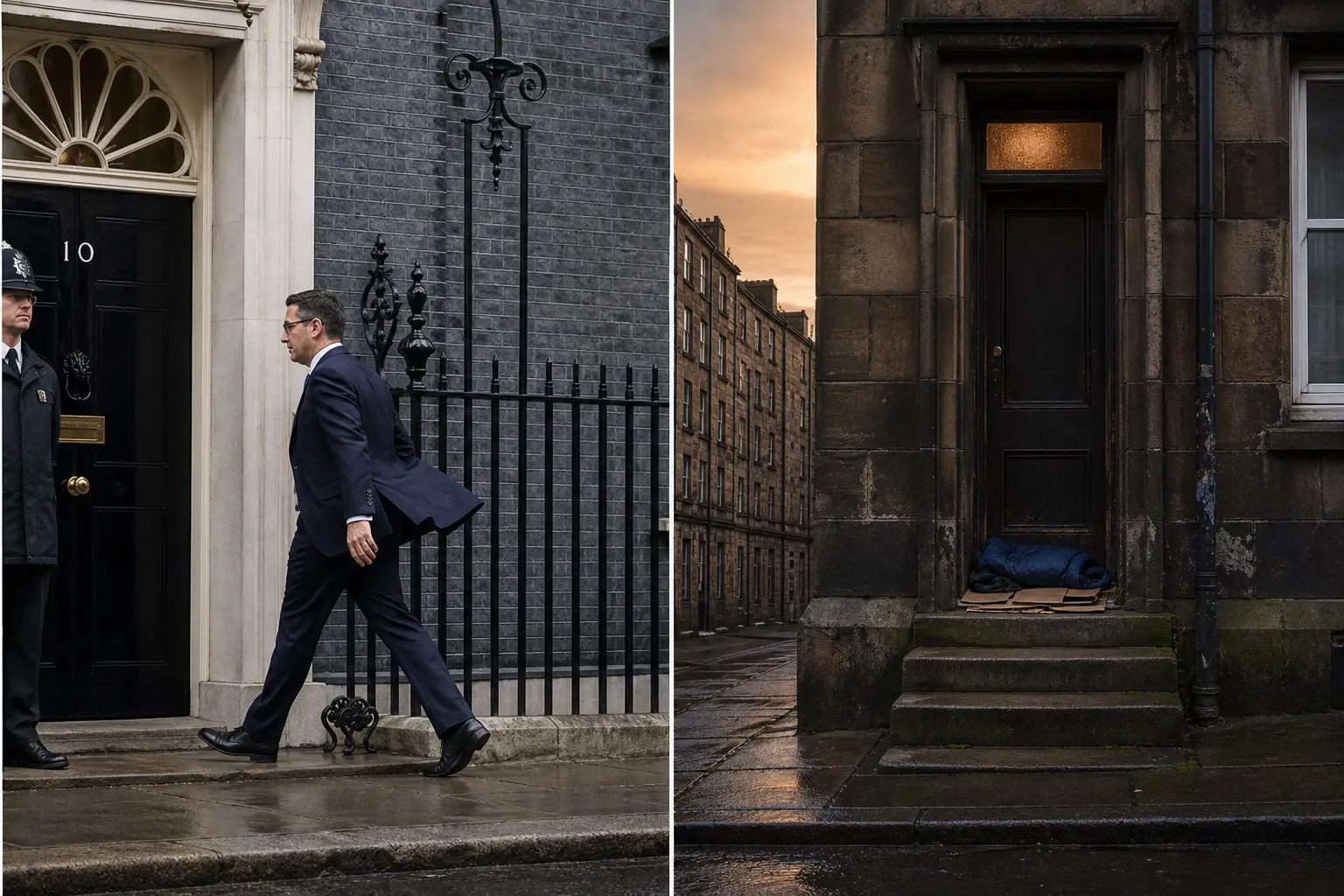
Scotland Runs the Shelters, Westminster Runs the Money
Housing and homelessness policy has been fully devolved to Holyrood since the Scotland Act 1998 gave the Scottish Parliament legislative competence over the area. Councils, homelessness law and temporary accommodation duties all sit with the Scottish government.
Welfare, asylum accommodation and the overall capital budget available to Holyrood do not. Universal credit, local housing allowance rates and the Home Office’s asylum estate all remain reserved to Westminster, meaning Burnham’s government sets rules that shape who ends up homeless in Scotland even though it has no direct hand in running Scottish shelters.
Gordon Llewellyn-MacRae, interim director at Shelter Scotland, welcomed the new prime minister’s focus but drew the line quickly.
“Andy Burnham is right to make homelessness his day one priority,” Llewellyn-MacRae said. “But it would be wrong to suggest that getting people off the streets is enough.”
Rough Sleeping Reports Have More Than Doubled Since 2021
Shelter Scotland’s own figures, drawn from Scottish government statistics, show how sharply the trend has moved over four years.
| Measure | Year to September 2021 | Year to September 2025 | Change |
|---|---|---|---|
| Households reporting rough sleeping the night before a homelessness application | 1,301 | 2,747 | +111% |
| Households assessed as homeless or threatened with homelessness | 28,813 | 33,966 | +18% |
Official 33,006 open homelessness applications recorded by September 2025 confirm the same direction, a 4% rise on the year before. Councils failed to offer any temporary accommodation at all on 10,710 occasions in the six months to September, up from 7,565 a year earlier.
Additional figures from the same statistical releases show where the strain is landing hardest.
- 18,092 households were in temporary accommodation as of 30 September 2025, a 9% increase on the same point in 2024, according to Crisis.
- 14,371 children were recorded as homeless in the year to September 2025.
- 43% of all rough sleeping reports in Scotland come from Glasgow alone, far ahead of Edinburgh’s 8%.
- A household in Scotland becomes homeless roughly every 15 minutes, based on the same statistics.
Maeve McGoldrick, head of policy and communications at Crisis Scotland, said the figures show the extraordinary pressure the homelessness system is being placed under. Every one of these numbers belongs to devolved services. Shelter Scotland argues the growth behind them traces back to decisions made in London.
Three Reserved Levers Shelter Scotland Wants Pulled
Llewellyn-MacRae listed the specific Westminster decisions he wants reversed, arguing each one feeds Scotland’s homelessness numbers directly.
- The local housing allowance freeze. Burnham should look again at how the UK government creates homelessness by cutting local housing allowance, Llewellyn-MacRae said, making it impossible for renters when wages don’t keep up with rents. The Department for Work and Pensions has confirmed rates will stay frozen at January 2024 levels through March 2027, the second consecutive freeze. UK rents have grown roughly 19% since that rate was set, according to the Institute for Fiscal Studies.
- The asylum move-on period. Llewellyn-MacRae wants Burnham to fix the asylum system that forces people fleeing persecution into homelessness by evicting them from accommodation. The Home Office briefly extended the window refugees get before losing asylum housing to 56 days, then reverted most cases back to a 28 day move-on period from September 2025, a change campaigners warned would push more newly recognised refugees onto the street.
- The bedroom tax. He wants Burnham to remove the so-called bedroom tax, which the Scottish government spends millions of pounds every year effectively eradicating, money Llewellyn-MacRae said would be better spent on prevention. Scotland has put more than £618 million into offsetting the policy since 2013, with a further £79.7 million budgeted for the 2025-26 financial year alone.
Burnham’s own record complicates at least one of those asks. He has separately backed doubling the time a migrant must wait before qualifying for indefinite leave to remain, a tougher immigration stance that runs counter to easing pressure on the asylum system.
Manchester Never Quite Delivered the Same Promise
This is not the first time Burnham has staked his name on ending homelessness. He made an almost identical pledge in 2017, when he became mayor of Greater Manchester.
CNN reported that homelessness in the city almost halved between 2017 and 2024, based on local government figures, but that numbers had begun climbing again since hitting their lowest point in 2021. Burnham never fully delivered on the original promise.
The comparison matters because Manchester gave Burnham direct control over tools he is now missing in Scotland. As mayor, he could not touch welfare or asylum policy either, since both remain reserved to Westminster regardless of which city or nation is asking.
What Does Scotland Actually Need From No 10?
Shelter Scotland’s answer is capital, not sympathy. The charity wants Burnham to boost capital investment flowing to Scotland so councils and housing associations can build social homes at scale, arguing that emergency accommodation shortages start with a lack of permanent homes to move people into.
“He should invest in a new generation of social housing, including increasing capital investment in Scotland,” Llewellyn-MacRae said, so that councils and housing associations can build at scale.
The gap is already well documented. A report by Shelter Scotland, the Scottish Federation of Housing Associations and the Chartered Institute of Housing Scotland put the cost of building the social homes Scotland needs at £8.2 billion a year between 2026 and 2031, well above the £4.9 billion the Scottish government has committed to affordable housing.
Other housing budgets face similar constraints. Scotland’s government reopened its first time buyer loan scheme this year at less than half its 2019 size, and separately fell short of its own housebuilding targets, according to Shelter Scotland’s earlier warnings.
Whether any of Burnham’s £340 million reaches Scotland at all is still an open question. Homelessness funding announced for England does not automatically transfer north. Any consequential payment would land in the Scottish government’s block grant, unringfenced, for ministers in Edinburgh to allocate as they choose.
Frequently Asked Questions
Does any of Burnham’s £340 million go to Scotland?
Not automatically. Homelessness spending announced for England typically generates a Barnett formula consequential added to the Scottish government’s block grant, but that money is not ring-fenced for homelessness and ministers in Edinburgh decide how to spend it.
What is the local housing allowance freeze?
Local housing allowance sets the maximum housing benefit or universal credit support a private renter can claim. The Department for Work and Pensions has frozen rates at January 2024 levels for a second consecutive year, through March 2027, even as rents keep rising.
Why does the Scottish government pay to offset the bedroom tax?
The bedroom tax reduces housing benefit for social tenants judged to have a spare room, a UK-wide welfare rule. Scotland uses devolved powers to fund discretionary housing payments that cancel the reduction out in full, at an estimated cost of £79.7 million in 2025-26 alone.
How reliable is the 2,747 rough sleeping figure?
It likely understates the true number. The count only captures people who slept rough the night before making a formal homelessness application to a council, so anyone sleeping rough without approaching a local authority goes unrecorded.
 ONGC licence frees Venezuela cash and operatorship talks
  Anthropic Hits $65 Billion Run Rate and Flips the AI Cash Test
  Supreme Court grounds the fare free-for-all with three-week clock
  Gold Nears $4400 as Soft Data Meets Oil Inflation Risk
  Nifty Slips as Zaggle Circuits and Dhoot Debuts Big
  Diesel Crack Tops $100 as Iran Rhetoric Lifts Crude