
 Ishan Crawford
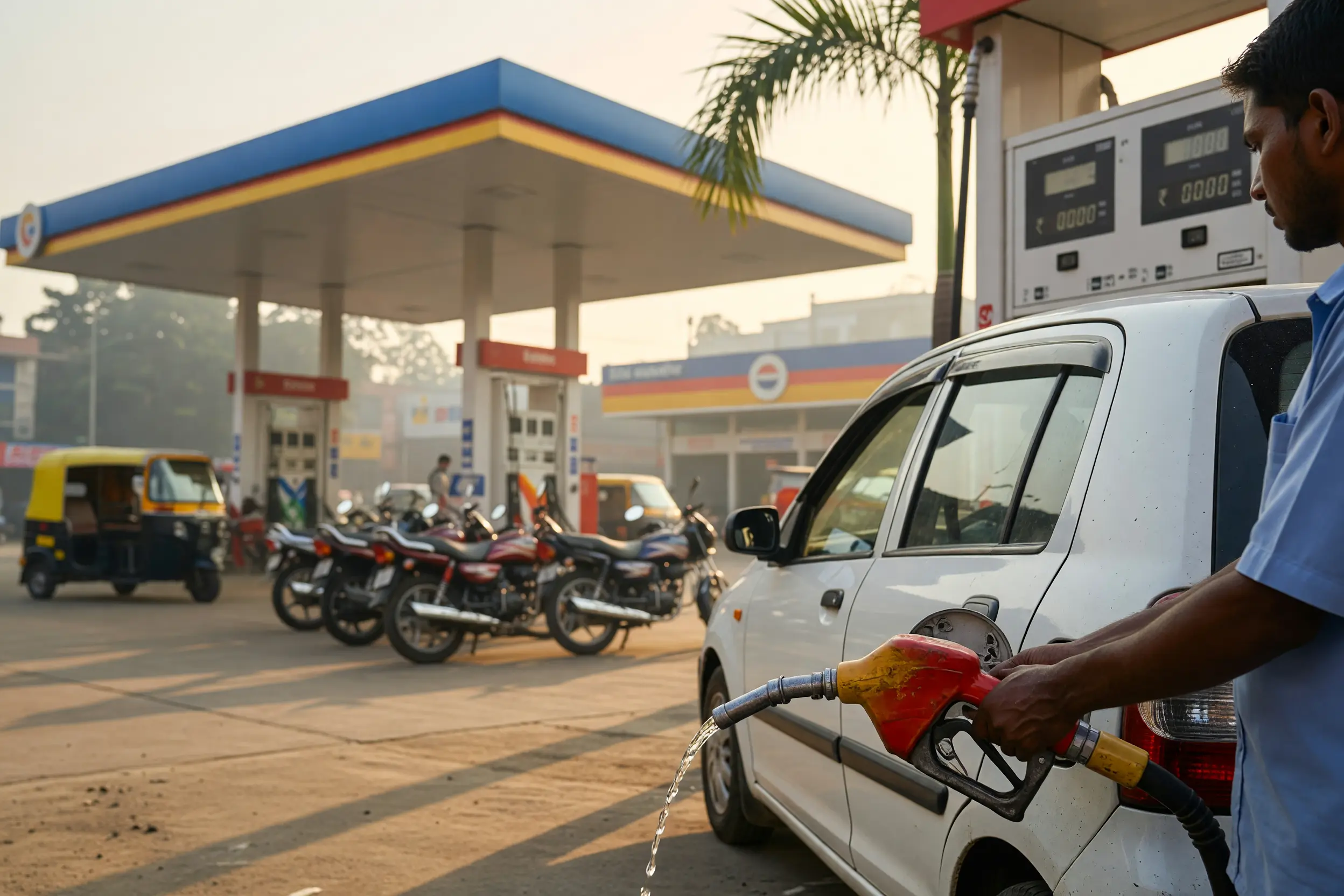
 India’s state-run fuel retailers raised pump prices on Monday for the second time in less than a week, an increase of about $0.0093 per litre that lifted petrol in New Delhi to 91.58 rupees per litre and diesel to 98.64 rupees, according to Reuters reporting summarised by OilPrice.com. The move arrived three days after Friday’s much steeper revision, the first retail change in four years.
The headline number is the smallest part of what is happening in India’s energy economy. Wholesale inflation has cleared 8 percent, the rupee slipped past 96 to the dollar this week, and households across Tamil Nadu, Karnataka, and Telangana are queueing for cooking-gas cylinders the government is rationing toward kitchens and away from restaurants.
What the Two Hikes Cover, and What They Don’t
Friday’s revision lifted petrol and diesel by roughly three rupees per litre across most state markets, the first retail change since May 2022. Monday’s increment added another 89 paise on petrol and 92 paise on diesel in New Delhi. Combined, the two moves cover slightly more than four rupees per litre at the pump.
The blended under-recovery sits well past that figure. Nomura’s mid-May client note pegged the gap on the retail basket at roughly 28 rupees per litre at a Brent price near $110, leaving about 24 rupees absorbed on every litre sold after both hikes. The Indian crude basket peaked at $157 in early April, according to data summarised by the Observer Research Foundation’s policy paper on the Hormuz disruption, before easing to its current band as President Donald Trump paused planned strikes against Iran for negotiations.
The table below puts the published retail moves against the published under-recovery.
| Move | Date | Petrol change | Diesel change | New Delhi pump rate |
|---|---|---|---|---|
| Friday hike, first since 2022 | May 15 | ≈ 3.00 rupees per litre | ≈ 3.00 rupees per litre | 97.75 / 90.66 rupees per litre |
| Monday hike | May 18 | 0.89 rupees per litre | 0.92 rupees per litre | 98.64 / 91.58 rupees per litre |
| Nomura blended under-recovery estimate | Mid-May | 15 to 28 rupees per litre | n/a | |
The Hormuz Closure Resets India’s Energy Math
The trigger sits 4,000 kilometres west of Mumbai. Coordinated US and Israeli airstrikes on Iranian nuclear and military facilities earlier this year drew Iranian retaliation across the Strait of Hormuz, the narrow corridor through which more than 40 percent of India’s crude oil flows moved before the conflict began.
The barrels India cannot move through Hormuz it cannot easily replace. Russian seaborne crude needs a renewed US Treasury waiver every month. Latin American grades cost more in freight than the saved purchase price. West African flows have already been redirected toward European buyers cut off from the same Gulf supply.
Per-barrel pricing tells the rest of the story. The Indian basket averaged $69 in February before the conflict, $126 in March, and peaked at $157 in early April. Brent settled near $110 once Trump’s pause on planned Iran strikes opened a window for talks, though traders are pricing the easing as conditional, not structural.
India’s pre-conflict import dependencies on the strait stack as follows:
- More than 40 percent of crude oil arrivals, the world’s third-largest crude import flow after China and the United States
- About 90 percent of liquefied petroleum gas (LPG, the household cooking fuel) arrivals, with roughly 60 percent of the basket from Qatar, the United Arab Emirates, and Saudi Arabia
- One-fifth of all global seaborne crude and liquefied natural gas passed through the same waterway before the closure
Refiners Are Absorbing the Gap
Indian Oil Corporation (IOC, the state refiner with the largest market share), Bharat Petroleum Corporation Limited (BPCL), and Hindustan Petroleum Corporation Limited (HPCL) are running their April books at marketing losses that wider crude-processing margins cannot offset. UBS analysts estimated integrated daily losses of $4, $8, and $19 per barrel respectively across the three, the spread widening on companies with thinner refining scale.
- 440 crore rupees in combined daily LPG losses across the three state refiners at current run rates, per Nomura’s mid-May note
- 76,000 crore rupees of combined FY26 profit on track to be wiped by FY27 first-quarter losses, according to a government source quoted by PTI
- $19 per barrel integrated loss at HPCL, the highest of the three, reflecting its smaller refining footprint and larger retail exposure
Inflation, the Rupee, and the Capital Flight
The headline macro reading arrived on May 14. India’s Wholesale Price Index hit 8.3 percent for April, a 42-month high and the steepest since the October 2022 reading at the peak of the post-Ukraine energy shock. March had printed at 3.88 percent.
Inside the basket, the Fuel and Power segment ran at 24.71 percent year-on-year, compared with 1.05 percent in March, with petrol at 32.40 percent and crude petroleum at 88.06 percent, according to data released by India’s Office of the Economic Adviser. Manufactured products posted 11.2 percent on basic metals, 7.45 percent on pharmaceuticals and plastics, and 5.12 percent on textiles, suggesting the pass-through into manufactured goods is already in motion.
The rupee has not held up either. On May 18 the currency touched a record 96.20 against the dollar before settling near 96.01. Bank of America Global Research moved its year-end forecast to 98, citing persistent dollar demand from oil importers and capital outflows from listed equities.
Capital is rotating out. Foreign portfolio investors pulled a net $9.3 billion from Indian equities and bonds in April, the largest single-month exit since the pandemic shock of March 2020. The Reserve Bank of India has been intervening in spot markets to slow the slide without burning through reserves it may need later in the year.
The slip carries through to the import bill. Every one-rupee depreciation against the dollar lifts India’s annualised oil import cost by roughly $1.6 billion at current run rates, according to a ratings note from ICRA Limited. The Monday hike does not move that math.
Cooking-Gas Queues Reach the Kitchen Table
LPG is where the supply squeeze became visible to households before it reached pump boards. India imports about 85 percent of its cooking gas from the Middle East on long-term contracts, with the bulk arriving via the same disrupted corridor. April consumption fell to 2.2 million tonnes, down from 2.62 million tonnes a year earlier, a 16.2 percent drop in the demand of a country whose kitchens almost universally run on the fuel.
State governments have rationed cylinders, diverting available supply away from industrial and commercial users toward residential connections. Tamil Nadu’s restaurant federation has flagged nearly 10,000 small and medium establishments likely to shutter by Wednesday, with larger chains operating on reduced menus. In Chennai, Bengaluru, and parts of Hyderabad, residents have queued from before dawn at distribution centres, scenes the country had not seen since the late 1970s. Scotland saw forecourts run dry under the same Middle East shock, though without the cooking-gas dimension that India faces at home.
There is no LPG supply issue. We have 45 days of cylinder stock and our long-term contracts with Qatar and the UAE are intact.
The reassurance came from Hardeep Singh Puri, India’s Petroleum and Natural Gas Minister, at the Confederation of Indian Industry’s Annual Business Summit on May 12. It preceded a fresh round of state-level rationing notices and reporting from Middle East Eye documenting workers leaving Mumbai and Hyderabad for rural districts where firewood remains an option.
Stockpile Math and the June 17 Cliff
Puri’s other claim, that India holds 69 days of crude and liquefied natural gas reserves, drew some quibbles. An Informal Group of Ministers briefing the day before put the figure at 60 days of crude, 60 days of gas, and 45 days of LPG. Independent estimates land between 70 and 74 days once private refinery and floating stocks are included, still below the International Energy Agency’s 90-day benchmark for member countries.
Russian crude has been the swing variable. The US Treasury issued a 30-day waiver on Russian seaborne oil already at sea in mid-March, extended it in April, and on May 18 extended it again to June 17. Each renewal applies only to barrels loaded before a hard cutoff, meaning the waiver finishes deliveries already in transit rather than authorising new purchases.
The Petroleum Ministry has issued conservation appeals, asking households to carpool, shift trips to public transport, and consolidate weekly errands. India’s foreign secretary said this week that New Delhi will keep buying Russian energy on commercial terms regardless of sanctions, a public position designed for the next round of talks with the Treasury rather than for the domestic audience already queueing for cylinders.
If the waiver renews on schedule and Trump’s negotiating window with Tehran holds open through June, the Friday and Monday moves look like the floor for retail pump prices and a slower bleed for refiner books. If the cutoff lapses and the strait stays disrupted, the under-recovery still pinned on IOC, BPCL, and HPCL becomes the daily question, and the rupee, the inflation print, and the empty cylinder lines that retail prices have not touched yet are where the bill arrives next.
 Verizon SoCal Fiber Cuts Expose Surging Attacks on Networks
  Adnoc Gas Turns OPEC Exit Into $8.2 Billion Capacity Push
  Gen Z Job Ghosting Hits 54 Percent After Offers Land
  Taylor Farms Lettuce Recall Hits 236000 Cases Across Chains
  SpaceX Lock-Up Rally Exposed Crowded Fear Trade Not True Demand
  AI Safety Tests Now Spawn Real Autonomous Threats