
BUSINESS
China Cut Treasuries in March and Did Not Stop
China’s March Treasury cut sat in a 13-year rundown that ran through July, even as private buyers and stablecoin issuers funded the other side.

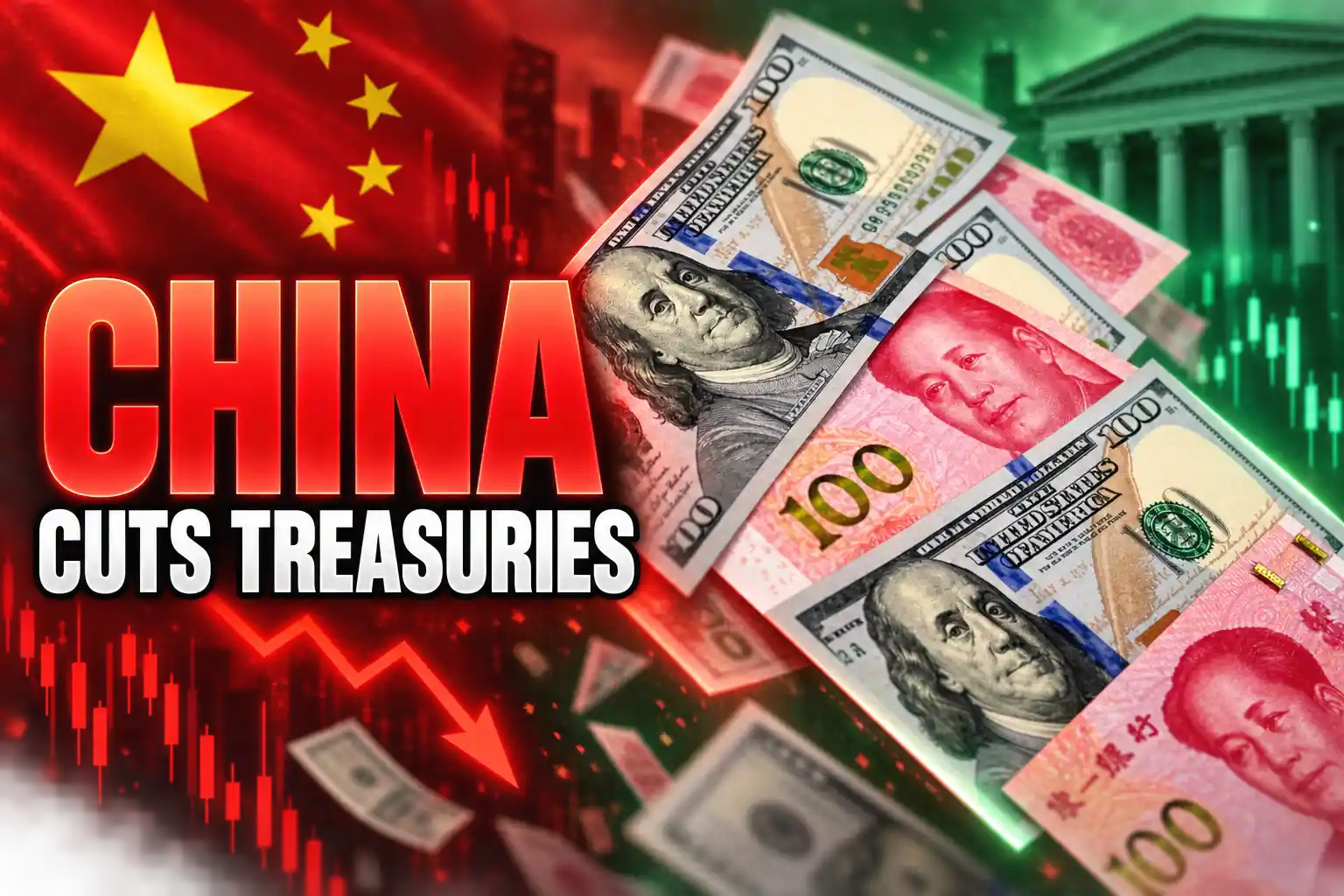
China cut its U.S. Treasury holdings by $40.9 billion in March 2026, to $653.3 billion, during a global bond selloff tied to the Iran war. The Treasury Department published those March figures on May 18. Four months later the same table put mainland holdings at $618.0 billion, the lowest reading since 2008.
By July, China was still the third-largest foreign holder, behind Japan and the United Kingdom. The war month was the loud print. The selling did not stop there.
China Cut $40.9 Billion in March and Kept Cutting
The U.S. Treasury’s table of major foreign holders of Treasury securities is the source for the country figures. February’s mainland balance was $694.2 billion. March took it down to $653.3 billion. That $40.9 billion drop was the sharpest one-month decline on the 2025-26 sheet.
Foreign holdings as a group fell from a record $9.487 trillion in February to $9.352 trillion in March, a $134.9 billion decline. Foreign official institutions, a group that includes central banks, cut their Treasury stockpile from $4,009.6 billion to $3,903.0 billion, a $106.6 billion reduction. Seven of the ten largest country lines fell that month. The United Kingdom, the Cayman Islands, and Ireland were the three that rose.
In March, the 10-year Treasury yield rose nearly 40 basis points to about 4.39 percent, and Brent crude held above $100 a barrel as fighting around the Strait of Hormuz disrupted oil flows. Rate-cut bets faded. Bond prices fell, so some of the drop in reported holdings is mark-to-market as well as sales.
FOREIGN TREASURY HOLDINGS, $ BILLIONS
| Holder | February 2026 | March 2026 | July 2026 |
|---|---|---|---|
| Japan | 1,239.3 | 1,191.6 | 1,103.9 |
| United Kingdom | 897.3 | 927.1 | 998.3 |
| China, Mainland | 694.2 | 653.3 | 618.0 |
| Belgium | 454.7 | 454.0 | 470.7 |
| Cayman Islands | 443.4 | 460.1 | 460.1 |
| All foreign holders | 9,487.3 | 9,352.4 | 9,248.1 |
| Of which: foreign official | 4,009.6 | 3,903.0 | 3,773.1 |
April barely moved China’s line, to $651.1 billion. May bounced to $659.3 billion. June then dropped it by $25.9 billion to $633.4 billion, and July took it to $618.0 billion. From February through July the mainland balance was down $76.2 billion. That is not a one-month flinch.
The Bigger Sale Came From Tokyo
Japan, still the largest foreign holder, cut $47.7 billion in March, to $1,191.6 billion. That is a larger dollar sale than China’s. Tokyo’s stockpile had peaked at $1.325 trillion in November 2021, and the March print left it well below that mark.
Japan then bought some paper back. April holdings rose $18.3 billion, to $1,209.9 billion. The rebound did not last. By July the Japanese line was $1,103.9 billion, $135.4 billion below February. The March sale was a yen-and-rates problem as much as a war problem, and the later months kept draining the account.
The United Kingdom went the other way. UK-booked holdings rose $29.8 billion in March, or 3.3 percent, to $927.1 billion. By July the UK line was $998.3 billion, after a $58.4 billion jump from June. A large share of those bonds is held in London for clients who live elsewhere, so the UK rise is a custody story as well as a British one. Even so, it is the line that absorbed what Tokyo and Beijing were shedding.
Private Money Covered Official Selling in March
Country holdings and cross-border flows are different prints. Holdings can fall when prices fall. Flows show who was buying. The March TIC release recorded a net TIC inflow of $150.7 billion, even as the big official holders cut their stockpiles.
THE MARCH TIC FLOW PRINT
- Net inflow: Foreigners added $150.7 billion across long-term securities, short-term paper, and bank flows.
- Private accounts: Private foreign inflows were $162.1 billion, more than enough to cover official selling.
- Official accounts: Foreign official institutions posted an $11.4 billion outflow, including $14.9 billion of net sales of long-term U.S. securities.
- Bills: Foreign holdings of Treasury bills fell $16.8 billion, a separate short-end drain from the notes China has been running down for years.
Private foreign investors bought $111.4 billion of long-term U.S. securities that month. After adjustments, overall net foreign purchases of long-term securities were $81.3 billion. Washington still found buyers. They were not the central banks that used to recycle trade surpluses into coupons.
July’s later print was smaller and mixed in a different way. Net TIC inflows were $83.7 billion, with $73.5 billion from private accounts and $10.2 billion from official accounts. Foreign official institutions were net buyers of long-term securities that month, even as China’s reported Treasury line kept falling. The official bid came back in aggregate. It did not come back through Beijing’s column.
Holdings Have Fallen by Half Since 2013
The March war scare did not start this trade. The monthly series of China’s Treasury holdings has been grinding lower for more than a decade. Wind, the Chinese financial data provider, puts the peak at nearly $1.32 trillion in November 2013. July’s $618.0 billion is 46.8 percent of that peak, less than half. Wind also puts the last lower print in August 2008, at $573.7 billion, which is why July is an 18-year low.
From July 2025 to July 2026 the mainland line fell $77.6 billion, or 11.2 percent, from $695.6 billion. China’s share of all foreign holdings in July was 6.7 percent. Japan still held $1,103.9 billion. The United Kingdom held $998.3 billion. The ranking did not change. The weight did.
THE CHINA RUNDOWN
- August 2008: Holdings fall to $573.7 billion, the trough later used to date the July 2026 low.
- November 2013: Holdings peak at nearly $1.32 trillion, according to Wind, when China was still the largest foreign creditor.
- March 2026: Holdings fall $40.9 billion to $653.3 billion as the Iran war lifts yields and oil.
- May 18, 2026: The Treasury releases the March TIC package that first put the war-month cut on the tape.
- July 2026: Holdings stand at $618.0 billion, with the July table published on September 16, 2026.
Beijing still runs a large goods surplus. In the 2000s that surplus was recycled into Treasuries because the market was deep enough to absorb it. After Washington froze Russian reserve assets in 2022, reserve managers treated dollar paper as a sanctions risk as well as a rate risk. The Iran shock in March 2026 added an inflation scare on top of that older worry. The path from $1.32 trillion to $618.0 billion is the through-line. March is one steep step on it.
22 Months of Gold Buying at the PBOC
The other side of the reserve book is metal. The World Gold Council, in its China update dated September 14, 2026, said the People’s Bank of China reported a 20.2-tonne gold addition in August, the largest monthly increase since October 2023. Official holdings had then risen for 22 consecutive months, reaching 2,387 tonnes of official gold by the end of August, or 9 percent of foreign-exchange reserves, up from 8 percent in July.
a global trend of diversification into gold… and agency bonds, as well as other assets like equities, especially with the AI boom
Wei Li, head of multi-asset investments, BNP Paribas Securities China
Gold cannot replace $618.0 billion of Treasuries tonne for tonne. It does not have to. The PBOC is shrinking the share of reserves that sit in a market Washington can freeze, and it is doing that in public, month after month. Agency mortgage bonds, European assets, and custody accounts in third countries fill more of the gap than bullion does. The gold streak is the part of the shift that is easy to see.
Who Bought the Paper China Dropped?
Over five years, stablecoin issuers added about $200 billion of Treasuries, enough to offset more than 40 percent of China’s decline over the same stretch, according to a September 28, 2026 Economic Letter from the Federal Reserve Bank of San Francisco. The letter says that bid is concentrated in bills, not the longer notes China has been cutting, and that since 2023 those issuers have added more short-term Treasuries than Japan.
A new Economic Letter highlights that stablecoin issuers' Treasury holdings have grown more than $200B in five years, helping offset the decline in China's holdings. https://t.co/F6axYt4YKR pic.twitter.com/B2CdXNbghI
— Federal Reserve Bank of San Francisco (@sffed) September 28, 2026
If the recent trend held, the San Francisco Fed wrote, demand from this source would nearly double to about $400 billion by the end of 2030. That is a projection, not a booking. It also describes a different product. China has been reducing longer-term bonds. Tether and USD Coin need assets they can turn into cash overnight, so they buy bills. The new bid cushions the short end. It does not automatically replace a central bank that used to own the belly of the curve.
THE ACCOUNTS THAT TOOK THE OTHER SIDE
- UK custody books: Holdings booked in the United Kingdom rose to $998.3 billion in July, up $58.4 billion in a month, and now sit just $105.6 billion behind Japan.
- Stablecoin issuers: About $200 billion of extra Treasury holdings over five years, mostly bills, equal to more than 40 percent of China’s decline in that window.
- Private foreign accounts: In March they supplied a $162.1 billion inflow while official accounts ran an $11.4 billion outflow.
- Cayman and Ireland: Both raised Treasury holdings in March, when seven of the top ten country lines were falling.
Some of that stablecoin demand may even loop back through Chinese users who buy dollar tokens and, in effect, rent a claim on T-bills. That would mean part of the “offset” is Chinese money in a different wrapper, not a new foreign creditor. It would still leave the U.S. Treasury with a shorter-duration, more redeemable buyer than a reserve manager who used to roll 10-year notes.
Overseas Custody Blurs China’s True Stash
The Treasury repeats the same warning in every TIC release: if a bond bought by a foreign resident is held in a custodial account in a third country, the true owner does not show up in the country table. Belgium and Luxembourg, home to Euroclear and Clearstream, are the usual suspects for paper that is Chinese in economic terms and European on the form. Belgium’s July line was $470.7 billion, up from $454.0 billion in March. That rise can be many things. One of them is hidden official money.
So the $618.0 billion mainland figure is a floor on what U.S. custodians see, not a full map of SAFE’s dollar book. Analysts have made that point for years. It does not erase the direction of travel. Direct, attributed holdings have been cut in half since 2013, the March war month took $40.9 billion off the tape in one step, and July made an 18-year low. Foreign official Treasury holdings as a whole were $3,773.1 billion in July, down from $4,009.6 billion in February.
The next TIC release, covering August, is scheduled for October 16, 2026. That print will show whether $618.0 billion was a pause or another step down. The four months after March already showed that China did not need a second oil shock to keep selling.
Disclaimer: This article is news reporting and analysis of Treasury International Capital data, central-bank gold figures, and related market prices. It is for information only and is not investment, trading, or portfolio advice, and it does not recommend buying or selling Treasuries, gold, currencies, or any other asset. Readers who are considering changes to a reserve, fund, or personal portfolio should consult a licensed financial adviser or qualified investment professional who can judge their own objectives and limits. Holdings, yields, and gold tonnage are those published by the cited official and research sources on the dates given, and later TIC revisions or new monthly prints can change the levels.

TCS Opens Q2 as Mid-Cap IT Keeps the Growth

Bitcoin’s Jobs Rally Fails While December Hike Odds Hold

The Heat Turn a Bucks Rematch Into Vice City Night

The G7 Opens Diesel Tanks While Carriers Head East

Kia Bets Fortuner Money on a Made-in-India Sorento

Volkswagen Sells the Osnabruck Plant to Clear a Board Fight

Tata Motors’ Iveco Tender Opens as Holders Still Decide

Saksham Gaur Finds He Is His Own Company’s Client

Onimusha Way of the Sword Preload Hits a Windows 11 Wall

The Frame Pro’s $1,200 Labor Day Cut Needs a Soundbar
-
 AUTO4 weeks ago
Volkswagen Sells the Osnabruck Plant to Clear a Board Fight
-
 AUTO1 month ago
Tata Motors’ Iveco Tender Opens as Holders Still Decide
-
 BUSINESS1 month ago
Saksham Gaur Finds He Is His Own Company’s Client
-
 GAMING1 month ago
Onimusha Way of the Sword Preload Hits a Windows 11 Wall
-
 NEWS4 weeks ago
The Frame Pro’s $1,200 Labor Day Cut Needs a Soundbar
-

 BUSINESS1 month ago
The Rs 4.66 Lakh Crore IPO Queue Is Mostly Paper
-

 NEWS1 month ago
Apple’s Foldable iPhone Hinges on Samsung Display Supply
-

 BUSINESS1 month ago
SEBI Reopens How F&O Settles After the Closing Auction