
 Ishan Crawford
 The rupee opened Monday at 96.20 to the US dollar, a fresh record low and a fifth straight session in which the screen has printed an all-time worst level. The move marks a 0.2% slip from Friday’s 95.97 close and takes the currency’s slide since the Iran war began on February 28 to roughly 5.5%, leaving the rupee Asia’s worst-performing currency this year and exposing a balance-of-payments problem that no single instrument can absorb.
Brent crude is doing most of the damage, trading around $111 a barrel after a drone strike on the Barakah nuclear power plant in the United Arab Emirates added a fresh supply scare to a market already starved by the closed Strait of Hormuz. With the Reserve Bank of India intervening in spot, banks newly capped on their dollar positions, gold and silver tariffs lifted to 15% over the weekend, and foreign portfolio flows running in reverse, every lever Delhi can pull is now in motion at the same time.
The 96.20 Print and What Sits Behind It
Friday already broke the psychological 96 wall, with the rupee touching an intraday 96.14 before settling at 95.97. Monday’s open extended that move rather than reversing it, which is the part that worries treasury desks. A first break of a round number is mechanical; a follow-through next session is sentiment.
The currency is now down 5.5% in roughly eleven weeks, a pace of depreciation India last saw during the 2022 dollar-strength episode but compressed into a much shorter window. Asia’s other big oil importers have moved too, yet the rupee has slipped further than the Korean won, the Thai baht and the Philippine peso since the conflict began, according to spot screens.
“The ongoing geopolitical uncertainty and energy-driven macro pressures continued to fuel strong dollar demand globally, pushing the rupee beyond the Rs 96 mark,” said Ponmudi R, chief executive of brokerage Enrich Money, in a note to clients. He flagged investor anxiety over India’s “rising import bill, worsening inflation trajectory, and potential slowdown in economic growth at a time when the macroeconomic environment is already under severe strain.”
The Nifty50 opened 247 points lower at 23,396.45, off 1.04%, while the BSE Sensex shed 808 points to 74,430.35, down 1.07%, before paring losses through the session. The opening tape is what currency desks watch; the recovery is what equity desks sell into.
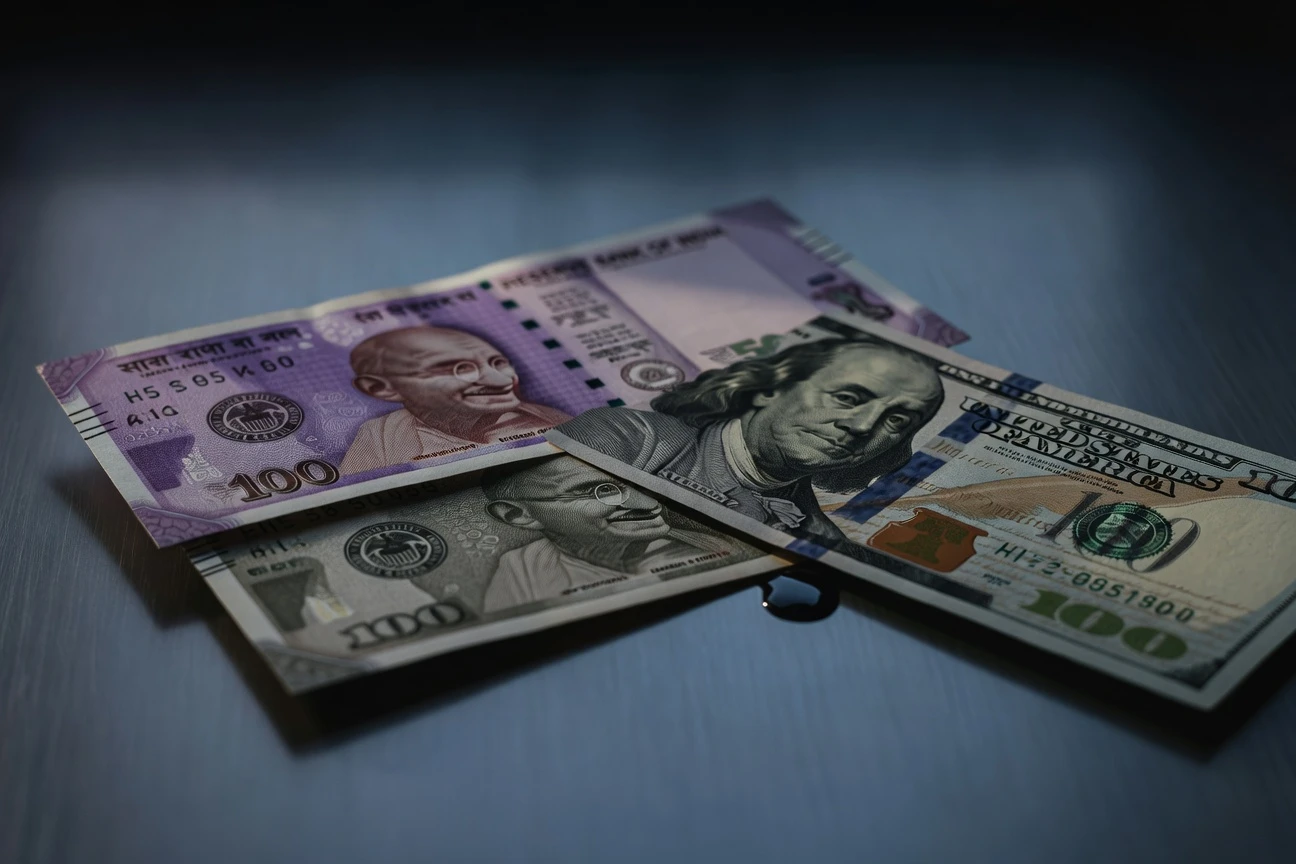
Oil Is the Engine, Not the Trigger
The Iran war put a floor under crude. The Strait of Hormuz, which handles about one-fifth of global oil and liquefied natural gas flows, has been largely blocked since late February, with the IRGC formally closing the chokepoint on March 27 to any vessel “to and from” the United States, Israel, and their allies. India imports about half its crude through the strait.
The trade math is brutal in real time. India’s trade deficit blew out to $28.38 billion in April, the widest reading in years and roughly $8 billion above March, according to commerce ministry data flagged by Reuters. The crude bill alone hit $18.6 billion.
- $111 a barrel: Brent crude on Monday morning, up after the Barakah drone strike report
- $126: peak Brent print since the war began, hit in March
- 81%: April gold-import bill rise versus April 2025, before the weekend duty hike
- 157%: April silver-import bill rise on the same comparison, a major reason for the import curbs
Brent at $111 is not the worst level seen since the war began; the peak was higher in March. But the macro damage is cumulative, not peak-driven. Every additional month of triple-digit oil widens the current account, drains reserves through intervention, and forces a higher hurdle for capital inflows to balance the book. That is the channel the rupee is now pricing.
Four Levers, Pulled at Once
What makes this episode different from earlier rupee scares is the breadth of the policy response. The RBI and the finance ministry are now using four instruments simultaneously, where in 2013 and 2022 the central bank leaned mostly on spot intervention and a one-off rate move. The combined posture is defensive across the entire balance sheet.
The Bullion Tariff Wall
On May 13 the government more than doubled basic customs duty on gold and silver to 15%, comprising a 10% customs duty and a 5% agriculture infrastructure and development levy. Over the weekend, most silver imports were curbed further, and duty-free import licences were capped at 100 kilograms. Gold and silver together account for nearly 11% of India’s import bill, which makes the bullion lever one of the few non-energy import categories large enough to move the trade gap.
The NOP Cap on Banks
From April 10, the RBI capped authorised dealer banks’ end-of-day Net Open Position in the rupee, known as NOP, at $100 million in the onshore deliverable market, down from a previous regime where private and foreign banks could run positions up to 25% of capital. Market estimates pointed to roughly $40 billion of large long-dollar positions getting squared off in the squeeze that followed.
Spot Intervention and Derivative Curbs
The central bank also restricted rupee non-deliverable forwards offered by authorised dealers, barred the cancellation and rebooking of forward contracts on the same exposure, and stepped into the spot market through April. Public dollar sales in April ran in the $3-4 billion range according to dealer estimates, on top of cumulative interventions earlier this year.
| Lever | Date | What changed | Hidden cost |
|---|---|---|---|
| Bullion import duty | May 13 | Gold and silver duty raised to 15% | Smuggling premium, retail jewellery slowdown |
| Silver import curb | May 16-17 | Most silver imports restricted, 100 kg licence cap | Industrial silver users pay premium |
| Bank NOP cap | April 10 | End-of-day rupee NOP capped at $100M | Bank mark-to-market losses, thinner FX liquidity |
| NDF / forward curbs | April 1 | Tighter rules on cancel-and-rebook, NDF access | Corporate hedging costs rise |
| Spot intervention | Through April-May | Roughly $3-4 billion sold in April | Reserve drawdown, signalling cost |
Each tool buys time. None solves the underlying gap. And each one has a constituency that will start lobbying loudly the longer it stays in force, with jewellers and bank treasuries already pushing back through industry channels.
Stocks Whipsaw, Foreign Money Keeps Leaving
The equity tape is doing two jobs at once. It is digesting the FX shock through the import-heavy parts of the index, while exporters with dollar revenue get a rerating bid that partially offsets the headline drag. By the close, Sensex and Nifty had erased most of the morning’s 1% gap on a sector rotation into IT.
Underneath, foreign portfolio investors have not stopped selling. The pace is what matters:
- ₹60,847 crore ($6.5 billion) pulled out of Indian equities in April, the heaviest month of selling in over two years
- ₹27,000+ crore already withdrawn in May through mid-month, on the same trajectory
- ₹1.92 trillion cumulative 2026 FPI equity outflow through April, already ahead of the full-year 2025 number
- ₹17,689 crore pulled from fully accessible route government securities since the war began
- 14.7% aggregate foreign holding in Indian listed stocks, a 14-year low
The debt outflow is the more telling number for FX. Equity selling rotates capital; debt selling withdraws dollars from the system at maturity. Combined with the trade gap, that loss of inflow is what is forcing the RBI to choose between using reserves and letting the rupee absorb the shock.
Where the Balance of Payments Cracks First
The structural issue is no longer about a single number. It is about which part of the external balance sheet bends when the others have already been used.
Economists at JP Morgan put the choice in plain terms in a note cited by Reuters this week.
In the near term, growing balance of payments pressures will have to be absorbed across multiple instruments: rupee depreciation, FX intervention, incentivising capital flows and compressing the current account.
Three of those four are already running near capacity. Depreciation is the lever doing the visible work. Intervention is running at a pace that, if sustained for several quarters, would meaningfully draw down headline reserves. The current-account compression has begun, via the bullion tariffs and silver curbs. The fourth, incentivising capital flows, is the hardest one to pull when global yields are rising and US rates are sticky.
Inflation is the next domino. BMI, the Fitch Solutions affiliate, has cut its India GDP growth forecast to 6.7% for fiscal 2026-27 from 7.7% in 2025-26, with the downgrade pinned directly to the oil shock. Higher landed crude raises pump prices, which raises transport-led core inflation, which complicates the RBI’s room to cut policy rates even as growth slows. A central bank cutting into rupee weakness invites a deeper FX move; one holding rates into a growth slowdown takes a political bill.
The currency tape is the cleanest read on which way that trade-off resolves. As long as Brent stays above $105 and the strait stays effectively shut, the rupee has no obvious reason to retrace. The shape of the next move depends on whether the RBI keeps absorbing the pressure with reserves or lets the spot rate continue absorbing it for them.
The 100-Rupee Question
Dealer chatter has shifted, in the last week, from “can we hold 96” to “how fast does 100 print.” Outlook Business and Business Standard have both run analyst pieces asking whether the market is bracing for ₹100 per dollar, and traders are quoting one-month forwards consistent with continued depreciation pressure rather than mean reversion.
The honest answer is that 100 is a function of two variables, not a forecast. If a ceasefire reopens Hormuz and Brent retraces toward $90, the spot rate can stabilise in the 95-96 band on FPI bargain-hunting alone. If the conflict extends through the summer and Brent stays above $110, depreciation, intervention costs, and current-account compression compound in a way that makes a triple-digit print less a tail risk and more a base case.
If the rupee holds the 96.50 area into next week and FPI debt outflows slow, the multi-lever defence has bought enough time for oil to do the rest. If 97 prints with the same speed that 96 did, the question stops being how India absorbs the shock and becomes which lever Delhi pulls next.
Disclaimer: This article is for informational purposes only and does not constitute investment, currency, or financial advice. Foreign exchange and equity markets carry significant risk, and outcomes depend on factors that can change rapidly. Readers with exposure to the rupee, Indian equities, or commodity-linked instruments should consult a qualified financial professional before acting on any information here. All figures are accurate as of publication on May 18, 2026.
 ONGC licence frees Venezuela cash and operatorship talks
  Anthropic Hits $65 Billion Run Rate and Flips the AI Cash Test
  Supreme Court grounds the fare free-for-all with three-week clock
  Gold Nears $4400 as Soft Data Meets Oil Inflation Risk
  Nifty Slips as Zaggle Circuits and Dhoot Debuts Big
  Diesel Crack Tops $100 as Iran Rhetoric Lifts Crude