
 Ishan Crawford
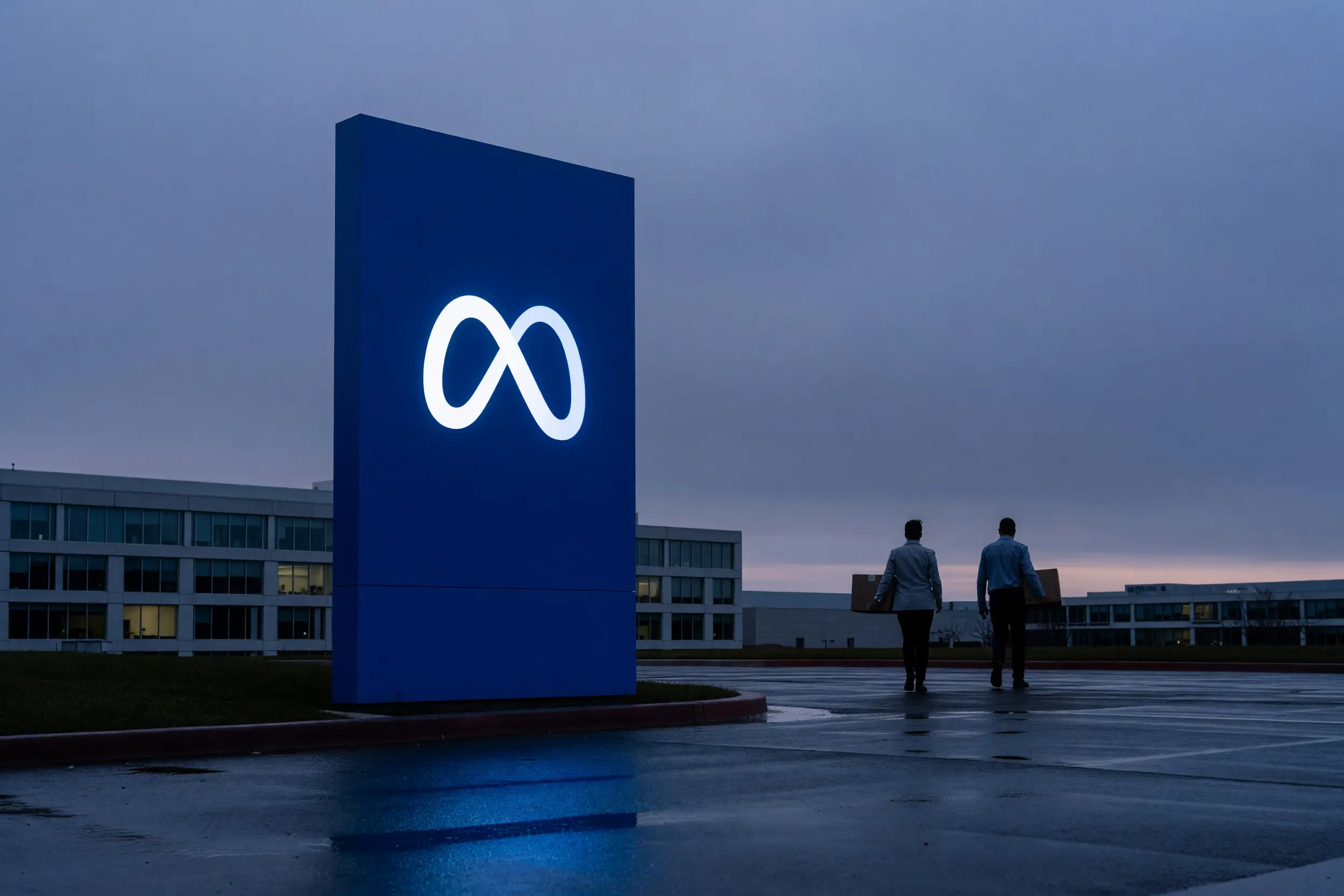
 On Wednesday, May 20, Meta will tell roughly 8,000 employees to clear out their desks. On the same day, another 7,000 will log on to find themselves reassigned to four newly created organizations, with new titles, new managers, and instructions to build AI products inside a structure with fewer layers of oversight than Facebook has used in two decades.
Both memos went out from Janelle Gale, Meta’s chief people officer. Together they touch close to one in five of the roughly 78,000 people Meta employed at the end of last year. By Wednesday evening, between the layoffs, the reassignments, and 6,000 cancelled open requisitions disclosed in April, the company will have rewired the staffing of nearly 20 percent of its jobs in a single news cycle.
Two Memos, One Reorganization
The 8,000 cuts surfaced first, in late April. Gale told staff the reductions were part of Meta’s continued effort to run the company more efficiently and would help offset other investments. She did not name those investments. The line investors actually watch is capital spending, and Meta now guides to between $125 billion and $145 billion in capex for 2026, more than double what it spent last year.
The reassignment memo landed Monday evening, two days before the cuts begin. Per reporting on the internal note, 7,000 employees are being moved into four new organizations focused on AI agents, AI-powered apps, and tools the company has not yet detailed publicly. Gale wrote that the new structure would be flatter, with smaller teams, and described it as using AI native design structures with fewer layers of management per employee.
- 8,000 layoffs scheduled for May 20, roughly 10 percent of headcount
- 7,000 employees reassigned to four new AI-focused organizations
- 6,000 open roles cancelled in the same restructuring
- 20 percent of the workforce touched by one or both actions
Taken together, this is the largest single-day workforce action Meta has run since its 2023 “Year of Efficiency,” and it lands on a company still posting growth. Fourth-quarter 2025 revenue cleared $56 billion and full-year free cash flow finished above $43 billion. The cuts are not a response to a bad quarter. They are a bet that a smaller, flatter company can ship faster.
Inside the Four New AI Organizations
The 7,000 reassignments fold into four units Meta has not formally introduced. Internal documents and reporting around the memo identify them as Applied AI Engineering, an Agent Transformation Accelerator, a Central Analytics group, and a still-unnamed Enterprise Solutions unit. Each reports up through Superintelligence Labs, the division Mark Zuckerberg, Meta’s chief executive, established last summer under former Scale AI chief Alexandr Wang.
Applied AI Engineering
Applied AI Engineering, or AAI in the memo, is the build arm. It absorbs engineers from across Facebook, Instagram, WhatsApp, and Threads who were previously embedded in product groups and consolidates them into a single horizontal pool. Roughly 1,000 employees have already received new titles, including “AI builder,” “AI pod lead,” and “AI org lead,” according to reporting on the memo.
The Agent Transformation Accelerator
The Agent Transformation Accelerator, tagged ATA XFN inside the company, sits closer to research. Its job is to ship the agentic versions of Meta’s chatbot and the customer-service and creator-support tools that until now lived inside the ads and partnerships organizations. The accelerator framing signals time pressure: the unit exists to deliver shippable agents on a quarterly cadence, not a research timeline.
Central Analytics
Central Analytics consolidates data-science and measurement work that had been duplicated across product teams. In the old org chart, Reels, Ads, and Reality Labs each ran their own analytics functions; the new unit pulls those into one reporting line. For the company, it removes overlap. For analysts who had a clear product home, it means a single, larger pool with thinner specialization.
Enterprise Solutions
The fourth unit, Enterprise Solutions, is the one Gale’s memo flagged as having details to come. The naming alone is significant: Meta has not historically organized around enterprise customers. A formal enterprise pod suggests the company plans to sell AI tooling, likely Llama-based, to companies rather than only to advertisers, putting it on collision course with Microsoft, Google, and a thicket of AI startups.
The Capex Bill That Forced the Cuts
Meta’s 2026 capex guide of $125 billion to $145 billion is not a standalone number. It sits inside a Big Tech spending wave that Deloitte’s 2026 tech trends survey on AI-native IT functions tracks at roughly $725 billion in combined AI infrastructure spending across the four hyperscalers this year. The same four are also doing the bulk of the industry’s layoffs.
The pattern is uniform enough to be a strategy, not a coincidence. Cash that funds chips, data centers, and power contracts has to come from somewhere, and operating-expense lines (people, in plain English) are the line item the CFO controls. The table below shows how the four leading spenders are running the same trade.
| Company | 2026 Capex Guide | 2026 Layoff Actions | Approx. Workforce Hit |
|---|---|---|---|
| Meta | $125B to $145B | 8,000 (May 20) | ~10% |
| Amazon | ~$125B | ~16,000 corporate (Q1) | ~5% of corporate |
| Microsoft | ~$80B+ | ~6,000 reported | ~2.5% |
| Alphabet | ~$75B | ~1,500 reported | under 1% |
What separates Meta from the others is depth, not direction. Amazon and Microsoft have moved larger absolute numbers of people, but neither has paired its cuts with a public reorganization of survivors into named AI pods. Meta is doing both at once, on the same day, by the same memo signer. The message to anyone left inside the company is unambiguous: the org chart you joined no longer exists.
Severance, Optics, and What “Flatter” Means for Survivors
For workers being let go, the package is broadly consistent with what Meta offered in 2022 and 2023. US employees receive a baseline of 16 weeks of pay plus tenure-linked extras. The package is one of the more generous in the current layoff cycle, though it sits inside a labor market where finding a comparable AI-adjacent role takes longer than it did two years ago.
- 16 weeks of base pay as a starting severance for US staff
- Two additional weeks of pay for each year of service, no cap disclosed
- 18 months of continued health coverage
- Remaining paid time off paid out at separation
For the roughly 70,000 employees who keep their badges, “flatter” has a specific meaning. McKinsey’s research on the agentic organization model describes the same shape Gale’s memo points at: small multidisciplinary teams of two to five people supervising 50 to 100 software agents, with middle management compressed because AI handles routing, scheduling, and basic performance checks. Survivors are inheriting that model whether they applied for it or not.
One Meta engineer quoted in coverage of the run-up to Wednesday described the mood inside the company as “everyone is unhappy.” That captures the optics problem. Flatter teams sound efficient on a slide. In practice, they remove the rung where a senior engineer becomes a manager, which is the same rung the company used to retain its best builders for two decades.
From Metaverse to Superintelligence Labs
The structural reorganization is easier to read against what Meta is walking away from. Reality Labs, the unit that housed the metaverse bet, lost $19.2 billion in 2025 and has now burned through roughly $80 billion in cumulative operating losses since it was carved out as a separate reporting segment. Horizon Worlds was effectively wound down as a standalone social product in January, and three VR game studios (Armature, Twisted Pixel, and Sanzaru) were closed alongside more than 1,000 Reality Labs layoffs.
Superintelligence Labs is the replacement vessel for the company’s ambition. Zuckerberg formed it in mid-2025, anchored by a deal valued at roughly $14.3 billion to bring Alexandr Wang and a slice of Scale AI’s research bench inside Meta. Wang, 28, was named chief AI officer. The new lab now sits above the four pods Gale’s memo creates, and it controls the budget line that the $125 billion to $145 billion capex guide actually funds.
The new structure will be flatter and mean smaller teams, with AI native design structures that do not have as many layers of management per employee.
That language, drawn from the chief people officer’s memo to staff this week, is the closest Meta has come to publishing an operating-model thesis. It also implicitly concedes that the layered structure Meta used to build Facebook, Instagram, WhatsApp, and Reels is the wrong tool for shipping agents and AI-native apps at the cadence Superintelligence Labs has been asked to deliver.
The pivot has a precedent inside Meta itself. The 2023 Year of Efficiency cuts removed roughly 21,000 roles and were followed by a stock-price recovery and a string of beat-and-raise quarters. Whether the 2026 cycle delivers the same is the live question; the difference this time is that the surviving workers are being reorganized at the same moment, not after a year of digestion.
What the May 20 Reset Sets Up
The first read on whether the new model works will come on the Q3 2026 earnings call, when investors get a look at AI-product revenue contribution, the run-rate efficiency of the new pods, and whether Reality Labs losses have begun the gradual decline Zuckerberg promised. Until then, the story is internal: titles, reporting lines, and the cultural test of whether a flatter Meta can keep the engineers it just told to stay.
If the smaller pods ship their first agentic products by the autumn and the Q3 numbers show operating leverage from the headcount cut, the reorganization will be remembered as the moment Meta successfully traded a layered product org for an AI-native one. If the products slip and attrition climbs through the summer, the same reorganization will read as the moment the company emptied the middle of its org chart just as it needed those people most. The memos went out this week. The verdict starts arriving in October.
 Adobe Bets on Experience Cloud’s Anil Chakravarthy as CEO
  The Quiet Architect Behind Akshay Oberoi’s Karjat Home
  PaperCut Rushes a Third Patch as Print Servers Fall
  Nothing Ear 3A Hits $79 and Repeats the Slide
  Hyderabad Gold Dip Freezes Buying as Duty Talk Hits Wedding Season
  India Pushes Japan CEPA Review After 15 Years of One-Way Gains