

The Honda City facelift launches in India on May 22 with a 360-degree camera, Level 2 ADAS (advanced driver-assistance systems, a package of radar and camera-based safety features), ventilated front seats and a larger touchscreen. The 1.5-litre petrol engine inside still makes the same 121 PS it did when the fifth-generation City landed in 2020.
That is the trade Honda has chosen for its bestseller sedan. More tech, more screen, more safety; same mechanical hardware, in a segment that has lost more than half its passenger-car share since the start of the decade.
What the Spy Shots Reveal
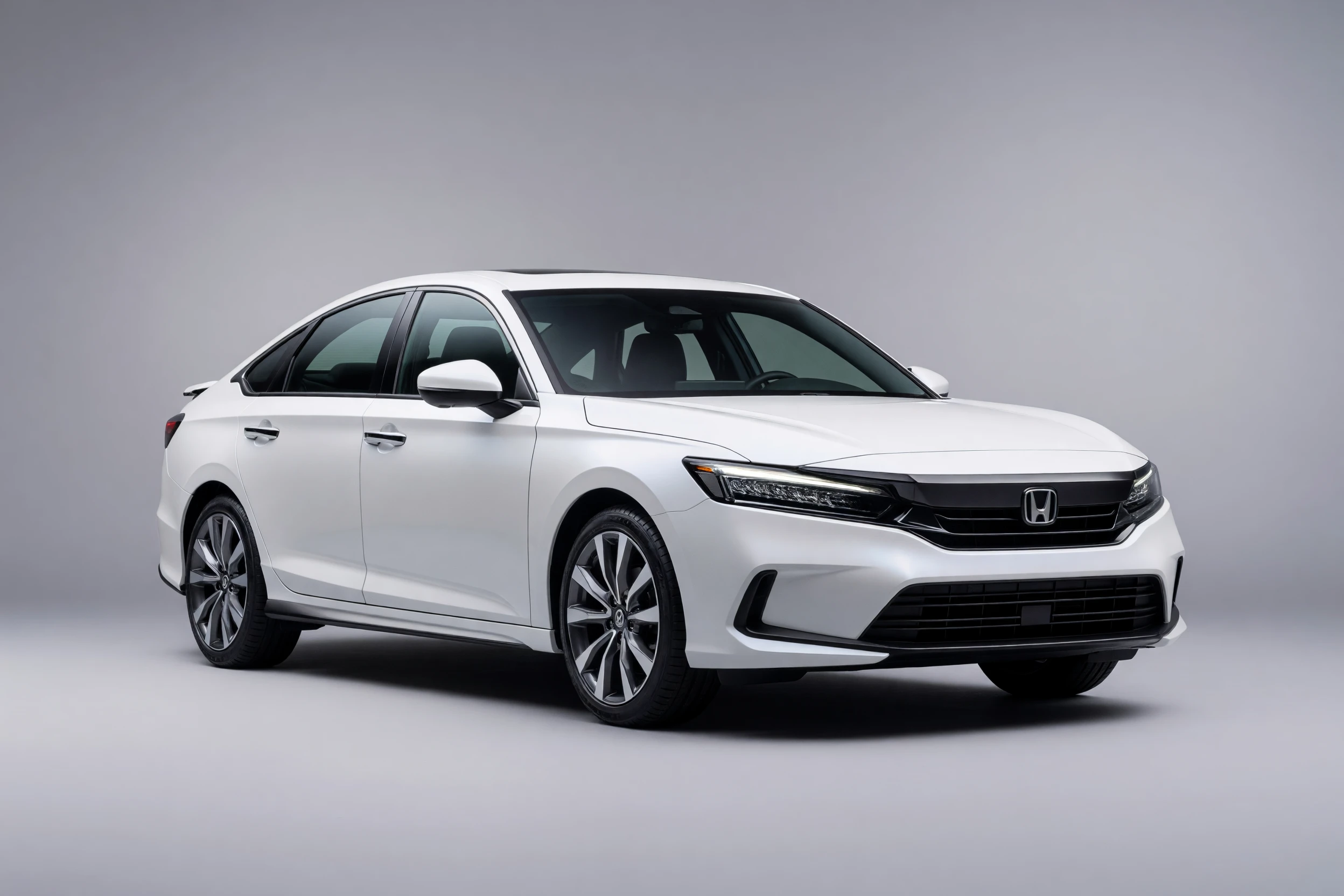
Undisguised leaked images, first surfaced by Indian motoring outlets in the week before launch, show the refreshed face clearly. The new car wears a horizontal light-bar daytime running lamp across the nose, paired with sleeker LED headlamps and a gloss-black mesh grille. The front bumper has been redrawn with vertical cut-outs at each lower corner. Chrome trim has been blacked out across the grille surround, window line and door sills.
A small front-facing lens is now visible above the grille, part of the surround-camera array that becomes available on the higher trims. The side profile is essentially carried over: the greenhouse, door cuts and shoulder line all match the outgoing fifth-generation car. The one meaningful side change is a sportier alloy wheel design.
At the rear, the bootlid spoiler has been reshaped and the bumper redesigned. The tail-lamp cluster keeps its existing shape but switches to a clear-lens treatment. Inside, the dashboard layout, three-spoke steering wheel, semi-digital instrument cluster and rotary climate controls all carry over. The most visible cabin change is a free-standing touchscreen, larger than the eight-inch unit in the current car. The familiar black-and-beige theme remains, with a fresher cabin colourway expected on the higher trims.
What the leaks show, in short:
- Light-bar DRL face with new LED headlamps
- Gloss-black grille and vertical bumper cut-outs
- Blacked-out chrome across grille, windows and sills
- New alloy wheel design and reshaped bootlid spoiler
- Clear-lens tail-lamp treatment
- Larger free-standing centre touchscreen
Features and Safety Get the Bigger Upgrade
The visible grille work matters less than what Honda has added to the spec sheet. The fifth-generation City debuted in India without driver assistance or a surround camera. The facelift adds both to a feature list that already included a wireless charger and a sunroof.
What Is New on the Safety Sheet
The 360-degree camera is the headline. Honda’s Sensing suite arrives as Level 2 ADAS, with adaptive cruise control, lane-keep assist, collision-mitigation braking and road-departure mitigation calibrated for Indian traffic. Six airbags become standard. Electronic stability control (ESC), hill-start assist, tyre pressure monitoring and ISOFIX child-seat anchorages are retained.
Honda is bringing the City in line with what the Hyundai Verna, Skoda Slavia and Volkswagen Virtus already offer at this price. The C-sedan segment has spent the past 18 months turning Level 2 assistance into table stakes rather than a premium upsell, and the outgoing City had become the only car in the bracket without it.
What Carries Over
Wireless Android Auto and Apple CarPlay stay. So does keyless entry, auto headlamps, rear AC vents, an electric sunroof and the eight-speaker sound system. The new touchscreen runs an updated user interface but serves substantially the same feature set as the unit it replaces.
| Feature | Outgoing City | Facelift City |
|---|---|---|
| Centre touchscreen | 8-inch | Larger free-standing unit |
| Surround camera | No | 360-degree camera |
| Level 2 ADAS | No | Yes (Honda Sensing) |
| Ventilated front seats | No | Yes |
| Airbags | 6 | 6 |
| Electric sunroof | Yes | Yes |
| Wireless Android Auto / CarPlay | Yes | Yes |
| Alloy wheel pattern | Existing | New sportier design |
The Engine Bay Stays Where It Was
For all the cabin and safety work, Honda has not touched the powertrain. The 1.5-litre naturally aspirated i-VTEC petrol carries forward with 121 PS and 145 Nm of torque, paired with a six-speed manual or a seven-step continuously variable transmission (CVT). That is the same engine, same numbers, same gearbox options the fifth-generation City has carried since its 2020 India launch.
The City e:HEV strong hybrid is untouched as well. It combines a 1.5-litre Atkinson-cycle petrol with a dual-motor setup for a combined 126 PS and 253 Nm, sent through an e-CVT. ARAI-certified mileage on the current hybrid exceeds 26 kmpl, and Honda is expected to retain those figures.
There is a reason for the conservatism. The current platform was rolled out globally in 2019, with India-specific tuning added later, and repeating it on a facelift cycle is standard industry practice. What is notable is that rivals have used their facelift cycles to swap engines (the Hyundai Verna fits a 1.5-litre turbo petrol making 160 PS in its top trim) while Honda has not.
The City stays naturally aspirated, with a hybrid as the only alternative. Buyers who want forced induction in a Honda sedan in India will not find one in this facelift.
A Sedan Segment Losing Share Every Year
The May 22 launch arrives in a segment that no longer drives Indian passenger-vehicle volume. Sedan share of total car sales has fallen from 19 percent in fiscal year 2019 to roughly 9 percent in fiscal year 2025. SUVs and MPVs now account for about 65 percent of the market, with SUVs alone crossing 55 percent share last year.
- 342,987 units: total sedan sales in India in fiscal 2025, down 10.36 percent year on year
- 35 percent: year-on-year decline reported for the Honda City alone in 2025
- 55 percent: SUV share of the Indian passenger-vehicle market last year
- One: number of sedan launches among the 27 new passenger-vehicle launches in 2025
Honda Cars India’s own monthly data tells the same story. The company reported 5,124 units in June and 6,774 units in Honda’s August 2025 India sales statement across its full range, with the City accounting for a smaller share than the Amaze hatchback-sedan and Elevate SUV.
The City has been falling behind its segment in absolute numbers, too. The Skoda Slavia crossed 4,800 units in October 2025, leading the mid-size sedan pack, while the City has spent most of the past six months in three-figure monthly territory. The Hyundai Verna sold 771 units in August 2025, a 6.66 percent month-on-month decline.
A facelift this comprehensive is rare for a segment this shrunken. Honda is investing where the volume is not.
How the City Stacks Up Against the Verna and Slavia
The Verna and the Slavia, along with its Volkswagen Virtus twin, define the rest of the C-sedan field. Both have already moved to turbocharged petrol engines and Level 2 assistance. The facelift City finally meets them on driver-assistance hardware, but not on power.
| Attribute | Honda City Facelift | Hyundai Verna | Skoda Slavia |
|---|---|---|---|
| Engine options | 1.5L NA petrol / 1.5L strong hybrid | 1.5L NA / 1.5L turbo petrol | 1.0L TSI / 1.5L TSI |
| Top power | 121 PS petrol, 126 PS hybrid | 160 PS (1.5 turbo) | 150 PS (1.5 TSI) |
| Gearbox | 6 MT / 7-step CVT / e-CVT | 6 MT / 6 AT / 7-DCT | 6 MT / 6 AT / 7-DSG |
| Driver assistance | Honda Sensing Level 2 | Hyundai SmartSense Level 2 | Level 2 |
| Surround camera | Yes | Yes | Yes |
| Strong hybrid option | Yes | No | No |
| Expected starting price | Rs 12.50 lakh | Rs 11.50 lakh | Rs 11.65 lakh |
Where the City Wins
The hybrid powertrain is unique in the segment. No rival offers a full-hybrid C-sedan in India, and the e:HEV’s claimed ARAI mileage above 26 kmpl is significantly better than anything the Verna or Slavia can match. For taxi-fleet operators and high-mileage commuters, that gap is the buying argument.
Resale value and service reach also still favour Honda in semi-urban markets, even with the company’s reduced dealership footprint compared to a decade ago.
Where the Verna and Slavia Win
On outright performance, both rivals beat the City. The Verna’s 1.5-litre turbo petrol pushes 160 PS through a seven-speed dual-clutch gearbox (DCT). The Slavia and Virtus pair offers 150 PS from the 1.5-litre TSI with a seven-speed direct-shift gearbox (DSG). The driving feel buyers paid for at this price point has shifted to forced induction, and Honda has not followed.
Both rivals also outsell the City month on month. The Slavia has led the segment for five consecutive months through October 2025, according to manufacturer-reported registrations.
Pricing, Variants, and the Hybrid Question
Honda is expected to start the new City at Rs 12.50 lakh (ex-showroom), running up to about Rs 19 lakh for the top petrol trim. The City e:HEV is likely to open at around Rs 20.50 lakh.
That puts the petrol within a few thousand rupees of the outgoing car, factoring in the added assistance hardware. The hybrid stays in its own price band, well above the conventional petrol trims of the Verna and Slavia.
For buyers choosing between petrol and hybrid, the pitch is fuel cost over four to five years. At ARAI-rated mileage above 26 kmpl, the hybrid pays back its roughly Rs 8 lakh premium over the base petrol only at very high annual running, the kind fleet operators and ride-hail aggregators rack up.
For a private buyer doing 12,000 to 15,000 km a year, the maths is tighter. The petrol facelift, with its bigger touchscreen and assistance suite, will likely be the volume seller. The hybrid is the technology halo that keeps Honda relevant as the segment shifts toward electrification.
Honda will also launch the imported ZR-V SUV on the same day at an expected price of Rs 40 lakh to Rs 50 lakh, a separate product story but a signal that the company is rebuilding its India lineup beyond sedans. Honda’s India newsroom is expected to detail variant-wise pricing on launch day.
If the new City’s hybrid trim picks up share faster than its petrol, Honda will have a case for keeping a sedan badge alive in India for another product cycle. If sedan buyers keep migrating to SUVs at the current rate, the May 22 launch may extend rather than reverse the City’s slide, with the next cycle decision likely arriving before the end of the decade.
Frequently Asked Questions
When does the 2026 Honda City facelift launch in India?
Honda Cars India has confirmed a launch on May 22, with the City facelift, City e:HEV hybrid facelift and the imported ZR-V SUV revealed on the same day.
What is the expected starting price of the new Honda City?
The petrol variant is expected to start from approximately Rs 12.50 lakh (ex-showroom) and run up to about Rs 19 lakh for the top trim. The strong-hybrid City e:HEV is likely to open at around Rs 20.50 lakh.
What new safety features does the City facelift add?
The facelift adds a 360-degree camera and the Honda Sensing Level 2 assistance suite, with adaptive cruise control, lane-keep assist, collision-mitigation braking and road-departure mitigation. Six airbags, electronic stability control, hill-start assist and ISOFIX anchorages carry over from the outgoing car.
Does the engine change in the 2026 Honda City?
No. The 1.5-litre i-VTEC petrol carries over unchanged, as do the six-speed manual and seven-step CVT gearbox options. The City e:HEV retains its 1.5-litre Atkinson-cycle petrol and dual-motor hybrid setup making 126 PS through an e-CVT.
How does the new Honda City compare with the Hyundai Verna and Skoda Slavia?
The City offers a strong-hybrid option that neither rival matches, but it stays naturally aspirated on petrol while the Verna’s 1.5 turbo (160 PS) and Slavia’s 1.5 TSI (150 PS) hold the performance advantage. All three sedans now offer Level 2 assistance and a 360-degree camera.