
 Ishan Crawford
 Britain’s biggest mortgage lenders spent two days this spring in the Scottish Highlands, chasing a construction method England mostly walked away from four decades ago. Executives toured sawmills, forests and factory floors to see how Scotland now frames 92% of its new homes in timber, against roughly 13% in England.
The gap did not open because Scotland discovered something new. It opened in 1983, when a single television documentary gutted English confidence in timber frame homes almost overnight. Scotland’s builders never had the same reaction, and that forty year divergence is now colliding with England’s own deadlines for low carbon housing.
England’s Biggest Lenders Just Went on a Field Trip to Scotland
The delegation that travelled north in April 2026 was not a group of curious architects. It included representatives of some of Britain’s largest mortgage lenders and housebuilders, organised by the Structural Timber Association (STA, the UK trade body for structural timber manufacturers) alongside the Future Homes Hub, an industry coalition working on the sector’s shift to low carbon construction.
Over several days, the group visited:
- A West Fraser sawmill in Morayhill, Inverness, one of Europe’s largest producers of the board sheathing used inside timber panels.
- Cublin Forest, a working woodland managed by Forestry and Land Scotland, where delegates traced timber from seed to harvest.
- A James Jones and Sons processing plant in Forres, on the Moray coast.
- Housebuilding sites run by Cala Homes and Bancon Homes in Milltimber, Aberdeen, and the factory floor of Kirkwood Timber Frame in Aberdeenshire.
That last stop matters more than it looks. Kirkwood Timber Frame is the same Aberdeenshire manufacturer credited on the original industry commentary comparing Scotland’s and England’s housebuilding models. Its managing director, Malcolm Thomson, called it “a pleasure to welcome the Structural Timber Association (STA), the Future Homes Hub (FHH) and a delegation of the UK’s leading homebuilders” to the factory. The company that helped frame the argument for timber frame was also hosting the tour meant to prove it.
Andrew Orriss, chief executive of the Structural Timber Association, put the point bluntly to the visiting lenders.
Scotland builds faster, greener, and more efficiently than England.
Orriss added that timber frame was the reason why, and said the industry wanted to work with lenders and builders to speed up delivery UK wide.
The 1983 Documentary That Scared England Off Timber Frame
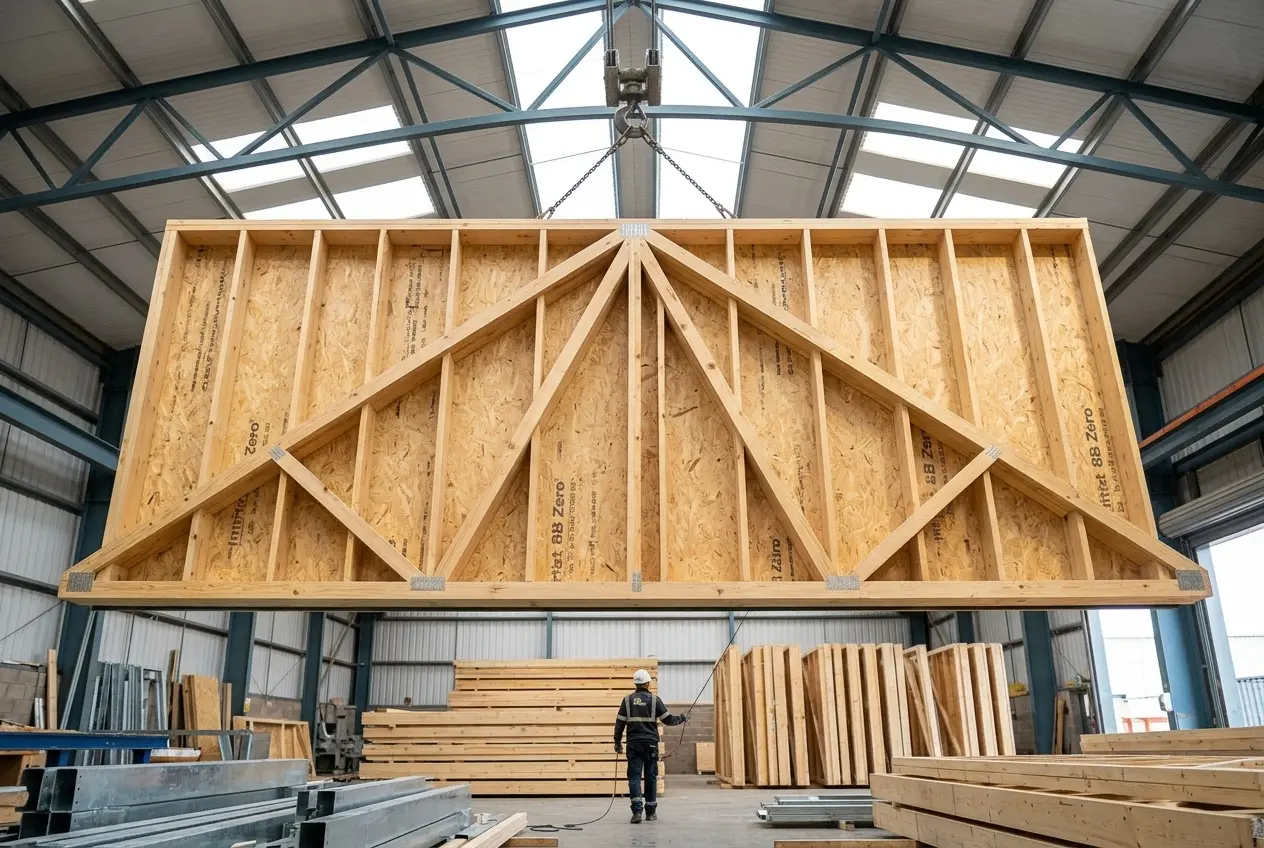
Timber frame was not always rare south of the border. Before the mid-1980s, it was a growing share of new English housing, closer in spirit to Scotland’s building culture today.
Then, on 27 June 1983, the ITV current affairs series World in Action broadcast an investigation into Barratt Homes, one of the country’s largest builders, alleging that timber frame houses were prone to rot and carried serious fire risks. The very next day, MPs used an emergency Commons procedure to demand action, warning of serious dangers and defects that could cause hardship for homeowners and tenants.
Construction trade media later described the fallout as a downward spiral. Timber frame building was, in the words of one industry publication, halted dead in its tracks. Mortgage lenders grew wary. Buyers grew wary. Confidence took years to rebuild, if it ever fully did.
The timing made it worse. In 1984, the Thatcher government deregulated construction rules that had capped the height of timber framed buildings since the era of the Great Fire of London, opening the door to taller timber structures just as the industry’s reputation cratered. Few builders had the appetite to walk through that door.
A fuller picture arrived years later. In 1996, the Building Research Establishment studied more than 120 timber framed homes built between 1920 and 1975 and found that decay was rare, usually confined to small spots caused by poor workmanship or neglect rather than the material itself. Paul Healey, managing director of Laing Homes at the time, said the findings reinforced his firm’s confidence in the method. By then, the damage to England’s market had already set in.
Why Did Scotland Never Lose Its Nerve on Timber Frame?
Scotland’s timber frame market absorbed the same 1983 headlines and kept building anyway, largely because the material was already doing a job English builders did not need it for. Colder winters and wetter weather made timber’s insulating performance genuinely useful, not optional, north of the border.
Barry Neilson, NHBC’s deputy director in Scotland at the time, said the Scottish market survived the scare partly because timber frame’s thermal performance made it the most suitable material for the country’s harsher climate. Buyers and lenders in Scotland had a practical reason to look past the panic that English buyers did not share.
That difference compounded over decades. By the time England began seriously planning for stricter carbon rules, Scotland already had a mature timber supply chain, an experienced workforce and lenders comfortable underwriting mortgages on timber built homes. England had to rebuild all three roughly from scratch.
The Numbers England Is Racing to Catch
The scale of the gap is easiest to see side by side.
| Measure | Scotland | England |
|---|---|---|
| New homes built with timber frame | 92% (some 2024 counts put it near 95%) | About 13%, up from 9% in 2019 |
| Homes built by small and medium developers | Around 40% of output | About 9% of output |
| Land used for housing | 1.4% | 7.7% |
| Annual new homes target | 25,000 (all tenures) | About 300,000 a year, from a 1.5 million, five year pledge |
| Low carbon building rule | Already in force for years | Confirmed March 2026, legal from 2027 |
The right hand column is about to get harder to fill. The UK government’s written statement confirming the Future Homes Standard requires new English homes to emit at least 75% less carbon than 2013 era houses, effectively ending gas boilers in new builds. Timber frame’s precision and speed make it one of the more straightforward routes to hitting that target, which is exactly why lenders wanted to see Scotland’s supply chain up close.
Kirkwood Timber Frame’s own figures, gathered before the most recent uptick, put 23% of homes across the whole UK in timber frame, a national average dragged down almost entirely by England’s low uptake.
A rough timeline of how the two paths split, and where they are heading, looks like this:
- 1983: World in Action airs its investigation into Barratt Homes, triggering an emergency Commons debate the next day.
- 1984: The Thatcher government deregulates rules on taller timber buildings just as confidence collapses, and few builders take the opening.
- 1996: A Building Research Establishment study of 120 timber framed homes finds decay was rare and usually down to workmanship.
- 2019: Timber frame sits at roughly 9% of new English homes, versus 92% in Scotland.
- March 2026: The government publishes the Future Homes Standard, mandating a 75% cut in new build carbon emissions.
- April 2026: Lenders and housebuilders tour Scotland’s timber supply chain, from an Inverness sawmill to an Aberdeenshire factory.
- March 2027: The Future Homes Standard becomes legally binding for most new English building work.
- March 2028: The transition period closes and full compliance becomes mandatory nationwide.
Small Builders Paid the Same Price
Timber frame’s collapse in England did not happen in a vacuum. It ran alongside a separate but related collapse in small and medium sized housebuilders, the firms best placed to actually adopt a factory built system on modest sites.
- 40% to 9%: the drop in small and medium builders’ share of new English homes since the 1980s, according to the Federation of Master Builders (FMB, the trade body representing small building firms).
- 12,000 to roughly 2,400: the fall in the number of active small housebuilding firms across the same period, based on industry estimates.
- Eight companies now build well over half of England’s new housing supply, according to evidence given to the House of Lords.
- 40%: the share of homes still delivered by SMEs in Scotland, where no equivalent collapse occurred.
Brian Berry, chief executive of the FMB, has pointed to signs of life even inside the smaller pool of firms that remain. He said small house builders are seeing real demand in their communities and are ready to respond, even as national construction data shows the sharpest slowdown since the pandemic.
The two declines reinforced each other. Timber frame works best at volume and with predictable factory contracts, conditions large developers can arrange more easily than small ones starting from a shrunken base. Scotland kept both halves of the system, its SME builders and its timber supply chain, growing together. England lost momentum in both at roughly the same time.
Scotland’s Own Cracks Are Showing
None of this makes Scotland’s system a finished model. Homes for Scotland, the trade body for the country’s housebuilders, has warned that the country is running a housing shortfall approaching 100,000 homes after fourteen straight years of undersupply against its own 25,000 home target. Around 250,000 people sit on Scottish housing waiting lists.
The number of active SME builders in Scotland has also fallen to its lowest point in twenty years, even with their 40% share of output intact, suggesting fewer, larger small firms rather than a genuinely wide base. Land is clearly not Scotland’s constraint, with only 1.4% of its territory used for housing against England’s 7.7%, yet the shortfall persists regardless.
Demand forecasting adds another wrinkle. Scotland’s own population growth has slowed to a crawl in recent years as net migration has fallen sharply, a trend that will eventually test whether the 25,000 figure still holds as the right target to plan around.
The Reckoning Runs Through 2028
Persimmon’s timber frame arm, Space4, has built a factory in Loughborough with capacity for up to 7,000 homes a year, a sign that England’s largest builders are already repositioning. Smaller firms are watching the same regulatory clock, with less capital to absorb a slow transition.
The Future Homes Standard’s 2027 start date and 2028 full compliance deadline give England roughly two years to close a gap that took forty to open. Scotland’s factories, forests and mortgage books already work the way England’s will need to. The April tour was one industry’s way of admitting that, and of trying to borrow time it does not have.
Frequently Asked Questions
Is timber frame construction safe to live in today?
Modern timber frame manufacturers are required to provide engineer certification confirming a frame’s design before assembly, and the National House Building Council (NHBC, the industry’s main new home warranty provider) offers its ten year Buildmark guarantee equally to timber and masonry homes, treating the two construction types the same for warranty purposes.
Does the Future Homes Standard apply in Scotland?
No. The Future Homes Standard is an England only set of Building Regulations. Scotland, Wales and Northern Ireland set their own separate building standards, and Scotland’s have required demanding energy and carbon performance for longer than England’s have.
What counts as an SME housebuilder in the UK?
The definition varies by source. Scotland’s 40% SME output figure covers builders delivering fewer than 1,500 homes a year, while the Federation of Master Builders’ own survey work focuses on firms building 100 homes or fewer, a far smaller tier than the Scottish threshold.
How much faster is a timber frame build than brick and block?
Timber frame’s offsite manufacturing lets crews erect a watertight shell in days rather than weeks, since walls arrive pre cut and largely finished. London developers have floated timber homes built in as little as five days as one option for speeding up delivery toward the city’s 88,000 home annual target.
What replaced England’s small housebuilders?
A small group of large listed developers. Evidence given to the House of Lords found fewer than a dozen major housebuilders responsible for around 70% of new English housing, with just eight companies accounting for well over half the national total.
 Scotland’s Facial Recognition Push Sparks Mask Ban Call
  Galaxy Z Flip 8 Hits $799 Only If Your Trade-In Qualifies
  If England Had Kept Water Public Like Scotland
  Samsung Smart Switch Now Moves Passwords and eSIM From iPhone
  Old Firm Spend Pulls Clear as Premiership Rivals Patch Squads
  Chinese Studios Quietly Seize the Gamescom Stage