
 Ishan Crawford
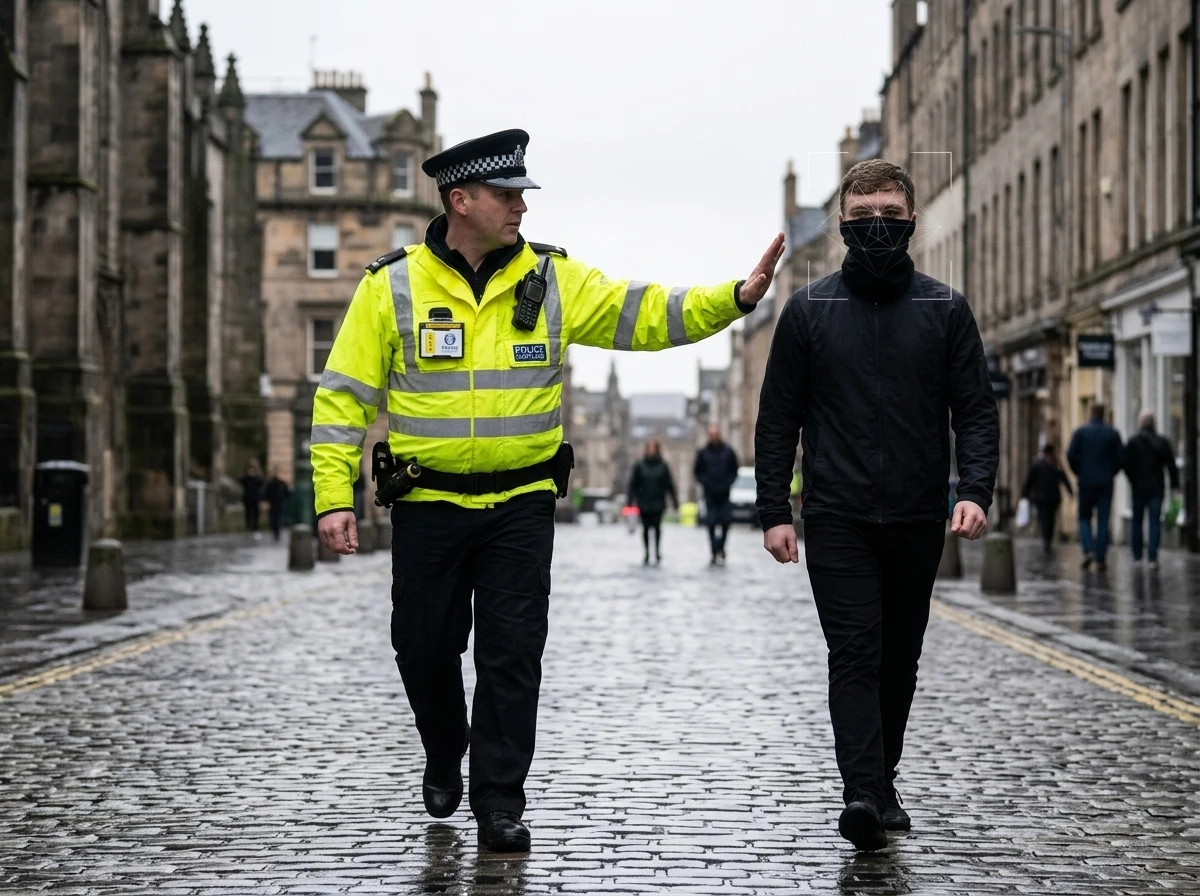
 Scottish Police Federation general secretary David Kennedy says live facial recognition will waste millions if suspects can simply pull on a mask, and he wants officers given clear powers to order coverings removed. The demand lands as a new academic project begins mapping ethical rules for the same technology.
Police Scotland remains years from any deployment. Yet the twin moves already lock high-tech scanning to low-tech unmasking rules that could alter protests and street stops first.
Federation Wants Removal Powers Before Cameras Arrive
Kennedy’s intervention followed a summer of masked disorder at football matches and anti-immigration protests. Officers currently hold only limited authority to demand a covering come off.
There is little point investing millions of pounds in sophisticated technology capable of recognising a face if an individual intent on committing crime can simply hide that face behind a mask or covering.
David Kennedy, General Secretary, Scottish Police Federation
He wants practical legal powers where officers reasonably believe a covering is used to conceal identity during criminality, violence or serious disorder. Exemptions would cover religious, cultural, medical and occupational reasons. Kennedy stressed facial recognition should only give an intelligence lead, never replace an officer’s judgment.
The federation has raised similar points before around Old Firm clashes. Rank-and-file pressure now ties the issue directly to any future live facial recognition spend.
That linkage matters because the spend argument and the powers argument now travel together. Without a clear removal rule, Kennedy’s case runs, any later camera business case risks looking hollow on day one. With such a rule, officers gain an immediate street tool that does not depend on vans, algorithms or a finished statutory framework for scanning itself.
The limited authority officers hold today leaves a gap between spotting a covered face and compelling its removal. Closing that gap is what the federation seeks before any live facial recognition budget lands.
Face[REC] Builds Governance Cards for 2027
At the same moment the Scottish Institute for Policing Research is funding the Face[REC] project. Dr Diana Miranda of the University of Stirling and Dr Lachlan Urquhart of the University of Edinburgh lead it. Both are directors at the Centre for Research into Information, Surveillance and Privacy.
The work runs from summer 2026 to late spring 2027 on a £20,000 SIPR main grant plus university support. Its four objectives are concrete:
- Critically analyse the fragmented UK regulatory landscape and compare it with the EU AI Act
- Run co-design and futuring workshops with citizens and police officers to surface ethical and governance concerns
- Design and test a physical deck of Face[REC] Cards that let policymakers, academics, police and regulators deliberate together
- Produce a final multi-stakeholder workshop, policy brief and academic paper that feed legislation debates
The project asks how live facial recognition should be governed for a more ethical Scottish approach and whether current regulation meets citizen priorities. The Face[REC] co-design workshops and card deck are meant to turn abstract rights talk into a shared physical tool.
Scotland has already run a national conversation through the Scottish Police Authority, Police Scotland and the Scottish Biometrics Commissioner. Face[REC] adds a structured next layer.
The card deck is the practical hinge. Workshops surface concerns; the cards then force those concerns onto the same table as operational and legal arguments. A policy brief and academic paper close the loop so Holyrood debates draw on a shared artefact rather than parallel monologues.
Because the project timeline ends in spring 2027, its outputs will arrive while any Police Scotland business case and any primary legislation talks are still live. That timing is deliberate sequencing, not coincidence.
England’s Act Already Criminalises Coverings in Zones
Kennedy points to England’s Crime and Policing Act 2026 as the model. Under that law an inspector or higher rank can designate a public place a mask-free zone for up to 48 hours if a protest is happening or expected, offences are likely, and the designation would limit those offences.
The Act creates a new criminal offence for concealing identity in designated zones. Penalty is up to one month in prison, a £1,000 fine, or both. People covering for health, religious or work reasons have an explicit defence. The measure closes a loophole where someone removed a covering on order then put it back on after walking a few streets.
Around 13 forces in England and Wales already run live facial recognition. The Home Office has funded extra vans. Scotland’s federation wants equivalent tools before any local cameras switch on.
- Designation trigger: reasonable belief protest may involve offences
- Maximum duration: 48 hours
- Penalty ceiling: one month or £1,000
- Built-in defence: health, religion, occupation
Civil liberties groups note the same stack of powers can chill lawful assembly even when cameras stay dark.
The English sequence put cameras and vans into the field first and the statutory mask zone second. Scotland’s federation is urging the reverse order: removal powers on the books before any local live facial recognition go-live. That reverse order is the core strategic claim in Kennedy’s intervention.
| Feature | England and Wales | Scotland (current) |
|---|---|---|
| Live facial recognition in use | About 13 forces | Not deployed |
| Mask-free zone power | Crime and Policing Act 2026 | Federation request only |
| Zone maximum | 48 hours | No equivalent yet |
| Penalty for concealment | One month or £1,000 | No equivalent yet |
| Primary LFR statute | Not a single dedicated Act | SNP conference requires one |
Public Comfort Sits Almost Exactly at Fifty-Fifty
The Scottish Police Authority’s 2025 national conversation survey drew 2,694 responses. Overall comfort with Police Scotland using live facial recognition split almost evenly: 49 percent comfortable with LFR use and 48 percent uncomfortable.
| Measure | Result |
|---|---|
| Overall comfort (very/somewhat) | 49% |
| Overall uncomfortable | 48% |
| Comfort with specific use cases | ~60% |
| Support further public engagement | 64% |
| 2021 support for public-space face ID | 66% |
| 2025 equivalent support figure | 72% |
Focus groups with 26 organisations produced four recurring themes: need for transparency and bias checks, demand for primary legislation, clear deployment conditions and authorisation rules, and only conditional support for going further. Written submissions from rights groups stressed chilling effects on assembly, accuracy problems for minority ethnic and trans people, and thin evidence of effectiveness elsewhere.
- Transparency and bias checks as a precondition
- Primary legislation rather than policy alone
- Clear deployment conditions and authorisation rules
- Support only on a conditional basis
On X, Big Brother Watch framed the inspector’s push for faster adoption as undemocratic given the near-even public split and an earlier SNP conference vote against routine use without primary law. Those voices treat the mask power request as the first concrete expansion of control, not a minor technical fix.
The near-even split explains why further engagement scored 64 percent support. Comfort rises toward roughly 60 percent when the survey turns to specific use cases, and the broader public-space support figure moved from 66 percent in 2021 to 72 percent in 2025. Those gains still leave a large uncomfortable minority and a political requirement for statute before routine use.
Primary Legislation Remains the Open Gate
Police Scotland confirmed in 2025 it would develop a business case but left any final go-ahead open. No funding request went into the 2026/27 budget. Work this year centres on engagement. ACC Stuart Houston leads the policy stream. The Scottish Police Authority will scrutinise any eventual business case for costs, safeguards, human rights and equalities.
Scottish Biometrics Commissioner Dr Brian Plastow has publicly backed limited, proportionate use inside a statutory framework set by Holyrood. An SNP conference resolution already states live facial recognition should not proceed without primary legislation. Scotland could become the first jurisdiction to pass such a dedicated law.
- June 2024: Scottish Police Authority launches national conversation
- April-May 2025: public survey and focus groups run
- September 2025: Police Scotland commits to business-case path
- October 2025: SNP conference requires primary legislation
- March 2026: Biometrics Commissioner outlines legislative options to Parliament
- August 2026: Federation mask-power call and Face[REC] launch
- Spring 2027: Face[REC] cards and policy brief due
The commissioner has noted that British Transport Police and border operations already bring facial recognition into Scottish space even while Police Scotland waits.
That external presence keeps pressure on the domestic gap. A business case without funding in the 2026/27 budget signals process without immediate purchase. Scrutiny by the Scottish Police Authority on costs, safeguards, human rights and equalities remains the formal gate even after any case is written.
Mask Rules Could Reach Streets First
The federation’s demand can move on a separate track from camera procurement. A removal power modelled on England’s zone offence would apply at football fixtures and protests whether or not live facial recognition vans ever roll in Scotland.
That separation is why civil liberties groups treat the request as more than a technical companion to scanning. A 48-hour designation, if replicated, would turn covering a face inside the zone into a criminal risk with a penalty ceiling of one month or £1,000, subject to the health, religion and occupation defences.
Officers would gain a tool usable on reasonable belief about criminality, violence or serious disorder. The same tool would meet the federation’s test that millions spent on recognition technology should not be defeated by a pulled-up covering.
Religious, cultural, medical and occupational exemptions would need clear street-level guidance. Until tested, the paper balance between enforcement and exemption stays unproven in Scottish conditions.
Who Holds the Real Leverage Now
Rank-and-file officers gain a practical enforcement tool that works whether or not cameras ever appear. Civil liberties organisations gain a clear target: any mask law becomes the visible thin end of the wedge. Academics running Face[REC] gain a seat at the table through the physical cards that force police, regulators and citizens into the same conversation.
Football supporters and protest organisers sit in the middle. A zone designation lasting two days can turn a lawful gathering into a place where covering a face risks arrest. Religious and medical exemptions exist on paper; how they play out on a wet Saturday night remains untested north of the border.
The irony is already visible. The technology sold as a precise way to find wanted people is generating demands for broader, older-style powers over what people wear in public. Those powers could land first. The cameras, the ethics cards and the primary Act may follow later, or not at all.
By spring 2027 the Face[REC] deck will be on tables in Holyrood and police headquarters. Whatever rules emerge will have been shaped as much by the unmasking argument as by the algorithms themselves.
 Galaxy Z Flip 8 Hits $799 Only If Your Trade-In Qualifies
  If England Had Kept Water Public Like Scotland
  Samsung Smart Switch Now Moves Passwords and eSIM From iPhone
  Old Firm Spend Pulls Clear as Premiership Rivals Patch Squads
  Chinese Studios Quietly Seize the Gamescom Stage
  Vivo V80 Lite 5G Hits Pakistan With Curved Screen and Split Identity