
 Ishan Crawford
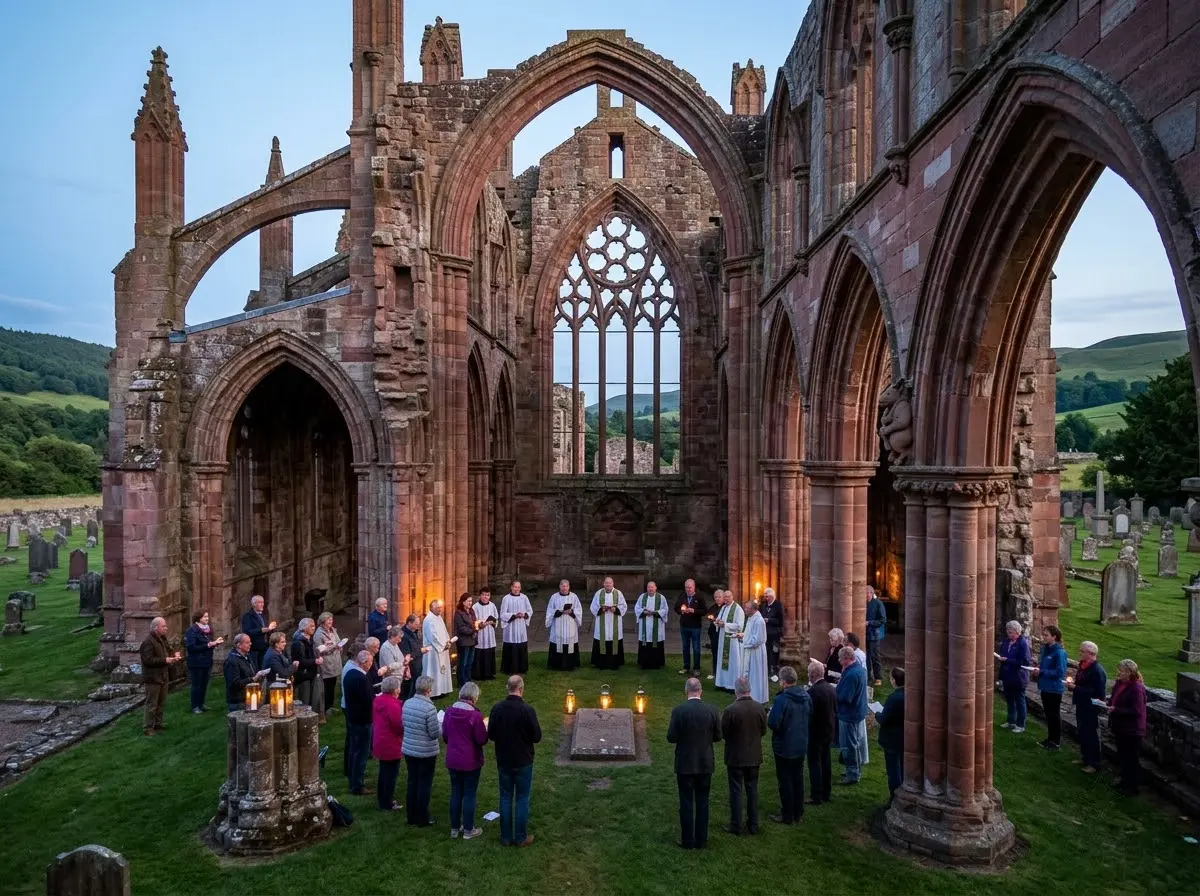
 More than 300 people gathered on the grounds of Melrose Abbey on 21 August 2026 for a Holy Mass marking 890 years since Cistercian monks founded Scotland’s first house of the order. The open-air rite drew Catholics from across the country, clergy from the United Kingdom, local Protestants and Borders dignitaries under the rose sandstone ruins.
Father Benedict Iwatt, parish priest of Our Lady and St Andrew in Galashiels and lead celebrant, called the anniversary a chance to honour the abbey’s place in Christian life in the Borders and to connect with other churches.
The Mass Under the Rose Sandstone
The ceremony sat on the ruined abbey grounds themselves, supported by Historic Environment Scotland. Organisers were the Catholic parishes of Our Lady and St Andrew (Galashiels), St Cuthbert’s (Melrose) and Our Lady and St Joseph (Selkirk).
Among those present were representatives of the Cistercian Order, the Knights of Malta and the Knights of St Columba, plus local MP John Lamont. Christians from other denominations joined the congregation.
The 890th Anniversary of the foundation of Melrose Abbey by the Cistercian Order is a truly auspicious occasion in the life of the parish of Our Lady & St. Andrew. We as a parish know the importance of commemorating this occasion and the historical significance of the foundation of Melrose Abbey in the Christian life of the country and the Borders region.
Father Benedict Iwatt, parish priest of Our Lady and St Andrew
Iwatt also thanked Historic Environment Scotland for backing the event and noted the chance to raise the profile of the local parishes.
Archdiocese of St Andrews and Edinburgh posts from the evening showed the celebrants: Fr David Edwardson, Fr Benedict Okakpu OCSO, Fr Benedict Iwatt as principal celebrant, Fr Andrew Garden and Fr Mark Downie OCSO as homilist. Lamont later wrote that it was a privilege to join hundreds of local people from across the Borders for their anniversary Mass.
Local Parishes and the Cistercian Guests
The presence of Cistercian monks from Sancta Maria Abbey at Nunraw, near Haddington in East Lothian, gave the Mass its deepest historical echo. Fr Benedict Okakpu OCSO serves as superior there. Fr Mark Downie OCSO delivered the homily.
- Catholics travelling from across Scotland
- Clergy from around the United Kingdom
- Cistercian Order representatives based at Nunraw
- Knights of Malta and Knights of St Columba
- Christians from other local denominations
- Local dignitaries including MP John Lamont
The Archdiocese had promoted the 6 pm Mass weeks earlier, inviting reservations through the Galashiels parish office. Video from the day later circulated from parish sources.
David I and the First Scottish Cistercians
In 1136 King David I asked Cistercian monks from Rievaulx Abbey in North Yorkshire to establish a house in Melrose. It became the first Cistercian monastery in Scotland. David founded several Borders abbeys to display both piety and power over contested territory.
The monks preferred fertile land beside the River Tweed and settled a little west of the earlier Celtic site of Old Melrose associated with St Aidan and St Cuthbert. The place was then called Little Fordell; today it is Melrose. The abbey church of St Mary the Virgin was dedicated in 1146.
Monastic life ran for roughly 450 years. The Cistercians followed a stricter reform of Benedictine practice that began at Cîteaux in France in 1098. Melrose quickly became a focal point on both sides of the border, richly endowed and a preferred burial place for the powerful. King Alexander II was buried there after his death in 1249.
Raids, Rebuilds and a King’s Heart
Its border location made Melrose a repeated target.
- 1300 and 1307: Attacks by Edward I required major repairs.
- 1322: Edward II’s army destroyed much of the abbey and killed many monks. Robert the Bruce later supported rebuilding.
- 1385: Richard II’s attack led to a complete rebuilding of the abbey church in the rose-coloured stone that survives today.
- 1544-1545: English forces in the War of the Rough Wooing, aimed at forcing the betrothal of the infant Mary Queen of Scots to Henry VIII’s son, badly damaged Melrose and its abbey again.
Robert the Bruce died in 1329. His body went to Dunfermline Abbey. His embalmed heart, encased in lead, was taken on crusade by Sir James Douglas against the Moors in Spain. After Douglas fell near Teba, the heart returned to Scotland and was buried at Melrose. A lead casket believed to contain it was found in the chapter house in 1921, rediscovered in 1996 and reburied under a memorial stone in 1998. Historic Environment Scotland notes three recorded heart burials at the site, so absolute proof is impossible, yet the association remains the popular and historical claim.
Visitors today can still find the low memorial in the chapter house area and join guided talks on Robert the Bruce, Old Melrose, St Cuthbert and David I.
Reformation Ends Monastic Life
After the Protestant Reformation of 1560 the existing monks were allowed to remain. The last, John Watson, died around 1590. The crumbling church served as a parish kirk until a new one rose nearby in 1810. The ruins passed into state care in 1918 and are now looked after by Historic Environment Scotland.
Only fragments of the first 12th-century church survive. The present rose sandstone building dates almost entirely from the post-1385 rebuild and ranks among the finest late medieval church architecture in the British Isles. Surviving elements include the presbytery, monks’ choir, transepts and parts of the nave. Exterior sculpture shows demons, hobgoblins, lute-playing angels, cooks with ladles and the famous bagpipe-playing pig.
Nunraw Closes the Circle
Cistercian life returned to Scotland in 1946 when monks from Mount St Joseph Abbey, Roscrea, in Ireland founded Sancta Maria Abbey at Nunraw. It was the first new Cistercian monastery in Scotland since the Reformation. The community built its permanent house over decades and still lives the same Rule that guided the 12th-century founders of Melrose.
Having Fr Okakpu and Fr Downie present at the 890th anniversary Mass therefore completed a historical loop that few other Scottish sites can match: the order that planted the abbey under David I stood again among its ruins nearly nine centuries later.
The crowd intelligence on X stayed quiet and local rather than national. Lamont’s post and the Archdiocese photographs of the celebrants framed the evening as a Borders gathering of faith and memory, not a spectacle.
HES Care and Fresh Access
Historic Environment Scotland finished essential conservation work in spring 2026. From 1 April visitors regained access to the nave, monk’s choir, crossing, south aisle and south transept. The abbey opens daily 9.30 am to 5 pm (last entry 4.30 pm) from April to September. Talks run at 2.30 pm and 3.30 pm Tuesday to Saturday; morning tours are available Tuesday to Friday. An audio guide is included with admission. Cloister House, a holiday let with direct views of the ruins, sits beside the site.
Across its staffed properties HES welcomed 4.7 million visitors in 2024-25, up from 4.5 million the year before, and generated substantial economic activity from heritage tourism. Melrose sits inside that wider picture of maintained medieval fabric still drawing both pilgrims and tourists.
| Feature | Detail |
|---|---|
| Foundation | 1136 by David I with monks from Rievaulx |
| Stone | Rose-coloured sandstone, mainly post-1385 |
| Heart burial | Memorial in chapter house area (reburied 1998) |
| Last monk | John Watson, died c. 1590 |
| Famous carving | Bagpipe-playing pig |
| 2026 access | Nave, choir, crossing, south aisle and transept reopened after repairs |
The 890th anniversary Mass therefore landed at a moment when more of the fabric was open again and when the founding order’s modern Scottish community could take part. The ruins keep both a tourist path and a living Christian claim.
Frequently Asked Questions
When was Melrose Abbey founded and by whom?
King David I invited Cistercian monks from Rievaulx Abbey in Yorkshire to found Melrose in 1136 as Scotland’s first Cistercian house; the church was dedicated to St Mary the Virgin in 1146 on land west of the older Celtic site of Old Melrose.
Is Robert the Bruce’s heart really buried at Melrose Abbey?
Historical accounts say his heart returned from a Spanish crusade and was buried at Melrose while his body went to Dunfermline; a lead casket found in 1921 and again in 1996 was reburied under a memorial in 1998, though HES notes three recorded heart burials at the site so absolute identification remains unproven.
What happened to the monks after the Reformation?
After 1560 the remaining monks were allowed to stay; the last, John Watson, died around 1590, after which the church served as a parish kirk until 1810.
Who are the Cistercians at Nunraw Abbey?
Sancta Maria Abbey at Nunraw was founded in 1946 by monks from Roscrea in Ireland as the first new Cistercian monastery in Scotland since the Reformation; Fr Benedict Okakpu OCSO is the current superior and took part in the 890th Mass.
Can visitors still go inside Melrose Abbey?
Yes; after conservation finished in spring 2026 the nave, monks’ choir, crossing, south aisle and south transept reopened, with daily summer hours 9.30 am-5 pm, free talks and an included audio guide under Historic Environment Scotland care.
 Scotland’s Facial Recognition Push Sparks Mask Ban Call
  Galaxy Z Flip 8 Hits $799 Only If Your Trade-In Qualifies
  If England Had Kept Water Public Like Scotland
  Samsung Smart Switch Now Moves Passwords and eSIM From iPhone
  Old Firm Spend Pulls Clear as Premiership Rivals Patch Squads
  Chinese Studios Quietly Seize the Gamescom Stage