
 Ishan Crawford
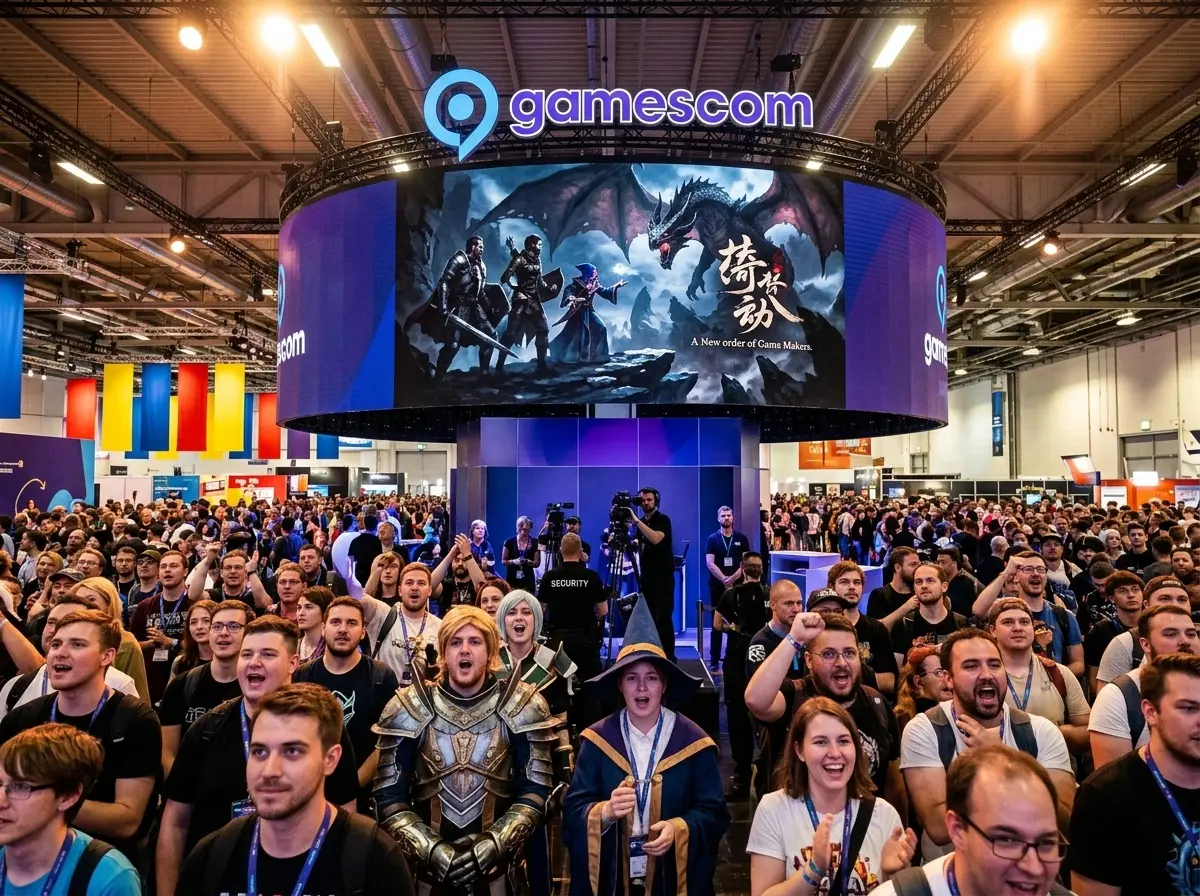
 Gamescom 2026 opened its trade doors in Cologne on Wednesday with every hall sold out for the first time and more than 1,600 exhibitors already on the floor, a clear jump past last year’s 1,568. Organizers expect at least 350,000 visitors through Sunday, matching the scale of the world’s largest gaming event while Chinese studios claimed the first slots on Opening Night Live the night before.
The games remain the draw for most of the hundreds of thousands making the trip. Yet the deeper change sits in who is filling the prime stages and nomination lists.
That shift shows up in the booking data, the Opening Night Live running order, the awards shortlists and the ministers walking the aisles. Scale alone no longer tells the full story. Who claims the floor space and the broadcast minutes now matters as much as how many people pass through the gates.
Halls Fully Booked for the First Time
Koelnmesse and the German Games Industry Association confirmed the entire 233,000 square meters of exhibition space filled by July. That forced early planning for 2027 expansions. Around 70 percent of exhibitors arrived from outside Germany. The indie section alone reached 420 studios, up 16 percent year over year.
Country pavilions climbed to nearly 50 from 40 nations, a 25 percent rise, with first-time stands from Bulgaria, Cyprus, Hungary, Morocco and Nigeria. Major names joining or expanding include Konami, Tencent Games, Embark Studios, Level Infinite, Nintendo, Xbox, Capcom, Ubisoft, EA and CD PROJEKT RED.
| Year | Visitors | Exhibitors |
|---|---|---|
| 2019 | 373,000 | 1,153 |
| 2024 | 335,000 | 1,462 |
| 2025 | 357,000 | 1,568 |
| 2026 (expected) | 350,000+ | 1,600-1,700+ |
Felix Falk of the Game association has said the goal is quality of stay rather than breaking the 2019 crowd peak. Saturday day tickets and some wildcards sold out early. Two-thirds of the exhibitor base is international, with Asian companies strongly represented.
The early sell-out changes how organizers plan the next cycle. Hall growth for 2027 is no longer optional if the show wants to keep both the big publishers and the 420 indie teams on site without packing aisles past comfort. The 25 percent jump in country pavilions also means more national funding bodies now treat Cologne as a fixed date on the export calendar.
- First-time pavilions: Bulgaria, Cyprus, Hungary, Morocco, Nigeria
- Indie studios on the floor: 420, up 16 percent
- Share of exhibitors from outside Germany: around 70 percent
- International share of the full exhibitor base: two-thirds
Those figures sit beside the visitor target of at least 350,000. Organizers are balancing a larger trade presence against the memory of 2019 crowding, when 373,000 people pushed the same site harder than planned.
Chinese Studios Own the Prime Slots
Opening Night Live on August 25 put a Chinese title first. Nodus Fall, from Hoyoverse, opened the show to cheers in the packed hall. Of roughly 55 games shown across the main program and pre-show, about 10 came from Chinese developers, second only to the United States. NetEase brought Ananta and Sea of Remnants. Eclipse Glow Games showed Tides of Annihilation. Tencent-linked projects and others filled further slots.
The pattern continues on the floor and in awards. The gamescom award 2026 nominees list includes multiple Chinese or Chinese-linked entries across mobile, epic and other categories: Where Winds Meet from NetEase, Arknights: Endfield, Genshin Impact and Zenless Zone Zero from HoYoverse, Escape From Duckov from bilibili, and Tides of Annihilation again.
- Nodus Fall (Hoyoverse), ONL opener, dark fantasy co-op
- Tides of Annihilation (Eclipse Glow), multiple award nominations
- Ananta and Sea of Remnants (NetEase)
- Lily’s World (Tencent), heavy pre-registration booth presence
- Mobile heavyweights already nominated in platform categories
Observers on the ground noted the shift is years in the making, accelerated after Black Myth: Wukong’s 2024 impact. One widely shared analysis put it plainly: Chinese development and publishing will overwhelm the industry and the plateau is nowhere in sight. Quality has risen across AAA-scale productions and smaller emotional titles alike. Western voices on X called the American industry picture bleak by comparison. The mobile giants are now aiming squarely at living-room consoles and PC.
Roughly one in five games on the main program and pre-show slate came from Chinese teams. That share, second only to the United States, now extends into jury and community award categories that once rarely featured them. The same companies are booking larger booth footprints and heavier pre-registration drives, turning a single showcase night into a full-week commercial test in front of Western players.
President Walks the Floor
German Federal President Frank-Walter Steinmeier becomes the first sitting head of state to attend Gamescom. He is scheduled to open the Gamescom Congress on Thursday, join a games-and-democracy discussion, and meet developers. Vice Chancellor and Finance Minister Lars Klingbeil, Research Minister Dorothee Bär and North Rhine-Westphalia Premier Hendrik Wüst were expected at the official opening.
The political calendar reflects a push for better German and European funding and tax conditions so studios stop losing projects to lower-cost or better-supported regions. Gaming revenue in Germany hit about €4.2 billion in the first half of 2026, down 3 percent under higher hardware prices. Domestic productions still claim only around 5 percent of local spending.
Key political markers this week
- First presidential visit, Steinmeier at Congress and community meetings
- Tax and funding talks, competitiveness vs other countries’ incentives
- Games & Democracy track, 85 talks, 165 speakers
- Accessibility expansion, clearer booth rules, more wheelchairs, sensory support
The event’s scale now makes it a platform politicians cannot ignore. Organizers frame the motto “Games Spark Excitement for the Future” around both new titles and company formation.
A first presidential visit raises the stakes for the tax and funding talks that follow. When domestic work accounts for only around 5 percent of local spending, and half-year revenue has already slipped 3 percent on hardware costs, the ministers leave Cologne with a clearer public case for action. The 85 talks and 165 speakers on the Games and Democracy track give them a ready forum to hear studios describe why projects leave.
The AI Power Bill Lands Next to the Demos
Artificial intelligence dominates developer conversations at Gamescom Dev and on the show floor. New tracks cover AI in gameplay (NPC behavior, procedural systems) and AI in production (asset generation, QA). Studios from Tencent, EA and others are on the bill. At the same time the energy, water and compute costs of large models sit in plain view.
What’s really important here is that we demand transparency from model developers to understand how much energy, water and things like that are being used.
Lisa Pak, Head of Operations, Playing for the Planet, speaking to CGTN
Playing for the Planet, the UN-backed alliance, has grown from 19 companies at its 2019 launch to nearly 60, including PlayStation, Xbox, Supercell and Tencent Games. Its Playing for the Planet alliance site tracks member net-zero pledges and tools such as a carbon calculator built for studios. Gamescom’s own Goes Green program continues recycling partnerships that kept 2,260 kg of material out of landfill last year, green tickets, a 33,500-square-meter forest expansion and food donations.
Host Geoff Keighley opened ONL by calling the industry’s evolution both exciting and scary, citing studio closures and hardware price rises driven by the AI components crunch. That hardware pressure links directly to memory and chip supply stories already moving markets.
The same week’s AI memory chip supply pressures show how tightly gaming hardware now tracks the broader AI build-out. Transparency demands from Pak and the alliance sit beside the demos rather than after them.
| Measure | Figure |
|---|---|
| Playing for the Planet members at 2019 launch | 19 |
| Playing for the Planet members now | nearly 60 |
| Material kept out of landfill last year | 2,260 kg |
| Forest expansion under Goes Green | 33,500 square meters |
Dev sessions on NPC behavior and asset generation run in the same week that Pak’s alliance asks for energy and water numbers on the models behind those tools. Keighley’s stage warning on closures and component-driven price rises ties the demo halls to the memory markets. The green ticket scheme and food donations keep the show’s own footprint visible while the larger debate moves upstream to model developers.
Indies Fill the Lounge and Speedrunners Arrive
Visitors still name the indie lounge as the best part of the trip. One told CGTN he looks forward to discovering unexpected titles while walking the halls. The expanded Awesome Indies showcase adds trailer premieres and team stories. Games Done Quick makes its European debut with three days of live charity speedruns tied to a Gaming for Democracy push.
- August 23-25, Gamescom Dev conference, 220-plus sessions, AI and law tracks, 380-plus speakers
- August 25, Opening Night Live with Geoff Keighley and Eefje “sjokz” Depoortere
- August 26, Trade and media day; public access limited
- August 27-30, Full public days; Congress; awards show August 28
- Throughout, GDQ speedruns, Asian Garden outdoor area, cosplay and K-pop programming
Asian pop culture gains more dedicated space without displacing games as the core. Cosplay, anime programming and the new outdoor Asian Garden reflect how franchises now cross media formats in both directions.
The 420 indie studios give the lounge its density, while GDQ’s first European run adds a charity clock to the public days. Dev’s 220-plus sessions and 380-plus speakers feed the trade crowd before the halls open wide. The Asian Garden and K-pop slots sit beside that core rather than instead of it, giving cross-media fans a reason to stay on site between demo appointments.
Chinese Teams Turn Cologne Into a Launchpad
Chinese studios leave the week with hands-on data from Western players and another cycle of proof that the Rhine halls work as a primary European launch stage. The Opening Night Live lead slot for Nodus Fall, the cluster of NetEase and HoYoverse award nominations, and the heavy pre-registration push around titles such as Lily’s World all point the same way.
About 10 of the roughly 55 games in the main program and pre-show came from Chinese developers. That volume, second only to the United States, now pairs with floor presence that reaches mobile, epic and console-facing categories at once. Observers tracing the arc back through Black Myth: Wukong’s 2024 impact see no plateau in sight.
For Western publishers the same week means full booths under the same hardware-cost pressure Keighley named on stage. The comparison is visible in real time: Chinese teams testing living-room and PC ambitions in front of a European crowd, while established platforms manage price sensitivity and supply limits tied to the AI component crunch.
Cologne’s sold-out floor and sold-out Saturday tickets turn those meetings into a dense feedback loop. Studios that once treated the show as a single press beat now treat it as a week-long product and perception test before wider release.
Funding Talks Meet a Shrinking Home Share
Germany’s half-year gaming revenue of about €4.2 billion, down 3 percent, arrives in the same week as the first presidential visit and a cluster of federal and state ministers. Domestic productions still take only around 5 percent of local spending. That gap is the backdrop for the tax and funding conversations planned around the Congress.
Steinmeier’s appearance, alongside Klingbeil, Bär and Wüst, puts the competitiveness case in public view. Studios have long argued that projects drift to regions with stronger incentives or lower costs. The Congress track of 85 talks and 165 speakers gives those arguments a formal stage before the ministers return to Berlin.
Organizers link the motto on future excitement to company formation as well as new releases. When two-thirds of exhibitors are already international and country pavilions have risen 25 percent, the local industry’s thin share of home spending stands out more sharply. Policy movement after the show will show whether the political calendar produced more than photo opportunities.
What the Numbers Still Leave Open
Final visitor tallies will come after Sunday. Organizers already study 2027 hall growth so the experience does not tip into the overcrowding some remembered from 2019. Awards winners drop on August 28 via combined jury and community votes. Tax and funding proposals will move or stall in Berlin after the ministers leave Cologne.
Chinese studios leave with hands-on data from Western players and another year of proof that Cologne works as their primary European launchpad. Western publishers leave with full booths and the same hardware-cost headwinds Keighley named on stage. The alliance keeps pressing for energy numbers on the models powering the next round of tools.
The visitor target of at least 350,000 sits below the 2019 peak of 373,000 on purpose. Quality of stay, not a new record, is the stated aim. How well that holds once the public days fill will shape the 2027 expansion brief already in draft.
For five days the center of the gaming world is a set of halls on the Rhine that can no longer expand without deliberate construction. The studios that filled them first this year are the ones most of the crowd will be talking about on the trains home.
 Scotland’s Facial Recognition Push Sparks Mask Ban Call
  Galaxy Z Flip 8 Hits $799 Only If Your Trade-In Qualifies
  If England Had Kept Water Public Like Scotland
  Samsung Smart Switch Now Moves Passwords and eSIM From iPhone
  Old Firm Spend Pulls Clear as Premiership Rivals Patch Squads
  Vivo V80 Lite 5G Hits Pakistan With Curved Screen and Split Identity