
 Ishan Crawford
 More than 2,500 hectares of moorland and forest, about 10 square miles, burned across the Cairngorms after a fire started near Ryvoan Bothy on 15 July 2026. A full week after the last Scottish Fire and Rescue Service crews stood down at RSPB Abernethy, hotspots still pop like a game of whack-a-mole.
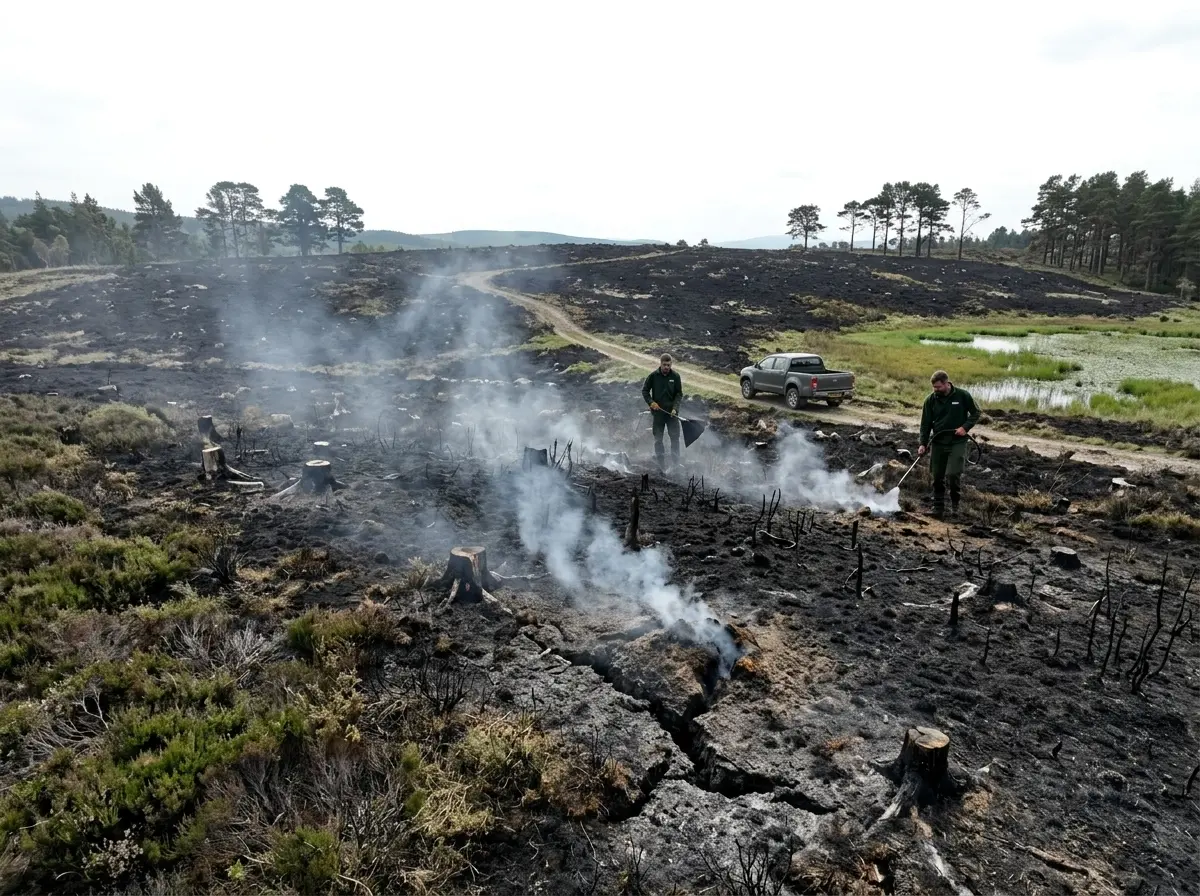
Smoke hung over the charred ground as site manager Ben Oliver-Jones reversed a pickup to stamp out fresh plumes. The same blaze emptied Nethy Bridge and carried haze 60 miles to Aberdeen. Now the focus has shifted from suppression to the layers of defence that might stop the next one.
The shift is practical rather than rhetorical. Crews that spent weeks on containment now watch managers widen breaks, raise water tables and cut fuel before another dry spell arrives.
The Burn That Stretched Five Weeks
Firefighters left the Abernethy Nature Reserve on 18 August after nearly five weeks. At its peak more than 500 personnel, specialist units and helicopter water drops worked the line. Police declared a major incident on 24 July when winds pushed flames toward the village of about 600 people. Residents returned the next day after rain and fresh fire breaks held.
RSPB Scotland called the hand-over an important milestone yet warned visitors would wait longer. Unstable ground, damaged roots and the risk of falling trees keep parts closed. Forestry and Land Scotland still restricts sections of Glenmore Forest.
- 15 July 2026: Fire starts near Glenmore and Ryvoan Bothy
- 24 July: Police declare a major incident; Nethy Bridge evacuated
- 25 July: Residents return after rain and fresh breaks hold
- 18 August: Firefighters leave Abernethy after nearly five weeks
- 24 August: Chief fire officer publishes open letter calling for formal fire safety regime
- Start date: 15 July 2026 near Glenmore and Ryvoan Bothy
- Area lost: roughly 2,500 hectares or 25 square kilometres
- Peak response: more than 500 firefighters plus partners
- Evacuation: entire Nethy Bridge village plus nearby properties
James Reynolds of RSPB Scotland described the burn scar as ugly and upsetting, with peat hotspots reigniting whenever wind rose. The reserve holds the largest remnant of ancient Caledonian pine forest and more than 5,000 species.
Those hotspots explain why the hand-over did not equal an all-clear. Surface flames can be knocked down while heat still travels through dry peat, then reappears days later when wind lifts fresh oxygen across the scar.
Four Changes Already Under Way at Abernethy
RSPB Scotland manages Loch Garten and Abernethy for ecological restoration. Opponents claim the approach leaves fuel loads that feed uncontrollable fires. The charity disputes that claim yet has begun four practical shifts.
| Measure | Action Taken or Planned | Reason |
|---|---|---|
| Wider fire breaks | Machines clear vegetation both sides of the long forest track network | Flames from heather can reach six metres; breaks need three times that height |
| Wetter ground | New ponds and raised water tables on drained bogs; one existing pool already quenched a June fire | Standing water supplies pumps and keeps peat moist |
| Fuel load cut | Grazing cattle plus machine cutting and mulching of grass, gorse, bracken and heather | RSPB rejects muirburn but accepts vegetation must be reduced |
| More broadleaved trees | Increase alder, rowan, aspen and birch beside Scots pine | Higher moisture content means they ignite less readily than resinous pines |
Tracks that once served as breaks failed where strong winds let flames jump. Cleared edges look bare now. The hope is insects and plants will colonise them later.
A small pond built with Scottish government nature restoration money for rare dragonflies already proved useful against a June flare. Staff are expanding that model across the site.
The four measures work as a set. Wider breaks slow lateral spread. Wetter ground denies fire the dry peat path. Grazing and mulching lower the continuous fuel bed. Broadleaves add patches that take longer to ignite than resinous pine. None of the four stands alone if wind and drought line up again.
Heather flames that reach six metres set the scale for the break work. A break cut only to the height of the fuel still lets fire leap. Clearing to three times that height aims to force the flame front down before it can jump the track.
Peat That Shields or Feeds the Flames
About 80 percent of Scotland’s peatland is degraded. Fire can run deep underground through dry peat as well as across the surface. Near-natural wet peat keeps water tables high and can stop a fire cold.
Roxane Anderson of the University of the Highlands and Islands studied a 2019 blaze near Melvich in Sutherland. When the fire hit ground re-wetted 20 years earlier, damage stayed superficial. She calls faster restoration “a complete no brainer” and urges work “as much as we can, as quickly as we can and as strategically as we can” under a changing climate.
National targets aim for 400,000 hectares restored by 2040. Peatland ACTION delivered 15,448 hectares restored in 2025-26, beating that year’s 12,000-hectare goal. Cairngorms National Park itself targets thousands more inside its boundaries.
| Peatland measure | Figure |
|---|---|
| Degraded share of Scotland’s peatland | About 80 percent |
| National restoration target by 2040 | 400,000 hectares |
| Peatland ACTION delivery in 2025-26 | 15,448 hectares |
| That year’s delivery goal | 12,000 hectares |
Healthy peat stores carbon, holds wildlife and now doubles as a fire barrier. Degraded peat does the opposite.
The Melvich comparison shows the mechanism in plain terms. Re-wetted ground kept the 2019 fire superficial. Dry peat lets heat travel below the surface, then reappear as the hotspots still troubling Abernethy weeks after crews stood down. Restoration that lifts the water table therefore cuts both carbon loss and the underground path a blaze can use.
Fuel Load Debates Reach the Licensing Gate
Scotland’s chief fire officer Stuart Stevens published an open letter on 24 August. He commissioned a formal debrief on the Cairngorms incident and called for a more formal fire safety regime matching urban business standards.
It is no longer enough to view wildfire primarily as an incident to be managed once it has started. The time to fight the risk is before the smoke is in the air.
Stuart Stevens, chief fire officer, open letter
Justice Secretary Neil Gray welcomed the letter and ordered a review of the Wildfire Strategic Action Plan.
The timing collides with new rules on muirburn, the controlled burning of heather used mainly on grouse moors. From 15 September 2026 a muirburn licence required from 15 September will cover every burn. Licensable purposes explicitly include preventing wildfire damage to habitats, people and property. Peat deeper than 40 cm faces tighter tests. Training on the Muirburn Practitioner Foundation Course becomes mandatory.
Scottish Land and Estates argue controlled burning remains a valuable tool for cutting fuel. RSPB Scotland refuses muirburn on its land yet uses cattle that eat and trample vegetation and machines that mulch the rest. Michael Bruce of Glen Tanar estate, a wildfire consultant who helps the fire service with forecasting, says UK research and modelling remain too thin for confident changes. “Wildfires find the gaps,” he said. Estates need stacked layers of defence rather than any single fix.
On X and in estate circles, gamekeepers describe unpaid weeks spent digging peat fires by hand and stress that daily ground knowledge matters. Fire service unions point to two decades of cuts that leave crews stretched when long dry spells arrive. Both threads sit under the same pressure the Cairngorms exposed.
The licence regime reframes the old argument without settling it. Preventing wildfire damage now sits inside the list of licensable purposes, so controlled burning can be argued as risk reduction rather than only as habitat management for grouse. Peat deeper than 40 cm still faces tighter tests, which keeps restoration goals in the same conversation as fuel cuts.
Bruce’s warning about thin research cuts both ways. Without stronger UK modelling, neither a pure muirburn strategy nor a pure grazing-and-mulching strategy can claim certainty. Stacked layers become the working answer while the evidence base catches up.
What the Bylaw Already Cut
In April the Cairngorms National Park Authority brought in a seasonal ban on campfires and barbecues running 1 April to 30 September. Recorded campfires or barbecues fell to 36 so far this year from 94 in the same stretch last year. The drop shows fewer ignition points even while one large fire still burned for weeks. Preventing start and limiting spread both matter.
Climate projections point to longer dry spells of the kind that turned summer 2026 into a tinderbox. Money spent on breaks, ponds, grazing and restoration is framed as future insurance rather than pure cost.
The bylaw figures underline a simple split in the problem. Ignition control reduced recorded campfires and barbecues from 94 to 36 across the same seasonal window. Spread control still failed once a fire took hold in dry peat and wind. Both halves of the defence have to work, or a single start can run for weeks.
Opposing Managers Found Common Ground in the Smoke
For five weeks reserve staff, neighbouring estate workers, gamekeepers, Forestry and Land Scotland crews, contractors with diggers, volunteers and the fire service fought side by side. RSPB Scotland later described the collective effort from staff volunteers and estates that kept the line.
Dee Ward of the Rottal estate in the Angus Glens has worked with the RSPB for years on re-wetting, tree planting and wading birds. He says ideological extremes have held the narrative while more estates quietly seek middle ground. “There are people that are very anti-grouse shooting. Fair enough, that’s your choice. But that’s clouding their view about muirburn because they’re saying because grouse shooters do it, it must be bad.” He wants both sides to judge practices through the wildfire lens and share what works.
Some sporting estates still reject ecological restoration language. Others already borrow its tools. The reverse is also true: restoration sites now clear wider breaks and graze cattle for fuel reduction. The end goals for the landscape may still differ wildly. The prism of wildfire risk is what may let practices cross the old lines.
Stacked Layers Close the Gaps Fire Finds
Michael Bruce’s line that wildfires find the gaps now reads as the practical lesson from Abernethy. Tracks failed as breaks where wind lifted flames across them. Dry peat let heat travel underground after surface fire was knocked back. A single tool left openings somewhere else on the ground.
The responses already in motion aim at those openings together:
- Wider cleared edges along the forest track network
- New ponds and raised water tables on drained bogs
- Cattle grazing plus machine cutting and mulching
- More alder, rowan, aspen and birch beside Scots pine
- Seasonal limits on campfires and barbecues across the park
- Licensed muirburn where estates still use controlled fire
Each layer addresses a different failure mode. Breaks and broadleaves slow surface runs. Water and wet peat block the underground path. Grazing, mulching or licensed burning reduce continuous fuel. The bylaw cuts casual ignition points. Bruce’s call for stacked defence rather than any single fix matches the mix now taking shape on and around the reserve.
Gamekeepers digging peat fires by hand and unions warning about stretched crews point to the same gap from opposite sides of the line. Local ground knowledge and sustained response capacity both form part of the stack. Neither replaces the land management layers, and the land layers do not replace them.
Longer Dry Spells Raise the Insurance Stakes
Climate projections that point to longer dry spells turn the summer 2026 tinderbox into a planning assumption rather than a one-off. The haze that reached Aberdeen and the evacuation of a village of about 600 people showed how far a single start can travel when fuel, wind and drought align.
Money spent on breaks, ponds, grazing and restoration is already framed as future insurance. The Melvich example, where ground re-wetted 20 years earlier kept damage superficial, supplies the return on that insurance in miniature. Peatland ACTION’s 15,448 hectares in 2025-26, ahead of a 12,000-hectare goal, shows delivery can beat the annual mark even while the 400,000-hectare target for 2040 still sits far ahead.
The open letter from Stuart Stevens and the review ordered by Neil Gray push the same logic into policy. Fighting the risk before smoke is in the air means treating breaks, water, fuel cuts and licences as standing defences, not as emergency extras called in once a bothy-side spark has already run.
Patches of smoke still rise from the peat six weeks after the first spark. The next dry summer will test whether the shared defence holds.
 Scotland’s Facial Recognition Push Sparks Mask Ban Call
  Galaxy Z Flip 8 Hits $799 Only If Your Trade-In Qualifies
  If England Had Kept Water Public Like Scotland
  Samsung Smart Switch Now Moves Passwords and eSIM From iPhone
  Old Firm Spend Pulls Clear as Premiership Rivals Patch Squads
  Chinese Studios Quietly Seize the Gamescom Stage