
 Ishan Crawford
 Scotland’s population grew by just 2,200 people in the year to mid-2025, the thinnest annual rise in decades, as net migration into the country fell by 62% in a single year. The total population now stands at 5,545,500, according to new estimates from the National Records of Scotland’s mid-2025 population release. Net migration, the engine that has carried nearly all of Scotland’s growth for two decades, dropped to 17,900 from a recent peak of 83,300.
Buried in the same release is a starker number. Deaths outnumbered births by 61,600 to 45,400 over the same 12 months, the widest such gap in years. Migration only just outran it. That gap, not any single visa rule, will decide whether Scotland’s population keeps growing at all.
Net Migration Craters 62% in a Year
For most of the last two decades, migration did the heavy lifting for Scotland’s population. The average annual increase between mid-2004 and mid-2024 ran around 23,000 people a year. This year’s total gain of 2,200 barely registers against that backdrop, and the percentage change works out to well under 0.1%, a rounding error compared with the growth Scotland logged through most of the 2010s and early 2020s.
Andrew White, head of population and migration statistics at National Records of Scotland (NRS), said Scotland’s population is continuing to rise but at a reduced rate compared with recent years. Net international migration added 9,300 people, and net migration from the rest of the UK added another 8,600, for a combined 17,900. That is barely a fifth of the 83,300 net migrants Scotland gained in the year to mid-2023.
| Period | Total Net Migration | Year-on-Year Change |
|---|---|---|
| Year to mid-2023 | 83,300 (recent peak) | Not applicable |
| Year to mid-2024 | 47,000 | Down roughly 44% |
| Year to mid-2025 | 17,900 (9,300 international, 8,600 rest of UK) | Down 62% |
Esther Roughsedge, NRS’s head of demographic statistics, told Scotland on Sunday that “migration has slowed” in the country. She described the run-up as a mirage of sorts. “We saw this really big increase in international migration from 2022 to 2024 and that’s fallen back down,” she said. “International migration is roughly where it was before then. It looks like a really steep fall, but really it was a big increase and a big fall and now we’re back to where we were.”
Deaths Have Outpaced Births Since 2014
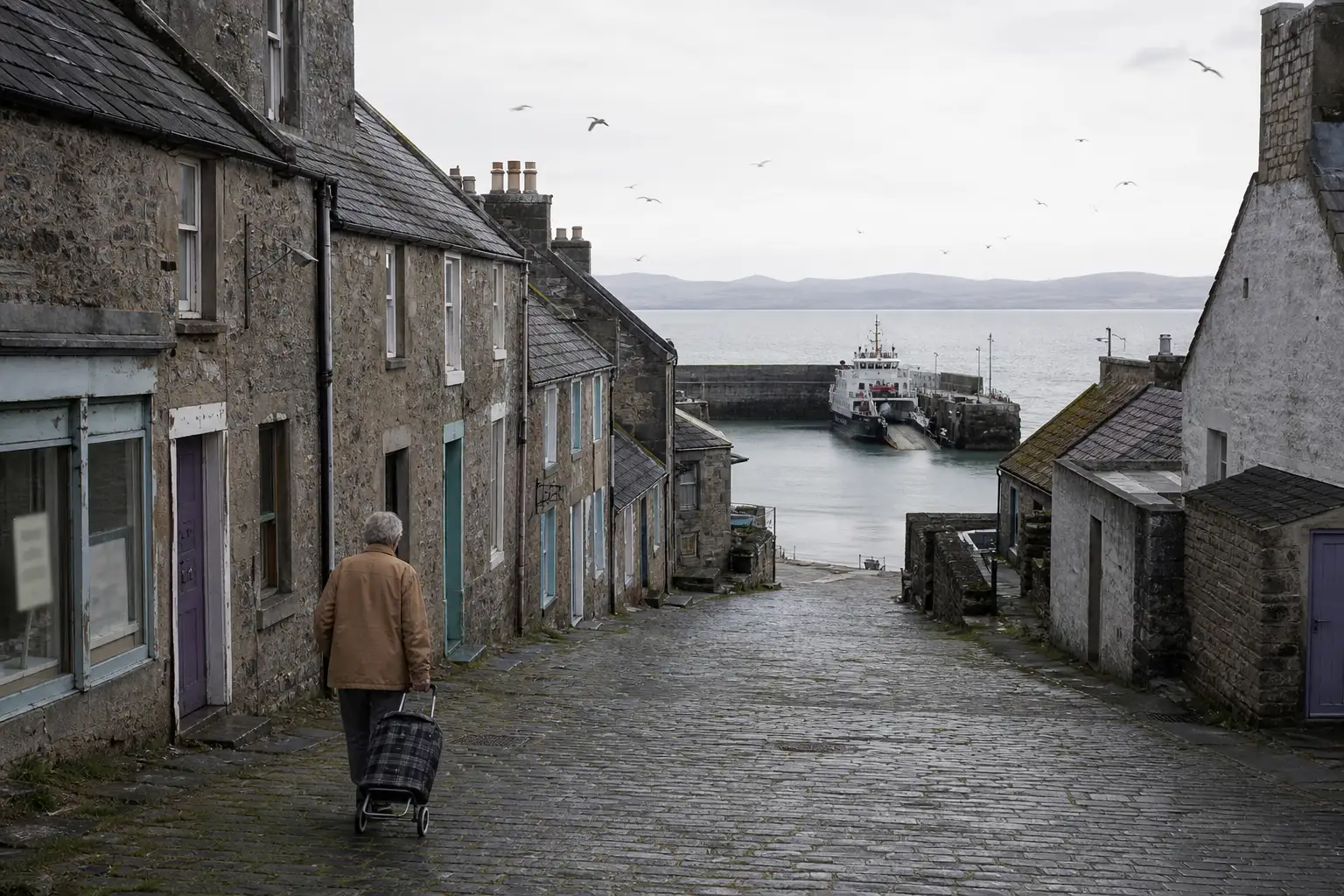
The migration swing is only half the picture. NRS figures show deaths outnumbered births in every council area except Midlothian and Glasgow City in the year to mid-2025. That is not a one-year blip. Separate annual vital events data show Scotland recorded just 45,763 live births in all of 2024, the lowest calendar-year total since registration began in 1855, with 16,528 more deaths than births. Scotland has had more deaths than births every year since 2014, and the gap has generally widened since.
The total fertility rate, a measure of how many children a woman is likely to have across her lifetime, fell to 1.25 in 2024. A rate of about 2.1 is needed for a population to replace itself without migration. Phillipa Haxton, NRS’s head of vital events statistics, said 2024 was “a year of record lows” for births, fertility, stillbirths and mortality alike.
Roughsedge explained why that matters more than the migration headlines. “It’s not that we’re dying at a faster rate,” she said. “It’s that we’ve got an older population, so that ultimately leads to more people dying. Also, our birth rates are falling and they’re quite low level.”
If you have the same level of migration, over time, that wouldn’t be enough to compensate for the widening gap between births and deaths.
That was Roughsedge’s assessment of what the numbers mean going forward. At mid-2025, 21% of Scotland’s population was 65 or older, up from 16.3% two decades earlier, while the share aged 0 to 15 fell from 18.2% to 15.8% over the same period. Migration has been propping up a population that is, underneath it, already shrinking on its own.
How a Student Visa Boom Turned Into a Bust
The 2022 to 2024 migration spike traced closely to two UK policy decisions rather than any sudden pull toward Scotland. Figures from the Higher Education Statistics Authority (Hesa) show international student numbers fell by almost 10,000 in a single year, unwinding a post-pandemic surge in overseas enrolment. Around the same time, the UK tightened the Health and Care Worker visa route that had briefly been one of the fastest-growing paths into the country.
The visa’s own history explains the shape of the curve. It was widened in February 2022 to cover care workers and senior care workers, and applications surged so fast that the route became a significant driver of record UK-wide net migration in 2023 and 2024. The rules have tightened in stages since, and the route to bring new overseas care staff into Scotland is now closed entirely.
- February 2022: The Health and Care Worker visa is widened to include care workers and senior care workers, triggering a surge in applications.
- March 11, 2024: New rules bar most care workers from bringing dependants and require care employers in England to register with the Care Quality Commission.
- July 22, 2025: The route closes entirely to new overseas care worker and senior care worker applications.
- October 13, 2025: The Scottish government pledges 500,000 pounds (about 635,000 dollars) to support displaced international care workers already living in Scotland.
- December 2025: The UK government proposes stretching the wait for permanent residence for care workers who arrived on the visa from February 2022, from five years to fifteen.
- July 22, 2028: Transitional arrangements letting existing care workers extend their stay or switch employer are due to end.
Each step reduced the pool of people who could realistically move to Scotland for care work, on top of the drop in international students who had been filling university towns and part-time jobs alike.
Edinburgh Keeps Growing as the Periphery Empties Out
Scotland’s growth is not spread evenly. Between mid-2024 and mid-2025 alone, population fell in 20 of Scotland’s 32 council areas. The steepest one-year drops were in Clackmannanshire, down 0.7%, followed by Dundee City, Na h-Eileanan Siar (the Western Isles) and Stirling, each down 0.6%.
| Council Area | One-Year Change to Mid-2025 | Also Shrank 2010 to 2025? |
|---|---|---|
| Clackmannanshire | Down 0.7%, the steepest fall | No, this is a new reversal |
| Dundee City | Down 0.6% | No, this is a new reversal |
| Na h-Eileanan Siar | Down 0.6% | Yes, shrinking since 2010 |
| Stirling | Down 0.6% | No, this is a new reversal |
Three of the four steepest one-year fallers were not among the ten council areas that shrank over the full 15 years to 2025, a group that includes Argyll and Bute, Dumfries and Galloway, Inverclyde and Shetland alongside the Western Isles. Argyll and Bute and the Western Isles are also the same glens and coastlines that helped Scotland’s tourism sector shatter visitor records in recent years, a reminder that a place can draw tourists in growing numbers while steadily losing residents.
Roughsedge said the pattern is partly generational. “You tend to see young adults move to cities for work and study,” she said. “Some people go back home afterwards and some people stay. Other people move out to the surrounding councils like the Lothians and the greater Glasgow area.” She added a comparison that puts Scotland’s problem in a UK context: “Scotland has lower birth rates than any other part of the UK, we also have lower life expectancy than any other part of the UK.”
Care Workers Left Stranded by a Closing Visa Route
Nowhere does the demographic squeeze bite harder than social care. Jennifer McCarey, Unison Scotland’s social care lead, said plainly that “social care is dependent on migrant workers.” She credited the wave of arrivals since 2022 with keeping the system upright. “Those who came to Scotland on UK certificate of sponsorships from 2022 onwards saved our care system from collapse, particularly in private care homes,” she said.
McCarey traced the staffing gap back further than the current visa fight. “Brexit meant that many EU citizens who were working in care left, particularly in rural Scotland, and large numbers found better pay and careers elsewhere,” she said. She warned that the newest restrictions compound an old wound. “The reduction in visas and the fact that workers are now barred from bringing their families has significantly reduced the pool of people who will come,” McCarey said. “Vital care services in Scotland are unsustainable without migrant workers and the UK government visa restrictions will just make this worse.”
The scale of the UK-wide reliance on this route is large. More than 220,000 international care workers came to the UK through the Health and Care Worker visa since 2020, before it closed to new overseas care applicants in July 2025. In Scotland specifically, around 650 international care workers were left without a sponsoring employer after licence revocations, according to the Scottish Parliament’s own research briefing on the issue. Neil Gray MSP, the Cabinet Secretary for Health and Social Care, said of a fund to help place those workers that “it is our intention for this work to begin immediately so that social care workers can settle into new jobs before Christmas.” The Scottish government’s displaced worker scheme lets employers apply for help hiring up to three displaced international care staff at a time.
Adam Stachura, Age Scotland’s policy director, connected the workforce strain directly to the ageing figures in the NRS release. “Older people today face considerable challenges getting the health and social care they need, and as that population grows even more people in the future will struggle to access timely support unless governments have a concerted plan and take action,” he said.
What Can Holyrood Actually Do About It?
Not much, directly. Immigration remains a reserved matter, so the Scottish government cannot write its own visa rules no matter how the population figures look. It can lobby Westminster, fund displaced-worker schemes and expand its own depopulation programs, which is the path ministers describe taking now.
Tom Arthur, the SNP’s minister for fair work, framed the stakes bluntly. “This makes immigration ever-more critical in ensuring we have working-age people to fill skills gaps, sustain public services like our NHS, support communities and grow the economy,” he said. Arthur pointed to Scotland’s Migration Service and its depopulation action plan as evidence of work already underway, adding that funding for the plan had grown sharply. “We have increased funding by nearly 50 per cent to the action plan this year, providing targeted support for projects within 10 local authority areas,” he said.
He also confirmed a specific commitment on the visa question itself. “In line with our 100 day commitment, I will soon submit Scottish visa proposals to the UK government,” Arthur said, while acknowledging immigration policy is reserved. On the care sector specifically, he said the government aims “to mitigate this decision by expanding the displaced workers scheme, with an aim to deliver a total of 45,000 extra hours of care a month.”
Stachura’s list of asks goes well beyond visas:
- Properly resourced health and social care, so older people are not left waiting for support they need now.
- More affordable, accessible housing built for a population that is ageing in place rather than moving on.
- Stronger backing for unpaid carers, who absorb gaps the paid workforce cannot fill.
- Action on loneliness and isolation alongside communities where people can stay independent for longer.
- Age-inclusive workplaces, since more people will work past traditional retirement age.
That does not change the arithmetic sitting underneath the latest release. Roughsedge said NRS projections published earlier this year assume past trends continue. “If they do continue, then Scotland’s population would continue growing at a very low level for a few years and then it would start to fall, because of this gap between births and deaths getting wider,” she said.
Frequently Asked Questions
When will Scotland’s population actually start shrinking?
NRS has not attached a fixed year to that turning point. Roughsedge cautioned that migration, the variable propping up the numbers, is inherently unpredictable. “Migration is difficult to predict,” she said. “It can fluctuate over time. Policy changes can have a big impact. Things that nobody expected like the Ukraine War, can happen and have an impact.” Births and deaths, by contrast, move in steadier, more forecastable lines.
What exactly happened to the Health and Care Worker visa?
Only the care worker and senior care worker categories, identified by occupation codes 6135 and 6136, closed to new overseas applicants on July 22, 2025. Doctors, nurses, midwives and other allied health professionals can still be sponsored on the same visa. Existing care workers can extend their stay or switch sponsors under transitional rules until July 22, 2028.
Which council areas are growing fastest in Scotland?
Over the 15 years to 2025, only nine of Scotland’s 32 council areas grew faster than the national average of 5.4%: Midlothian, East Lothian, Edinburgh, Glasgow, East Renfrewshire, Renfrewshire, West Lothian, South Lanarkshire and Perth and Kinross. All but one border Edinburgh or Glasgow.
Can Scotland set its own immigration policy?
No. Immigration is fully reserved to the UK government, which runs the system through the Home Office. The Scottish government can propose changes, and minister Tom Arthur said Scottish visa proposals would go to Westminster soon, but Holyrood has no power to legislate its own entry rules.
How does Scotland’s birth rate compare with the rest of the UK?
It is the lowest of the four UK nations. Roughsedge said birth rates in Scotland are “lower than other parts of the UK and at the lower end of European countries, but not the lowest.” She also noted Scotland has lower life expectancy than any other UK nation, a combination that widens the births-deaths gap from both ends.
How many people actually moved in and out of Scotland last year?
Gross flows were far larger than the net figures suggest. Roughly 57,600 people arrived from abroad while 48,300 left, and about 50,200 arrived from elsewhere in the UK while 41,600 left for other UK nations. Once both flows are netted against each other, the total gain was 17,900.
 ONGC licence frees Venezuela cash and operatorship talks
  Anthropic Hits $65 Billion Run Rate and Flips the AI Cash Test
  Supreme Court grounds the fare free-for-all with three-week clock
  Gold Nears $4400 as Soft Data Meets Oil Inflation Risk
  Nifty Slips as Zaggle Circuits and Dhoot Debuts Big
  Diesel Crack Tops $100 as Iran Rhetoric Lifts Crude