
 Ishan Crawford
 Four common hospital germs took a simulated trip to Mars inside a lab chamber in Germany, and some of them survived sixteen days of the planet’s punishing desiccation without dying. Then the story got stranger. When researchers exposed the survivors to human immune cells, those cells fought back noticeably weaker than they normally would.
That finding comes from new research out of Radboud University in the Netherlands, and it lands at an awkward moment. Space agencies have spent more than three decades watching bacteria mutate and grow tougher aboard orbiting stations, and a Mars crew would be too far from home to simply wait out an infection.
Four Familiar Germs Take a Simulated Trip to Mars
The work comes from Tommaso Zaccaria, a microbiology researcher who defended his doctoral thesis at Radboud University in Nijmegen, with lab experiments carried out at the German Aerospace Center (DLR) in Cologne. His dissertation, titled “Life beyond Earth: microbial survival and immune health in space,” focuses on a question NASA and ESA (European Space Agency) planners increasingly raise: what humans might carry to Mars inside their own bodies.
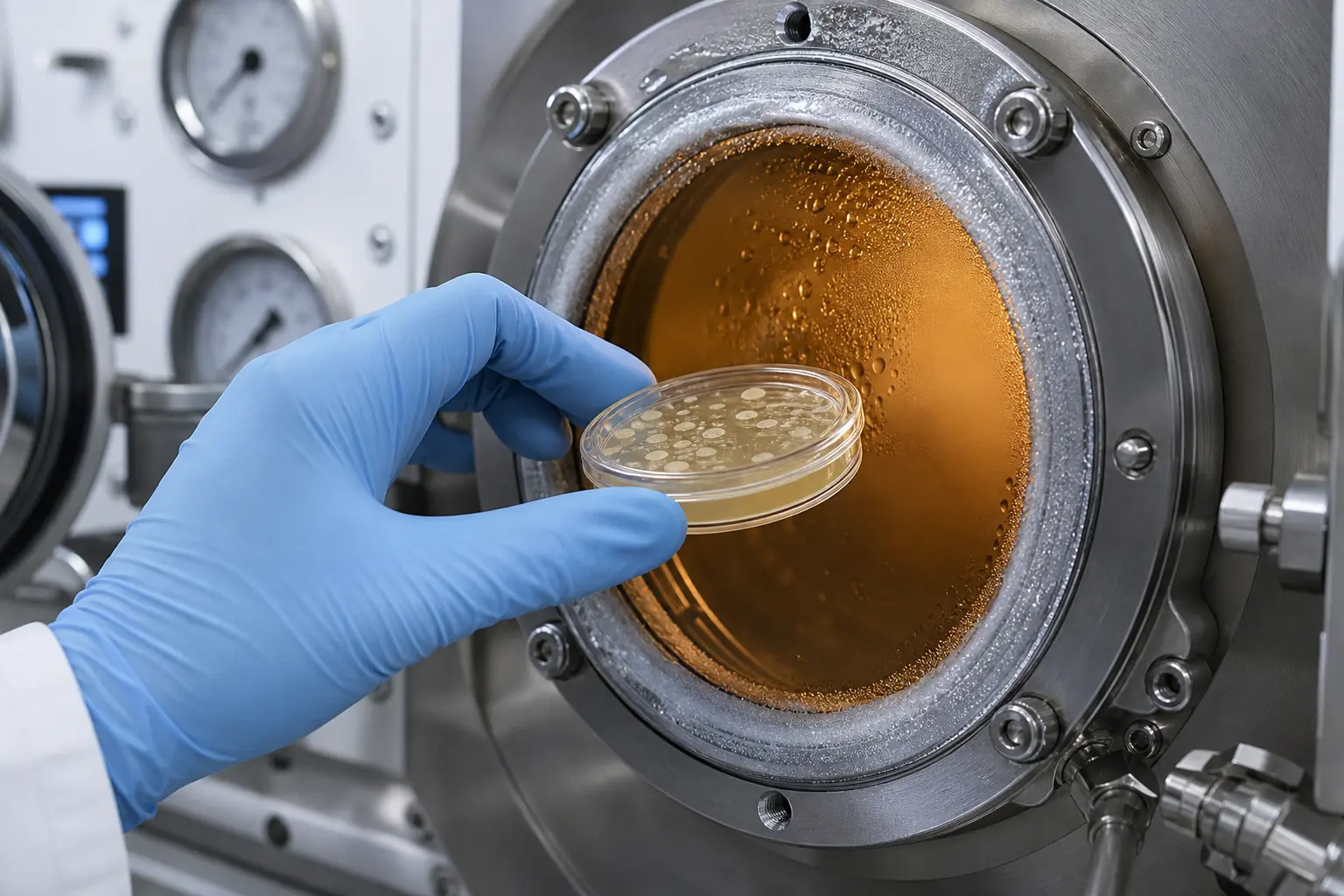
Zaccaria and colleagues took four opportunistic pathogens, bacteria that rarely bother healthy people but can cause serious infections in weakened patients, and exposed them to conditions copying the Martian surface: near vacuum pressure, deep desiccation, intense ultraviolet radiation, and salty brines loaded with perchlorate, a corrosive chemical common in Martian soil. The species were Burkholderia cepacia, Klebsiella pneumoniae, Pseudomonas aeruginosa, and Serratia marcescens, all recognized in hospitals as sources of stubborn infections.
Individually, the bacteria held up far better than expected. Some strains survived 16 days of desiccation alone, and others shrugged off the perchlorate brines or the thin pressure by themselves. The survival data across combined Martian stressors tell a harder story. Stack every punishment together the way an actual Martian surface would, and most bacteria died off within about a day.
The Survivors Slip Past the Immune System
A day still matters. Astronaut habitats are warm, humid, and full of oxygen, exactly the shelter a stressed microbe needs to recover once it hitches a ride indoors. And the ones that make it through are not quite the same bacteria that left Earth.
In follow-up laboratory work, Zaccaria’s team mixed the Mars-exposed survivors with peripheral blood mononuclear cells (PBMCs), a category of human immune cell, and measured a weaker cytokine and reactive oxygen response than untreated bacteria produced. Cytokines and reactive oxygen species are the chemical weapons immune cells normally use to destroy invaders.
In plain terms, a bacterium that survives a trip to Mars may already have slipped past the body’s early warning system by the time symptoms show up.
That finding lands on top of an already known problem. Spaceflight itself suppresses astronauts’ immune systems through changes tied to microgravity, and researchers have described signs of accelerated ageing in long-duration crews, an “immunological age” that can vary sharply from person to person. Stack a blunted immune response on top of that, and a minor infection could turn serious fast.
Bacteria Have Been Evolving in Orbit for Decades
Space agencies have watched bacteria mutate aboard orbiting spacecraft since at least the 1980s, and the same pattern turns up again in nearly every study that goes looking for it.
NASA’s own Jet Propulsion Laboratory reached a similar conclusion in 2024, when scientists studying the space station found that multi-drug resistant strains had turned genetically and functionally distinct from their Earth relatives after prolonged exposure to station conditions.
| Spacecraft or Program | Organism | What Changed |
|---|---|---|
| Salyut 7 (1980s) | Escherichia coli | Minimum drug concentration needed to stop growth rose from 4 µg/ml to above 16 µg/ml versus a ground control |
| Mir and shuttle Discovery flights | Staphylococcus aureus | Resistance roughly doubled against oxacillin, chloramphenicol, and erythromycin |
| International Space Station (surface study) | Staphylococcus epidermidis | 24-fold higher mutation rate in a gene linked to rifampicin resistance after 122 hours in orbit |
| International Space Station, NASA JPL, 2024 | Enterobacter bugandensis | Thirteen isolated strains mutated into distinct, multidrug-resistant versions that persisted in abundance |
| International Space Station, Weill Cornell, 2022 | Acinetobacter pittii | Grew more antibiotic resistant despite no onboard antibiotic exposure |
Weill Cornell Medicine researchers, who studied the Acinetobacter pittii strains, said the results challenge how narrowly the field usually defines drug resistance.
These ISS bacteria likely haven’t been exposed to antibiotics, yet they appear more resistant. This indicates how anthropomorphic our view of antimicrobial resistance really is; we define it in terms of exposure to antibiotics, but in fact there are plenty of mechanisms through which it can occur.
Braden Tierney, a postdoctoral associate in computational biomedicine at Weill Cornell Medicine and first author of that 2022 analysis of ISS bacterial genomes, made the point in comments released by the university.
The Dust Problem
Bacteria are not the only hazard Zaccaria’s research turned up. A separate set of experiments looked at what Martian and lunar dust does to lungs.
Using realistic simulants of Martian and lunar soil, his team compared their effect on human airway cells and live mice against ordinary Earth sand. The Martian and lunar simulants damaged the protective lining of lung tissue and triggered signs of infection. The Earth sand did not.
The likely culprit is regolith’s jagged, glass-like grain structure, something weathered Earth sand does not have. For future crews walking the surface, inhaled dust could turn into a hazard that has nothing to do with bacteria at all.
Habitat Design Becomes the First Line of Defense
The individual findings do not guarantee disaster on their own. Together, though, they point toward a design problem agencies cannot leave to chance.
A Mars mission will not resemble a six-month rotation on the International Space Station, where a sick astronaut can come home in hours if mission control decides it is urgent. NASA’s own architecture documents note that astronauts face interrelated risks tied to radiation, isolation and distance from Earth that short missions never have to manage for years at a stretch.
NASA is already building surveillance into current missions. Its Genomic Enumeration of Antibiotic Resistance in Space (GEARS) experiment runs a station-wide survey for antibiotic-resistant organisms, focused on Enterococcus faecalis and Enterococcus faecium, two gut bacteria already known to tolerate desiccation, starvation, and disinfection.
“Enterococcus is a type of organism that’s been with us since our ancestors crawled out of the ocean, and is a core member of the human gut,” said Christopher Carr, an assistant professor at the Georgia Institute of Technology and a co-principal investigator on GEARS.
Beyond surveillance, agencies describe several other layers of defense taking shape at once:
- Antibiotic stockpiling, since a Mars crew cannot call for a mid-mission resupply shipment if an infection resists the drugs on board.
- Faster onboard diagnostics, built to identify an infection before it spreads through a sealed habitat.
- Microbiome monitoring, tracking each astronaut’s own bacterial population before launch, in transit, and after landing.
- Habitat material choices, limiting where bacteria can cling and grow without harming the crew living inside.
Planetary protection rules add a second layer of pressure on top of crew health. NASA, ESA, and other agencies restrict how spacecraft are built and cleaned specifically to keep Earth life from contaminating Mars, both to protect any future signs of native Martian life and to keep the results of any life-detection experiment trustworthy.
How Sure Are Scientists About This Risk?
Not certain, and researchers are careful to say so. The lab results show bacteria can survive Martian stress and blunt immune detection in controlled tests, but nobody has watched this unfold during an actual multi-year Mars mission, and scientists want real flight data before drawing firm conclusions.
What we know:
- Four opportunistic pathogens tolerated individual Martian stressors for extended stretches, including 16 days of desiccation for some strains.
- Bacteria that survived a simulated Mars trip triggered a measurably weaker cytokine and reactive oxygen response from human immune cells in lab tests.
- ISS-isolated bacteria have shown documented resistance shifts and functional mutations across roughly four decades, from Salyut 7 through strains isolated in 2024.
What remains unconfirmed:
- Whether lab-simulated adaptation plays out the same way during a real, multi-year Mars mission rather than a short lab exposure.
- Whether a spaceflight-adapted microbe has ever caused a clinically serious infection in an actual astronaut.
- How much combined, prolonged Martian exposure, rather than the separated stress tests used so far, would speed up or blunt these changes.
Mars is still lethal to nearly everything that lands on it. But the handful of microbes tough enough to survive the trip, and the astronauts who will carry them there, are the reason mission planners are studying this years before a single boot print appears on Martian regolith.
Frequently Asked Questions
Has life been found on Mars that could infect astronauts?
No confirmed life has ever been found on Mars. The entire concern in Zaccaria’s research is about Earth microbes that hitch a ride with the crew and spacecraft, not native Martian organisms, which is why planetary protection rules focus on stopping Earth life from reaching Mars in the first place.
Could this research help fight drug-resistant infections back on Earth?
Yes. Zaccaria’s supervisors have said the dissertation offers insights useful outside spaceflight, and NASA’s parallel GEARS experiment on the space station states its findings could also inform how hospitals track resistance that develops through stress rather than direct drug exposure.
Did the research test anything besides bacteria?
Yes. The broader thesis also examined yeasts and other extremophile organisms from places like volcanoes and Antarctica, finding that yeasts tolerated simulated space conditions best of all by ramping up DNA repair and protective chemical defenses inside their cells.
Would a Mars habitat’s design change because of this research?
Mission architecture documents already list microbial control as a factor in habitat design, alongside radiation shielding and life support, and researchers say future designs may need surfaces and air systems engineered specifically to limit bacterial growth without harming the crew.
Is this an urgent risk for astronauts on the ISS right now?
Less so than it would be on Mars. Space Station rotations run about six months with a real option to return home quickly if a crew member falls seriously ill, a safety net a multi-year Mars mission will not have.
What does planetary protection mean?
It refers to rules NASA, ESA, and other agencies use to limit contamination in both directions: keeping Earth organisms off Mars so future life-detection experiments stay trustworthy, and keeping any material brought back from Mars from posing a risk to Earth.
 ONGC licence frees Venezuela cash and operatorship talks
  Anthropic Hits $65 Billion Run Rate and Flips the AI Cash Test
  Supreme Court grounds the fare free-for-all with three-week clock
  Gold Nears $4400 as Soft Data Meets Oil Inflation Risk
  Nifty Slips as Zaggle Circuits and Dhoot Debuts Big
  Diesel Crack Tops $100 as Iran Rhetoric Lifts Crude